

Партнерка на США и Канаду по недвижимости, выплаты в крипто
- 30% recurring commission
- Выплаты в USDT
- Вывод каждую неделю
- Комиссия до 5 лет за каждого referral
The Perspectives of University Spin-Offs Formation in Russian Socio-Economic Reality
Natalia A. Klimova
Deputy Director, National Research University Higher School of Economics, Nizhny Novgorod
25 Bolshaya Pechorskaya Street, Nizhny Novgorod, Russia
Tel: +41; Fax: +41
E-mail: *****@***ru
Pavel V. Malyzhenkov
Associated Professor, National Research University Higher School of Economics, Nizhny Novgorod
25 Bolshaya Pechorskaya Street, Nizhny Novgorod, Russia
E-mail: *****@***ru
Tel: +7-8; Fax: +41
Maurizio Masi
Associated Professor, Universita’ degli Studi della Tuscia (Viterbo, Italy)
Department of Business, Technological and Quantitative Studies
via del Paradiso 47,Viterbo, Italy
E-mail: maurizio. *****@***it
Tel: +716; Fax +716
Introduction
For maintenance of the accelerated development and increase of efficiency of economy, for perfection of social structure of regions each country needs qualified experts. At the moment education becomes more and more focused on individual interests and requirements of the separate individual, and what is especially important, on interests and inquiries of business. Thus, the formation of regionally focused educational establishments is topical.
Transition to a competition on the basis of the intellectual capital and formation of economy of knowledge creation of such relations between employees who would stimulate them to an exchange of knowledge and experience with each other have demanded, and also formed requirement to share them with the organization as a whole. All above becomes competitive advantage and with the minimum costs to mobilize expert resources under a specific target.
In Europe, the attention to this type of technology transfers is found both in regional politics, that perceive the USOs as an important mechanism of development of university-industry relations and creation of jobs and wealth in academic circles whose aim is to obtain the best results out of university research, as it was specified in the European Trend Chart on Innovation in 2002. The present article aims to analyze the spin-off phenomena in Russia, comparing it to similar international experience and underlying the main problems it faces.
1. Development of phenomena spin-off: international overview (Pavel Malyzhenkov)
The spin-off phenomenon was known at business level years ago. The distributed universities actually represent one of forms of the organizations – the network companies. In the modern quickly changing environment such organizations are capable to use optimum knowledge and also its internal and external relations. In comparison to classical type of hierarchically built bureaucracy these network structures unite two key distinctive features: fusion borders of the organization and a support on informal relations of trust. Thus expenses for overcoming of spaces it is compensated by expenses for connection to network resources and the organization of effective access to them. The support on informal relations of trust assumes high importance.
Such possibilities cannot be got for money and in short terms – their creation demands no information purchase, but formation of relations of trust inside and outside the company. Thus, studying of the social aspect in network universities is connected with mechanisms of successful realization of centralized educational system modernization projects (federal one in Russia). The social capital is a resource in which other resources in expectation of the future profits on investments can be invested. Just as investments of the capital into industrial sphere are capable to make profit, and investment in the human capital is capable to increase the price of labor, the expenses necessary for creation of social communications, are productive. These expenses allow using possibilities of a social network for the decision of problems which could not be solved in another way or their decision would be less effective.
In Australia the growth of spin-off firms is being verified since the beginning of 80s and the peaks of activity were registered in 80s, middle 90s and 2000. The financing of spin-offs in Australia is distributed in such a way: 33% falls onto the research bodies, 23% onto privates and 15% is delivered by venture funds. Less than 15% don’t obtain financing and the investing in their activity is limited by the obtaining of technological license. Australian spin-offs are not large, their staff usually amounts to 2-3 members. According to data by CSIRO[1], 100% of such firms existed for not less than two years and 88% for not less than 5 years. Subsequently, as a rule, these companies were bought by larger firms and existed for seven years in average.
In Canada university spin-offs began to spread since early 80s. According to the data of National Research Council of Canada[2] in 80s 205 such firms and 444 in 90s were opened on the base of 45 leading universities. The program of new industrial applications substaining covered with proper financing 40% of opened spin-offs on the universities base. The equity share of research bodies amounted to 50% and large universities can permit themselves to have proper funds to develop such enterprises. Less than 20% of university spin-offs have more than 100 collaborators and the personnel number is much higher than in the other countries, where the researches have been conducted.
In France the information about spin-off activity is accumulated by Ministry for Research and Technology which publishes it every four years. In 80s 387 spin-off firms were opened (including those opened by professors, researchers and students). France pays great attention to technological and human resource transfer to such firms. The peak of spin-offs had fallen onto the end of ’80 and beginning of ’90, but after that, in the 2000s the reduction of their number was registered. The main contribution in the creation of hi-tech companies was realized by National Institute for Research in Computer Science and Control[3] - 40 enterprises. In France the financing of spin-offs is the combination of proper funds of the universities, private funds, banks, venture capital and capital of other firms. A special state programme for small innovative entrepreneurship sustaining exists and the major part of spin-offs has 5-10 persons in the staff.
The spin-offs are majorly diffused in the USA, all the information is gathered by the Association of University Technology Managers[4]. The companies, founded by professors or researchers has no status of spin-off the end of ‘90s the average number of new companies a year reached 281 firms[5].
2. International experience of spin-offs development: case of Italy (Maurizio Masi)
The significant increase we have witnessed in recent years towards these realities observed by researchers from many countries (Fici, Veld, Piccaluga, Merkulova, Surlemont) is due primarily to the new role that universities are taking about commercializing their researches or in other words to their new, more entrepreneurial, approach. Secondly, it is linked to the lack of stable positions in universities, a factor that pushes the researcher-entrepreneurs to expand their possible range of activities beyond the mere academic role and, finally, it is important to underline that the increasing autonomy of universities will enable them to decide freely whether to endorse and support the development of USOs.
In the last few years, Italy has made huge strides towards improving the R&D sector, with the ultimate goal of increasing the country’s competitiveness worldwide. Although there is still considerable room for improvements and the Italian innovation performance remains below the EU average, the high quality of research occurring in the Italian infrastructures as well as the strength of Italy’s scientific community and the gradual but constant increase in the number of patents are interesting features that emerge by the most accredited reports on innovation.
Italian institutions, both at regional and national level, are increasingly becoming aware of the importance of supporting innovation and research. Fiscal incentives and programs such as “Industria 2015”[6] are among the numerous possibilities of co-financing. Still, Italy is experiencing a significant lack of venture capital activity and the industry is not as developed compared to ones of other European countries. However, venture capital in Italy is starting to grow.
The OECD Science Technology & Industry Scoreboard of 2009 (referring to 2008) ranked Italy in 13th position in terms of availability of venture capital funds as a percentage of GDP, which were equivalent to 0.025% of GDP[7]. However, according to the Italian Private Equity and Venture Capital Association (AIFI), the effects of the international financial crisis reached the Italian private equity and venture capital market which, after hitting record levels in 2008, saw a decrease in activity in 2009, registering 283 new deals that year, for a total value of € 2,615 million (a 52% drop from the previous year).
In order to facilitate the transition from bench to market and with the aim of providing brilliant academic scientists with the necessary instruments to best use their innovative ideas and translate them in commercial technologies, 90.7% of the Italian universities are now flanked by a Technology Transfer Office (TTO), each staffed with an average of 4 people (an increase of one employee from 2003). TTOs’ main objective is to accelerate the creation of entrepreneurial activities, by offering assistance and valuable instruments to spin-offs VC investments in Italy are far less than the US’s, but are growing. According to AIFI, the Italian Private Equity and Venture Capital Association, in the first six months of 2010 early stage investments accounted for 51 deals (€41 million), on par to surpass the number of deals registered in 2009[8].
|
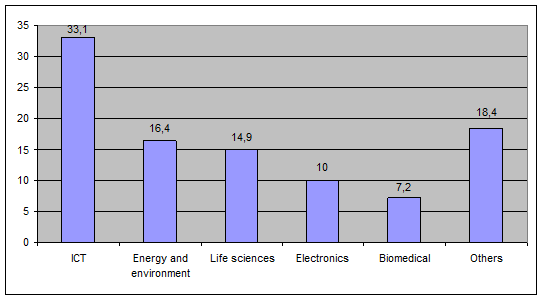
Fig. 1 Italian spin-offs distribution by sector
*****ssian experience in the field of spin-offs (Natalia Klimova)
The international experience shows that namely small innovative enterprises represent the element that links together research and industry. They can assume the risk of transforming of business idea into industrial prototypes realization, without which it is impossible to evaluate how perspective the research idea will be on the market and if it’s worth commercial realization. The innovation risk is the reason by which many large companies don’t realize broad-scale investments: they need at least some guarancee of success. So, from the practical point of view the application of research to the industrial process became the niche of small innovative firms. This procedure became possible in Russia after the Federal Law N° 127 “About Science and the State Scientific and Technical Policy” adoption. The main advantages of this Law were the following[9]:
- unemployment reduction;
- the possibility for the universities to develop the own innovative technologies;
- enhancing of the state funds directed to innovation development effectiveness;
- practical realization of ideas in socio-economic sphere.
It’s worth mentioning that around the leading foreign institutes the so-called “innovation belts” for the realization of the technical-scientific applications are usually created. Some years ago similar ideas appeared in Russia too, but no legislation basis was created. As a result the innovation chain in Russia has been broken: the linkage between the science and industry represented by the small innovative enterprises, ready to realize the first, the most risky phase of commercialization was absent. It lead to the out flow of the ideas abroad and to “brain drain”.
Changes in an education system in Russia have led to gradual introduction in educational process the so-called campus technologies, assuming development of a network of student's and academic cities, to development of the distributed educational institutions. The distributed educational institutions use new educational technologies, such as training with use the Internet, optical networks, systems of videoconferences, etc. The distributed university is a type of multilevel system consisting from scientifically-administrative kernels and networks of the educational centres united by flexible system of delivery of the educational resources. Management of such higher schools is based on use of network technologies, network communications and relations, and educational activity is focused on individual interests and requirements of the separate individual, and that is especially important.
Actually, in modern Russia the bases for the successful development of this phenomenon have been created. It consists, first of all of the innovational infrastructure: Investment funds, Russian venture company, Bank for development and external economic activity (Vnesheconombank), joint corporations in the defense branches of industry, technological parks, business incubators, regional venture funds of investments into small business in scientific technical sphere. Before crisis the volume of venture investments amounted to 653 million dollars. Thus, the purpose of our research consists in analysis of conditions and elaboration of recommendations for the USOs development mechanism as well as assessment methods of their efficiency. The analysis based on the international and Russian experience is aimed also to verify the possibility of best international practices adoption in the Russian industrial tissue.
Conclusions
One of the priority tasks of cooperation between universities and business in Russia is not only the growth of partnerships number and the realization of joint or university researches in the modern scientific or technological directions, but the creation of alliances between universities and firms. So, there arises the objective necessity in the strategic concept, aimed to the enforcement of innovative potential of higher school in the field of technique and technology and providing the preparation of competent specialists for the further work in business structures.
References
Chesbrough H., Open innovation: the new imperative for creating and profiting from technology, Harvard Business School Press, Boston, 2003;
David P. A., Metcalfe S., Universities must contribute to enhancing Europe’s innovative performance, Knowledge Economists‘ Policy Brief n° 2, 2007;
European Commission, University spin–outs in Europe. Overview and good practice, Directorate General for Enterprise, Bruxelles, 2002;
Federal Law of Russian Federation № 000 «About Science and the State Scientific and Technical Policy», August 23, 1996;
Fici L., Piccarozzi M., University Spin-Offs, Venture Capital And Public Funds: a Network For the Creation of Value, “Business Administration, Finance and New Methods of Management in Organizations”, Workshop Proceedings, RIREA, 2011;
Grossi G., Ruggiero P. Lo spin-off accademico. Attori ed ambiente nella fase di gestazione aziendale, Padova, Cedam, 2008;
Ghuljaevskaja N., Shumakova S., Popov A. Cooperation of Business and Universities in Development of Innovative Economics (in Russian), Journal of Saint Petersburg University of Fire Service, N°3, 2010;
Lerner J., A brief review of venture capital and private equity: A casebook. Toronto, John Wiley& Sons, 2000;
Malinowski B. Special Issue: Spin-offs // Science Technology Industry. 2007. № 26;
Italian Trade Commission, Report Research in Italy, 2nd edition, New York, 2011;
Shane S., Academic Entrepreneurship. University spinoffs and Wealth Creation, Edward Elgar, Cheltenham, UK, 2004;
Wright M., Lockett A., Clarysse B., Binks M., University spin-out companies and venture capital, Research Policy, n. 35, pag. 481-501, 2006;
Wright M., Clarysse B., Mustar P., Lockett A., Academic Entrepreneurship in Europe, Edgar Elsevier, Cheltenham, UK, 2007.
[1] Commonwealth Scientific and Industrial Research Organisation, Australia's national science agency and one of the largest and most diverse research agencies in the world founded in 1926. For more details: www. csiro. au.
[2] The National Research Council (NRC) is the Government of Canada's premier organization for research and development. It is active since 1916, www. nrc-cnrc. gc. ca.
[3] The National Institute for Research in Computer Science and Control is a national research institution in France which focuses on computer science, control theory and applied mathematics. It was created in 1967,www. inria. fr.
[4] AUTM's global network of members is constituted by more than 350 universities, research institutions, teaching hospitals and government agencies as well as hundreds of companies involved with managing and licensing innovations derived from academic and nonprofit research. The association was founded in 1974 as the Society of University Patent Administrators with the objective of addressing a concern that inventions funded by the U. S. government were not being commercialized effectively. Source: www. .
[5] The example of “Hewlett-Packard” company is rather demonstrative. Almost 90% of all research is being developed in the laboratories of the company itself and only 10% are placed in the university laboratories. The most important here is that HP, for sure, would have been able to fulfill all the tasks independently, but the cooperation with the universities brings other very important advantages. It is the possibility to exchange opinions, exchange new scientific ideas, select best students for work and, the most important, is the positioning of the firm as the company which supports higher education.
[6] “Industry 2015” is the name of the synthetic Bill (proposed law) aimed to enhance the competitiveness and industrial policy, approved on 22 September 2006 by the second government lead by Romano Prodi. Industry 2015 provides the strategic lines of the Italian industrial policy, basing them on a conception of industry which integrates not only the manufacturing but also advanced services and new technologies in the medium-long term (2015).
[7] Italian Trade Commission, Report Research in Italy, 2nd edition, New York, 2011
[8] A very interesting example of spin-off successful functioning and of the synergy between universities (in particular public resources and founds) industry and finance is the PharmEste Ltd, a spin-off of the University of Ferrara. PharmEste, founded as a USOs of the University of Ferrara is a private drug development biopharmaceutical company based on a unique Transient Receptor Potential (TRPs) ion channel technology platform that brings together strong expertise on TRPs area and industrial competences in research & development process applied to small molecule therapeutics (Source: L. Fici, M. Piccarozzi, University Spin-Offs, Venture Capital And Public Funds: a Network For the Creation of Value, “Business Administration, Finance and New Methods of Management in Organizations”, Workshop Proceedings, RIREA, 2011). The investment was supported by two of the financial partners of the first round financing, namely Z-Cube s. r.l., the corporate venture of the Zambon Company S. p.A, and Quantica Sgr (Italian leading vc Company), the Asset Management Company dedicated to innovative Venture capital activities and by two new financial partners: Emilia Venture, managed by MPS Venture Sgr (Montepaschi Group) and MP Healthcare Venture Management Inc., the Boston Venture fund jointly owned by Mitsubishi Tanabe Pharma Corporation and Mitsubishi Chemical Holdings Corporation in Japan. Another Italian reality famous for its synergy between research and industry is Etna Valley, a large conglomerate of small innovative enterprises (electronics and semiconductors) concentrated in Catania area.
[9] Ghuljaevskaja N., Shumakova S., Popov A. Cooperation of Business and Universities in Development of Innovative Economics (in Russian), Journal of Saint Petersburg University of Fire Service, N°3, 2010.
