

Партнерка на США и Канаду по недвижимости, выплаты в крипто
- 30% recurring commission
- Выплаты в USDT
- Вывод каждую неделю
- Комиссия до 5 лет за каждого referral
UNIT IV
Planning (pp. 38-491 Reading and Vocabulary
I Pre-reading questions
1. What is the purpose of planning?
2. What does planning involve?
II Read the text and a) find the following English word-combinations; b) match them with the Russian word-combinations from section B.
A. To secure objectives; decision sequence; to enter into a process; to adhere to a policy; to scrutinize consequences; to exploit opportunities; public policy; to have long-range significance; cost-effectiveness; to combat threats; to allow for changes; to hold values; to make adjustments in a policy; to deliver services; to bear on; to undermine effort; to handle the crisis.
В. Пользоваться возможностями; государственная политика; иметь ценностные представления; рентабельность; придерживаться политического курса; последовательность принятия решений; обеспечивать достижение целей; стать частью процесса; иметь отношение к чему-либо; тщательно обдумывать возможные последствия; предусматривать изменения; иметь значение в будущем; справляться с кризисом; противостоять возможным угрозам; предоставлять услуги; вносить коррективы в политический курс; подрывать усилия.
III Find English equivalents for the Russian word-combinations in the text and translate the sentences into Russian.
Planning - сущность планирования (38); пренебрежительное отношение к планированию (38); процесс планирования (38); планирование землепользования (39); городское планирование (39); бюджетное планирование (40); планирование в сфере управления (40); планирование в госуправлении (42); цель планирования (43); планирование политического курса (44); среднесрочное планирование (46).
Plan - план землепользования (39); всесторонний план (39);
осуществлять план (40); разрабатывать план действий
(42); систематически выполнять план (42),
Program - учреждать программу (41); выполнение программы (41); проводить различия между политическим курсом и программой (44); программный подход (44); проводить программу в жизнь (54); содействовать выполнению программы (45).
IV Define the following terms in English and match them with their Russian equivalents.
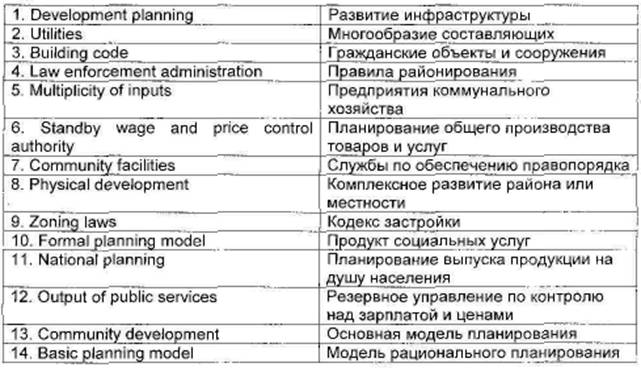
Check your understanding I Consult the text and do the following tasks: A. Answer the questions:
1. How is the essence of planning defined in the text?
2. How is planning related to the future?
3. In what way does planning shape the field of public administration?
4. What does land-use planning look at?
5. What areas of community life are covered in comprehensive plans?
6. What are the key stages in managerial planning? What is central in each of them?
7. What are the underlying foundations of any government planning effort?
8. In what way has the Basic planning model expanded on the Formal planning model?
9. Why does the author find program approach inadequate?
10. What steps should be taken to transform a policy into action?
11. How should a public manager approach the design of alternatives?
12. How is successful implementation achieved?
13. What is critical in evaluation? Give your reasons.
14. In what way does feedback loop make implementation more effective?
B. Explain what is meant by:
1. "There is... an enormous payoff to the skilled probing of the future".
2. "But attention to the definition of problems must not replace attention to the discovery of opportunities".
C. Comment on the following sayings:
"... the worst, the most corrupting of lies is the problem poorly stated"
(p.43).
"... One of the most important things about American government is that
too much public policy is defined in terms of a program" (p.44).
D. Name the ways and techniques developed to scrutinize the consequences of alternatives.
Translating
Модальные глаголы, в отличие от обычных глаголов обозначают не действия, а необходимость, возможность, вероятность и желательность совершения действия.
Модальные глаголы не употребляются самостоятельно, а только в сочетании с инфинитивом смыслового глагола. Инфинитив при модальном глаголе может иметь форму простую, перфектную, продолженного вида и страдательного залога.
У модальных глаголов отсутствует целый ряд грамматических форм, например, в 3-ем лице единственного числа настоящего времени модальные глаголы не имеют окончания - s; некоторые
моральные глаголы не имеют формы прошедшего времени (must, need, ought).
Инфинитив, следующий за этими глаголами, употребляется без частицы to. Исключение составляет глагол ought, за которым следует инфинитив с to.
CAN - глагол can употребляется для выражения возможности или способности совершения действия при наличии определенных условий и переводится на русский язык глаголами мочь, уметь, например: Decision analysis is a technique that can help avoid mental pitfalls by better structuring complex problems. - Анализ возможных решений - это метод, с помощью которого можно избежать ошибок в рассуждениях путем структурирования сложных проблем.
Глагол can также выражает предположение и переводится словами может быть, возможно, мог, например: ...if the president and his appointees can be at cross-purposes with agencies oven the ends of policy, so too can they be over the means. - «...если президент и назначенные им должностные лица могут иметь цели, прямо противоположные целям госучреждений, они также могут иметь и разное представление о способах достижения целей».
COULD - форма could употребляется для выражения возможности или способности совершения действия в прошлом и переводится на русский язык с помощью мог, умел, был в состоянии, например: Local governments could act as transmitters of the will or desires of the people. - Местная администрация могла выступать как передатчик воли или желаний народа.
The higher levels of authority could suspend or dissolve a local council. - Более высокие властные уровни могли временно прекратить деятельность или распустить местный совет.
Форма could также передает меньшую уверенность в предположении. На русский язык переводится словами может быть, вероятно, возможно, могли бы. Например: We should establish a formal system of recruitment for public service generalists who could develop expertise in specific areas of public service. - Для госучреждений следует создать официальную систему найма людей с широким образованием, которые могли бы развить профессионализм в конкретных областях госслужбы.
MAY - глагол may означает предположение о возможности совершения действия, а также возможность, связанную с разрешением. May переводится на русский язык с помощью может быть, возможно. Например: While they may not have a specialist's understanding of the techniques -...effective questioners know that a conceptual understanding is important. - Несмотря на то, что хорошие аналитики, возможно и не разбираются профессионально в методах и приемах, они знают, что важным является понимание общей идеи.
Форма might означает меньшую уверенность в предположении, сомнение. На русский язык переводится с помощью вероятно, возможно, может быть и возможно. Например: This approach might be fine for public works projects such as street construction and repair. - Этот подход может быть и подходящим в отношении проектов гражданского строительства, таких как застройка и ремонт улиц.
После глаголов сап и may иногда употребляется наречие well, которое в данном случае переводится словами с успехом, вполне. Например: Transparency and openness can very well help advance some dimensions of quality democracy. - Прозрачность и открытость с успехом могут способствовать развитию некоторых аспектов истинной демократии.
Citizen participation in public administration may well raise the issues of accountability, efficiency and administrative discretion. - Участие населения в госуправлении вполне могло бы поднять вопросы отчетности, действенности и административной ответственности.
MUST - глагол must имеет значение долженствования и передает необходимость совершения действия. На русский язык переводится с помощью должен, нужно, надо. Например: A public administrator must assess the benefits of goals and he also must weigh the cost of each goal. - Госадминистратор должен определить выгоды от достижения цели и он также должен взвесить затраты, необходимые для достижения цели.
MUST также передает предположение, которое говорящий считает правдоподобным, в этом случае must переводится на русский язык с помощью должно быть, вероятно. Например: Government must be the biggest and the oldest industry in the world but whether it can offer quality services remains an open question. -Государство, вероятно, самая крупная и древняя индустрия на земле, но вопрос о том, может ли оно предложить услуги высокого качества, остается нерешенным.
SHOULD - глагол should выполняет функцию модального глагола и выражает моральный долг или совет. Переводится на русский язык с помощью должен бы, следует, следовало бы, не мешало бы. Например: Local governments should have the right to determine local tax rates and tax bases. - Местной администрации следует иметь право определять размер местных налогов и налоговой базы.
NEED - глагол need выражает необходимость, целесообразность совершения действия и переводится с помощью нужно, надо, есть необходимость. Например: Not only does public administration need to be efficient, but it also needs to prove it and to show it to the citizenry. - Госуправлению нужно не только быть
эффективным, госуправлению нужно также доказать и продемонстрировать гражданам свою эффективность.
WILL - глагол will употребляется как вспомогательный глагол для образования будущего времени, но в некоторых случаях он имеет модальное значение и переводится с помощью должен, наверняка. В этом значении глагол will часто употребляется в документах, при составлении правил и инструкций. Например: The New Act on the Openness of Government Activities will apply to documents irrespective of their manner of storage (paper or electronic documents). - Новый Закон о гласности в деятельности госучреждений должен касаться (всех) документов, независимо от способа их хранения (на бумаге или в компьютерных файлах).
Модальные глаголы употребляются в сочетании с перфектной формой инфинитива, выражая предположение о возможности совершения действия в прошлом.
Can/could + перфектная форма инфинитива передает сомнение в возможности совершения действия (сап часто употребляется в отрицательных предложениях).
Cannot have performed | - не может быть, чтобы выполнил |
Could have performed | - мог бы и выполнить (упрек) - мог бы и выполнить (если бы для этого были условия) |
May (might) + перфектная форма инфинитива выражает предположение с большой долей неуверенности и сомнения.
May have performed | - мог и выполнить |
Might have performed | - пожалуй (может быть) выполнил |
Must + перфектная форма инфинитива выражает предположение с большой долей уверенности в вероятности совершения действия.
must have performed | -должно быть, выполнил |
Should + перфектная форма инфинитива выражает порицание и упрек.
Should have performed | - должен был (ему следовало бы выполнить) |
Need not + перфектная форма инфинитива указывает, что в действии не было необходимости, хотя действие и имело место.
Need not have performed | - не нужно было (не было необходимости) выполнять |
Will + перфектная форма инфинитива выражает предположение с большой долей уверенности в совершении действия.
Will have performed | - по всей вероятности (наверняка) выполнил |
I. Translate the sentences into Russian, pay special attention to the meaning of modal verbs.
1. Increasing transparency and openness are desirable on matters on which parts of public may well have better knowledge and understanding than governance.
2. The roots of legality might be traced to the organic growth of law in the antiquity and the middle ages.
3. We need early in our enquiry to put the size and importance of the public sector in proper perspective.
4. The planning process began, it will be recalled on a lofty plane, where goals are set and policy established.
5. In some cases we should base budget decisions on sheer guesses as to future needs and accomplishments.
6. A variety of specific actions can very well serve as vehicles to pursue environmental policies.
7. The criteria for making the budget can't have been as irrational as the criteria used in planning the budget.
8. Central regulation over the aggregate level of domestic borrowing may be justified.
9. To achieve multiplicity of inputs the planner must studiously avoid becoming the captive of any group of advisers or experts.
10. Professor Key may have been questioning the applicability of the marginal utility theory to public budgeting.
11. We should strive for public administration which will be dynamic, creative and innovative and which will provide an environment for quick economic development.
12. One might as well ask whether the present Administration is as honest as the previous one.
13. The manager must always keep going, never sure when he on she has succeeded, never sure when the whole organization may come down because of some miscalculation.
14. A reformed second chamber could have powers to block constitutional changes until after further general elections or a referendum. Such a chamber might perform the "checking" role that the judges might otherwise assume.
15. Meanwhile it will not have escaped notice that thousands more officers were being recruited from ethnic communities which aimed to make their manpower mirror the communities they cover.
II. Translate the text in to Russian.
Norm and Instrument.
Transparency and openness partake of a double nature: They are both a norm and an instrument.
As a norm, transparency and openness are part of the value systems of liberal democracy and of human rights, which provide for a right of citizens to know what is going on in governance and for a duty of government to be transparent and open.
However, it should be noted that these are not unconditional or absolute rights and duties. Therefore, they have to be considered in relationship with other rights and duties. And, in case of conflict, value judgment is needed on the normatively correct "value-cost-benefit" evaluation and the resulting mix of rights and duties to be realized or not to be realized.
For example, citizens have a right to privacy and governments have a duty to arrive at as good policies as possible. These can easily conflict with transparency and openness. When this is the case, a value judgment is necessary on how much of transparency and openness to sacrifice as against privacy and policy quality.
In order to prevent arbitrariness in such value judgments and protect them against misuse, legislation should set down criteria and determine who shall exercise discretion in applying the criteria to specific cases. Judicial oversight is essential, but it may well be that it should be put into the hands of administrative tribunals that have expertise in governance and not only in law and that have access to internal governmental material without necessarily putting it on the public record.
Transparency and openness are also an instrument making for more efficiency and effectiveness, by forcing governance to be more careful so as stand public scrutiny.
But requirements of efficiency and effectiveness are not automatically served by more transparency and openness. There is a danger that governance may be swayed by too much transparency and openness to act more "by the book" and in ways which protect it from criticism, instead of serving the future for the better. Also, transparency and openness may contradict some other requirements of high quality governance, such as frank advice to be given by advisors - which may be impossible if their papers are sure to reach the public and be used in political competition.
Therefore, a balance is needed between norms and requirements in advancing transparency and openness.
III. Translate the sentences in to Russian.
1. Привлечение частного сектора могло бы способствовать улучшению деятельности госучреждений по оказанию разнообразных услуг населению.
2. План следовало бы выполнять систематически, с применением обратной связи и анализа информации.
3. Вполне возможно, мэр начнет проводить в жизнь политический курс, где достижение целей групп интересов будет иметь приоритет.
4. Французская система управления наверняка представляла для России 19-го века нечто вроде недостижимого идеала упорядоченной государственной системы.
5. Для привлечения ценных кадров, нужно, чтобы данное учреждение имело высокий престиж в обществе, а сами служащие - некоторые привилегии.
6. Корректировка по результатам стратегического контроля может касаться как реализуемой стратегии, так и целей организации.
7. Нереальная цель может привести к демотивации работников, что, в свою очередь, могло бы негативно сказаться на деятельности организации.
8. Цель должна четко фиксировать, что необходимо получить в результате деятельности, в какие сроки следует ее достичь, и на кого возложены обязанности по достижению цели.
9. На нижних уровнях организации могло возникнуть неприятие целей и сопротивление их достижению.
10. План действий следовало бы разбить по временным интересам.
11. К настоящему времени какое-то решение, по всей вероятности уже принято.
12. Изменения возможно и предсказуемы, но не все они поддаются контролю и управлению.
13. Сами правила вполне могут быть предметом стратегического управления в том случае, если стратегической задачей организации может быть изменение ее внутренней жизни.
Precis-writing
Linking words and phrases
There are certain words and word-combinations that help to tie the sentences together and show different relationship between and within sentences. Moreover they make it easier for reader to follow the author's thoughts because they provide continuity and coherence between sentences and paragraphs. There are linking words to denote reasons and results of time relationship, etc. The following functional relationship can help you to trace the relationship between different linguistic units.
Addition, sequence Contrast | In addition, moreover, furthermore, first, second, again But, however, nevertheless, on the other hand, yet, no doubt, conversely |
Similarity | Likewise, in the same way, in a similar case |
Illustration, exemplification | As an illustration for instance to illustrate that consider |
Clarification | In effect, in particular, that is, in other words |
Concession | Admittedly, although, it may be true that |
Emphasis | In fact, most important, indeed |
Conclusion, result | Therefore, consequently, thus, as the result |
Summation | Finally, in short, to sum up, in conclusion |
I Look through the chapter planning (pp. 38-49) and point out some linking words and phrases which the author used to link sentences within paragraphs and to connect paragraphs together. Sort them out according to the given classification.
II Give Russian equivalents to the chosen linking words and phrases.
Ill Copy out 7 sentences with the linking words and translate them into Russian.
