

Партнерка на США и Канаду по недвижимости, выплаты в крипто
- 30% recurring commission
- Выплаты в USDT
- Вывод каждую неделю
- Комиссия до 5 лет за каждого referral
Ownership
This variable is the participation of foreign equity the firm and is expected to have a positive relationship on the probability of firms engaging in learning. It is calculated dividing the percentage of foreign ownership by 100.
Experience of the firm
To measure the firmХs experience, we use the natural logarithm of the number of years since the firm began actual manufacturing activity. Assuming that firms retain a memory of the environment in which they were founded and operated, it is expected that this variable will be negatively correlated with the probability of conducting more complex learning activities.
Tier supplier level
A binary variable of technological specialization with the value 1 if the firm belongs to the first-tier supplier level and 0 otherwise was created. This variable is expected to have a positive relationship with the probability of conducting learning activities as the degree of specialization required increases as firms become more closely related to assemblers.
4.2.2. Organizational Strategies
Adoption of mechatronics in the production process
The coupling of electronic functions with traditional mechanical engineering routines, namely mechatronics, results in relatively complex machinery with routines that tend to demand higher and sometime specialized skills. The implications for firms are two-fold. First additional learning efforts are required to master the new electronic functions embedded in mechatronics. Second a reorganization of the workplace function is often required, because digital-based technologies do not stand-alone and often work within networks. The adoption of mechatronics in the production process is expected to be positively associated with firmsХ likelihood of conducting any of the learning mechanisms analyzed. This variable is measured by the proportion of computerized machine tools (CMT) and robots in the total machinery and equipment used in the production process.
Level of education of the workforce
There is no doubt that a more skilled workforce facilitates firmsХ efforts and investments to upgrade their capabilities. Ratios reflecting the proportion of white and blue-collar workers with a university education and postgraduate education are considered to have a positive effect on the dependent variables analyzed. In addition, as all decision-making is concentrated in the firmХs management, we included a variable measuring the number of managers with post-graduate education divided by the total number of managers in the firm. This variable is expected to have a positive and significant association with firmsХ likelihood of engaging in more complex learning mechanisms.
Adoption of Just in time (JIT) or Total quality control (TQC)
This variable has the value 1 if the firm has adopted in its organizational management either JIT or TQC methods, and 0 otherwise. As the combination of these two proxies is one of the main characteristics of the worldwide industry flexible production model, we expect a positive relationship between this variable and the probability of the firm adopting any of the learning mechanisms in our analysis.
Adoption of Computerized Process Control
A binary variable for computer-aided programs used in production takes the value 1 if the firm uses statistically or computerized process controls and 0 otherwise. This variable is expected to have a positive relationship with the probability of the firm conducting the learning mechanisms analyzed.
4.2.3. Time Effects
NAFTA
The analysis aims to compare the learning mechanisms chosen by this group of firms before and after NAFTA. Therefore we divided the sample into the two periods, prior to the agreement (1991) and after NAFTA, the years 1994, 1998 and 2000. Two dummy variables for the years 1998 and 2000 were incorporated in the analysis to enable comparison with 1994. We assume that by 2000, firms have adjusted to the structural changes produced by NAFTA.
4.3. Descriptive Statistics
Tables 2 and 3 presenting descriptive statistics show that there have been some important changes over time in the learning mechanisms adopted by firms. The columns showing the means of the dependent variables indicate that firmsХ propensity to conduct operational training in both periods, pre and under NAFTA, has changed only slightly.
Table 2. Descriptive statistics during the period prior to NAFTA (1991)
Variable | Mean | Std. Dev. | Min | Max |
Number of firms=193 | ||||
Dependent Variables | ||||
Operational training | 0.5803 | 0.4947 | 0 | 1 |
Training in Quality Control | 0.2227 | 0.4172 | 0 | 1 |
Learning from changing (R&D) | 0.6839 | 0.4661 | 0 | 1 |
Learning by searching (technological packages/transfers) | 0.3108 | 0.4640 | 0 | 1 |
Learning by using-new (acq of new machinery/equipment) | 0.5699 | 0.4963 | 0 | 1 |
Learning by using-used (acq. used machinery/equipment) | 0.1139 | 0.3186 | 0 | 1 |
Independent Variables | ||||
Size of the firm (number of employees in log) | 5.8388 | 0.8488 | 3.0910 | 8.7631 |
Foreign equity participation (%) | 0.2283 | 0.3682 | 0 | 1 |
Experience of the firm (number of years in log) | 3.0524 | 0.5731 | 1.3863 | 4.1744 |
Tier supplier level (dummy) | 0.1761 | 0.3819 | 0 | 1 |
Adoption of mechatronics in production (%) | 0.0479 | 0.1226 | 0 | 0.9000 |
Participation of workforce with graduate studies (ratio) | 0.0017 | 0.0051 | 0 | 0.0436 |
Participation of workforce with university studies (ratio) | 0.0931 | 0.0823 | 0 | 0.4899 |
Participation of managers with graduate studies | 0.2131 | 0.3371 | 0 | 1 |
Adoption of JIT or TCQ (dummy) | 0.0829 | 0.2764 | 0 | 1 |
Adoption of statistical process control (dummy) | 0.1813 | 0.3863 | 0 | 1 |
Table 3. Descriptive statistics during the period under NAFTA
Variable | Mean | Std. Dev | Min | Max |
Number of firms= 537 | ||||
Dependent Variables | ||||
Operational training | 0.5810 | 0.4938 | 0 | 1 |
Training in Quality Control | 0.5065 | 0.5004 | 0 | 1 |
Learning from changing (R&D) | 0.4674 | 0.4994 | 0 | 1 |
Learning by searching (technological packages/transfers) | 0.3798 | 0.4858 | 0 | 1 |
Learning by using-new (acq of new machinery/equipment) | 0.6481 | 0.4779 | 0 | 1 |
Learning by using-used (acq. used machinery/equipment) | 0.1240 | 0.3299 | 0 | 1 |
Independent Variables | ||||
Size of the firm (number of employees in log) | 5.8329 | 0.8398 | 3.1781 | 8.7013 |
Foreign equity participation (%) | 0.2838 | 0.4109 | 0 | 1 |
Experience of the firm (in log) | 3.2282 | 0.5748 | 0 | 4.3176 |
Tier supplier level (dummy) | 0.1750 | 0.3803 | 0 | 1 |
Adoption of mechatronics in production (%) | 0.1204 | 0.2005 | 0 | 0.9300 |
Participation of workforce with graduate studies (ratio) | 0.0027 | 0.0073 | 0 | 0.0636 |
Participation of workforce with university studies (ratio) | 0.1273 | 0.1535 | 0 | 2.0454 |
Participation of managers with graduate studies | 0.1637 | 0.2675 | 0 | 1.1428 |
Adoption of JIT or TCQ (dummy) | 0.5195 | 0.5000 | 0 | 1 |
Adoption of statistical process control (dummy) | 0.4171 | 0.4935 | 0 | 1 |
1998 (dummy) | 0.3370 | 0.4731 | 0 | 1 |
2000 (dummy) | 0.3575 | 0.4797 | 0 | 1 |
These two tables show that there was a noticeable increment in the number of firms offering employees training in quality control issues under NAFTA, which may be related to an increase in firmsХ capabilities in production processes involving more elaborated organizational changes and technological updates. There is also a significant reduction in the number of firms conducting R&D under NAFTA. These results tally with those of (Archibugi and Pietrobelli 2003) who found that in Latin America, the level of in-house R&D activities for both domestic and foreign firms is very low. Table 4 shows the decrease in R&D activities in foreign firms after NAFTA. Probably due to legal regulations in Mexico, foreign firms prefer to conduct their R&D activities in subsidiaries in other countries or in their headquarters.
Table 4. FirmsХ R&D interaction with Knowledge Agents (% of firms in which R&D=1)
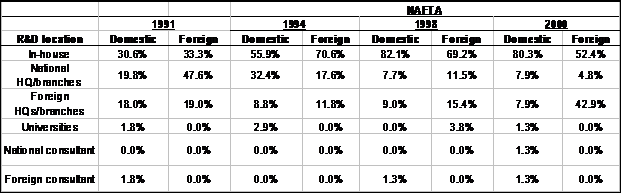
Like most other developing countries, MexicoХs manufacturers depend on the acquisition of technology from foreign countries. For firms in the sample, unsurprisingly the US is the main supplier of technology; MexicoХs technological dependence on the US is longstanding, it is geographically close, and the main automotive assembly firms in Mexico are US-owned. The analysis identifies the technology purchased as new or used equipment as these categories have a bearing on firmsХ technological achievements. As Tables 2 and 3 showed, procurement of both kinds of physical capital increased after NAFTA was introduced[12].
It can be seen from the data that about 12% of the sampled population of firms acquired used machinery or equipment in 1991. This proportion increased slightly under the NAFTA environment to 13% of firms. The increase in the number of firms acquiring new equipment after NAFTA is higher, probably because of the need to upgrade their manufacturing standards to the requirements of the export market Р the main destination of production from the automotive sector under NAFTA.
With regard to firm characteristics, the descriptive statistics show no significant changes between the two periods. FirmХ size and experience remained unchanged, while the average number of first tier suppliers reduced slightly after NAFTA. Foreign equity participation increased to 29% under NAFTA from 23% in 1991. As NAFTA brought about new automotive models and production requirements, Mexican auto parts producers felt the need to invest in the automatization and modernization of their plants. This activity falls into two categories: automatization of production lines to achieve improved speed and consistency; and robotization of key operations to improve product quality. Innovation in production often refers to the incorporation in the manufacturing plant of more complex technologies. Tables 2 and 3 show that there was increasing automatization and computerization of the manufacturing processes of Mexican auto parts suppliers under the NAFTA environment, which may be associated with the new market conditions brought by the trade agreement, involving new automotive models and production requirements. The tables show an increasing trend towards the adoption of more complex technologies under NAFTA. While in 1991 only about 5% of the manufacturing processes in the sampled firms involved computerized machine tools or robots, this increased to 12% under the agreement. It is assumed that firms introducing mechatronics into their production processes have better capabilities than those using more simple technologies. However, despite this significant increase, the use of mechatronics in production is still quite low. This may reflect the fact that although auto parts firms in Mexico are increasingly upgrading their production processes, and therefore the technological complexity of their products, automotive manufacturing in Mexico is concentrated mainly on low to medium technology components, which lends weight to our findings about the use and acquisition of machinery and equipment (Bancomext 1999). In other words, as firms do not produce technologically advanced products, they do not require technologically complex equipment in their plants. However, this produces a vicious circle: if firms do not have more technologically complex equipment, they cannot upgrade their production. Only conscious investments in learning and capability upgrades will break this cycle.

|
Из за большого объема этот материал размещен на нескольких страницах:
1 2 3 4 |
