


Партнерка на США и Канаду по недвижимости, выплаты в крипто
- 30% recurring commission
- Выплаты в USDT
- Вывод каждую неделю
- Комиссия до 5 лет за каждого referral
Краткие тезисы работы
Автор: Уразгильдина Виктория
Руководитель научно-исследовательской работы по иностранному языку:
(учитель первой категории)
Тема: «Британский и американский варианты английского»
Актуальность: в течение долгого времени принятой нормой при обучении английскому языку считался его британский вариант (будем называть его английским). Но объективной реальностью является то, что в других англоязычных странах английский язык несколько другой. Естественно, наиболее распространенным сегодня представляется американский его вариант. Отличий довольно много и они могут быть крупным препятствием для тех, кто сдает серьезные экзамены. С этой целью сделаем обзор наиболее известных отличий в этих двух вариантах английского языка
Объект исследования: один иностранный язык в двух вариантах
Цель научно-исследовательской работы: сравнительный анализ британского и американского вариантов английского.
Для достижения цели были поставлены конкретные задачи:
изучить и проанализировать литературу по теме исследования;
провести сравнительный анализ с целью выяснения различий между британским и американским вариантами английского в фонетике, произношении, грамматике
Для реализации поставленных задач были использованы следующие методы исследования:
анализ теоретической литературы;
наблюдение;
описание;
Contents
Introduction. The history of English. British and American English. Conclusion. Literature. Addendum 1. Addendum 2. Illustrations.Introduction
English is spoken in many countries either as the mother tongue or as a second language. That’s why instead of "English" there are many "Englishes" -- variations of the language. In this work I’ll focus on the two mostly commonly used versions of English - British and American English.
Before we take a look at some of the differences between the two main types of English I’d like to stress that these differences are somewhat minor and with the ongoing internationalization of our modern world they could even said to be diminishing.
The few differences that exist between British and American English tend rather to enrich communication than slow it down.
The American version of spoken English is becoming more and more dominant for several reasons. Let me give you an example to show you why American English has a stronger impact on British English than vice versa.
When you go to the UK and switch on the TV you will see a lot of American shows, movies and films which, of course, are shown in the original, American version. Young people watching TV will learn a lot of American vocabulary and phrases which they easily internalize and use as their own. It follows; modern British English is much more likely to be influenced by American English than the other way round because when you live in the US and watch TV you rarely will see a British show or film.
Another area where US English dominates is international business. Most globally operating companies are based in the US and hence the influence of American English terminology is very strong.
However, as with any issue, the more you think about it, the more variations you will encounter and it would be impossible to cover them all in one article.
That’s why we’ll move on now to the differences between British and American English. Instead of giving you a comprehensive rundown of all imaginable items I’ll limit myself to a small selection of my personal observations.
The history of English
When the Romans conquered Britain in 43 BC, they brought the Latin language to add to the Celtic languages that were spoken by the ancient Britons. The Angles and Saxons replaced the Romans and largely replaced the existing languages by a form of old German. Then Danish settlers added some words of old Norse, and the Normans added a lot of French to the mixture. Words from ancient Greek and Latin were added later by scholars, and the final additions to English came in the 19th and 20th centuries from faraway countries that were members of the British Empire.
English is a Germanic language, and most of the common words in English are Anglo-Saxon. However, there are words in English that have come from over 100 different languages, and 40 per cent of all the vocabulary of English is derived from Latin or French.
English also has many words taken directly from other languages; here are just a few examples:
banana.......................Spanish
chocolate....................French
coffee.........................Turkish
fiasco..........................Italian
*****ssian
kangaroo.................... Aborigine (Australia)
kayak..........................Inuit (Greenland)
lager...........................German
penguin...................... Welsh
pyjamas......................Urdu (India)
sauna..........................Finnish
ski................................Norwegian
tattoo.........................Polynesian
thermometer.............Greek
whisky........................Gaelic (Scotland)
zero............................. Arabic
British and American English
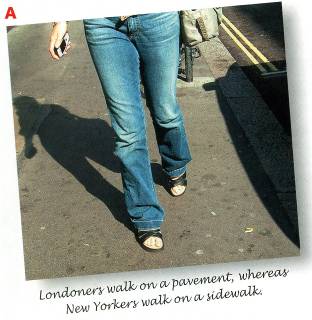
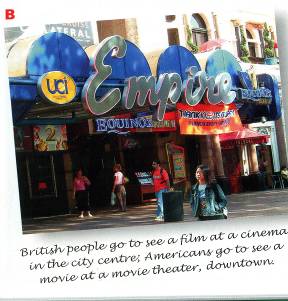
Is there any difference between the English spoken in the United States and that of Great Britain? Yes, there is: in vocabulary, pronunciation and in the meaning of some words; but the English and the Americans understand each other without great difficulty. Perhaps they are helped by the fact that there are no differences in suffixes, prefixes, morphology and syntax. To give you an idea of some of the differences in vocabulary, take for example the word underground meaning in England the underground electric railway. The Americans call it the subway. An American goes to the movies; an Englishman to the pictures, or to the cinema.
Differences in vocabulary can be explained by turning to American history. The Americans borrowed words from those languages with which the English-speaking colonists came into contact on the American continent: American Indian, French, and Spanish. Another thing is that some words which had the same meaning on both sides of the Atlantic during the 17th and 18th centuries were given a new meaning either in England or in America.
Vocabulary
There are some words and terms that are either used only in British or American English. However, with new media like the internet and in the more internationalized world these words become fewer and fewer.
That's why I'll give you only a selection of the examples I've personally come across. What's really important is not that there are differences but that any British person understands any American without great difficulty and the other way round. I know I'm repeating myself, but please don't forget that British and American English are more similar than different.
British English | American English | |
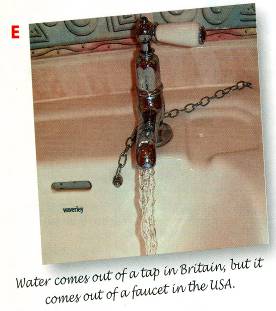
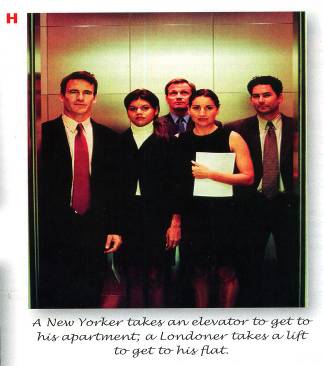
lift | elevator | |
boot | trunk | |
autumn | fall | |
litter | garbage | |
crossroad | crossing | |
trousers | pants |
Well, we could add to this list a couple of hundred words and phrases and even then the vast majority of the almost 1 million English words would be the same in both versions of English.
Just one last example I'd like to give you here as it might be a bit amusing. The rather colloquial phrase "I'm totally pissed" means different things in British and American
English. I won't give you the two different meanings here - if you really want to I'm sure you'll have your own way of finding out.
And what about differences in spelling?
Spelling
When it comes to different spellings there isn’t really that much to say because in the near future the world will more or less agree on one uniform version.
British English has a tendency to keep the spelling of many words of French origin whereas Americans try to spell more closely to the way they pronounce words and they remove letters not needed, which makes sense to me.
Here are some examples:
British English | American English | |
centre | center | |
theatre | theater | |
realise | realize | |
catalogue | catalog | |
programme | program | |
travelled | traveled | |
neighbour | neighbor | |
grey | gray | |
plough | plow | |
to practise (verb) | to practice (verb) | |
practice (noun) | practice (verb) | |
cheque | check (noun) |
Again, these are in my opinion examples for the most important spelling differences between British and American English. Of course, there are more of them and the purpose of this article is not to elaborate on orthography but to raise your awareness of the subject so you can make your own observations and draw conclusions.
There are a number of differences. For example, in America, programme is written like program; there is no letter u in words like colour, labour; theatre arid kilometre are spelt theater and kilometer, traveller and travelling and other words like them have only one letter l. Such differences in spelling are nothing compared with those in pronunciation. Even an Englishman when first landing in the States has difficulty in understanding the talk of people standing around him.
Pronunciation
There are dozens if not hundreds of different ways to speak English. I can't cover all the varieties of accents, dialects and derivations of spoken English in this article. Let's focus on the basics here.
There are two major standards of spoken English - British and American English. Interestingly enough "RP" ("Received Pronunciation", which is also known as "Queen's English" or "Oxford English") is spoken only by about 5% of the UK population which means there are many different dialects to be found in the British Isles. If you travel the UK you will notice that the differences in pronunciation are stronger and wider than in the US although the latter clearer is the bigger country.
I think this is due to the fact that statistically the average US American relocates more often within the US than his British counterpart. A dialect develops when people live closely together for a longer period of time and the community creates their own unique way of speaking. No doubt people in the southern US states have that distinctive "drawl" whereas people from Boston sound pretty different. But let's focus on the major differences between RP and standard US American English:
Americans usually pronounce the letter "r" by rolling their tongue back and pressing it to the roof of their mouths whereas most British people don't pronounce the letter "r", especially when it occurs at the end of a word.
In American English the words "can" and "can't" sound very much alike while in standard British English you can clearly make out a difference. (not so in most British made pop songs, though).
Americans tend to pronounce words like "reduce", "produce", "induce", "seduce" - mostly verbs that end with "duce" - more relaxed, that means after the letter "d" there follows the vowel "u". In British English after the letter "d" you can make out a little "j".
Americans have a tendency to reduce words by omitting letters. The words "facts" for example sounds in American English the same as "fax" -- the "t" is not spoken.
Sometimes letters are omitted in British English such as in the words "secretary", where the "a" is not spoken.
In American English, the letter combination "cl" in words such as "cling", "climate", "club" etc., sound more fricative. You can produce these sounds by straining your vocal cords.
Grammar
The differences in American and British grammar are as small and few as holds true for both versions of their lexicon. Still, here are some of them:
Use of the Present Perfect
In British English the present perfect is used to express an action that has occurred in the recent past that has an effect on the present moment. For example:
"She’s lost her purse. Can you help her look for it?"
In American English the following is also possible:
"She lost her key. Can you help her look for it?"
In British English the above would be considered incorrect. However, both forms are generally accepted in standard American English. Other differences involving the use of the present perfect in British English and simple past in American English include "already", "just" and "yet".
British English
"I’ve just received an email."
"I’ve already answered it."
"Have you completed your article yet? "
Have you heard the news?
He's just gone out.
I've got a sister.
She hasn't got a car.
I've got a pen.
I suggest he should see the doctor.
He did not eat at all.
at the weekend
Monday to Friday
different from/to
stay at home
write to somebody
American English:
"I just received an email." OR "I’ve just received an email."
"I’ve already answered it." OR "I already answered it."
"Have you completed your article yet?" OR "Did you complete your article yet?"
Did you hear the news?
He just went out.
I have a sister.
She doesn't have a car.
I've gotten a pen.
I suggest (that) he see a doctor.
He did not eat any.
on the weekend
Monday through Friday
different from/than
stay home
write somebody
Possession
There are two forms to express possession in English. -- "have" or "have got"
"Do you have a computer?" "Have you got a computer?" "She hasn’t got any hobbies." "She doesn’t have any hobbies." "She has an interesting new book." "She’s got an interesting new book."
While both forms are correct (and accepted in both British and American English), "have got" ("have you got", "he hasn’t got", etc.) is generally the preferred form in British English while most speakers of American English use the "have" ("do you have", "he doesn’t have" etc.)
Present Progressive (also known as Present Continuous)
There are some verbs in British English that cannot be used in the Present Progressive while in American English they can. Here are two examples:
British English
"I like this conversation more and more."
American English
"I’m liking this conversation more and more."
British English
"I remember this quite clearly."
American English
"I’m remembering this quite clearly."
Adverbs
Americans tend to use adjectives instead of adverbs. Instead of "That’s really good" you might hear them say "That’s real good" or instead of "I’m doing very well" they say "I’m doing pretty good".
Here are some examples:
British English | American English | |
He did that really quickly. | He did that real quick. | |
Let’s take things slowly. | Let’s take things slow. | |
Her car drives more quickly. | Her car drives quicker. |
Plurals
There are a number of nouns that are uncountable (they don’t have a plural form) in British English while they do have a plural form in American English.
Here are some examples:
British English | American English | |
types of accommodation | accommodation | |
types of food | foods | |
a lot of fruit | many foods | |
strands of hair | hairs |
Conclusion
British and American English are more similar than they are different. New media and globalization enable more and more people to participate in an active exchange of ideas and experiences.
Differences in spelling are nothing in compared with those in pronunciation. The pronunciation of British English differs from the pronunciation of American English. One of the differences is the American “a”, another difference is – “r”.
The differences in American and British grammar are as small and few as holds true for both versions of their lexicon.
Literature:
1. Журнал «Speak English», выпуск № 51
2. , «Английский язык». Учебники для 10-11 классов
3. http://www. /
Addendum 1.

Addendum 2


ФГОУ ВПО «Чувашский Государственный
университет имени »
Научно-исследовательская работа
по иностранному языку
(английский язык) 
Работу выполнила ученица 11а класса
Уразгильдина Виктория
МОУ Яльчикская СОШ
Научный руководитель:
, учитель иностранных
языков
Яльчики, 2009.
IV районная ученическая научно-практическая конференция
посвященная 100-летию академика АН СССР ,
80-летию летчика-космонавта СССР
и 80-летию народного учителя СССР
Секция «Иностранные языки»
Работу выполнила ученица 11а класса
Уразгильдина Виктория
МОУ Яльчикская СОШ
Научный руководитель:
, учитель иностранных
языков
с. Яльчики, 2009
