

Партнерка на США и Канаду по недвижимости, выплаты в крипто
- 30% recurring commission
- Выплаты в USDT
- Вывод каждую неделю
- Комиссия до 5 лет за каждого referral
New Lunar Lander Site Selection.
Y. Lu1, J. Ping1, V. Shevchenko2, 1National Astronomical Observatory, CAS, 20A Datun Rd., Chaoyang, Beijing, China, 2Sternberg State Astronomical Institute, MSU, University prospect, 13, Moscow, Russia. Contact: *****@***com
Introduction:
In March 2012, China began manufacturing the body and payload of the Chang'e 3 lander, which will perform lunar surface and space studies independently of the mission's mobile rover. Chang'e 3 is scheduled to be the first spacecraft to perform a soft landing on the Moon since the Soviet Union's Luna 24 in 1976, breaking a 37-year gap in lunar surface exploration. The stationary lander will be equipped with a radioisotope thermoelectric generator (RTG) in order to power its operations during its planned three-month mission. The lander has a mass of 1,200 kg (2,600 lb) and will have a scientific payload of seven instruments and cameras. In addition to their lunar scientific roles, the cameras will also acquire images of the Earth and other celestial bodies. The Chang'e 3 mission incorporates a lunar rover, designed to deploy from the lander and explore the lunar surface independently. The development of the six-wheeled rover began in 2002 at the Shanghai Aerospace System Engineering Institute and was completed in May 2010. The rover stands 1.5 m high and weighs approximately 120 kg. With a payload capacity of approximately 20 kg the rover may transmit video in real time, and can dig and perform simple analysis of soil samples. It can navigate inclines and has automatic sensors to prevent it from colliding with other objects. Energy will be provided by a solar panel, allowing the rover to operate through lunar days. The six-wheeled rover is designed to explore an area of 3 square kilometres during its 3-month mission, with a maximum travelling distance of 10 km. The rover will carry a radar unit on its underside, allowing for the first direct measurement of the structure and depth of the lunar soil down to a depth of 30 m, and investigation of the lunar crust structure down to several hundred meters' depth. It will also carry an alpha particle X-ray spectrometer and an infrared spectrometer. Chang'e 3 is scheduled for launch in late 2013 as part of the second phase of the Chinese Lunar Exploration Program.
Landing site:
Topographic data from the Chang'e 1 and 2 orbiters were used to select a landing site for Chang'e 3. The lander is scheduled to land on the Sinus Iridum at latitude of 44° north. The Sinus Iridum is a plain of basaltic lava that forms a northwestern extension to the Mare Imbrium.
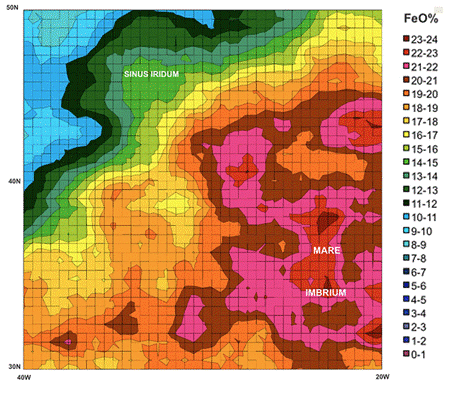
Fig. 1
On Figure 1 it’s shown the map of iron content inside considered region. These results were obtained by means of the gamma-ray spectrometer data and alpha particle spectrometer data received from «Lunar-Prospector» spacecraft. In particular, more accurately able to determine the content of iron (Fe) in the frozen lava of volcanic melts. Their concentration was different for different parts of the surface morphology – Sinus Iridum and northern part of Mare Imbrium. The intermediate zone between both areas is more interesting region for site studies.
Figure 2 shows the variations in the lunar gravity field as measured by the “GRAIL” mission (image credit: NASA, MIT). Red corresponds to mass excesses and blue corresponds to mass deficiencies.
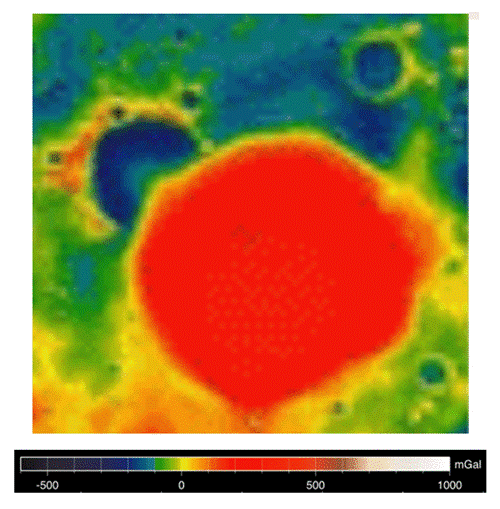
Fig 2
We can see the similar intermediate zone between Sinus Iridum region and Mare Imbrium area on gravity field map. Beneath its heavily pockmarked surface, the Moon’s interior bears remnants of the very early solar system. Unlike Earth, where plate tectonics has essentially erased any trace of the planet’s earliest composition, the Moon’s interior has remained relatively undisturbed over billions of years, preserving a record in its rocks of processes that occurred in the Solar system’s earliest days.
Conclusions:
It’s known that due to the lunar impact mascon basins have been dominated by an isosdetic processing of the mantle uploading and basalt filling at basin bottom, this evolution is directly connect with igneous activity. Identifying the mascon basins of various features will give more information to uncover the lunar dynamical evolution history.
So, in result of Chang'e 3 mission we can investigate in situ such lunar features as structure of impact craters, near-surface magmatism, mechanisms and timing of deformation, cause(s) of crustal magnetization, estimation of upper-crustal density on intermediate zone between Sinus Iridum region and Mare Imbrium area.
