

Партнерка на США и Канаду по недвижимости, выплаты в крипто
- 30% recurring commission
- Выплаты в USDT
- Вывод каждую неделю
- Комиссия до 5 лет за каждого referral
The research of hydrodynamic characteristics
of a long-term free water surface
© Furmakov E. F., 2005
Joint Stock Company “Techpribor”
Russia, St. Petersburg, Varshavskaya st., 5a
E-mail: *****@***spb. su
УДК 541.18.537
The previously unknown phenomenon of spontaneous gelling of a near-surface layer of free water surface on the boundary of fluid and gas during the process of natural evaporation has been revealed and explored. It was discovered that in several dozens of hours of the existence of free water surface it can gradually become viscoelastic which is not typical of classical fluid, but of non-Newtonian fluid. At the same time the hydrodynamic parameters of a near-surface layer increase considerably, i. e. the dynamic viscosity increases a lot, and the previously absent longitudinal and shear elasticity become rather considerable. Viscoelastic characteristics of a water surface can be discovered in various combinations of water and gas, including industrial water and distillate, air and rare gas.
What’s the ground for the pond-skaters to slide?
Many people might remember the answer to this riddle since their childhood. Pond-skaters slide on the water surface. Indeed, on the surface of a pool or a lake you can often see not only floating leaves but also pond-skaters, the small running insects. The mirror of the water that is a border which separates water from air is a flat smooth surface. It seems to be natural that small light creatures can slide on the water surface as easily as they do by land. The question about the way they do it is not usually raised as it is widely known that there are surface tension strengths on the interface of fluid and gas. This surface tension strength creates an elastic layer of liquid on which the insects jump as on tight rubber film. Let’s quote the “Animal life” encyclopedia which says “…pond-skaters live and slide on the water surface pushing off the film of the surface tension with the help of their long spider-like pads”[1].
However, if you accurately take a pond-skater and place it from a pond into a vessel with fresh water and then observe the behavior of an insect, you can notice that its movements change. They become quicker and rougher. It gives the impression as if the pond-skater has been taken to another surface which is less elastic and homogeneous than the previous one.
What has changed? What’s the difference between the water in a vessel and in a pond?
At least, one of the answers for this question is obvious: the lifetime of the free water surface has changed as the settled water surface in the pond was replaced by a newly formed water surface in the vessel.
But can the state of a water surface depend on its age?
It turned out that it really can.
We have established that some physical characteristics of a free water surface are associated with its lifetime. When we compared hydrodynamic characteristics of two water surfaces which differed in the T lifetime only (that is the lifetime from the moment the water surface was formed until the moment of the observation), this lifetime (T) under all equal conditions goes up to:
T1 ≤ T0,
T2> >T0, where
T0 is the lifetime of a water surface during which its characteristics keep nominal reference value, we found out that the viscosity η1 of a “fresh” surface which exists over the T1 period is essentially different from the viscosity η2 of an “old” surface which exists over the T2 period of time:
η2 > >η1 (1), where
η2 and η1are dynamic viscosity factors of the water in a near-surface layer.
Moreover, a long-term water surface is getting elastic which is typical of non-Newtonian fluid only. Thus, a fresh water surface characterized by the T1 period of time doesn’t have elasticity at all:
E1=0 [2].
What about a long-term water surface, there we can easily find the characteristics typical of elastic media only:
E2 > > 0 (2), where
E1 and E2 are moduluses of longitudinal elasticity of a near-surface layer of a fluid.
In case, when a viscoelastic near-surface layer of water consists of hundreds of monomolecular layers, not only a tensile stress, but also a shear layer stress can appear there under a tangential load. The shear layer stress is characterized by a correspondent elasticity modulus:
G2 > > 0 (3),
while such tension never appears in a newly-formed near-surface layer of a fluid. The reason for this is that classical fluid does not have resistance to tangential stress:
G1 = 0 [3]
( where G1 and G2 are moduluses of a near-surface layer shift).
The lifetime of a surface when it becomes substantially viscoelastic depends on the quality of water and on the conditions of an experiment and it can go up to hours:
T2 = hours.
The lifetime of a “fresh” surface with nominal value of viscoelastic parameters η1, E1, and G1 is
To ≤ 15 hours.
Research of gelling
You can obtain a visual notion of changing viscoelastic properties of a near-surface fluid layer while time passes if you use peculiar indicators of surface fluid characteristics, i. e. submagnetic and non-magnetic plates which float freely on its surface.
A submagnetic freely floating water-resistant rectangular plate is made of metal foil with low ferromagnetic characteristics. When you accurately put this plate on a water surface, it floats and some time later it directs itself along the magnetic field of the Earth.
We characterized the degree of submagnetization of a plate floating on a fresh surface of a fluid as τ0, i. e. the period it takes the longitudinal axis of the plate to be fixed along the magnetic field with a deflection which does not exceed ± 5°.
The behavior of the submagnetic plate strongly depends on the lifetime of a water surface.
In case, when T ≤ To , i. e. the lifetime does not exceed 10-15 hours since the time of the formation of the fluid mirror, the plate arbitrarily placed on the water surface quickly directs itself along the horizontal component of the magnetic field of the Earth (it can deflect from it within the limit of ± 5°).
The time it takes the plate measuring 8×1,5×0,1 mm to direct itself along the magnetic field goes up to
τ0 ≤ 15 sec.
In case, when T > T0, i. e. in approximately 15-20 hours after the formation of the water surface, the arbitrarily placed plate directs itself along the magnetic field much slower than in the first case:
τ0 ≤ 150 sec,
where the deflection can increase up to ± 15°.
In case, when T > > T0, i. e. when the lifetime of the water surface exceeds 40 hours, the arbitrarily placed plate retains its occasional position for a long time and it does not direct itself along the field.
It is important to notice that the abovementioned values of the lifetime are not limiting but typical of the T parameter point. In some cases there can be a substantial deflection from these figures. The values can both increase and decrease.
Picture 1 and picture 2 illustrate the system of water surface qualitative investigation with the help of several arbitrarily floating plates.
The first one shows the above view of a water surface with floating plates 1. The water investigated 2 is in a plain vessel 3.The lifetime of the water surface is defined under a condition of T1 < < T0.
The direction of the magnetic field H is indicated by a needle. The vessels 3 are not moved during the time of the experiment.
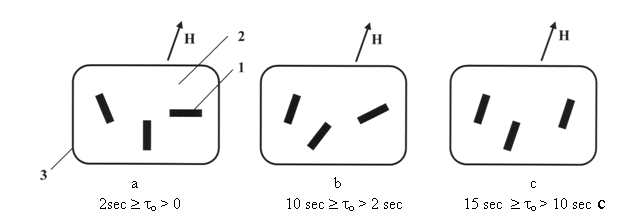 In the beginning (pic. 1a, 2 sec ≥ τ0 > 0) all the plates retain their occasional misaligned position. In the second period (pic 1b, 10 sec ≥ τ0 > 2 sec) they begin to turn slowly approaching the direction of the field H, and finally, in the third period (pic 1c, 15 sec ≥ τ0 > 10 sec) they direct themselves along the field with an inessential dispersion to each other.
The behavior of the submagnetic plates on the fresh water surface
Pic. 1. T1 < < T0
The picture (picture 2) shows the behavior of the same plates placed on a long-term surface. The lifetime of the surface T2 > > T0 goes up to dozens of hours. In this case, the position of the arbitrarily placed plates does not change at all. This is seen especially when you turn the vessel with water along the direction of the field (H).
At the picture (pic 2a) the initial position of the vessel 3 and the plates 1 coincides with their positions at the picture 1a. To be more precise we pointed out one of the angles of the vessel.
At the picture 2b and 2c the vessel is turned according to the initial position around its centre at the angles β = π / 4 and β = π / 2, respectively. However, in spite of the fact that under these turns the initial position of the plates concerning the direction of the field H changes up to a mutually orthogonal position, they remain as if “trapped” into the water surface 2 and retain their position concerning the vessel during the whole experiment.
The results of the experiments show that the near-surface layer changes its characteristics as time passes, i. e. the layer shows resistance in a way that the plates can not change their position even if they move in the fluid rather slowly.
Obviously, the resistance to move is caused by a rapid increase of viscosity of a near-surface layer of a long-term water surface in compliance with (1).
Besides the fact that the viscosity of the fluid increases the settled water surface becomes elastic.
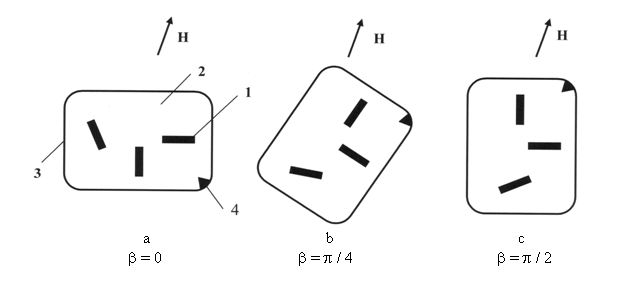
The behavior of the submagnetic plates on the long-term water surface
Pic. 2. T2 > > T0
The elastic characteristics can be easily found with the help of several non-magnetic plates 1,2 and 3 which float on the water surface 4 in a vessel 5 (see pic 3). Non-magnetic plates differ from submagnetic ones only in the material of a metal foil they are maid of.
When you place several non-magnetic plates on an “old” water surface with the life-time of
T2 > > T0
so that they are in parallel with each other in positions 1,2 and 3 as it is shown at the picture, and then on purpose you move one of the plates, plate 1, for instance, in a way that it is in parallel to itself in the direction pointed by a needle at a distance ℓ1 to the position 1¢, then the plate 2 which is the nearest to it will spontaneously shift in the same direction to a new position 2¢ at a distance ℓ2.What about the plate 3, it will shift to the position 3¢ at a distance ℓ3, where
ℓ3 < ℓ2 < ℓ1.
If the shift of the first plate is not considerable (ℓ1 < 5 mm), then all the plates return to their initial positions 1, 2, 3 when you take the load away.
In compliance with (2) and (3), this experiment shows us the elastic characteristics of a long-term free water surface.
Viscoelastic properties of a long-term free water surface can be seen in different combinations of water and gas.
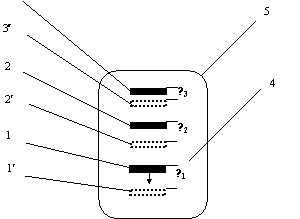 |
The behavior of the non-magnetic plates on the viscoelastic water surface
Pic. 3. T2 > > T0
In our research we used different types of water, such as lacustrine water, artesian water, industrial, boiled, filtered water, water from melted snow, magnetic, distilled, deionized water. Their free surface bordered upon open air, nitrogen, argon (under standard pressure) and rarefied air (forevacuum is 10-3 mm D. C.).
It is known that changes in the abovementioned phase combinations can effect the time of the formation of a viscoelastic layer only. These changes do not effect a spontaneous gelling of a free water surface.
We will examine the possible reasons for this phenomenon in our next research.
Literature:
1. , ред. Жизнь животных. Энциклопедический сборник, т.3, с.159.Изд. «Просвещение», М., 1969.
2. , Свойства и структура воды. Изд. МГУ, М., 1974.
3. Д. Эйзенберг, В. Кауцман. Структура и свойства воды. Гидрометиоиздат, Л., 1975.
4. , ред. Поверхностные явления в жидкостях. Изд. ЛГУ, Л., 1975.
