

Партнерка на США и Канаду по недвижимости, выплаты в крипто
- 30% recurring commission
- Выплаты в USDT
- Вывод каждую неделю
- Комиссия до 5 лет за каждого referral
Proposal for the German-Russian Interdisciplinary science center (G-RISC)
Date: DD-MM-YYYY (filing date)
Title: The title of project.
Involved partner groups from Germany and Russia:
- Institute, University in Germany, leader of the project from Germany, principal investigator surname and name
- Institute, University in Russia, leader of the project from Russia, principal investigator surname and name
Investigator (student who is carrying out the project): surname and name of student
State-of-the-art and own previous work:
Quantum-well states (QWS) in metallic nanostructures have already been objects of continued interest for more than 20 years. Nevertheless, they still exhibit permanently novel fascinating phenomena. In the case of thin films, the physical origin of the formation of a QWS is the confinement of electrons by potential barriers at the surface and the interface. The latter can be induced by energy gaps or symmetry mismatch of the substrate. As a consequence, the dispersion of the energy band being continuous in the bulk of the crystal breaks up into discrete energy states E(k^) for the momentum direction perpendicular to the surface of the thin film.
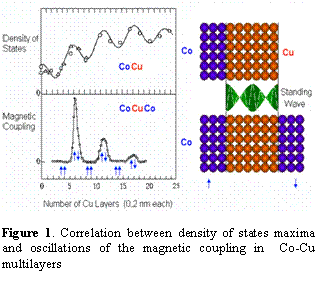 Of particular interest are QWS appearing in artificial nanostructures composed of alternating layers of magnetic/non-magnetic materials. It is generally believed that QWS are main driving force for the various astonishing phenomena experimentally detected in such systems as the giant magnetoresistance (GMR), magneto-optics, the oscillatory magnetic coupling that are important, for instance, for applications in magnetic information storage. To date several systems have been found which exhibit such phenomena; among them Cu/Co and Ag/Fe multilayer structures. Because the lattice parameters of Cu and Co as well as Ag and Fe perfectly match, one can grow these structures epitaxially with extremely high quality, which is important for the appearance of QWS. Note that defects and instabilities at the corresponding interfaces would lead to additional electron scattering, losing of the required confinement and thus disappearance of the QWS and related phenomena.
In a set of independent as well as joint works by the cooperation partners related to QWS in thin metallic films a few rather interesting phenomena were manifested recently. In particular, it was shown that QWS could be used successfully to probe the electronic structure of strongly correlated materials in the GROUND state. This elegant approach was elaborated on the Ag/N(111) model system. Moreover, it was demonstrated that QWS can be applied for the evaluation of the parity of the wave function of bulk electronic states which is extremely useful to gain insight into such astonishing properties of matter as heavy-fermion behavior.
In the scope of the present proposals the cooperation partners intend to carry out joint research aiming towards the spin-resolved fine structure of the QWS in Ag/Fe and Cu/Co multilayers on Fe and Co substrates, respectively, which exhibit the above mentioned phenomena. It is anticipated that the proposed detailed spin - and angle - resolved photoemission experiments will be the ideal tool to attack the puzzle of how changes in the electronic structure lead to new magnetic properties.
Aim of the project:
In order to disclose the connection between quantum well states and magnetic phenomena in layered magnetic/non-magnetic materials we intend to carry out comparative and systematic photoemission experiments at both the synchrotron radiation facility BESSY (Berlin). Our efforts at BESSY would concentrate on determining the spin-resolved electronic structure while the overview angle-resolved spectra will be obtained at the lab. Since the spin-resolved experiments are quite time consuming, it is impossible to complete the full scientific program at one experimental run at the synchrotron and thus it is necessary to combine the research with the lab facilities, too.
We believe to deliver the information on the energy range and the degree of spin-polarization of the QWS induced into thin Cu and Ag layers. Also, we intend to explore the conditions under which the spin-polarized QWS would appear at the Fermi level leading to unusual transport properties of these artificial structures. It is anticipated that this should happen for certain, well-defined thicknesses of the noble metal layers.
Brief work plan or outline of activities:
The brief work plan consists of the following items:
- Spin-resolved photoemission measurements at the BESSY facility on Cu/Co and Ag/Fe multilayer systems prepared on single-crystal Co(100) and Fe(100) surfaces as well as on thin Co and Fe films epitaxially formed on W(100) substrates. Particular attention will be devoted to the role of the thickness of the magnetic as well as a noble metal interlayers on the behavior of the spin-polarized QWS. Additionally, the effect of avoided crossing with QWS formed in the neighboring layers will be explored with respect to its the influence on magnetic phenomena.
- For the nearer future, it is intended to perform follow-up experiments based on the here proposed study. Therefore, cooperation partner surname and name of student will be involved.
- Carrying out angle-resolved photoemission studies on Cu/Co and Ag/Fe.
References
[1]. Author et al., Phys. Rev. B 46, 8
· Requested funds and justification
Total requested G-RISC funds are *** EUR. They are necessary for:
(i) Support for X months (***EUR) research activity at BESSY and TU-Dresden for surname and name and additional *** EUR for travel expenses.
ONLY for outstanding and successful students:
(ii) Sur-place stipend for surname and name (***EUR).
