


Партнерка на США и Канаду по недвижимости, выплаты в крипто
- 30% recurring commission
- Выплаты в USDT
- Вывод каждую неделю
- Комиссия до 5 лет за каждого referral
АНГЛИЙСКИЙ ЯЗЫК
Методические указания и контрольные задания
для студентов первого курса всех специальностей
по грамматической теме
Modal Verbs (Модальные глаголы)
Кемерово
2005
МИНИСТЕРСТВО ОБРАЗОВАНИЯ РФ
ФЕДЕРАЛЬНОЕ АГЕНТСТВО ПО НАУКЕ И ОБРАЗОВАНИЮ РОССИЙСКОЙ ФЕДЕРАЦИИ
КЕМЕРОВСКИЙ ГОСУДАРСТВЕННЫЙ ПРОФЕССИОНАЛЬНО-ПЕДАГОГИЧЕСКИЙ КОЛЛЕДЖ
АНГЛИЙСКИЙ ЯЗЫК
Методические указания и контрольные задания
для студентов первого курса всех специальностей
по грамматической теме
Modal Verbs (Модальные глаголы)
Кемерово
2005
РАССМОТРЕНО на заседании Методические указания составлены
цикловой комиссии общих в соответствии с примерной (рабо -
гуманитарных и социально - чей) программой по дисциплине
экономических дисциплин АНГЛИЙСКИЙ ЯЗЫК для всех специаль-
Протокол №________ ностей
Председатель комиссии Заместитель директора по учебной
_________ работе ___________
«____»_________20___ г. «____»_________20___ г.
Рекомендовано к изданию использованию в качестве учебно-методических указаний
учебно-методическим Советом колледжа
Рецензенты:
1. , старший преподаватель кафедры иностранных языков КемГУ;
2. , председатель ЦК социально-экономических дисциплин, препода-
ватель высшей категории Кем ГППК.
Английский язык: Методические указания и контрольные задания для студентов первого
курса всех специальностей по грамматической теме: Modal verbs (Модальные глаголы)/ Сост.
− Кемерово: Изд-во Кемеровск. гос. проф.-пед. колледжа, 2005.- с.
Содержание
Пояснительная записка 4
1. Модальные глаголы(Modal verbs) 5
1.1.Модальный глагол Can(Could)
1.2.Модальный глагол May(Might)
1.3.Модальный глагол Must
1.4. Модальные глаголы Should и Ought to
1.5. Модальный глагол Shall
2. Упражнения
3. Тест для самопроверки 1
4. Эквиваленты модальных глаголов
4.1.Эквивалент модального глагола Can - to be able to
4.2.Эквивалент модального глагола May - to be allowed to
4.3.Эквиваленты модального глагола Must - to have to и to be to
5. Упражнения
6. Тест для самопроверки 2
7. Контрольные задания
7.1. Вариант 1
7.2. Вариант 2
7.3. Вариант 3
7.4. Вариант 4
8.Приложение 1
Тексты для дополнительного чтения.
9.Приложение 2
Таблица модальных глаголов и их эквивалентов
10.Приложение 3
Ключи к упражнениям
Список литературы
Пояснительная записка
Настоящие методические указания предназначаются для студентов всех специальностей первого года обучения и могут быть использованы на аудиторных и факультативных занятиях, а также для самостоятельной работы студентов.
Цель методических указаний - способствовать более эффективной организации процесса обучения английскому языку, формировать коммуникативные навыки, оказать помощь студентам в изучении, закреплении и повторении грамматической темы Модальные глаголы и их эквиваленты.
Особенностью модальных глаголов является их широкое использование в разговорной речи, а также в художественных, технических и научно-популярных текстах.
В результате изучения данной темы студент должен иметь представление: об употреблении модальных глаголов и их эквивалентов, о структуре отрицательных и вопросительных предложений;
знать: значение модальных глаголов и их эквивалентов, правила построения предложений с модальными глаголами и их эквивалентами в разных временах; уметь: находить в тексте модальные глаголы и их эквиваленты и переводить их в соответствии с временной формой, активно использовать
изученный материал в монологической и диалогической речи.
Данные методические указания содержат:
- теоретический материал, сопровождаемый примерами
- упражнения коммуникативного характера и тренировочные грамматические упражнения
- тренировочные тесты с самопроверкой
- контрольные задания (4 варианта)
- тексты для самостоятельного чтения (Приложение 1)
- таблицу модальных глаголов и их эквивалентов (Приложение 2)
- ключи к упражнениям (Приложение 3),предназначенные для самостоятельной проверки
студентами правильности выполнения заданий
- список литературы
Модальные глаголы (Modal verbs)
В английском языке есть особая группа глаголов, которые называются модальными глаголами.
Основные глаголы этой группы: can, may, must, should, ought to.
У модальных глаголов есть ряд характерных черт:
1.Особое значение. Эти глаголы, в отличие от большинства обычных глаголов, не выражает
действие или состояние, но лишь способность, возможность или необходимость совершения какого-либо действия. Сравните:
Mary speaks English.
Глагол speaks выражает действие, совершаемое Машей:
Маша говорит по-английски.
Но: Mary can speak English.
Маша может говорить по-английски.
Mary must speak English.
Маша должна говорить по-английски.
2.У этих глаголов меньше форм, чем у остальных глаголов:
а) нет неличных форм (инфинитива, причастия, герундия);
б) нет формы будущего времени;
в) нет окончания –s в третьем лице единственного числа настоящего времениОни не употребляются как отдельный член предложения – простое глагольное сказуемое, но только в сочетании с ещё одним, не модальным глаголом в форме инфинитива, образуя составное глагольное сказуемое.
Запомните: инфинитив, с которым сочетается модальный глагол, употребляется без частицы to
( кроме инфинитива, который следует за модальным глаголом ought). Сравните:
I like to sing. - Я люблю петь.
После обычного глагола like инфинитив употребляется с частицей to.
Но: I can sing.– Я умею петь.
После модального глагола can инфинитив следует без частицы to
4. Отрицательная и вопросительная формы предложений с модальными глаголами образуются без вспомогательных глаголов.
Отрицательная форма образуется при помощи частицы not,которая стоит после модального глагола.
You must not smoke here. – Вы не должны здесь курить.
В вопросе модальный глагол стоит перед подлежащим.
Can you translate the text? – Ты можешь перевести этот текст?
Модальный глагол CAN
Модальный глагол can переводится как мочь, уметь. Он имеет два времени: настоящее(can) и прошедшее(could).
Ann can read.
Анна может (умеет) читать.
Ann could read.
Анна умела (могла) читать.
Для образования отрицательной формы после глагола can(could) ставится отрицание not
Ann cannot read.
Запомните: отрицательная форма cannot пишется слитно. Сокращённая форма отрицания – can’t
[ka:nt].
Для образования вопросительной формы глагол can (could) ставится перед подлежащим.
Can Ann read? . Умеет ли (может ли) Анна читать?
Could Ann read?
Умела ли (могла ли) Анна читать?
Вопросительное предложение с глаголом can может быть просьбой.Could придаёт такой просьбе
ещё более вежливый оттенок: Не могли бы вы..?
Could you give me a lift?
Не могли бы вы подвезти меня? Или: Подвезите меня, пожалуйста.
Модальный глагол MAY
Модальный глагол may используют, чтобы выразить разрешение и чаще всего переводят русским можно. Модальный глагол may имеет два времени: настоящее (may) и прошедшее (might).
You may stay if you want to.
Можете остаться, если хотите.
Отрицательная форма may not сообщает о запрете: нельзя.
You may not park your car here.
Нельзя оставлять машину здесь.
Для образования отрицательной формы may ставится перед подлежащим.
May I come in?
Можно войти?
Глагол may (might) может также выражать предположение, основанное на неуверенности. В этом случае он переводится русским может быть, возможно.
It may rain.
Возможно, будет дождь.
I may see her in the afternoon.
Может быть, я увижусь с ней после обеда.
He might be at home now.
Возможно, он сейчас дома.
Запомните: might выражает бóльшую степень сомнения.
Модальный глагол MUST
Модальный глагол must (должен, обязан) имеет одну неизменяемую форму, то есть у него нет формы прошедшего времени. В утвердительном предложении must выражает необходимость, обязанность, долг.
Students must do homework.
Студенты обязательно должны выполнять домашнее задание.
Отрицательная форма must not (mustn’t) выражает запрещение и часто переводится русским нельзя.
You must not steal.
Нельзя воровать.
Для образования вопросительной формы must ставится перед подлежащим.
Must they do it now?
Они должны сделать это сейчас?
Модальный глагол must может также выражать предположение, содержащее большую долю уверенности. В этом случае он переводится русским должно быть.
It must be about ten o’clock now.
Сейчас, должно быть, десять часов.
Модальные глаголы SHOULD и OUGHT TO
Модальныe глаголы should и ought to являются синонимами. Их используют, когда нужно высказать вежливую рекомендацию, поучение, совет. Русский перевод: следует, необходимо, нужно.
He should speak louder.
He ought to speak louder.
Ему нужно (следует) говорить громче.
Отрицательная форма ` should not (shouldn’t) и ought not to (oughtn’t to) используется для рекомендаций и советов не делать чего-либо: не следует, не нужно.
You shouldn’t believe everything people say.
Не следует верить всему, что люди говорят.
Для образования вопросительной формы глаголы should и ought ставят перед подлежащим.
Should we consult a doctor?
Нужно ли нам проконсультироваться у доктора?
Модальный глагол SHALL
Модальный глагол shall употребляется в вопросительных предложениях, когда говорящий обращается к собеседнику за распоряжением. Этот глагол употребляется только в первом лице единственного и множественного числа.
Shall I read?
Мне читать? (Должен ли я читать?)
Shall we go home?
Нам идти домой?
Упражнения
1.1.Скажите, что вы умеете и чего не умеете делать, используя данные слова и выражения.
 I can skate
I can’t ski
play the guitar
play tennis
ride a bike
drive a car
swim
1.2.Прочтите и переведите диалоги, обращая внимание на перевод модальных глаголов can / could.
Выучите диалоги наизусть и расскажите в парах.
A. ( Mr. Brown speaks to Mr. Petrov on the telephone.)
- Hello.
- Is that Mr. Petrov?
- Speaking.
- Good morning, Mr. Petrov. This is Mr. Brown.
- Good morning, Mr. Brown. What can I do for you?
- Could I see you on Monday?
- Certainly. When can you come?
- At ten in the morning.
- Very good. See you on Monday then. Good morning,
- Good morning, Mr. Petrov.
B. (Jenny is 26. She is a teacher. She is in class now. She speaks to her pupil Martin. )
- Now, Martin…can you swim?
- Yes, I can…I could swim when I was five.
- Could you?
- Yes, Miss…could you swim when you were five?
- I could swim when I was three.
- Really, Miss? Could you read and write when you were three?
- No, Martin…of course I couldn’t.
1.3. Задайте вопросы к данным предложениям и ответьте на них отрицательно.
Образец: Mary can speak English. Can Mary speak English? Mary can’t speak English. .
1. We can read English books. 2. You can help your mother in the kitchen. 3. He can play football.
1.4. Переведите предложения, используя can или could.
1. Мы можем тебе помочь. 2. Никто не мог мне помочь. 3.Она могла отослать телеграмму вчера. 4. Ты умеешь кататься на коньках?– Да, умею. 5. Ты умел кататься на коньках, когда тебе было пять лет?– Нет, не умел. 6. Что я могу для тебя сделать?
1.5. Переведите предложения, обращая внимание на значение модального глагола may.
A.1. You may sit down at the first desk. 2. May I close the window? – Yes, you may. 3. May I open the door? – No, you can’t. They are having a lesson in the classroom. 4. The children may play in the yard after school.
B.1. He may be in the yard now. I can’t find him at home. 2. She may come on Sunday.
1.6. Задайте вопросы к данным предложениям и ответьте на них отрицательно.
Образец: He may open the window. May he open the window? He may not open the window.
1. My little sister may watch TV. 2 She may take my book. 3. You may eat this cake.
1.7. Переведите предложения, употребляя may и might.
1. Можно мне посмотреть этот фильм? – Да, можно. 2. Он, возможно, будет смотреть этот
фильм. 3. Можно мне почитать ещё немного?– Нет, нельзя. Уже слишком поздно. 4. Они, возможно, примут участие в спортивных соревнованиях. 5. Вы можете пользоваться учебниками. 6. Может быть, она скоро напишет вам письмо.
1.8.Переведите пословицы, обращая внимание на перевод модальных глаголов. Найдите русские эквиваленты для этих пословиц. Употребите одну из них в краткой ситуации.
1. Never put off till tomorrow what can be done today.
2. The wolf may lose his teeth, but never his nature.
3. What is done, cannot be undone.
4. A fair face may hide a foul soul.
5. You can lead a horse to water but you can’t make it drink.
6. If the mountains will not come to Mahomet, Mahomet must go to the mountains.
1.9. Переведите предложения, обращая внимание на значение модального глагола must.
A. 1. She is on duty today. She must open the windows and clean the blackboard. 2. Must I read the text? – Yes, you must. 3. He must go home. Mother is waiting for him.4. Children mustn’t play in the street. 5. May I do this exercise at home?–No, you must do it in class. 6. May I play in this room? – No, you mustn’t do it. Your little sister is sleeping.
B. 1. Mary must be at the sports camp now. 2. Switch on the light. It must be too dark in the room.
3. He must be a good sportsman.
1.10. Задайте вопросы к данным предложениям и ответьте на них отрицательно.
Образец: We must read the text.– Must we read the text? We must not read the text.
1. She must sit here. 2. Lily and I must work in the garden today. 3. I must go to bed at 9 o’clock.
1.11. Выразите разную степень уверенности в совершении действия, употребив may ,might, must.
1. a) He… know grammar. But I can’t believe it. He makes too many mistakes. b) He… know grammar. He is not a bad pupil. c) He…know grammar. He often helps his classmates with their exercises. 2.
a) He…be a good painter, but I personally do not like his pictures. b) He…be a good painter. Many people like his pictures. c) He…be a good painter. So many people like his pictures and praise them highly.
1.12. Переведите предложения, употребляя must.
1.Вы должны быть там ровно в два. 2. Дети должны помогать родителям. 3. Вы не должны (нельзя) курить, если вы находитесь в театре. 4.Вы, наверное, голодны. Садитесь к столу. 5. Должно быть, уже семь часов. На улице совсем темно. 6. Он, скорее всего, уже дома. В это время он всегда приходит домой.
1.13. Скажите, что следует, а чего не следует делать, если вы хотите быть здоровыми. Используйте данные выражения.
 |
go in for sports
eat a lot of sweets
You should(ought to) eat more fruit and vegetables
You shouldn’t (oughtn’t to) do morning exercises
drink fresh water
watch TV day and night
drink much coffee
spend much time in the open
1.14. Как же быть? Дайте правильный ответ.
1. My grandma isn’t very well. She can’t leave the house.
2. These exercises are very difficult.
3. The weather is wonderful.
4. I haven’t got any more money.
5. We need some books for school.
6. I’ve put on twelve pounds.
7. We’re very hungry.
a You should go outside and enjoy it.
b You should have a snack.
c You must go to a bank.
d You should go on a diet.
e You should ask a student to help you.
f You should really visit her.
g You must buy them, then.
1.15. Переведите предложения, используя should или ought to.
1. Тебе следует сегодня раньше лечь спать. 2. Нам нужно ехать на автобусе. 3. Детям не следует играть со спичками. 4. Мне нужно остаться после уроков? 5. Когда и где нам нужно встретиться? 6. Погода сегодня плохая. Вам не следует выходить из дома.
1.16. Подберите к каждому предложению подходящую пару.
1. We’re short of money.
2. They want to go out into the country.
3. She can’t understand this.
4. He doesn’t know the truth.
5. I’ve lost my address book.
a Shall I take them there?
b Shall I lend you some?
c Shall I help you to find it?
d Shall I tell him?
e Shall I explain it to her?
1.17. Заполните пропуски соответствующими модальными глаголами.
(must, should, ought to, can, could, may, shall)
1. You …take my dictionary. 2 You don’t look well, you… consult the doctor. 3. Why …I give you my money? 4. She …not speak any foreign language. 5. He …to help them, they need his help. 6. …you tell me the time? 7. …we do this exercise now or at home? - Do it now. 8. In winter we …often skate. 9. You …not miss your classes. 10. … you play the piano before?
1.18. Переведите предложения.
1.Ты можешь мне помочь?- Боюсь, что нет. 2. Можно я закрою окно? – Да, можно. 3. Мы обязательно должны писать диктант сегодня? 4. Вам следует навестить вашего друга. Он сегодня не пришёл на урок. 5. Почему ты пришла так поздно?– Я не могла придти раньше, была очень занята. 6. Давай спросим маму. Она, наверное, знает его адрес. 7. Я не могу закончить эту работу сегодня. 8. Тебе не следует пить холодную воду. 9. Возможно, он сейчас в офисе, уже девять часов. 10. Мне переводить этот текст?– Нет, вы можете сделать это дома.
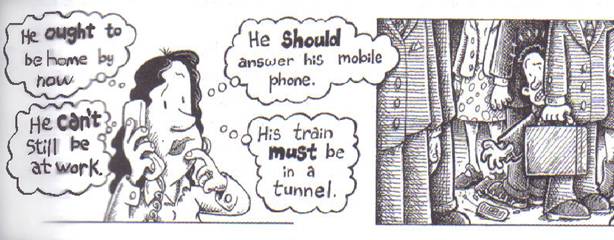 |
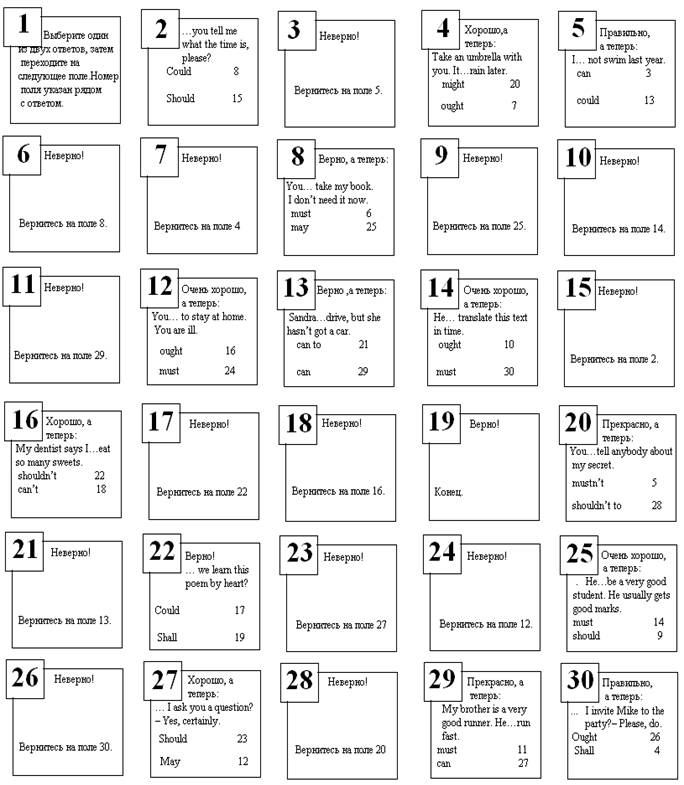
Тест для самопроверки 1
Эквиваленты модальных глаголов
Поскольку модальные глаголы являются недостаточными (у них отсутствуют некоторые глагольные формы, в частности, форма будущего времени), то для восполнения недостающих форм используют синонимичные обороты – эквиваленты модальных глаголов.
Эквивалент модального глагола CAN –TO BE ABLE TO
Синонимом, т. е. эквивалентом модального глагола can, является оборот to able to(быть способным,
быть в состоянии сделать что-то). Этот оборот может употребляться во всех временах.
В настоящем времени:
She is able to drive a car.
Она может (в состоянии) вести машину.
Или: She can drive a car.
Она может (умеет) вести машину.
В прошедшем времени:
She was able to drive a car.
Она смогла вести машину.
Или: She could drive a car.
Она могла (умела) водить машину.
В будущем времени:
She will be able to drive a car.
Она сможет вести машину.
Эквивалент модального глагола MAY– TO BE ALLOWED TO
Эквивалентом модального глагола may является оборот to be allowed to (получить разрешение сделать что-либо). Этот оборот можно употреблять во всех временах.
В настоящем времени:
I am allowed to visit you.
Мне можно (разрешено) вас навестить.
В прошедшем времени:
I was allowed to visit you.
Мне разрешили навестить вас.
В будущем времени:
I will be allowed to visit you.
Мне разрешат вас навестить.
Эквиваленты модального глагола MUST
Заменителями модального глагола must являются глаголы to have to и to be to. Эти глаголы имеют дополнительные оттенки значения.
Глагол to have to означает «должен, т. к. вынуждают обстоятельства» и часто переводится русским
вынужден, приходится.
I have to get up early. (I live far from the college).
Мне приходится вставать рано. (Я живу далеко от колледжа).
Глагол to be to означает должествование, связанное с расписанием, графиком, планом или предварительной договорённостью.
The train is to arrive at five.
Поезд должен прибыть в пять (по расписанию).
Глагол to have to может употребляться во всех временах.
В настоящем времени:
She has to stay at home. (She is ill).
Она вынуждена оставаться дома. (Она болеет).
В прошедшем времени:
She had to stay at home. (The day was very cold).
Ей пришлось остаться дома. (День был очень холодный).
В будущем времени:
She will have to stay at home tomorrow. (Mother asked her to look after her little brother).
Завтра она должна будет остаться дома. (Мама попросила её присмотреть за маленьким братом).
Запомните: отрицательные и вопросительные предложения с глаголом to have to образуются при помощи вспомогательных глаголов do/does (в настоящем времени) и did (в прошедшем времени).
Tom doesn’t have to work on Sundays.
Том не должен (ему не приходится) работать по воскресеньям.
Why did you have to call the doctor?
Почему вам пришлось вызвать доктора?
Глагол to be to может употребляться только в прошедшем и настоящем временах. В настоящем времени глагол to be to может указывать на будущее действие.
We are to begin the experiment tomorrow.
Мы должны начать эксперимент завтра.
В прошедшем времени:
I was to phone him at six.
Я должен был позвонить ему в шесть.
Упражнения
2.1.. Прочтите и переведите диалоги, обращая внимание на перевод эквивалентов модальных глаголов. Выучите диалоги наизусть и расскажите их в парах.
A. Pat: Mary, will you be able to help me this morning?
Mary: No, I won’t but I’ll be able to help you tomorrow.
Pat: John, can you help me today?
John: I’m sorry I can’t help you today or tomorrow, but I’ll be able to help you the day after tomorrow.
Pat: Harry, what about you? Can you help me?
Harry: I don’t think so. I won’t be able to help you until I see you next week.
Pat: What helpful friends!
B. Doctor: You have to stay in bed now. And you’ll have to take this medicine every six hours.
Boy: But, doctor, I am to take part in the concert on Saturday.
Doctor: I don’t think you could sing. You have a sore throat. And, I’m afraid, you’ll have to stay in bed
for a week.
2.2. Переведите предложения на русский язык, обращая внимание на перевод эквивалентов модальных глаголов.
1. We have to stay at home. 2. He was allowed to take this book. 3. Who is able to do this work? 4. He had to leave for Moscow earlier. 5. We are to take exams in June. 6. Am I allowed to visit you? 7. They were able to do this work in time. 8. I shall be able to take this examination. 9. She will be allowed to watch TV. 10. I have to come in time. 11. The train is to come soon. 12. Are you able to drive a car?
2.3. Замените модальные глаголы соответствующими эквивалентами.
1. He couldn’t explain anything. 2. We are going to write a dictation tomorrow. I must learn new words.
.3.Can you swim? 4. You may take this book. 5. They can run quickly. 6. She might work in our room. 7. Who can read this text? 8. They must go there tomorrow. 9. May I go to the cinema? 10. We must meet at 7 o’clock.
2.4. Поставьте вместо точек: can (not), could (not), to be able to.
1…you show me this umbrella, please? 2. When I was a child I … not understand my parents. 3. I’m afraid I …meet you at 7 this evening. 4. I know the town well so I … advise you where to go. 5. They are going to build a new shop near our house. Soon we … buy food nearby. 6. At the age of five I … read but I … write. 7. Excuse me, how … I get to the nearest supermarket? 8. We … open the door if I find the key in my bag.
2.5.Употребите may, might или to be allowed to.
1. You … take this book at any library. 2. … I speak to you for a moment? 3. You ought to buy it now; prices… go up. 4. When I was at school we … not … to wear jeans. 5. It … rain, you’d better take an umbrella. 6. He said that it … rain. 7. She feels much better now. You … to visit her soon. 8. I … never be able to see you again.
2.6. Поставьте вместо точек один из следующих модальных глаголов: must, to have to, to be to в отрицательной или утвердительной форме.
1. You … wear a uniform at this school. It is compulsory. 2. I … finish the work yesterday but I didn’t have enough time. 3. It became dark in the room, and he … switch on the light because he wanted to read. 4. The manager is out now so you … wait. 5. Robert … take his exams next month. 6. He … do it. It’s his duty. 7. I … make a report so I … go to the library next week. 8. Tom … get up early yesterday, he had his day off.
2.7. Дополните предложения, употребляя модальные глаголы или их эквиваленты в нужной форме.
1. Last night Don became ill. We … call a doctor. 2. My friend is a very good sportsman, he … play football, basketball and tennis. 3. … you tell me the way to the station, please? 4. You … work hard at your English if you want to do well in this subject. 5. … I send a telegram now? – No, you can do it after lunch. 6. George …not pass his exam in May but I am sure he … pass it in June. 7. When you are working in the library you … make a lot of noise. 8. The conference … begin next Monday. 9. I’m sorry I can’t come tomorrow. I … work late. 10. He … be at his friend’s or he … be at home. I don’t know what he has chosen. 11. He … be at his friend’s. Where else can he be? 12. You …watch TV day and night.
2.8.Переведите предложения с русского языка на английский.
1.  Ты можешь помочь мне сейчас? – Извините, не могу. 2. Мне отправить письмо? – Да, пожалуйста. 3. Вам следует навестить вашего друга. Вчера он не пришёл в школу. Возможно, он болен. 4. Можно мне посмотреть телевизор? – Нет, уже поздно. Ты должен скоро ложиться спать. 5. Я рад, что мне не пришлось заканчивать эту работу вчера. 6. Вы обязательно должны придти и посмотреть нашу новую квартиру. – С удовольствием. 7. Боюсь, я не смогу поехать за город. Я должна перевести текст к понедельнику, так что придётся работать в воскресенье. 8. Он, должно быть, хорошо говорит по-английски. 9. Мой сын очень прилежный ученик, мне не приходится помогать ему с уроками. 10. Ты умел играть в шахматы раньше? – Нет, а ты? – Я умел играть в шахматы, когда мне было пять. 11. Детям нельзя так поздно ложиться спать. 12. Не могли бы вы сказать мне, сколько сейчас времени?
Тест для 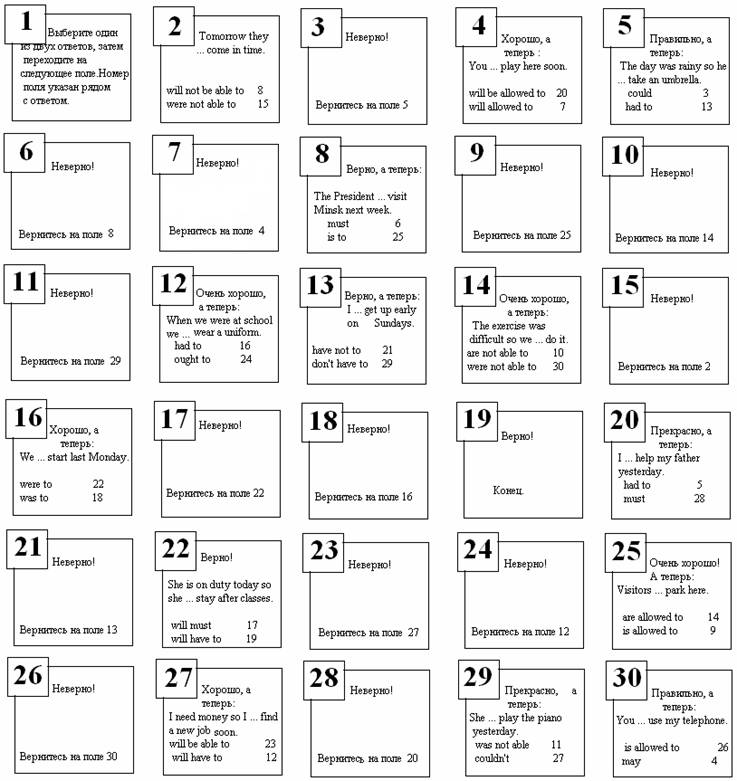 самопроверки 2
1. .
Приложение 1
Тексты для дополнительного чтения
Read and have fun!
I Have Forgotten …
In a train there was a well-known writer. When the conductor came for the tickets, the writer could not find his ticket. “All right”, said the conductor, “I know you, because I’ve read your books. They are the most interesting books I have ever read in my life. I am sure you have the ticket.”
“But I must find the ticket,” answered the writer. ”I have forgotten where I am going.”
A Song
Shoes have tongues but cannot talk,
Tables have legs but cannot walk,
Needles have eyes but cannot see,
Chairs have arms but can’t hug me.
Can the Dog Have a Seat?
A woman with a dog got in a bus. It was a big dog and very dirty, too.
“Conductor,” said the woman, “I’ll pay for my dog. Can it have a seat like people then?”
“Of course,” answered the conductor. “The dog can have a seat like people, but like people it must not
put its feet on the seat.”
The Great Scientist and His Little Cat
Sir Isaac Newton was one of the greatest English scientists. He had a beautiful cat and liked it very
much. When he was working in his study nobody could disturb him. Only his cat.
He often had to open the door to let it in. After some time Newton said to his servant: “Please, make
a big hole in the door so that the cat can go in and out whenever it likes!” So the servant did.
Next spring the cat had five lovely kittens. And when these began to play and run about it was a fine
picture, and Newton liked them too. Once more he asked the servant to come: “Now you must make
a second hole, a small one in the door, so that the kittens can pass through too!”
A Funny Story
Once a man went to the shop and bought a pair of trousers. When he came home, he put the trousers on. Then he saw that they were too long for him.
So he went to his wife and said:
“Please make my trousers shorter, they are too long for me, I cannot put them on.”
But the wife said: “I have no time now. I must wash the plates. It is late now, I shall do it tomorrow.
The man went to his daughter and asked her:
“Can you make my trousers shorter? I cannot put them on.”
“No, I cannot,” said the daughter. “I must do my lessons now. I shall do it tomorrow.”
The man went to his sister, but she could not help him. She said: “I must make my dress now. I shall do it tomorrow.”
So the man went to bed and left his new trousers on a chair near his bed.
His wife washed all the plates, came into the room, took the trousers, made them shorter and put them back on the chair. When his daughter did her lessons, she came into his room, took his trousers and made them shorter. Late in the evening his sister came too and made the trousers shorter.
The man got up at 7 o’clock in the morning. His wife told him: “I have made your trousers shorter; you can put them on”. But when the man put them on, he saw that they were too short for him and he could not wear them.
A Traveling Circus
A traveling circus was visiting a little town. Among the attractions were some dogs. Each dog was to show the trick. One dog was to pretend that it could count, another dog was to ride a bicycle. At the end of the performance they showed a dog, Fray by name, who could play the piano. Fray was a chief attraction, and before it began its trick, the manager always stood up and said: “And now, boys and girl, you will have to be very quiet. Fray, our great artist is to play the piano”. The dog sat on a chair, put its paws on the piano and seemed to play it. One day during the performance Fray started to play the piano as usual. Suddenly one of the boys shouted loudly:”Rats!” Immediately “the artist” jumped off the chair and rushed in the direction of the cry. And here everybody burst out laughing – the piano continued to play.
His First Money
Somebody once asked Mark Twain whether he could remember the first money he ever earned.
“I remember quite well”, the famous writer answered. “It happened at school. Schoolboys in those days had very little respect for their teachers and even less for their desks. The boys used pens and pencils and even knives to draw stars and faces or to write their names on their desks. At last, the school principal said: “The next time anybody does such a thing, he will have to pay five dollars, or he will receive a beating in front of the whole school”.
“Soon after that, I had to go to my father and ask him to give me five dollars. I was honest enough to explain that I could agree to receive a beating instead, but he said:”No, I can’t allow you to connect our name with such things. So I’ll pay the five dollars. But you must suffer for what you have done. I’ll give you the beating here, at home”.
“So he beat me, and then gave me the five dollars to take to school. But I decided that the beating didn’t hurt me much, and another beating at school wouldn’t be worse. So I told them to give me a beating in front of the whole school, and I kept the five dollars. And that was the first money I ever earned”.
Приложение 2
Таблица неправильных глаголов и их эквивалентов
Модальные глаголы и их эквиваленты | Значение | Present | Past | Future |
|
Сап | Физическая способность или возможность совершить действие | I, you, he, she, it, we, they can read | 1, you, he, she, it, we, they could read | Эквивалент to be able lo |
|
to be able to | I am you, we, they are he, she, it is able to read | I, he, she, it was you, we, they, were able to read | I, we shall you, we, they, he, she, it will be able to read |
| |
Must | Долженствование | I, you, he, she, it, we, they must read | Эквивалент to have to | Эквивалент to have to |
|
to have to | Должен, вынужден, приходится | I, you, we, they have to read he, she, it has to read | I, you, he, she, it, we, they had to read | I, we shall have to read you, we, they he, she will have to read |
|
Модальные глаголы и их эквиваленты | Значение | Present | Past | Future | |
to be to | Должен (по плану, по договоренности) | I am you, we, they are he, she, it is to read | I, he, she, it was you, we, they, were to read | ||
should, ought to | Рекомендация, совет | 1, he, she, it, you, we, they should read | |||
May | Разрешение (мне разрешено, можно) | (I, he, she, it, you, we, they may read | I, he, she, it, you, we, they might read | Эквивалент (to be allowed to) | |
to be allowed to | I am you, we, they are he, she it is allowed to read | I, he, she, it was you, we, they, were allowed to read | I, we shall you, we, they, he, she will be allowed to read | ||
Приложение 3
Ключи к упражнениям
Модальные глаголы
Упр. 1.4.
1. We can help you. 2. Nobody could help me. 3. She could send the telegram yesterday. 4. Can you
skate? – Yes, I can. 5. Could you skate when you five? – No, I couldn’t. 6. What can I do for you?
Упр. 1.7.
1. May I see this film? – Yes, you may. 2. He may / might see this film. 3. May I read a little longer?
– No, you can’t. It’s too late. 4. They may take part in the sports competitions. 5. You may use the
text-books. 6. She may / might write a letter soon.
Упр. 1.11.
1. a) might b) may c) must
2. a) might b) may c) must
Упр. 1.12.
1. You must be there at two o’clock. 2. Children must help their parents. 3. You mustn’t smoke if you
are in a theatre. 4. You must be hungry. Sit down to dinner. 5. It must be seven o’clock. It’s very dark
in the street. 6. He must be at home now. He always comes home at that time.
Упр. 1.14.
1.f; 2.e; 3.a; 4.c; 5.g; 6.d; 7.b
Упр. 1.15.
1. You should go to bed earlier today. 2. We ought to go by bus. 3. Children shouldn’t play with matches. 4. Should I stay after classes? 5. When and where should we meet? 6. The weather is bad today. You shouldn’t go out.
Упр. 1.16.
1.b; 2.a; 3.e; 4.d; 5.c
Упр. 1.17.
1.may; 2.should; 3.must; 4.can; 5.ought; 6.could; 7.shall; 8.can; 9.must / should; 10.could
Упр. 1.18.
1. Can you help me? – I’m afraid not. 2. May I close the window? – Yes, you may. 3. Must we have a dictation today? 4. You should visit your friend. He didn’t come to the lesson today. 5. Why did you come so late? – I couldn’t come earlier, I was very busy. 6. Let’s ask mother. She must know his address. 7. I can’t finish this work today. 8. You shouldn’t drink cold water. 9. He may be at his office now, it’s nine o’clock already. 10. Shall I translate this text? – No, you may do it at home.
Эквиваленты модальных глаголов
Упр. 2. 3.
1. wasn’t able to; 2. have to; 3. Are you able to swim? 4. are allowed to; 5. are able to; 6. was allowed to; 7. is able to; 8. are to / have to; 9. Am I allowed to …? 10. are to.
Упр. 2.4.
1. Could; 2. Could; 3. will not be able to; 4. can; 5. will be able to; 6. could, couldn’t; 7. can; 8. will be able to.
Упр. 2.5.
1. may; 2. may; 3. may / might; 4. were not allowed to; 5. may; 6. might; 7. will be allowed to;
8. may / might.
Упр. 2.6.
1. must; 2. was to; 3. had to; 4. will have to; 5. is to; 6. must; 7. am to; 8. will have to; 8.
didn’t have to.
Упр. 2.7.
1. had to; 2.can; 3.could; 4. should; 5. shall; 6. could, will be able to; 7. mustn’t; 8. is to; 9.
will have to; 10. may, may; 11. must; 12. shouldn’t
Упр.2.8.
1. Can you help me now? – I’m sorry, I can’t. 2. Shall I send the letter? – Please, do. 3. You should
visit your friend. He didn’t come to school yesterday. He may be ill. 4. May I watch TV? – No, you can’t. It’s late. You are to go to bed soon. 5. I am glad I didn’t have to finish this work yesterday. 6. You must come and see our new flat. – I’d love to. 7. I’m afraid I won’t be able to go to the country. I am to translate the text by Monday, so I’ll have to work on Sunday. 8. He must speak English well. 9. My son is a very diligent pupil, I don’t have to help him with his lessons. 10. Could you play chess before? – No, I couldn’t. And you? – I could play chess when I was five. 11. Children mustn’t go to bed so late. 12. Could you tell me the time, please?
Список литературы
1. А 23 Английский язык для средних специальных заведений. – Ростов н/Дону:
«Феникс», 2003. – 320 с.
2. , , Б 81 Учебник английского языка. В 2 ч. Ч. 1.– М.: . « ЭКСМО» – «ДЕКОНТ + » – «ГИС», 2003. – 637 с.
3. Б 87 Английский за 30 дней. – М.: Астрель», 2004. – 296 с.
4. Б 87 Английская грамматика: самое необходимое. – С-Пб: Изд-во «Авалон»,
2002. – 96 с.
5. Р 34 Грамматика английского языка с упражнениями. – Смоленск – Москва: АО
«Манускрипт», 1995. – 288 с.
6. , Х 30 Английский язык для поступающих в вузы.– Мн.: Выш. шк.,
2003. – 463 с.
7. Христорождественская курс английского языка. – Мн.: «Аурика», 1993. –
416 с.
8. , Ч 48 Как сдать ЕГЭ по английскому языку на 100 баллов. –
Ростов н/Дону: «Феникс», 2003. – 256 с.
9. Luke Prodromou Grammar and Vocabulary for First Certificate // English, 2001. – 320 c.
10. Maximilian Bose Read and Have Fun // English, 1989. – 48 c.
