


Партнерка на США и Канаду по недвижимости, выплаты в крипто
- 30% recurring commission
- Выплаты в USDT
- Вывод каждую неделю
- Комиссия до 5 лет за каждого referral
II. Translate the following word combinations:
Removable storage, paper punch cards, commercial software, back-up copy, storage capacity, iron oxide, direct-access storage, magnetic medium, flexible plastic film, software application, sealed aluminum box, controller electronics, magnetic domains, highly-filtered vent hole, extremely simple, pie-shaped wedges, magnetic flux patterns.
III. Phrases with prepositions for you to remember:
1. to be coated with – быть покрытым
2. to distinguish from – отличать, различать
3. to turn into – превращать(ся)
4. to detach from – отделять, отсоединять, разъединять
IV. Memorize the following “false friends”:
1. extremely – чрезвычайно, в высшей степени, очень
2. originally – первоначально, изначально, поначалу
V. Translate the following sentences into Russian paying attention to the Absolute Participial Construction:
1. The experiments being demonstrated, all the students watched them with great attention. 2. There are two diagrams in this figure, one of them showing the relation between volume and temperature. 3. A new radio set having been shown to them, they began to examine its details. 4. Electrons leaving the surface, the metal becomes positively charged. 5. We defined the volume, all the measurements having been done with respect to the instruction. 6. The computer performing addition, two numbers to be added come from the memory. 7. Atoms consist of three kinds of particles — electrons, protons and neutrons, the number of particles determining the kind of element. 8. The workers increased the output of measuring instruments, new devices having been applied in all the shops of the plant. 9. The experiment having been carried out, the students left the lab. 10. I was writing the translation, my friend helping me. 11. Part of the energy being changed into heat, not all the chemical energy of the battery is transformed into electric energy.
VI. Choose the sentences with the Absolute Participial Construction from the ones given below. Translate them into Russian:
1. Speaking about the new method of work the engineer told us many interesting details. 2. The temperature of a conductor being raised, the motion of the electrons in the conductor increases. 3. Special instruments measuring cosmic radio signals are being installed in the observatory. 4. Transistors are very sensitive to light, some of them reacting even to star-light. 5. The first man-made satellite having been sent up, it became possible to investigate various types of radiation. 6. Obtaining new data engineers can improve their knowledge. 7. The resistance being very large, the current in the circuit was small. 8. When improving the design the constructor made many calculations. 9. A great variety of substances are semi-conductors, germanium and silicon being the most important of them. 10. A series of attempts having been made, Lodygin came to a successful solution of the problem.
VII. Read the words and word combinations and memorize their meaning:
back-up copy – запасная (резервная) копия
to secure – защищать, обеспечивать безопасность
incredible – невероятный, удивительный
enduring – выдержавший испытание временем
drive – привод, дисковод
direct-access storage – ЗУ с прямым доступом
platter – большой диск
GIF (Graphic Interchange Format) – формат графического обмена
sealed – герметичный, запечатанный
controller electronics – электронное управление
to spin – вращать
to assemble – компоновать, собирать, монтировать
underneath – внизу, ниже (относительно какого-либо объекта)
vent – воздушный клапан
to equalize – уравновешивать, выравнивать
precise – точный, точно установленный
tolerance – устойчивость
hub – центр
edge – край
wedge – что-либо, имеющее форму клина
cluster – кластер, группа, блок
instantly – мгновенно, сразу же
flux - поток
VIII. Read and translate the text:
Removable Storage
Removable storage has been around almost as long as the computer itself. Early removable storage was based on magnetic tape like that used by an audio cassette. Before that, some computers even used paper punch cards to store information.
We've come a long way since the days of punch cards. New removable storage devices can store hundreds of megabytes (and even gigabytes) of data on a single disk, cassette, card or cartridge. There are several reasons why removable storage is useful: it’s commercial software, you can make back-up copies for storing software and information that you don't need to access constantly, it’s possible to transport data between two computers (e. g. copying information to give to someone else), you can secure information that you don't want anyone else to access.
Modern removable storage devices offer an incredible number of options, with storage capacities ranging from the 1.44 megabytes (MB) of a standard floppy to the upward of 700 gigabyte (GB) capacity of some portable drives. All of these devices fall into one of three categories: magnetic storage, optical storage, solid-state storage.
MAGNETIC
Floppy disc
The most common and enduring form of removable-storage technology is magnetic storage. For example, 1.44-MB floppy-disk drives using 3.5-inch diskettes have been around for about 15 years, and they are still found on many computers sold today. In most cases, removable magnetic storage uses a drive, which is a mechanical device that connects to the computer. You insert the media, which is the part that actually stores the information, into the drive.
Just like a hard drive, the media used in removable magnetic-storage devices is coated with iron oxide. A disk is made from a thin piece of plastic coated with magnetic material on both sides. On the disk there are tracks. The tracks are arranged in concentric rings so the software can jump from "file 1" to "file 19" without having to fast forward through files 2 through 18. The disk spins like a record and the heads move to the correct track, providing what is known as direct-access storage.
The read/write heads ("writing" is saving new information to the storage media) do not touch the media when the heads are traveling between tracks. There is normally some type of mechanism that you can set to protect a disk from being written to.
Hard disc
Hard discs were invented in the 1950s. They started as large discs up to 20 inches in diameter holding just a few megabytes. They were originally called “fixed discs” or “Winchesters”. They later became known as “hard discs” to distinguish them from “floppy discs”. Hard discs have a hard platter that holds the magnetic medium, as opposed to the flexible plastic film found in tapes and floppies.
A typical desktop machine has a hard disc with capacity of between 60 and 400 gigabytes. Data is stored onto the disc in the form of files. A file is simply a named collection of bytes. The bytes might be codes for the characters of a text file, or they could be instructions of a software application for the computer to execute, or they could be the records of a data base, or they could be the pixel colors for a GIF image. No matter what it contains, however, a file is simply a string of bytes. When a program running on the computer requests a file, the hard disc retrieves its bytes and sends them to the CPU one at a time.
A hard disc itself is a sealed aluminum box with controller electronics attached to one side. The electronics control the read/write mechanism and the motor that spins the platters. The electronics also assemble the magnetic domains on the drive into bytes (reading) and turn bytes into magnetic domains (writing).The electronics are all contained on a small board that detaches from the rest of the drive. Underneath the board are the connections for the motor that spins the platters, as well as highly-filtered vent hole that lets internal and external air pressure equalize.
Removing the cover from the drive reveals an extremely simple but very precise interior: the platters which are manufactured to amazing tolerances and are mirror-smooth and the arm that holds the read/write heads. It is controlled by the mechanism in the upper-left corner and is able to move the heads from the hub to the edge of the drive.
Data is stored on the surface of a platter in sectors and tracks. Tracks are concentric circles, and sectors are pie-shaped wedges on a track. A sector contains a fixed number of bytes. Either at the drive or the operation system level, sectors are often grouped together into clusters.
Hard disc has got some benefits – you can move to any point on the surface of the disc almost instantly; the information can be easily erased and rewritten, and it will “remember” the magnetic flux patterns stored onto the medium for many years.
IX. Say “true” or “false”. Correct the “false” sentences:
1. Removable storage appeared later than computer.
2. Removable storage has only one advantage.
3. Removable storage devices can be of three categories.
4. The most convenient is a floppy disc.
5. Hard disc consists of several floppy films.
6. File is a string of letters and numbers.
7. A hard disc is a sealed box controlled by electronics.
8. Data is stored in sectors and tracks.
UNIT 7 “Optical auxiliary storage devices”
I. Read and guess the meaning of the following international words:
Compact, design, spiral, laser, micron, focus, polycarbonate, aluminum, organic, temperature, mixture, crystallize, multimedia, version, identical, physical, parameter.
II. Memorize the following “false friends”:
Momentum – импульс, толчок
III. Translate the following sentences into Russian. Pay attention to the modal verbs:
1. Heat is a form of energy and may be measured in the units in which energy is measured. 2. We must say that the discovery of atomic energy is as important as the discovery of fire. 3. Electronic machines can add, subtract, multiply and divide much quicker than man. 4. The origin of automation can be traced back to the early days of the first industrial revolution. 5. She may use different methods in her research work. 6. For a long time scientists could not discover the secret of the atom. 7. This equipment can work with high accuracy. 8. You may use these devices in your research work. 9. The atom is a great force that must be used for the good of mankind. 10. Chemists must create the materials which don't exist in nature. 11. Naturally, this circuit can be modified if necessary. 12. This kind of energy must find application in transport.
IV. Choose the sentences where the verbs to have and to be are used in the functions of Modal Verbs and translate them:
1. These devices have been used in our experiment. 2. Scientists have to work hard to create a new atomic technique. 3. A modern computer has two main parts: a memory and a computing unit. 4. As the known resources of coal and oil are limited, man has to find new sources of power. 5. Very difficult calculations in mathematics and electrical engineering have to be solved by computers. 6. People of good will have to struggle for peaceful use of atomic energy. 7. When technique reaches a very high stage of development, new methods of work will be possible. 8. We are to take into consideration all the advantages and disadvantages of this device for the future work. 9. We are to take special steps to reduce the weight of this mechanical part. 10. These new data are obtained after our experiment. 11. At present our engineers are to develop the most advanced methods of production. 12. Our design bureau has to construct a new adding machine. 13. This device has been used in our experiment. 14. The experts are to inspect this plant.
V. Translate the sentences into Russian. Pay attention to the use of Modal Verbs and their Equivalents:
1. Without a computer scientists will not be able to solve complicated problems. 2. Modern computers can multiply two numbers in a microsecond. 3. This machine can do the work of hundreds of workers. 3. He has to finish his experiment in time. 4. She was allowed to carry out this research as she had taken part in the scientific symposium. 5. Every student must know the difference between automation and mechanization. 6. With the help of radioactive elements we were able to measure the thickness of various materials. 7. Every engineer must improve his technical knowledge. 8. Scientists of different countries must cooperate in their research and peaceful application of their discoveries. 9. In fact, there is hardly any sphere of life where the atom may not find useful application. 10. The computer can perform different mathematical operations. 11. Our plant is to increase its output. 12. Every plant must fulfill its plan in time. 13. Workers must apply new methods of production.
VI. Translate the following sentences into Russian paying attention to Modal Verbs with Perfect Infinitive:
1. The engineer might have overlooked something that may turn out to be important in carrying out this experiment. 2. All the preparations must have been completed long ago. 3. Some day atomic energy might have been used to control the weather of the world. 4. He may have got the condenser he needed for his experiment. 5. He cannot have broken the tube while making this experiment. 6. You should have changed the current strength at all points of the circuit. 7. He may have got the article he needed. 8. You should have helped your friend.
VII. Read the words and word combinations and memorize their meaning:
to be familiar with – быть знакомым, знать
bump – углубление
injection-molded – литой
tricky – искусный, сложный
to dye – окрашивать
antimony - сурьма
compound – смесь
versatile – универсальный, многоцелевой
to gather momentum – приобретать движущую силу
revenue – доходный
shot run – короткий период, небольшая партия изделий, малый тираж
standalone – автономный
backwards – имеющий отношение к прошлому
compatibility – совместимость
outset – начало
add-on – добавленный для расширения
UDF – (User-Defined Function) функция, определяемая пользователем
bond – связывать, соединять
substrate – подложка, основание печатной платы
OPTICAL
CD
The optical storage device that most of us are familiar with is the compact disc (CD). A CD can store huge amounts of digital information (783 MB) on a very small surface. The design that makes this possible is a simple one. The CD surface is a mirror covered with billions of tiny bumps that are arranged in a long, tightly wound spiral. The CD player reads the bumps with a precise laser and interprets the information as bits of data.
The spiral of bumps on a CD starts in the center. CD tracks are so small that they have to be measured in microns (millionths of a meter). Most of the mass of a CD is an injection-molded piece of clear polycarbonate plastic that is about 1.2 millimeters thick. During manufacturing, this plastic is impressed with the microscopic bumps that make up the long, spiral track. A thin, reflective aluminum layer is then coated on the top of the disc, covering the bumps. The tricky part of CD technology is reading all the tiny bumps correctly, in the right order and at the right speed. To do all of this, the CD player has to be exceptionally precise when it focuses the laser on the track of bumps.
When you play a CD, the laser beam passes through the CD's polycarbonate layer, reflects off the aluminum layer and hits an optoelectronic device that detects changes in light. The bumps reflect light differently than the flat parts of the aluminum layer, which are called lands. The optoelectronic sensor detects these changes in reflectivity, and the electronics in the CD-player drive interpret the changes as data bits.
CD-R works by replacing the aluminum layer in a normal CD with an organic dye compound. This compound is normally reflective, but when the laser focuses on a spot and heats it to a certain temperature, it "burns" the dye, causing it to darken. When you want to retrieve the data you wrote to the CD-R, the laser moves back over the disc and thinks that each burnt spot is a bump. The problem with this approach is that you can only write data to a CD-R once. After the dye has been burned in a spot, it cannot be changed back.
CD-RW fixes this problem by using phase change, which relies on a very special mixture of antimony, indium, silver and tellurium. This particular compound has an amazing property. When heated to one temperature, it crystallizes as it cools and becomes very reflective; when heated to another, higher temperature, the compound does not crystallize when it cools and so becomes dull in appearance.
CD-RW drives have three laser settings to make use of this property:
• Read - The normal setting that reflects light to the optoelectronic sensor
• Erase - The laser set to the temperature needed to crystallize the compound
• Write - The laser set to the temperature needed to de-crystallize the compound
Other optical devices that deviate from the CD standard, such as DVD, employ approaches comparable to CD-R and CD-RW.
DVD
DVD, the Digital Versatile Disc, is a high capacity CD-size disc for video, multimedia, games and audio applications. DVD started in 1994 as two competing formats, Super Disc (SD) and Multimedia CD (MMCD). Capacities for the read-only disc range from 4.7GB to 17.1GB. The high quality of video and audio has helped DVD-Video to compete very effectively with VHS.
DVD-Video, which was launched in 1997 in the USA, has become the most successful of all the DVD formats, as it has proved to be an ideal vehicle for distributing video content from the movie industry. It can store a full-length movie in high quality video with surround sound audio on a disc the same size as a CD.
DVD-ROM is beginning to replace the CD-ROM and provide a new high capacity disc format for the computer industry. New PCs are now provided with DVD drives instead of CD drives. The entertainment industry has developed new games consoles (e. g. Sony's PS2 and Microsoft's X-Box) which incorporate DVD-ROM drives for more sophisticated and realistic games applications.
DVD-Audio, which was launched in 2000, is slowly gathering momentum to become the format for very high quality, surround sound music, offering the music industry new revenue opportunities.
Recordable formats such as DVD-RAM, DVD-RW and DVD-R are now being extensively used in PCs for computer backup and short runs of DVDs and in standalone products such as video recorders and camcorders. The main features of the DVD formats are:
• Backwards compatibility with current CD media. All DVD hardware will play audio CDs and CD-ROMs and most will play CD-Rs and CD-RWs.
• Physical dimensions are identical to the compact disc but each disc comprises two 0.6 mm thick substrates, bonded together.
• Single-layer/dual-layer and single/double sided options are available.
• Up to 4.7 GB read-only capacity per layer, 8.5 GB per side maximum.
• Designed from the outset for video, audio and multimedia, not just audio.
• All formats use a common file system (UDF).
• Digital and analogue copy protection for DVD-Video and DVD-Audio built into the standard.
• Recordable and re-writable versions are part of the family.
Although identical in appearance, DVDs and CDs differ in a number of key physical parameters. To meet the requirements for 133 minutes of high quality video on one side of a single disc requires the use of a thinner (0.6 mm) substrate, two of which are bonded together to form a disc that is thick enough for general use. The use of a sandwich of two substrates allows a range of formats from one layer to four and one or two sides, giving capacities from 4.7 GB to as much as 17.1 GB.
All types of DVD discs (DVD-Video, DVD-ROM and DVD-Audio) contain data in files. These files are accessed using a file system common to all DVD discs. For compatibility with recordable and re-writable versions and with existing operating systems, including Windows9x and later the UDF Bridge Format was chosen.
DVD-ROM is essentially the pre-recorded DVD physical and logical format used for DVD-Video, DVD-Audio and a range of other applications, particularly general computer and multimedia applications, for which it can provide at least 7 times the capacity of a CD-ROM. Applications can include MPEG-2 video, as used on DVD-Video discs, to give added realism to games and richer content for multimedia applications. DVD-ROM drives will also play CD-ROM and CD audio discs and are forecast to replace CD-ROM drives within the next few years. They are already available as add-on drives and built into new PCs.
Copy protection for DVD is only for video and audio content and comprises both digital and analogue methods for preventing users from making perfect copies of the source material.
UNIT 8 “Modems”
1. Read and translate the following international words:
To communicate; to concentrate; to electrify; standard; technique; to manipulate; diagram.
II. Read the text and find English equivalents for the following Russian words and word combinations:
Обрабатывать информацию; двойной язык; связка единиц и нулей; более общий термин; произвольно; в обратном направлении; единственный недостаток.
WHAT IS A MODEM AND HOW DOES IT WORK?
Most people are aware of the fact that computers process information in binary language. If computer A wants to communicate with computer B, A will have to send a bunch of ones and zeros to B, in some meaningful (to them) order, across some medium. But how is it actually done?
Let us concentrate on the communications part. Taking things in order, we first must have something with which to connect the two machines. We'll run a wire between the two computers.
Next, we need to send a bunch of ones and zeros across that wire. We'll worry about making the stream meaningful later. First we electrify the wire. We'll pick a standard voltage of +5V DC. We'll make that equal to a "one." A "zero" will be represented by OV DC, or ground. So, by applying and removing voltage on the wire we have ran between the two machines, we can send across a bunch of ones and zeros. It looks like it

We did say something about making the stream meaningful, though. What if we want to send across fifteen ones in a row? For convenience let's refer to ones and zeros by the more generic term "bits." We can arbitrarily assume a standard transmission time for each bit of one second. So if machine A wants to send the stream "," it would take twelve seconds and look something like this:

Since the machines have agreed on sending a new bit once per second, all machine В has to do is wait until A has begun transmission, wait another 1/2 second (to ensure that it isn't trying to read the value of the line while machine A is changing it), and start checking the voltage on the wire each second thereafter, as shown by the hash-marks in the following diagram:

So now В knows what A is sending. How does В know when A is ready to send bits? How does it know when A is finished sending?
We need another wire.
This new wire will hang out at OV DC until A is ready to send data, then A will "take it high," or put +5V DC on it. When В notices that the new wire is now carrying 5 volts, it waits 1/2 second and starts reading bits. It continues to read a new bit every second until A takes the new wire low again (drops the voltage on the wire to OV DC), then stops.
We really are only looking at half the problem. A can talk to B, but В is going to have to talk to A, if only to let A know В has received the data. We can add two more wires providing the same functions but in the opposite direction.
This is very inefficient, but it would work.
Requiring four wires to implement bi-directional (sometimes called "full duplex") communication would not win an award from anyone.
We could do it with two.
Say we chose, instead of+5V DC and OV DC, +5V DC and -5V DC. We made the machines agree that once A took its line high, В would wait a predetermined amount of time and start reading. Knowing the amount of time В would wait, A would wait 1/2 second less and start munication in the other direction would work the same way.
We could do it with one.
The above paragraph describes a technique that works just as well with one wire as with two, with a small exception. Whoever takes the line high becomes the transmitter, the other machine becomes the receiver. The only drawback is we can only operate in half-duplex mode, since both machines can't be manipulating the voltage on the same wire at the same time.
In reality there are many ways for machines to decide what is a one and what is a zero, and many more ways of sending said ones and zeros all over the place. In reality even an inexpensive modem can handle data transmission rates 19,200 times faster than our example.
Vocabulary notes:
bunch – связка
stream meaningful – значащий поток
generic – общий
arbitrarily – произвольно
full duplex – полная двойная связь
half-duplex mode – полудуплексный способ
III. Match the sentences according to the text:
1) We are aware of the fact … 2) It’s necessary to run a wire between the two computers… 3) By applying and removing voltage on the wire… 4) Computer B continues to read a new bit every second until… 5) Requiring four wires to implement bi-directional communication… | a) …it is very inefficient b) …we can send across a bunch of ones and zeros c) …that computers process information in binary language d) …in order to connect them e) …computer A takes the new wire low again |
plete the following sentences according to the text:
1) Computers process information …;
2) We can arbitrarily assume a standard …;
3) It is very inefficient to add …;
4) We can operate in half-duplex mode …;
5) Actually even an expensive modem can …
V. Read the text “Introduction to telephony” and find English equivalents for the following Russian words and word combinations:
Передача; провод; изучить возможные варианты; переключатели, локализующиеся в определённых областях; высокопроизводительный; протоколы передачи данных; границы пространства и времени.
INTRODUCTION TO TELEPHONY
Assuming we have a workable means of transmitting bits across a wire between two machines, the next question could be, "What do we do if the machines are 6,452 miles apart?"
We'll need four wires, that's 25,808 miles of copper. Perhaps we should investigate alternatives. There are fortunately people out there who have already run wire (or run fiberoptic cable, or built microwave towers) all over the world, and are more than willing to loan us the use of their facilities for a nominal fee. They are called long-distance carriers. We'll call them LDCs.
They have a network of interconnections that stretches from one end of the globe to the other. We have the aforementioned LDCs and we have Local Exchange Carriers, or LECs. They have networks that go out to everyone's house and connect them all to big (in some cases, very big) switches in centralized locations. The LDCs have high-capacity connections to these switches.
Their facilities are not based on ones and zeros. They are, after all, voice-transmission facilities. The LDCs have networks specifically designed for data transmission, but it is not really cost-effective for you to pay to have them run a line out to your house. The alternative is to find some way to translate between voice transmission and data transmission protocols.
A protocol is just an agreement between two machines about things like how long bits should be, and what voltages are good for ones, etc. It just gets complicated trying to cover all the bases while the machines are compressing the data to shove more across in the same time, and sending simultaneously in 350 different frequencies to take advantage of available bandwidth, and stretching the bounds of space and time.
Vocabulary notes:
fiberoptic cable – оптоволоконной кабель
long-distance carriers – дальние курьеры
aforementioned – вышеупомянутый
local exchange carriers – местные обменные курьеры
cost-effective – рентабельный
to shove - пихать
available bandwidth – доступная полоса пропускания
VI. Answer the following questions:
1) What do you know about long-distance carriers?
2) What is the difference between LCDs and LECs?
3) What is a protocol?
VII. Read the text “Modulation and Demodulation”
MODULATION & DEMODULATION
MODEM is short for modulator/demodulator. Modulation is the conversion of digital bit streams into analog telemetry, suitable for transmission over phone lines. Demodulation is the reversal of that process.
Remembering the diagrams presented earlier, what was at the time obviously just fluctuations in the voltage on a line can also be considered a square wave of constant amplitude (peaks are always +5V DC, valleys are always 0V DC) and varying period or frequency (how long the signal stays high or low). So, the changes in amplitude tell us whether a one or a zero is present, and the changes in period/frequency give us the pattern of ones and zeros, the actual intelligence of the message.
As we discussed earlier, we specified 0V DC as "low" for simplicity, but really we would probably have made "low" the opposite of "high," or -5V DC.
As you can see, nothing has changed. We're still sending the same message, "," it is still taking 12 seconds, and we're still representing ones and zeros by playing with the voltage on the line. The only difference is the specified value used to represent a zero. In fact, we could just as easily have chosen -5V DC to represent a one and +5V DC a zero. The serial communications standard, "RS-232," actually specifies that a binary one is represented by negative voltage. According to RS-232, any voltage from -3V DC to -15V DC will be acceptable as a one. If you get a seventy-five-foot cable to connect your two machines, you will get the infamous “unpredictable results”.
Square waves are nice, neat and easily understandable. They are either one value or another. Voice transmission facilities are not based on square waves, though. They are based on sine waves. Sine waves are not quite so neat. They look like this:
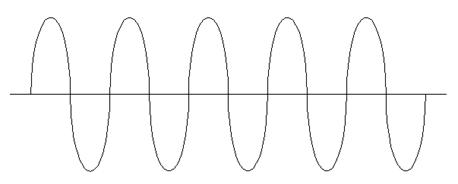
Voice transmission is achieved by manipulating an existing sine wave, or carrier. Obviously, converting a square wave into a sine wave for addition to an existing carrier is not a simple task.
Modems take a signal from a computer and encode it for transmission. Some examples of encoding techniques are “amplitude shift keying”, “frequency shift keying”, and “phase shift keying”. Modems encode a square-wave-oriented signal into a signal that can be added onto a carrier, and the other modem decodes it on the other end using the reverse of whichever technique was used to do the encoding.
Vocabulary notes:
reversal – инверсия
fluctuations – колебания
square waves – меандры
sine waves – синусоидные волны
amplitude shift keying – амплитуда переключения регистров
frequency shift keying – частота переключения регистров
phase shift keying – стадия переключения регистров
VIII. Make up a 100-word essay on “How does modem work?” using information from these texts.
IX. Translate the following sentences into Russian paying attention to Complex Subject:
1. These elements are known to have been found two decades ago. 2. Semiconductors are shown to be good detectors of radio waves. 3. Metal is known to conduct electricity. 4. Electrical charges are known to be positive and negative. 5. This engineer appears to have presented some interesting data. 6. The problem of new generators is likely to be one of the most essential. 7. This method of switching is sure to be cheaper. 8. All the details of the plan are supposed to have been explained to you. 9. The chemist is expected to obtain a new substance. 10. They are considered to carry out their research in time. 11. The origin of the word 'robot' is said to have appeared first in a play of a Czech playwright, Karel Capec. 12. Four atomic power stations are assumed to be built for experimental purposes. 14. The improvement of the technological processes is supposed to ensure lower cost of power. 15. Long transmission lines are known to be necessary for the transfer of electric energy over long distances. 16. Some types of reactors are known to produce more nuclear fuel during their operation than they consume.
VIII. Choose the sentences with Complex Subject, translate them into Russian:
1. The engineers were glad to have obtained such good results. 2. Our task is to study well. 3. This system is expected to have wide application. 4. For him to have done these experiments is a great success. 5. Heat causes the liquid to evaporate. *****ssia is known to have put into operation the first atomic station in 19The engineer made his assistants check the results many times. 8. The apparatus to be assembled is very complicated. 9. The idea to use this new substance is not new. 10. The application of this device in our experiment is certain to give better results.
IX. Translate the following sentences into Russian paying attention to the emphatic construction it is (was)... that (who):
1. It is electronics that produced radar. 2. It was Einstein who provided a new conception of time, space and gravitation. 3. It was A. S.Popov who invented the radio. 4. It was from radio that the subject of electronics was born. 5. It was radioelectronics that produced cybernetics, cosmonautics and nuclear physics. 6. It was in the laboratory that I found him. 7. It was D. I.Mendeleyev who formulated the Periodic Law. 8. It was in the Soviet Union that the first atom-driven ice-breaker "Lenin" was made. 9. It was in 1868 that D. I.Mendeleyev formulated the Periodic Law of Elements. 10. It is automation that improves working conditions. 11. It was in 1944 that the first relay machine was completed. 12. It is the programme that ensures the execution of all operations assigned to the computers. 13. It was in the 20th century that electronic computers appeared.

|
Из за большого объема этот материал размещен на нескольких страницах:
1 2 3 4 5 |
