

Партнерка на США и Канаду по недвижимости, выплаты в крипто
- 30% recurring commission
- Выплаты в USDT
- Вывод каждую неделю
- Комиссия до 5 лет за каждого referral
Restoration of coppice forests in protected resort region Caucasian Mineral Waters
Novikova Anna (SPbFTA, Sankt-Petersburg, RF)
Special recreational value has forests of protected ecological resort region of the Russian Federation - Caucasian Mineral Waters - bordering the resort towns. Assessment of regeneration process of coppice forests in this region will determine what action should be taken to their successful replacement.
Introduction
The forests of Stavropol region which are located in the central part of North Caucasus and account for 2% of the territory are mostly represented by deciduous species. The landscape of this area is characterized by hilly country. The forests are fully assigned to the categories of protection, which is not allowed to do the final felling. They are the main asset not as a source of wood, but as a natural system, perform environmental, water protection, protection, sled-packaged-hygiene, health and other useful functions. (Alexidze, M., 2002)
After the Second World War big part of the forests in region of Caucasian Mineral Waters have been cut down for fuel and reforested by underwood. Coppice forest are short-lived and now needed the gradual replacement by the seminal (Hershkowitz, B., 2005).
The object of this study is forests in the East slope of Beshtau mountain which relate to protective forests of KMV. Analysis of quantitative and qualitative characteristics of the forest regeneration and light regimes in the coppice stands of the study area was done.
Forest resources of the region
The total forest area of the Stavropol Territory to 1 January 2009 is 129,107 ha, including forest. Forest lands occupy 2% of the province. The territory belongs to the extremely sparsely wooded areas of the country. The forests are divided into the mountains and plains and assigned to eight categories of protection on the priorities of their functions, which also provides a variety of approaches in forestry and complicated issues of design of its organization and development.
In the agro-climatic zone of sufficient moisture, consists of foothill areas of region - specially protected ecological resort region of the Russian Federation - KMV, the natural conditions which are characterized, in general, sufficient rainfall, the presence of vertical zoning of climatic parameters, and highest in edge forest coverage. Are generally composed of broadleaf forests with participation of pine (5%).
This area of natural and climatic conditions are most favorable in the region for the growth of trees and shrubs, but it is feeling the effects of some harmful factors, and there impact with a more rugged also depends on the steepness of slopes, their exposure, vertical zones etc.
(http://mpr. *****/natres/forest/o_lesnih_resursah. html)
Research methodology
On the eastern slope of Mount Beshtau in 2004 laid the four test areas with similar site conditions. They appreciated the taxation characteristics of the stand, estimated light regime and calculated the undergrowth.
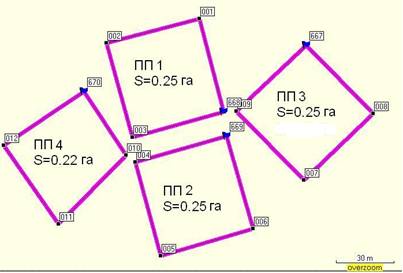
Fig.2. Sheme of permanent plots Kislovodsk mountain forest laboratory FSI NIIgorlesekol incorporated in 2004. Oak stand. Beshtaugorsky district.
In 2005, 2 plots were carried out selective sanitary cuttings of varying intensity for the care of undergrowth oak. Plots №1 and 3 was remaining like control (Tab.1).
Table 1. Characteristics of sample plots and the intensity of sanitary cutting.
Plot | Area, ha | Species composition, % | Density | Cutting intensity, % of volume |
1(control) | 0.25 | Oak – 80% Ash – 20% single hornbeam, pear, acer | 0,6 | 0% |
2 | 0.25 | Oak – 90% Ash – 10% single hornbeam, pear, elm | 0,6 | 30% |
3(control) | 0.25 | Oak – 80% Ash – 10% Hornbeam – 10% | 0,8 | 0% |
4 | 0.22 | Oak -80% Ash – 20% single hornbeam, pear | 0,6 | 50% |
Accounting undergrowth is made on 25 sites 4 m2 (2 x 2 m), placed over the area evenly. Undergrowth was distributed to high-altitude groups (shoots up to 10 cm, 11-25, 26-50, 51-100, 101-150 and above 150 cm) and origin (seed, coppice).
Illumination under the canopy was studied using luxmeter SE-116.
On the plots the measurements were made on profiles crossing the sample at a height of 0, 0.5 and 1.0 m above the soil surface. Possible reduction (up to 50) number of measurements allowed for a high canopy of the stand and advanced stage of underbrush smoothing the contrasting differences in the light of various sections of the sample. As a control, during the definition of light under the canopy of measurements made simultaneously at full brightness since the beginning of observations until their expiration. Calculate the light relative to the open space, expressed in percent of full light.
Searching renewing process in the forest
After sanitary cutting undergrowth and light regime were re-measured twice: in 2005 and 2010. Analysis of the light regime reflects a natural increase of illumination after logging and its gradual decline during the formation of dense undergrowth. On the control area and area is observed the reverse situation. Perhaps there after the seed year was formed a lot of small undergrowth which for the most part not been preserved because of the lack of adequate lighting.
Table 2. Light regime at the sample plots before and after cutting.
Year | 2004 | 2005 | 2010 | ||||||
Plot № | 0 m | 0,5 m | 1 m | 0 m | 0,5 m | 1 m | 0 m | 0,5 m | 1 m |
1 | 4,21 | 5,92 | 6,3 | 1,27 | 2,05 | 1,61 | 1,67 | 1,91 | 2,08 |
2 | 4,93 | 7,13 | 7 | 33,87 | 23,34 | 35 | 3,52 | 5,25 | 4,78 |
3 | 4,485 | 4,475 | 5,77 | 1,67 | 1,47 | 1,99 | 2,41 | 2,4 | 2,45 |
4 | 5,9 | 7,7 | 8,1 | 24,36 | 32,4 | 28,95 | 6,38 | 15,38 | 15,95 |
Dynamics of total undergrowth including oak is reflected in Table 2. In all sample plots increase a number of undergrowth in 2005 after cutting but in 2010 its amount become less. In the same time amount of large and medium undergrowth, which can be considered trustworthy, increase.
At the plot №3, where not carried out logging, amount of trustworthy undergrowth decrease. At the plot №1 amount of trustworthy undergrowth increase but insignificantly. The largest increase in the number of trustworthy undergrowth observed at the plot №4 where the highest intensity of logging (Tab.3).
Table 2. Dynamic of total number of undergrowth,
including oak (in the denominator).
Plot № | Total number of undergrowth, thousand pieces / ha, including oak | ||
2004 | 2005 | 2010 | |
1(control) | 89,6 | 114,2 | 85,7 |
18,8 | 20 | 5,2 | |
2 | 153,8 | 207,9 | 62,2 |
25,6 | 25,6 | 13,9 | |
3(control) | 113,9 | 147,4 | 53,9 |
25,2 | 25,2 | 5,1 | |
4 | 70,1 | 293,6 | 64,6 |
17,3 | 17,3 | 4,8 |
Table 3. Number dynamic of large and medium undergrowth,
including oak (in the denominator).
Plot № | Number of large and medium undergrowth, thousand pieces / ha, including oak | ||
2004 | 2005 | 2010 | |
1(control) | 1700 | 1700 | 2300 |
0 | 0 | 0 | |
2 | 1200 | 1100 | 2500 |
100 | 100 | 200 | |
3(control) | 300 | 3100 | 2200 |
0 | 0 | 100 | |
4 | 200 | 200 | 6500 |
0 | 0 | 500 |
Coppice forests multiple generations retained sufficient potential for the reproduction of seed reproduction of hardwood. In the undergrowth of deciduous formations dominated by European ash. Ash regeneration should be considered natural, corresponds to conditions in the region and increase the biological stability of the forests.
Conclusion
In conditions of growing high density forests of the region determines the forest regeneration process factor is the light-ground space.
Mode of illumination under the canopy coppice forests is limited by a high crown cover is predominantly middle-aged trees and significant development of underbrush in them.
Seed reproduction potential of coppice forests in the region can be used for natural regeneration of indigenous tree stands. Conducting sanitary thinning in high density forests can improve conditions for undergrowth of main tree species, including the promotion of natural regeneration of oak stands.
Such a measure would facilitate the renewing process requires much less labor and resources than the creation of forest plantations, and also allows to keep constantly in forested areas. This is especially important for the forests in the region with special recreational value.
References
Hershkowitz, B., Mikhailenko, D., Dovgotko, N., Povolotskaya, N., Slepakov, S., 2005: Sustainable Development of All-Russian resort KMV: economics and ecology. Report of PGLU: 203 p.
Zaitsev,K., Pridnya, M., Slepuh, V., 2004: Report on research work on "Development of a scientific basis for the restoration of natural forests in areas of intensive anthropogenic impact of the central part of the North Caucasus." . FSI NIIgorlesekol, Sochi: 33 p.
Alexidze, M., 2002: Caucasus Environment Outlook (CEO). Tbilisi, GEORGI: 100p.
http://mpr. *****/natres/forest/o_lesnih_resursah. html
