

Партнерка на США и Канаду по недвижимости, выплаты в крипто
- 30% recurring commission
- Выплаты в USDT
- Вывод каждую неделю
- Комиссия до 5 лет за каждого referral
К ПРОБЛЕМЕ УСТОЙЧИВОСТИ РЕЛЯТИВИСТСКИХ УДАРНЫХ ВОЛН В СУБАДРОННОМ ВЕЩЕСТВЕ
,
Объединенный институт высоких температур РАН, Москва
Уравнение состояния ядерного вещества, описывающее фазовый переход от его адронного состояния к кварк-глюонной плазме, построено с использованием варианта модели MIT-мешка [1]. Проведен анализ построенного уравнения состояния с целью проверки выполнения критериев неустойчивости и нейтральной устойчивости релятивистских ударных волн [2, 3]. Показано, что адиабаты Тауба, проходящие через область фазового перехода, содержат сегменты с неоднозначным представлением ударноволнового разрыва. Такая неоднозначность обусловлена выполнением первого из двух условий неустойчивости ударной волны L<-1 (термин L имеет тот же смысл, что и в пионерской работе [4], но записан с релятивистскими поправками). Ударные волны, принадлежащие к таким сегментам, расщепляются с формированием комбинированной волны сжатия [5]. Изэнтропы, проходящие через область смешанной фазы, имеют изломы и не являются полностью выпуклыми (в плоскости p-t, где t - динамический объем). В этой связи в субадронном веществе следует ожидать появления ударных и комбинированных волн разрежения. Такое поведение ударных волн и волн разрежения является типичным для сред с фазовым переходом первого рода. Этот вопрос в отношении субадронного вещества рассматривался в ряде работ (см. например, [6]).
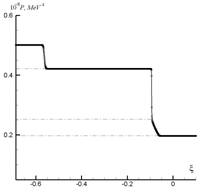
Уравнение состояния субадронного вещества было включено в релятивистские гидродинамические коды [7], разработанные ранее на основе существенно неосциллирующей схемы третьего порядка точности. Результаты моделирования полностью подтвердили выводы теоретического анализа. Кроме того, расчеты показали, что разность между скоростями ударной волны–предвестника и замыкающей волны фазового перехода намного меньше, чем релятивистская скорость вещества. Это означает, что в экспериментах с соударением тяжелых ионов расщепление ударной волны может маскироваться вязкими и неравновесными эффектами, а его идентификация представляется весьма проблематичной. Было также показано, что для используемого уравнения состояния условие нейтральной устойчивости выполняется лишь для ударных волн с конечным состоянием в области смешанной фазы. Однако такие ударные волны не реализуются в связи с их расщеплением. Это означает, что только ударные волны фазового перехода, замыкающие комбинированную волну сжатия, могут быть нейтрально устойчивыми.
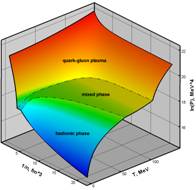
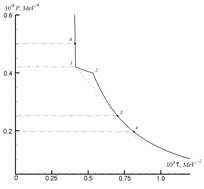
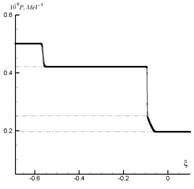
На рисунке показаны фазовая диаграмма ядерного вещества с кварк-адронным фазовым переходом (левая панель), изэнтропа с изломами в точках пересечения с границами смешанной фазы (средняя панель) и комбинированная волна разрежения, образующаяся вместо простой изэнтропической волны (правая панель). Комбинированная волна разрежения состоит из двух изэнтропических волн (“0-1” и “3-4”) и ударной волны разрежения “1-3” между ними. Волна разрежения “0-1” целиком принадлежит фазе кварк-глюонной плазмы, прямая “1-3” является касательной к исходной изэнтропе в точке 3.
LITERATURE
1 Cleymans J., Gavai R. V., Suhonen E. Quarks and gluons at high temperatures and densities, Phys. Reports. , 217-
2. Kontorovich V. M. Stability of shock waves in relativistic hydrodynamics, JETP., 127–
3. Russo G. and Anile A. M. Stability properties of relativistic shock waves: Basic results, Physics of Fluids. 30, 2406-2
4. D'yakov S. P. On the stability of shock waves, JETP., 288-
5. Konyukhov A. V., Likhachev A. P., Oparin A. M., Anisimov S. I., Fortov V. E. Numerical modeling of shock-wave instability in thermodynamically nonideal media, JETP., 811–
6. Bugaev K. A., Gorenstein M. I., Kampfer B., Zhdanov V. I. Generalized shock adiabatics and relativistic nuclear collisions, Phys. Rev. D, Vol, №9, .
7. Konyukhov A. On shocks in a high energy relativistic jets: numerical simulation, In: Physics of Extreme States of Matter-2013, Moscow 2013, 126-129.
ON PROBLEM OF RELATIVISTIC SHOCK WAVE STABILITY IN SUBHADRONIC MATTER
A. V. Konyukhov, A. P. Likhachev
Joint Institute for High Temperatures of RAS, Moscow
The equation of state of subhadronic matter describing the quark-hadronic phase transition has been built using the MIT-bag model variant [1]. The theoretical analysis of the EOS constructed has been carried out to check the fulfillment of the criteria of the instability and neutral stability of relativistic plane shock waves [2, 3]. It has been shown that the Taub adiabats passing through mixed phase have segments with an ambiguous representation of the shock wave discontinuity. The ambiguity is due to the implementation of the first condition of the shock wave corrugation instability L<-1 (the term L has the same meaning as in the pioneering work [4] but with relativistic corrections). Shock waves belonging to such the segments split with formation of composite compression wave [5]. Isentropes passing through mixed phase have kinks and are not convex (in p-t plane, t is dynamic volume) and the appearance of rarefaction shocks or composite rarefaction waves is expected. Such the behavior of shock and rarefaction waves is typical for the media with the phase transition of the first order. This issue for the subhadronic matter has been discussed before in a number of works (see, for instance, [6]).
The EOS built was embedded in the previously elaborated relativistic hydrodynamic codes [7] based on the third order essentially non-oscillatory scheme. The results of calculations have completely confirmed the predictions of the theoretical analysis. Besides, it has been found that the difference between the velocities of the precursor shock in hadronic phase and the shock wave of phase transition is much less than relativistic speed of the matter. It means that in experiments with heavy ion collisions the splitting may be masked by viscid and nonequilibrium effects and the identification of this phenomenon in the real events seems rather problematic. It has been else found that for the equation of state used the neutral stability condition is fulfilled only for shocks with the final state in the mixed phase. However, these shocks are unstable with respect to splitting and are not realized as unique wave. Thus, only the shocks of phase transition being a part of the composite compression wave may be neutrally stable.
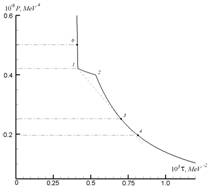
The picture demonstrates the phase diagram of subhadronic matter with quark-hadronic phase transition (left panel), the isentrope kinked in the points of its intersection with the mixed phase boundaries (middle panel) and the composite rarefaction wave formed instead of simple isentropic expansion (right panel). The composite rarefaction wave consists of two isentropic waves (“0-1” and “3-4”) and the rarefaction shock “1-3” between them. The wave “0-1” is completely disposed in the quark-gluon phase; the straight line “1-3” is tangent to the initial isentrope at the point 3.
LITERATURE
1 Cleymans J., Gavai R. V., Suhonen E. Quarks and gluons at high temperatures and densities, Phys. Reports. , 217-
2. Kontorovich V. M. Stability of shock waves in relativistic hydrodynamics, JETP., 127–
3. Russo G. and Anile A. M. Stability properties of relativistic shock waves: Basic results, Physics of Fluids. 30, 2406-2
4. D'yakov S. P. On the stability of shock waves, JETP., 288-
5. Konyukhov A. V., Likhachev A. P., Oparin A. M., Anisimov S. I., Fortov V. E. Numerical modeling of shock-wave instability in thermodynamically nonideal media, JETP., 811–
6. Bugaev K. A., Gorenstein M. I., Kampfer B., Zhdanov V. I. Generalized shock adiabatics and relativistic nuclear collisions, Phys. Rev. D, Vol, №9, .
7. Konyukhov A. On shocks in a high energy relativistic jets: numerical simulation, In: Physics of Extreme States of Matter-2013, Moscow 2013, 126-129.
