

Партнерка на США и Канаду по недвижимости, выплаты в крипто
- 30% recurring commission
- Выплаты в USDT
- Вывод каждую неделю
- Комиссия до 5 лет за каждого referral
ТЕПЛОВАЯ КОНВЕКЦИЯ ВО ВРАЩАЮЩЕМСЯ НАКЛОННОМ ПЛОСКОМ СЛОЕ
,
Лаборатория вибрационной гидромеханики
Пермский государственный гуманитарно-педагогический университет, Пермь
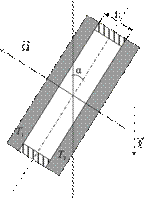
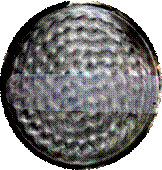
Целью работы является изучение тепловой конвекции в наклонном плоском слое (рис.1), вращающемся вокруг оси, ориентированной перпендикулярно его плоскости. Изучается порог возбуждения конвекции, а также структура надкритических течений (рис.2) в зависимости от угла наклона, разности температур и скорости вращения.
|
|
Рис.1. Схема кюветы. | Рис.2. Конвективные структуры: |

 - температуры границ слоя
 ,
, 
Слой толщиной  с цилиндрической боковой границей расположен на столике, вращающемся с заданной скоростью вокруг наклонной оси. Гидравлический распределитель обеспечивает циркуляцию жидкости от термостатов в теплообменниках. Эксперименты проводятся на воде и водоглицериновых растворах. Скорость вращения варьируется в диапазоне
  об/с. Разность температур на границах слоя варьируется в пределах
  К.
К.
В проведенных экспериментах выделяются два предельных случая расположения слоя, горизонтальный ( ) и вертикальный (
 ). Для горизонтального случая полученные результаты хорошо согласуются с теорией [1] и экспериментами [2]. Повышение безразмерной скорости вращения (числа Тейлора) приводит к расту порога устойчивости. При вертикальном расположении слоя конвекция возбуждается пороговым образом под действием термовибрационного механизма [3].
Изучено влияние угла наклона на возникновение тепловой конвекции и структуру надкритических течений. Обнаружено, что отклонение слоя от горизонтали приводит к стабилизации устойчивости квазиравновесия. Изучен теплоперенос в зависимости от угла наклона слоя, при различных значениях разности температур на границе слоя. Обнаружено, что смена механизмов конвекции, сопровождающаяся изменением структуры и теплопереноса, происходит при  . При меньших углах наклона слоя на смену рэлеевскому механизму конвекции приходит термовибрационный [4]. В этом случае, сила тяжести вызывает колебания неизотермической жидкости в полости и порождает осредненные виброконвективные потоки. Результаты исследования устойчивости квазиравновесия и теплопереноса в надкритической области представлены в зависимости от безразмерных параметров, гравитационного числа Рэлея, вибрационного параметра и скорости вращения. Обнаружено, что возбуждение осредненной термовибрационной конвекции возможно и при
  (подогрев слоя сверху).
Работа выполнена в рамках Программы Стратегического Развития ПГГПУ (проект 029-Ф) при поддержке РФФИ (проект № а) и Министерства образования Пермского края (проект С-26/625).
ЛИТЕРАТУРА.
1. Chandrasekhar S. Hydrodynamic and hydromagnetic stability. Oxford University Press, 19p.
2. Rossbу Н.Т. A study of Benard convection with and without rotation, J. Fluid Mech., 1969, 36, № 2, 309.
3. , , Рылова конвекция в плоском слое, вращающемся вокруг горизонтальной оси // Изв. РАН МЖГ. 2003. № 1. С. 12–21.
4. Козлов тепловая конвекция во вращающихся полостях // Изв. РАН МЖГ. 2004. № 1. С. 5–14.
THERMAL convection in a rotating inclined plane LAYER
K, Y.Risin V. G. Kozlov
Laboratory of Vibrational Hydromechanics
Perm State Humanitarian Pedagogical University, Perm
The aim is to study thermal convection in an inclined plane layer (Fig.1) rotating about an axis oriented perpendicular to the plane. The threshold of convection excitation and the structure of supercritical flows (Fig. 2) depending on the angle of inclination, the temperature difference and the rotational speed are studied.
|
|
Fig.1. Cavity scheme. | Fig.2. convective structure: |


The layer of thickness with cylindrical lateral boundary is located on a table rotating at a predetermined speed around an inclined axis. Hydraulic distributor provides the circulation of liquid from the thermostats in the heat exchangers. Experiments are carried out on water and glycerol-water solutions. The speed of rotation varies in the range rps. The temperature difference at the boundaries of the layer varies in the range K.
In the experiments there are two limiting cases of the layer orientation: the horizontal () and vertical (). For the horizontal orientation (the classical case) the results obtained are in good agreement with the theory [1] and experiments [2]. The increase of the dimensionless rotation velocity (Taylor number) leads to growth of stability threshold. In case of vertical layer orientation the convection is excited in a threshold way by the action of thermovibrational mechanism [3].
The influence of the inclination angle on the occurrence of thermal convection and structure of supercritical flows is studied. It is found that the deviation of layer from the horizon leads to stabilization of quasi-equilibrium. The heat transfer in dependence on the angle of inclination of the layer is studied for different values of temperature difference at the layer boundaries. It is found that the change of the mechanisms of convection accompanied by changes of convective structure and heat transfer takes place at . At lower angles of the layer inclination the thermovibrational mechanism [4] comes to replace the Rayleigh convective mechanism. In this case the gravity causes fluctuations of nonisothermal fluid in the cavity frame and generates the average vibroconvective flows. The results of investigation of the quasi-equilibrium stability and heat transfer in the supercritical region are plotted against the dimensionless parameters: gravitational Rayleigh number, vibrational parameter and dimensionless rotation velocity. It is found that the excitation of average thermovibrational convection is possible at (heating of layer from the top).
The work is done in the frame of the strategic development program of PSHPU (project 029-F), with partial support from RFBR (grant а) and Ministry of Education of Perm region (project S26/625).
ЛИТЕРАТУРА.
1. Chandrasekhar S. Hydrodynamic and hydromagnetic stability. Oxford University Press, 19p.
2. Rossbу Н.Т. A study of Benard convection with and without rotation, J. Fluid Mech., 1969, 36, № 2, 309.
3. A.A. Ivanova, V. G. Kozlov, and V. V. Rylova. Thermal convection in a plane layer rotating about a horizontal axis // Fluid Dynamics. 2003. V. 38. No 1. P. 9–17.
4. V. G. Kozlov. Thermal vibrational convection in rotating cavities // Fluid Dynamics. 2004. V. 39. No 1. P. 3–11.
