

Партнерка на США и Канаду по недвижимости, выплаты в крипто
- 30% recurring commission
- Выплаты в USDT
- Вывод каждую неделю
- Комиссия до 5 лет за каждого referral
Hybrid mesh-less and Cartesian grid method for moving boundary aerodynamic applications
A. Jahangirian* and M. Y. Hashemi**
Department of Aerospace Engineering, Amirkabir University of Technology, Tehran, Iran
(*****@***ac. ir*)
Abstract
A hybrid grid generation method that combines the computational efficiency of the Cartesian grid and the flexibility of the mesh-less strategy is developed for computation of compressible viscous flows with moving boundary applications. The mesh-less zone is created around the geometry by producing layers of nodes along normal direction vectors while Cartesian grid method is used elsewhere. Last layer is used as virtual geometry for automatic generation of unstructured Cartesian grid around mesh-less zone. An efficient central difference scheme with artificial dissipation terms is developed for both Cartesian grid and mesh-less zones. The method is used for computation of flows around stationary and moving airfoils at subsonic and transonic flow conditions. Results indicate good agreements with those of available unstructured finite-volume flow solver (Uns2D) and other reference numerical data.
1. Introduction
The main problem of computational fluid dynamics (CFD) is mesh generation for configurations with complex geometry specially with moving boundaries. The structured grid methods are not efficient for such cases. The main advantage of unstructured grid methods is the facility of grid generation for complex configurations. However, the computational costs and memory requirements are generally higher than their structured grid counterparts. Alternatively, the unstructured Cartesian grid methods can be used that offer ease of grid generation, lower computational storage requirements, and significantly less operational count per cell compared to body fitted curvilinear grids [1]. Embedded and adaptive grids, can also be used to provide better resolution and moving of geometry and flow features in Cartesian grid. However, the main challenge in using this method deals with arbitrary boundaries. As the grids are not body aligned, Cartesian cells near the body can extend through surfaces of solid components. Hence, accurate means of representations for surface boundary conditions are essential for the success of Cartesian schemes.
In this research a hybrid grid generation method that combines the computational efficiency of the Cartesian grid and the flexibility of the mesh-less strategy is developed for computation of the compressible viscous flows over moving boundary applications. The mesh-less zone is created around the geometry by producing layers of nodes along normal direction vectors while Cartesian grid method is used elsewhere. Last layer is used as virtual geometry for automatic generation of unstructured Cartesian grid around mesh-less zone. Since the majority of computational domain is solved using the Cartesian grid method, the resulting procedure is very efficient in terms of both computational cost and storage requirements. In addition, since the mesh-less method is used to obtain the solution for the solid boundary points the developed method can easily be used for complex geometries without need to generate the body-fitted mesh. The Cartesian grid is then adapted to the location of virtual geometries and flow solution to enhance the quality of the results with the minimum computational cost. The Navier-Stokes equations are solved using a cell-centered finite volume scheme in Cartesian grid zone that stabilized by artificial dissipation [2]. Like finite difference method, the mesh-less algorithm is applied directly to the differential form of the governing equations[3]. The least-square discretization is stabilized by artificial dissipation.
An advantage of this approach for unsteady moving boundary problems is that the Cartesian grid is fixed similar to a background grid and the mesh-less zones are moving on top of the Cartesian grid. The Cartesian grid is then adapted to virtual geometry position. Thus the equations of flow are solved in arbitrary Lagarangian–Eulerian formulation in time in mesh-less zone and Eulerian formulation in time in Cartesian grid. The Cartesian grid is adapted to the new virtual geometry and flow solution to enhance the quality of the results with the minimum computational cost. An efficient binary tree data structure is used for generating Cartesian grid.
2. Results
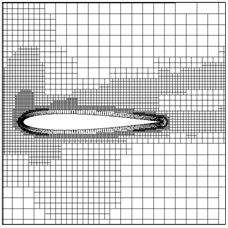
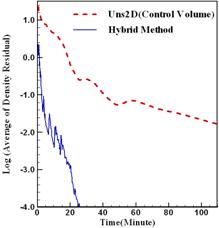
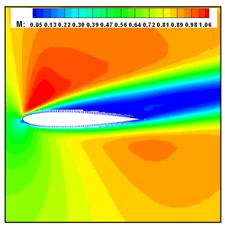
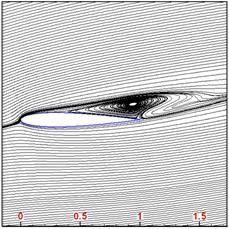
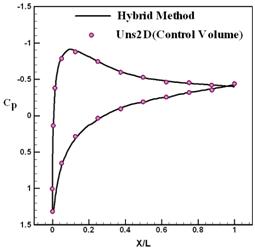
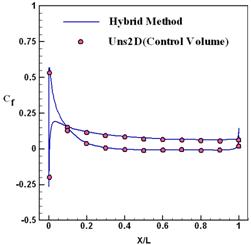
To demonstrate the capabilities of the present method steady and unsteady flow computations are carried out. The first case is the flow around NACA0012 aerofoil at  . A hybrid adapted Cartesian grid with mesh less zone over NACA0012 airfoil are shown in figure (1). The hybrid adapted grid contains 3841 nodes in the mesh-less zone and 8529 Cartesian cells. The triangular unstructured grid that is used for Uns2D flow solver has 26030 cells. The Convergence histories for the new hybrid and fully unstructured control volume (Uns2D) methods are presented in figure (2). As illustrated the computational time is reduced by more than 70% when using the new method compared with the fully unstructured grid finite volume flow solver. Figures (3 and 4) show the Mach number contours and streamlines over the airfoil including a separation zone in the upper surface of the airfoil, respectively. These figures show smooth variation of contours between mesh-less and Cartesian grid zones. The Pressure coefficient and skin friction coefficient distribution over the airfoil are compared with (Uns2D) data in figure (5). The calculated lift and drag coefficients are 0.475 and 0.261 respectively that are again within the range of results reported in ref. [4]. In particular, the separation point for this flow is about 37% of the chord with maximum 1.0% error compared with the numerical results reported in ref. [4].
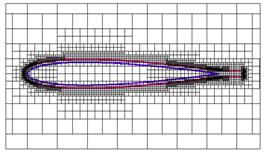
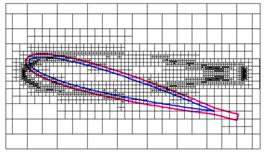
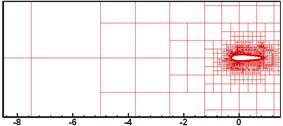
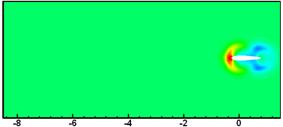
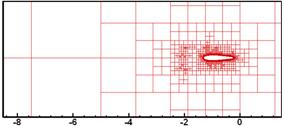
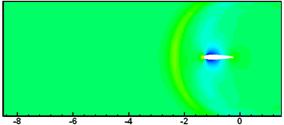
Figure 6 shows the process of geometric adaptation for a rotating NACA0012 aerofoil. A test case to validate the hybrid method is simulation of unsteady around moving NACA0012 airfoil with Mach number 0.5 in the stationary air. For comparison, this problem is also run in the steady mode in which the airfoil is stationary and the air flow has the speed of Mach 0.5. For the simulation of moving airfoil, the grid motion and the pressure contours at different times are shown in figure 7. In figure 8 the pressure distributions along the airfoil surface from both the steady and moving airfoil simulations are compared with each other and data from ref. [5].
Figure 1: Hybrid adapted grid |
Figure2: Convergence history at |
Figure 3: Mach contours around NACA0012 airfoil at |
Figure 4: Streamlines of separated flow around NACA0012 airfoil. |
(a) |
(b) |
Figure 5: a) Surface pressure coefficient distribution and b) Skin friction coefficient distribution for NACA0012 at |
(a) |
(b) |
(c) |
(d) |
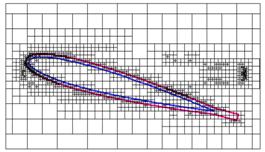
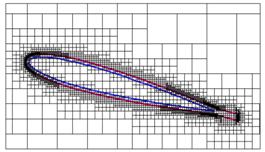
Figure 6: Geometric adaptation of the grid for moving boundaries.
|
| (a) 480 m sec |
| |||
|
| (b) 3200m sec |
|
| ||
|
| (c) 9600 m sec |
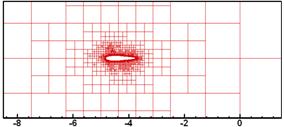
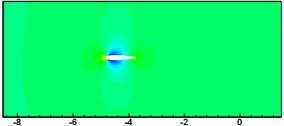
Figure7: Pressure contours and adapted grid for moving boundary solution with Mach number 0.5.
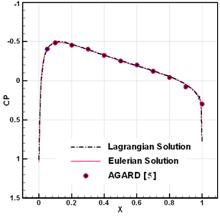
Figure 8: Calculated pcressure coefficient distribution over NACA0012 airfoil by fully Eulerian and fully Lagrangian solution with Mach number 0.5.
References
[1] Aftosmis MJ., 1999. Solution Adaptive Cartesian Grid Methods for Aerodynamic Flows with Complex Geometries. Von Karman Institute for Fluid Dynamics, March 1997, Lecture Series 1997–02.
[2] Jahangirian A., Y. Shoraka, 2008. Adaptive unstructured grid generation for engineering computation of aerodynamic flows. Mathematics and Computers in Simulation. 2008;78:627–644
[3] Hashemi Y., A. Jahangirian, 2009. Implicit Fully Mesh-Less Method for Compressible Viscous Flow Calculations, 14th International Congress on Computational and Applied Mathematics (ICCAM2009). 29 September - 2 October, Antalya, Turkey.
[4] Grasso F., A. Jameson, L. Martinelli, 1985. A Multistage Multigrid Method for the Compressible Navier-Stokes Equations. A GAAM-Workshop on Numerical Simulation of Compressible Navier-Stokes flow, Edited by: M. Bristeau, R. Glowinski, J. Periaux and H. Viviand, Nice, France.
[5] AGARD Fluid Dynamics Panel, pendium of Unsteady Aerodynamic Measurements. AGARD, R -702.
