

Партнерка на США и Канаду по недвижимости, выплаты в крипто
- 30% recurring commission
- Выплаты в USDT
- Вывод каждую неделю
- Комиссия до 5 лет за каждого referral
Principles of Macroeconomics
Morgan Community College
Test #1
Answer Key
Name:
Please choose the best answer. Mark your answer by bolding the text.
Multiple Choice – 2 pts. Each (20 pts. total)
1. The opportunity cost of attending college is:
a. The money one spends on college tuition, books and so forth
b. The highest valued alternative one forfeits to attend college
c. The least valued alternative one forfeits to attend college
d. Equal to the salary one will earn when one graduates from college.
2. Ceteris paribus means:
a. all other things held constant
b. the correct relationship specified
c. Assuming economics motives
d. One more
3. A decrease in resources
a. Shifts the production possibilities curve inward
b. Shifts the production possibilities curve outward
c. Moves the economy up a given production possibilities curve
d. Moves the economy down a given production possibilities curve
4. Each of us taking on the job that we’re best at is an example of:
a. Socialism
b. Diminishing marginal utility
c. Entrepreneurship
d. Specialization
5. Oil is discovered under you Aunt Janie’s property. An economist would consider this which type of resource?
a. Labor
b. Capital
c. Land
d. Entrepreneurship
6. An economist would consider a “rubber chicken molding machine” to be which type of resource?
a. Land
b. Labor
c. Capital
d. Entrepreneurship
7. A point lying outside of a production possibilities curve represents a level of production:
a. Attained with full employment and full productivity
b. That can’t be reached with the resources currently available
c. Limited by unemployment or inefficiency
d. Attributed to a third type of good
8. Assume an economy is operating at some point on its production possibilities curve which shows yo-yo’s and soccer balls. If the output of soccer balls in increase, the output of yo-yo’s:
a. Must decrease
b. Must increase
c. May increase or decrease
d. Will remain the same
9. If the United States has a comparative advantage in the production of wheat when compared to the country of Egypt, then:
a. In the US, the opportunity cost of producing wheat is higher than in Egypt.
b. In the US, the opportunity cost of producing wheat is lower than in Egypt.
c. Neither the US or Egypt should specialize only in the production of wheat.
d. The US will export all of its wheat.
10. Economists tend to look at decisions on the margin. Why?
a. Economics is focused on the theoretical “big picture”
b. Individuals & businesses can look at each decision they make incrementally; as “one more”
c. Marginal decisions may result in the maximization of utility
d. They study information recorded in the margin of the text
Short Answer (16 pts. Total)
11. What is the difference between macroeconomics and microeconomics? (4 pts.)
Microeconomics is the study of choices made by individuals and businesses and the impact that those choices have on individual markets
Macroeconomics studies choices and their impacts on the aggregate, or total, level for an economy.
12. What are the three fundamental economic questions that must be answered as a result of scarcity? Describe why these questions are important in relation to the scarcity issue.(6 pts.)
1). What should be produced? Using scarce resources will require the production of 1 thing to be given up in order to produce another thing with the same resources.
2). How should goods and services be produced? Employing skilled/unskilled workers, produce foreign/domestic, use recycled/raw materials etc.
3). For whom should goods and services be produced? If the good or service is produced for a certain group that means another will have to give it up or it won’t be available to them.
13. What two (2) criteria must be satisfied to consider a resource as capital? (2 pts.)
1) Resource must have been produced
2) Resource can be used to produce other goods & services
14. Do all economies operate on the production possibilities curve? If no, where do they operate? Inside or outside of the production possibilities curve? (2 pts.)
No, if they aren’t operating on the PPC, they must operate inside of it. Points on the outside of the PPC aren’t’ possible at that given level of resources.
15. Define scarcity and explain how it is important to economics. (2 pts.)
Scarcity is the condition of having to choose between alternatives. It is a fundamental condition of economics because economics is the study of choices and alternatives.
Applying Concepts - Graphs (8 pts. Total)
Draw the graph and explain (in words) what is happening to the curve.
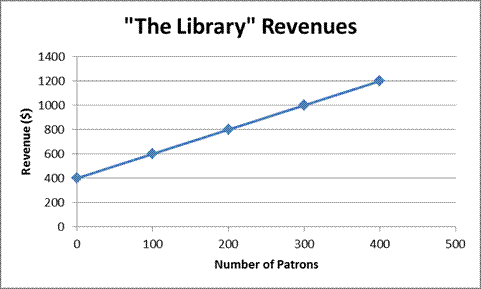
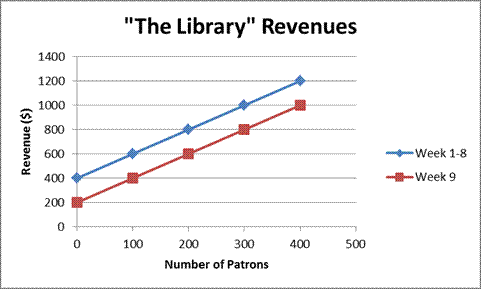
The hotel management class runs a restaurant, “The Library” throughout the semester. The students’ final grade is dependent on “The Library’s” success. The hotel management department gives “The Library” $400 per week for the first 8 weeks of the semester, the remaining weeks “The Library” receives only $200 per week from the department.
This semester the class made “The Library” a buffet where students pay per lb. of food purchased. “The Library” charges $2 per lb. of food from the buffet. The average patron eats 1 lb. of food per visit.
16. Using the table above, construct a graph of revenue for “The Library”. Assume that this graph is showing revenue from the first 8 weeks.
17. What will happen to the curve in Week 9 of the semester?
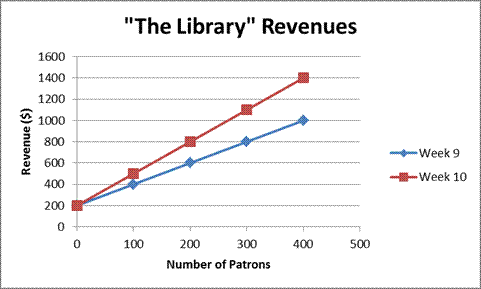
18. What would happen to the curve if, in Week 10, the price per lb. was increased to $3.
19. What is the slope of the curve in:
a. Week 1: (800-600)/(200-100) = 2
b. Week 9: (800-600)/(200-100) = 2
c. Week 10: (800-500)/(200-100) = 3
20. What is the
a. Dependent variable: Revenue
b. Independent variable: Number of Patrons
Applying Concepts (8 pts. Total)
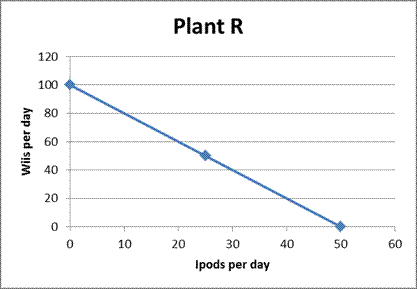
Suppose a manufacturing firm is equipped to produce Ipods and Wiis. It has two plants, Plant R and Plant C, at which it can produce these two goods. Given the labor and capital available at both plants, it can produce the combinations of the two goods at the two plants shown below.
Output per Day, Plant R | ||
Combination | Wii | Ipod |
A | 100 | 0 |
B | 50 | 25 |
C | 0 | 50 |
Output per Day, Plant C | ||
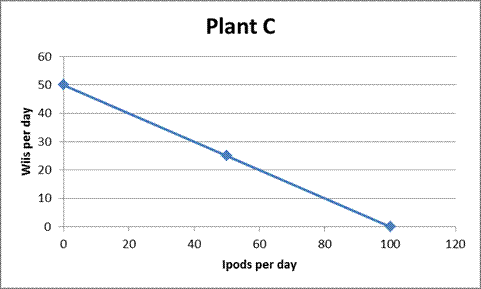
Combination | Wii | Ipod |
D | 50 | 0 |
E | 25 | 50 |
F | 0 | 100 |
21. Put the Wiis on the vertical axis and the Ipods on the horizontal axis. Draw the production possibilities curve for Plant R. on a separate graph, draw the production possibilities curve for Plant S.
Production Possibilities Curve for Plant R
Production Possibilities Curve for Plant C
22. Using the information above, which plant has a comparative advantage in Wiis?
Plant R
23. Which plant has a comparative advantage in Ipods?
Plant C
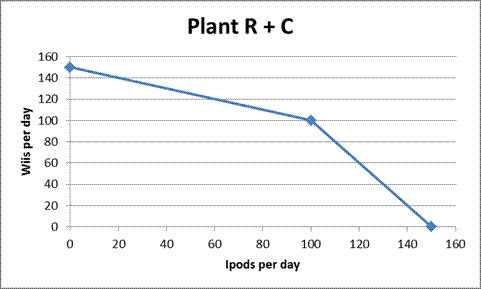
24. Now draw a graph that shows the combined production possibilities curve for both Plants.
Combined Production Possibilities Curve; Plant R & C
25. If the firm produces 100 Ipods, which plant would they produce them at?
If the firm went from producing 150 Wiis and 0 Ipods to producing 100 Ipods, they would produce Ipods at Plant C.
26. How many Wiis would the firm be able to produce at the same time?
The firm would be able to produce 100 Wiis at the same time.
27. Which plant would produce the Wiis?
Plant R
Bonus: (5 pts.)
What war did the Treaty of Ghent end?
War of 1812
