

Партнерка на США и Канаду по недвижимости, выплаты в крипто
- 30% recurring commission
- Выплаты в USDT
- Вывод каждую неделю
- Комиссия до 5 лет за каждого referral
3.5 AR No. 005 – Repair Leaks in the Compressed Air System ARC 2.4236.2
Observation
During the assessment the IAC team noticed air leaks throughout the facility. Air leaks can cause unwanted drops in system pressure, shorten the life of all supply system equipment and cause the compressor to run for longer periods of time, thus, causing unwanted energy use.
Recommendation
Repair leaks in the compressed air system. A non-leaking system will reduce energy usage and cost associated with operating the air compressor. Implementation costs are calculated as leak repair of piping system.
 Our team could not obtain an air leak decay test from the plant, because the plant is unable to perform a scheduled plant shutdown. To estimate the potential savings, we assume a 20% pressure drop over 3 minutes, based on plants of similar size. During the 3 min (180 sec) test, pressure dropped from 122 psig to 97.6 psig. The air system in this plant consists of three 50 hp rotary screw compressor with a 300-gallon accumulator. The volume of the piping consists of 325 ft of 2-inch diameter pipe.
Calculations
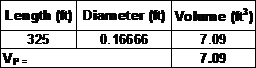
Calculations to find the volume of the air system:
Vp = π/4 ´ d2 ´ l
Va = 300gal. ´ 1 ft3 / 7.48 gal
Va = 40.11 ft3
Vs = Vp + Va
Vs = 7.09 ft3 + 40.11 ft3
Vs = 47.20 ft3
Where
Vp = volume of piping, [ft3]
Va = volume of accumulator, [ft3]
d = diameter of piping, [ft]
l = length of piping, [ft]
Vs = total volume of air system, [ft3]
Calculations to get from 122 psig to 97.6 psig:
Mass of air in accumulator and piping at atmospheric pressure:
M1 = Vs ´ D1
M1 = 47.20 ´ 0.075
M1 = 3.54 lbm
Where
D1 = density of air at atmospheric pressure, [lbm/ft3]
M1 = mass of air in system at atmospheric pressure, [lbm]
Mass of air in tank at 122 psig:
D2 = (P2 + Po) / (P1 + Po) ´ D1
D2 = (122 + 14.7) / (0 + 14.7) ´ 0.075
D2 = 136.7 / 14.7 ´ 0.075
D2 = 0.697 lbm/ft3
M2 = D2 ´ Vs
M2 = 0.697 ´ 47.20
M2 = 32.90 lbm
Where
Po = atmospheric pressure correction, [psia]
P1 = gauge atmospheric pressure, [psig]
P2 = gauge working pressure, [psig]
D2 = density of air at 122 psig, [lbm/ft3]
M2 = mass of air in system at 122 psig, [lbm]
Mass of air in tank at 97.6 psig (after 3 minutes):
D3 = (P3 + Po) / (P1 + Po) ´ D1
D3 = (97.6 + 14.7) / (0 + 14.7) ´ 0.075
D3 = 112.3 / 14.7 ´ 0.075
D3 = 0.573 lbm/ft3
M3 = D3 ´ Vs
M3 = 0.573 ´ 47.2
M3 = 27.05 lbm
Where
P3 = gauge pressure @ 3 minutes drop, [psig]
D3 = density of air at 97.6 psig, [lbm/ft3]
M3 = mass of air in system at 97.6 psig, [lbm]
Mass flow rate for the decay test of the total compressed air system:
MF = ((M2-M3)/ T)
MF = ((32.90 – 27.05) / 180)
MF = 0.033 lbm/sec
Where
T = time from 122 psig to 97.6 psig, [180 sec]
Energy Savings (ES)
ES = {MF ´ CP ´ Ta ´ H ´ K1 ´ K2 ´ [(PL /PI)g - 1/g – 1]} / (EA ´ EM)
ES = {0.033 ´ 0.24 ´ 520 ´ 8,760 ´ (1/3,412) ´ 3,600 ´
[(136.7 / 14.7)(/1.4 – 1]} / (0.82 ´ 0.916)
ES = 45,156 kWh/yr
Where
CP = specific heat of air, [0.24 Btu/lbm-°R]
Ta = temperature of line air, [520 °R]
H = annual operating hours of compressors, [365 ´ 24=8,760 hrs/yr]
K1 = conversion factor, [1 kW / 3,412 Btu]
K2 = conversion factor, [3,600 sec/hr]
PL = line pressure, [136.7 psia (122 psig)]
PI = atmospheric pressure, [14.7 psia]
ץ = specific heat ratio, [1.4] no units
EA = air compressor isentropic efficiency, [82%]
EM = motor efficiency, [91.6%]
Energy Cost Savings (ECS)
ECS = ES ´ CE
ECS = 45,156 ´ 0.06581
ECS = $2,971.72/yr
Where
CE = cost for electricity, [$0.06581/kWh]
Fees Cost Savings (FCS)
EFCS = ECS ´ TRE
EFCS = 2,971.72 ´ 0.038
EFCS = $112.93 /yr
Where
TRE = tax rate on electrical consumption, [3.8%]
Cost Savings (CS)
The cost savings associated with eliminating the air leaks are computed below:
CS = ECS + FCS
CS = 2,971.72 + 112.93
CS = $3,084.65 /yr
Implementation Cost (IC)
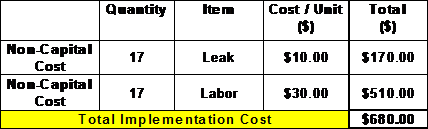
The following implementation costs are assumed for 17 air leaks (note: number used only for manpower calculations – not the exact number of leaks) and labor of 1 hour per leak. Assume that the company will utilize two people for one week with total plant overhead being $30.00/hour. In addition, a miscellaneous cost for materials ($10 per leak) is considered to repair each leak.
NL = 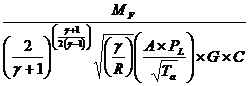
NL = 
NL = 17
Where
NL = total number of leaks in the system
MF = mass flow rate, [lbm/sec]
R = gas constant for air, [ft2/(s2 - ºR)]
A = cross-sectional area of leak, [in2]
PL = line pressure, [psia]
Ta = temperature of line air, [°R]
G = conversion constant, [ft/s2]
C = discharge coefficient for a square-edge orifice, constant
Payback
Payback = IC / CS
Payback = 680.00 / 3,084.65
Payback = 0.22 yrs (2.6 months)
