


Партнерка на США и Канаду по недвижимости, выплаты в крипто
- 30% recurring commission
- Выплаты в USDT
- Вывод каждую неделю
- Комиссия до 5 лет за каждого referral
§ I find it really….(interesting / awful….) / It looks a bit……(strange / difficult…)
§ It makes me….(angry/ worried / smile / want to…..)
6. Как сделать выбор
§ I prefer…..to……./ I’d rather …..(do/have…) than…/ I’d rather we had……than……/ I much prefer………/ I wouldn’t mind +Ving
§ I find it really….(interesting / awful….) / It looks a bit……(strange / difficult…)
7. Как высказать мнение
§ It’s very difficult to say, but I think……/ What I mean is……/ In my opinion…..
§ It’s not something I feel very strongly about, but………
§ Actually I feel quite strongly that……./ I’m quite certain that………
§ Personally, I feel…/ think…/ suppose…/ guess…
§ I’ve never really thought about it, but I suppose…/ I don’t really like…but if I had to choose….
§ I think it’d be better if…./ I think we should…
8. Как прийти к обоюдному согласию
§ Neither of us liked…………/ So that was the conclusion we reached:……………
§ What have we decided then? / So, let’s decide which one……… / OK, so which (two) are the best?
§ I think we’ve agreed that…….. / So, we’ve decided………
§ Well, I chose……../ We both agreed that………/ N. was in favour of…..but I thought…….
Task2. Choosing a way of travelling" – a 3-4 minute talk (Модулированная ситуация)
You are staying with your friend who lives in the UK. You would like to travel across the country together. Discuss the following options and choose one kind of transport that appeals to both of you:
* train *ship *bicycle * car
Remember to:
· Discuss all the options
· Take an active part in the conversation and be polite
· Come up with ideas and give good reasons
· Find out your friend's attitudes and take them into account
· Invite your friend to come up with suggestions
· Come to an agreement
A Help!
- | + | |
Train | They travel too fast, so we won’t be able to see much. We’ll have to change trains. Some trains aren't very comfortable and if you sleep on the upper berth, you may be afraid of falling down. Sometimes the neighbours in the compartment are unpleasant and very talkative. | It's not expensive. You cab buy a return ticket and spend the rest of your money on other things. We’ll be able to see much as trains cover very long distances. Trains in the UK are very comfortable. They are always on time. There are no traffic jams. |
Ship | A cruise holiday can be too expensive for us. There is usually nothing much to see in the ports. Young people may feel lonely and get bored. You may be sea-sick. You have to follow a strict time-table and are not able to explore places as much as you'd like. | I think it’s the most comfortable and relaxing way of traveling. We’ll be given a chance to see many different sights at each port within a short time. We don’t have to worry about travel arrangements during the trip and we can spend all day sunbathing and swimming. Many ships have swimming pools. |
Bicycle | We’ll never be protected from weather (sunny or rainy). It’s very tiring. We can’t take much luggage with us. It's dangerous as a cyclist can be knocked over. It's not good for long trips. | It’s a well-balanced combination of rest and exercise. It’s very economical. We’ll be able to stop where we want. It's environmentally friendly. We are not afraid of traffic jams. |
Car | We can get into traffic jams on motorways and that’s very stressful. I always get tired of sitting in a chair for a long time. I get sick travelling long distances. Petrol is expensive. It's difficult to find a parking lot. | Travelling by car is safer and more comfortable than walking. We don’t have to look for a seat. We can leave when we want and we can stop when we want, we don't depend on time table. We can take more luggage. |
Подготовительные упражнения для совершенствования навыков диалогического высказывания
Exercise 1. Как реагировать на реплики? Отреагируйте на различные высказывания.
I'm interested in taking a holiday abroad. Could you tell me what holidays are on offer?………….. I hate packed holidays - too many excursions…………… It's too crowded there and we wouldn't feel comfortable ………………………. Well, what do you think about travelling by ship. I think that it would be fun………… Well, I still doubt it would be nice to travel by car……….. Our friends would enjoy the view of these buildings. What do you think of it? It's dangerous as a cyclist can be knocked over. It's not good for long trips…………… Trains in the UK are very comfortable and they are always on time……….Exercise 2. Как выразить согласие / несогласие на просьбу? Прочитайте следующие предложения и ответьте на них согласием и несогласием.
1. Cooking meals over the fire is great fun. Agree: / Disagree:
2. Travelling by car is safer and more comfortable than walking. Agree:/Disagree:
3. Sometimes the neighbours in the compartment are unpleasant and very talkative. Agree:/ Disagree
4. Travelling by train is more economical than travelling by taxi. Agree:/ Disagree
5. The best way of spending your holiday is in Spain. Agree:/ Disagree
Exercise 3. Как внести предложение и как сделать выбор? Выскажите своё мнение.
You are discussing with your friend where to go in summer. You have some options:
Spain, Bulgaria, Canada, England, Scotland, Italy, Egypt, Africa, North Pole, Japan.
Работа в парах По очереди выдвигайте предложение и делайте выбор где провести лето, используя фразы:
1. Why don't we… How about… Do you want to… Do you feel like…Would you like to… Do you think we should … What do you think of… Do you fancy…
2. I …….if we should……. Maybe the best…….would be to…… What do you think……? I think the ……thing might be to… I'm not……..I agree, to be honest……… I'm not convinced it's a good…….because….
Exercise 4. Как закончить диалог? Прочитайте высказывания одного участника разговора и подберите подходящую реплику партнёра.
Excuse me, could you tell me where School #45 is?...................... Excuse me, is it possible to buy postcards here? ……………… Do you happen to know when the supermarket closes? …………… Could you tell me where I can find a police station? ……………… ………………….There are two planes to London on Saturday –at 2.30 and 8.00 …………………. It's about 20 minutes by bus and 10 minutes by taxi. …………………...We have classes from 9 a. m. to 1 p. m. and some optional classes after lunch.Exercise 5. Как составить диалог? Прочитайте эти фразы и составьте короткий диалог.
Travelling by…….would be a good idea because…………… One thing we should remember is that……… Personally, I suggest………because……… One advantage of traveling by……is…………. In my opinion, the way to……………. Maybe the best………would be…….. I think it's not a good idea……because……. I wonder…………….if we should………. I'm not convinced it's a good idea………..because………. Let's think about………..
Организация контроля диалогической речи ( в плане обмена опытом)
Экзамен по иностранному языку в 9-м и в 11 классах ставит своей целью проверку уровня сформированности коммуникативной компетенции учащихся в говорении (в двух формах: монологической и диалогической ). Сейчас в книжных магазинах появилось много литературы по подготовке учащихся к сдаче ЕГЭ. Все они, как правило, предлагают готовые задания для учащихся в виде "топиков" или ситуаций для монологических высказываний, а подготовка учащихся к диалогическому высказыванию остаётся за кадром.
Учить учащихся тематически высказываться можно индивидуально, в парах, в группах ( более подробно см. Т. Киреева "Системный подход к подготовке учащихся е единому государственному экзамену" Английский язык №3 2006)
При обучении диалогу большое значение имеет обучение спонтанному реагированию на реплики партнёра. Естественно, диалог не может звучать вне тематической ситуации. Источником порождения диалогической речи может быть тематическая ситуация, основанная на программе школьного курса, (например, « В магазине», «Разговор по телефону» и т. п.) или на свободном общении ( интервью, дискуссия, диспут). Диалог может быть подготовленным дома, в классе же проводится контроль подготовленной речи постоянных пар. Диалог может быть частично подготовлен дома, но контроль проводится в классе со сменными парами. И наконец, высший пилотаж - когда диалог проходит спонтанно, с незнакомым партнёром.
Любой диалог проходит три стадии:
|
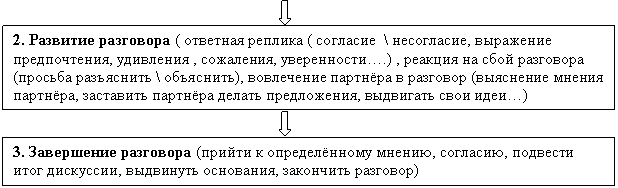
Сначала необходимо закрепить в речи «речевые образцы» по всем трём стадиям диалога.
1) Initiating / Focusing
§ There are several possibilities for…. / So, we have to……. / Let’s talk about……first, shall we?
§ Let’s see what the good points are / I think we will (would) need to ….so…
§ What do you think? / Do you think we should…..? / What shall we do first?
§ What’s your opinion? / What about you? / Do you agree? / And what else?
2) Polite Requests
§ Can I ask you a personal question? – Of course, go ahead / Would you mind if I ask you…..
§ I’d also like to know some information about……. / Could you tell me about……..?
§ Could I have a …..( receipt) ? / Do you think I could have…?
§ Could you take this….. to…., please? / Would you mind +Ving? / Is it all right if …..?
§ Could you possibly……. ? / Would it be possible to ………?
§ OK / Yes, sure / Yes, certainly / Yes, of course / Yes, I’ll do that / I’m sorry, but…..
§ Excuse me. Could you……., please? – Yes, certainly.
§ Thank you. – You’re welcome.
3) Making Suggestions / Discussing Suggestions / Giving Opinion
§ Why don’t we do this? / How about …+Ving? / What about…+ Ving?
§ Let’s do this / Let’s decide about…first, shall we?
§ What do you think…? / Do you think we should…?
§ Perhaps we should… / What shall we do first? / So, what do you think we should do……..?
§ How do you feel about this?
§ It’d be a good idea if we… / What would be really great is if we… / It’s about time we… That’s a good idea / Surely, it’d be better…
§ OK, let’s do that / OK. Why don’t we both do that?
§ That sounds like a good idea / That’s a great idea / I think the best thing to do would be to… / It would be a good idea to…/ I’ve got a good idea…/ I’ve got a better idea ……./ That sounds a bit boring…/ I don’t think that’s such a good idea because……..
§ Personally, I’m not that keen on…/ You know, it’s not really my thing / Don’t you think……? / And, to be honest…./ That’s not the point
4) Agreeing / Disagreeing
§ That’s a good point / I absolutely agree / You’re right / That’s true / Yes, but…..
§ I’m afraid you’re wrong / I see what you mean, but don’t you think………. ?
§ I don’t think I would go along with that / Yes, but isn’t it also true that……..?
§ That sounds like a good idea / I’m not sure about that
5) Expressing Feelings / Likes and Dislikes
§ Wow! / Really! / Goodness! / What a surprise!
§ I (really) like/ enjoy / love / I really like doing that too / I’m not keen on…/ Oh dear. What a pity / Never mind I don’t like………. / I can’t stand……….. / I hate…….
§ I find it really….(interesting / awful….) / It looks a bit……(strange / difficult…)
§ It makes me….(angry/ worried / smile / want to…..)
6) Making Choices
§ I prefer…..to……./ I’d rather …..(do/have…) than…/ I’d rather we had……than……/ I much prefer………/ I wouldn’t mind +Ving
§ The thing I like best is………./ I don’t think I’d like to ……..
§ I find it really….(interesting / awful….) / It looks a bit……(strange / difficult…)
7) Offering and expressing opinion
§ It’s very difficult to say, but I think……/ What I mean is……/ In my opinion…..
§ It’s not something I feel very strongly about, but………
§ Actually I feel quite strongly that……./ I’m quite certain that………
§ Personally, I feel…/ think…/ suppose…/ guess…
§ I’ve never really thought about it, but I suppose…/ I don’t really like…but if I had to choose….
§ I think it’d be better if…./ I think we should…
8) Developing the discussion
§ I’d like to add something to what you / I just said………
§ There’s another thing I wanted to say…….
§ The good / bad thing is……./ One advantage / disadvantage is……/ On the other hand…….
9) Speculating
§  It could be…./ might be…/ might have been…/ must be…/ can’t be…
§ I think… Probably…. Perhaps…
 this would be good for ……….
 this might not help in the situation / this could cause problems
§ I get the impression that …………/ I would imagine …….. / I would guess ………
§ It’s hard to say, but I think… / It seems to me that…/ It looks like a…./ It looks as if it’s…
10) Summarizing and Reporting a decision / Coming to a conclusion
§ So, shall we say……..? / I think we’ve agreed that…….. / So, we’ve decided………
§ What have we decided then? / So, let’s decide which one……… / OK, so which (two) are the best?
§ Well, I chose……../ We both agreed that………/ N. was in favour of…..but I thought…….
§ Neither of us liked…………/ So that was the conclusion we reached:……………
Предлагаемые экзаменационные билеты носят примерный характер и могут быть использованы в качестве основы при разработке экзаменационных материалов с учетом образовательной программы данной школы. Диалогические умения предлагается проверять в ситуации общения ( в режиме: Учитель-Ученик; Ученик-Ученик).
Card 1
You decided to take a language course. Telephone the secretary and ask about:
· location
· length of the courses available / schedule
· course fees
· accommodation
· details of the admission and social programme
Remember to:
· be active and polite
· ask all the questions
· decide if this Language School suits you
A Help!
Student | Teacher |
Инициирование разговора · Hello. I’d like to do a course at this school. Can you give me some information? · Hello. I’d like some information on ….. · Hello. I’m interested in courses for learning English. · I want to improve my English speaking skills. Could you give me some information about your courses? | · Hello, school ……. Can I help you? · Of course. What would you like to know? · Certainly. What exactly are you looking for? |
Развитие разговора · What courses are available? · Could you tell me what….is like? · First of all, when does …….start? · When do the lessons begin/ finish? · How long does the class last? Do you know how long it takes? How long does the course take to finish? · And on which days are the lessons? · And what time are the classes? · And how much do the courses cost? Do you have any price rebates for schoolchildren? · Do we have to pay an enrolment fee? · One more thing. Could you send me an application form, please? What else do I need to have?
| § We’ve got two courses, Learn English (for beginners) and Real English (intermediate level) § It teaches you all the grammar. It also comes with a CD so that you can hear people speaking English. § Well, the course begins …. ( December 1st) and goes through to ……(May 12th) § We have… lessons a day. Students go to school 5 days a week. § It takes about eight months to finish the course. § You can choose to enrol for the Monday and Wednesday classes or attend Tuesday and Thursday classes. § Again you have a choice. Either 3.00 to 5.00 or 5.30 to 7.30. § They are £150. No/Yes. § Certainly, if you’ll just give me your name and address…… |
Завершение разговора § OK. I’ll take…..(make choice) § Thank you. / Thank you very much! Goodbye.
| § So, have you decided? Would you like me to put your name down for this course? Which day would you like? § That’s fine. I hope to see you on…….(Monday) § You’re welcome. |
Card 2.
You and your friend are thinking of where you could go for a Sunday morning. Discuss with your friend all the options and choose one you both like most of all.

|
Из за большого объема этот материал размещен на нескольких страницах:
1 2 3 4 |
