

Партнерка на США и Канаду по недвижимости, выплаты в крипто
- 30% recurring commission
- Выплаты в USDT
- Вывод каждую неделю
- Комиссия до 5 лет за каждого referral
EVOLUTIONARY READING OF MAX WEBER'S ECONOMIC SOCIOLOGY: A REAPPRAISAL OF 'MARX-WEBER PROBLEM'
Kiichiro YAGI
Graduate School of Economics, Kyoto University, Yoshida-Honmachi, Kyoto, JAPAN
E-mail: *****@***kyoto-u. ac. jp
Abstract
Worrying about the prevailing view of Max Weber with the bias of intellectualism, the author explores the possibility of an evolutionary reading of Weber. He finds that an evolutionary scheme is conceivable in Weber's discussion of diversified concepts of 'rationality.' Though Weber rejected evolutionism with the reason that 'selection' cannot explain the emergence of new social relations, Weber's whole work forms an evolutionary view of the world history based on the interaction of economy and culture. However, an idealistic value theory as well as the lack of 'population thinking' hindered Weber from becoming an evolutionary scholar. The author believes that an evolutionary reading of Weber has an advantage also in the reappraisal of 'Marx and/or Weber' discussions.
Keywords: interpretative sociology, rationality, selection, Marx-Weber problem, evolutionary scheme, social economics
1. Marx-Weber Problem in Japan
To some generations of the post-1945 social scientists in Japan, Karl Marx and Max Weber were special figures that provided them with themes and methods of the research. The interest in Marx and Marxism was revived immediately after the collapse of militarist government and acquired an overwhelming influence in social sciences soon. As the diffusion of modern economics and other social sciences, which had been developed mainly in Anglo Saxon world during the years of Japan's isolation, lagged behind it considerably, it was Max Weber and his works that many academicians adopted to defend themselves against the influence of Marxism.
Naturally, Marxists criticized Weber in charge of his idealistic position and the arbitrary nature of his value theory. However, a group of influential scholars, whose representative figure was Hisao Otsuka, economic historian of the University of Tokyo, took the position that Weber's works illuminate the nature of modern economic society together with the works of Marx.[1] This group admitted general dominance of material interests over historical development, but followed Weber in respect to the switching role of ideas in the selection of development path of the history. Such a reconciling position was called often 'Marx and Weber' position in contrast to the 'Marx or Weber' position that demanded the researchers their exclusive commitment.
This reconciling position coincided with the reading of Marx's works as a self-criticism of the modernity from the viewpoint with of idealized modern civil society. The well read Japanese translation of Karl Lövith's article "Max Weber und Karl Marx" contributed to the diffusion of similar position among Japanese academics. For the researchers from economics, sociology, political science to history and ethics, the 'Marx and/or Weber' problem was a crossroad where researchers of various backgrounds could meet and exchange their views on methodology and general frame on the common ground of the works of two great scholars.[2]
At present, since the waning of the influence of Marxism in academism became apparent in the mid of nineteen-eighties, the debate of 'Marx-Weber Problem' has been dead long already. Particularly in economics, most contemporary theoreticians don't read Weber at all; they know the name of Weber only as a sociologist. However, I think it worth for a modern evolutionary institutionalist like me to revisit it, particularly when the interest in economic sociology is rising.[3] It might be a rich heritage from which we can draw valuable insights as well as lessons to avoid confusions.
Though I wrote that the 'Marx-Weber Problem' has died long, still, I have the impression that an intellectualistic trait, which in my view is closely related to a biased view of 'Marx-Weber Problem', lingers in contemporary social and human sciences in Japan. This might be one of the elements that hinder the diffusion of evolutionist ideas in academics. According to usual understanding of Weberian methodology, an 'ideal type' is constructed from the 'relations of meaning' of action and the 'value' that guides the research is given externally. The political orientation depends on the personal choice of value that resides out of the research. Thus, the task of researchers is confined to the construction of 'ideal types' and the recognition of the distance of the reality from them. This separation between reality and idealized concepts fitted well to the mentality of those social scientists that wished to protect the value of modern civil society despite all countervailing facts in the development of the society in Japan. In case of Max Weber, as well as in the case of the first generation of post-1945 Japanese social scientists, an ardent interest in social problems and policy matters was presupposed. Without a serious interest in real life and praxis in it, 'the struggle among gods (values)' will fall into an intellectual game. The research that has lost the strain of praxis tends to a sort of trivialism, however it is intellectually refined. If this guess is correct, a criticism of intellectualist interpretation of Weber can be also a criticism of modern academician in Japan.
An evolutionist like me doesn't deny an 'ideal type' theoretical construction in general, but holds the view that the interactions of heterodox agents and the path-dependent changes are not easy to approach with the construction of isolated types. The insight drawn from the reflections on 'ideal type' theory should be treated as a partial interpretation of the dynamic process of interaction of heterogeneous actors and ever changing environmental conditions. The 'unintended outcomes' of social interaction or the emergent property of social process is what the evolutionists focuses their attention.
On the other hand, evolutionists in social sciences reject the primacy of politics over the research as well as the claims of evaluation and praxis from external values. To them, values and politics are endogenous factors in the social life of human beings. In this respect, evolutionists are more close to Marx than Weber, though they are against the deterministic thought of historical materialism. Avoiding the risk of falling into policy nihilism, evolutionist researchers should be conscious of the meaning of their research in the present reproduction process of the society and not to hesitate to be involved in the arena of public policy questions.
In this article, I would argue that evolutionism is not totally foreign to Weber's theoretical position and propose an evolutionist turn of the (revived) 'Marx-Weber Problem' to recover the bridge between the history and theory in social sciences.
2. Max Weber and Evolutionism
2.1. Functionalism, Intellectualism, and Evolutionism
What I call with the term of 'intellectualism' is the position that focuses the attention on the meaning of action that is thought in the consciousness of actor or is reconstructed as such by the researcher and constructs the explanation of the social process from the relation of such meanings. This view of Weber's methodology is grounded by his concept of 'action' and 'social action'[4] and his view of theoretical analysis as the construction of 'ideal types.' This trait is named also as 'rationalism' or 'methodological rationalism,' since Weber chose the rational action with a clear relation of purpose and means (action oriented to 'instrumental rationality') as the initial cannon of the explanation. Further, in respect to the focus on the significance of 'ideal elements' conveyed by the actor, Parsons' term of 'voluntaristic theory of action' hits very near to my use of 'intellectualism.' [5]
The question is whether this view of Weber is the only one reading of his works. Is an evolutionary reading is totally foreign to Weber's methodology and his work? I think not.
This question emerges with the recognition of the defect of functionalism in the analysis of change over the time. If an action A1 fits well to the reproduction of the system S1, then this functioning can explain the relationship of A1 and S1. If we take an example from the utility of long neck to giraffes, the functionalist explanation is "Long neck of giraffe is useful for her to eat the foliages of tall trees in the savanna." However, evidently, this is not an explanation of the emergence of giraffe with long neck. Then, does the explanation of intellectualism or voluntarism succeed? "The reason of giraffe's long neck consists in her recognition of her benefit for her nutrition, or in her will to have a useful neck for good nutrition!!" Sure, such explanation fits only to the motion of a giraffe that has already a long neck. In this case, an intellectual or voluntary explanation is almost redundant, so long as the main utility (function) of the long is explained already.
Contrastingly, the explanation of evolutionist is the following: "Because giraffes with long neck fitted better to the environment than those not, this characteristic was preserved and prevailed among giraffes." Neither intellectual recognition nor voluntary will, but a natural selection is the mover of the process. But we must take note that the success of such an evolutionary explanation presupposes a population of giraffes with variations in the length of neck.
2.2. Weber's Encounter with Evolutionism
The evolutionary vision of economic development was not foreign to Weber. He was grown up to a scholar within the Historical School that stipulated an evolutionary stage theory. In their vision, all sorts of intellectual elements from religion and ethics to culture and politics are integrated with economic elements and formed an organic totality, national economy as a whole. Weber rejected this holistic view. Particularly, it was not endurable to him, when he found a hidden assertion of value judgment in an argument for social evolution.
Weber clearly sided Carl Menger's position in his 'debate on methods' against Gustav Schmoller.[6] As I argued previously, Weber adopted the Austrian position of methodological individualism to solve a wider problem of the Historical School. An interesting question is how Weber reacted to the 'exact explanation' of 'organic emergence' of institutions, which Menger proposed as an alternative to a holistic explanation of the historical development. According to Menger, many useful social institutions such as money, market, and towns emerged as 'unintended outcomes' of accumulated actions of individuals that aimed only at their individual gains.[7] As we know from Hayek's theory of 'spontaneous order,' this idea is a powerful argument for the evolutionary thought in contemporary social sciences. I have no clear answer to this question. But in this article I maintain that Weber's work that focuses the interaction between culture (religion) and economy itself could be interpreted as his response to this question.
The third evolutionary direction that Weber had to confront was Marx and Marxism. This position is radically objectivistic, since it maintains the primacy of the being of men (positions in production relations) over their consciousness (intellectual life). When Weber started his academic career, Marxism established its dominant position in the labor movement in Germany and its influence penetrated further to the intellectuals and the youth. Weber was a critic of Marx and Marxism; in his scientific works he was against the deterministic view of historical materialism, and in his political life he was an anti-socialist that was skeptical on the political maturity of the working class and warned against the optimistic illusion of socialist economy. However, as many researchers have so far remarked, in the whole of his life Weber appreciated Marx's insight highly and understood his own works following the grand universal view that had been explored by Marx. This is the reason why I deal with Weber in this article, not the massive literature of 'Marx-Weber Problem' in later years.
Marx's position, however, needs an elaboration, when one would have a close look into the social process through which economic relations determines the intellectual world of men. One of the most effective arguments is an evolutionary one that maintains that the economic situation leads the selection of actors and thus promotes their adaptation to it. Thus capitalist economy creates classes of capitalists and laborers whose consciousness reflects the typical class interest under capitalist production relations.
Weber was fully aware of the effectiveness of such kind of argument. In his sociological analysis of the economic ethics of world religions, he often used this kind of argument to explain the affinity between the intellectual traits of social stratums and the nature of their material interest. He even drafted an ambitious research program[8] with this selection and adaptation scheme for an enquete of the Association for Social Policy in 1908/09, which intended to investigate into the influence of large scale industry over the psychological traits of workers. This is remarkable, since it focused not on the intellectual contents but on the more basic traits of human characters that are molded by the conditions of capitalist economy. If this enquete should have been successful, Weber could verify at least a causal relation in which economic situation could determine the basic direction of intellectual world. However, it turned out that Weber had expected too much from the aid of psychopysicists and physiologists at that time. Partly due to the premature situation of (present) psychology, physiology, and the biology of heredity, Weber deserted this venture with no success. As W. Schluchter[9] suggests us, this failure motivated Weber to devote himself resolutely in founding of his 'interpretative sociology (verstehende Soziologie).' However, we can notice his temporary reservation in this direction, when we read the reference to those literature in the mid of his description of his 'interpretative sociology.'
From this brief overview of Weber's encounter with three types of evolutionism at that time, we can guess boldly the direction Weber would hit to overcome or integrate the advantage of evolutionary thought in social science. Decisively rejecting the holistic view of Historical school and the determinism of Marxism, Weber chose a moderate direction that focuses on conscious action of individuals but admits the 'unintended outcomes' under the given historical conditions. We deal with it in the next section.
3. Evolutionary Argument in 'Interpretative Sociology'
3.1. Instrumental Rationality and Functional Rationality
The 1913 article "Some Categories of Interpretative Sociology" was a manifesto of the methodological position Weber founded as his own one. Originally it was the methodological part of the manuscript he wrote for the promised contribution to the series of Outline of Social Economics (Grundriss der Sozialökonomik). This contribution, which was published in 1921 posthumously with the title of Economy and Society (Wirtschaft und Gesellschaft) has different introductory chapter "Basic Sociological Terms" (Soziologische Grundbegriffe), because the editor gave the priority to the manuscript of later origin (1919-20) in making the book out of the related manuscripts.[10]
In the 1913 article Weber chose the 'action' (Handeln) as the 'specific focus' of interpretative sociology' and defined it "intelligible behavior toward objects, behavior whose 'actual' or 'intended' subjective meaning may be more or less clear to the actor, whether consciously noted or not."[11] Further it stressed the strategic importance of the 'instrumentally rational action' (zweckrationales Handeln), i. e. "behavior explusively oriented to means (subjectively) considered adequate to attain goals (subjectively) clearly comprehended,"[12] as the most self-evident action. Weber vindicated its usefulness even in case of the analysis of non rational action to measure the effect of 'instrumentally irrational' elements by the distance from this 'ideal type' of action. Apparently, this is a position with strong tendency to intellectualism or rationalism.
However, if we read this article carefully, it contains several texts that step over the intellectual boundary of rational action. Consider the following citations.
[I] On the one hand, there is behavior that seems wholly irrational but has an unperceived ('disavowed') yet relatively extensive rationality: it is 'understandable' because of that rationality.[13]
[II] On the other hand, there is the fact, substantiated hundreds of times (especially in cultural history) that phenomena apparently directly conditioned by instrumental rationality actually originated historically through wholly irrational motives; and subsequently because changing conditions nurtured in them a high degree of technical 'correct rationality,' they survived as 'adaptations' and occasionally became universal.[14]
[III] Sociology recognizes, of course, not only the existence of 'rationalizations,' or 'substitute satisfactions' of drives and the like, but rather is specially aware that even absolutely 'unintelligible' qualitative components of a motivational sequence codeterminate these in most far-reaching ways, in relation both to meaning and to consequences. Action that is 'identical' in its meaning relationship occasionally takes what is, in the final effect, a radically varying course because of purely quantitative variations in the 'reaction time' of participants. Precisely such differences and especially qualitative states of mind frequently direct the motivational chains, originating in 'identical' meaning relationship, into diverging paths.[15]
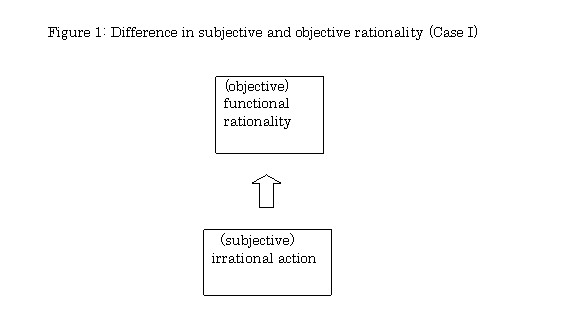
The first and second text (I, II) suggests the existence of another sort of 'rationality' that does not depend on the existence of subjective 'instrumental rationality.' It is an objective relationship that brings benefit to the actor. Crying of a baby or an eruption of anger of a frustrated spouse is irrational in the sense that the actor is conscious of neither end nor means in their action. Still, it is often functionally rational, if his/her parent or spouse reacts promptly. (See Figure 1.) The translator applied the term 'objectively correct action' to this sort of rationality i. e. Richtigkeitsrationalität. This is a text-loyal translation. However, recollecting the reflection in previous section, we would use the term 'functional rationality' to signify this objective relationship.

If we follow the suggestion to look for examples from the cultural history, we can mention the convention of Sunday holiday. The Christian convention of ceasing of the work on a day per a week for the glory of God is a completely 'instrumentally irrational' custom for a pagan like me. However, as it is functionally rational for almost everyone to maintain health and refresh vigor, this custom is now adopted worldwide regardless to the difference in confessions.
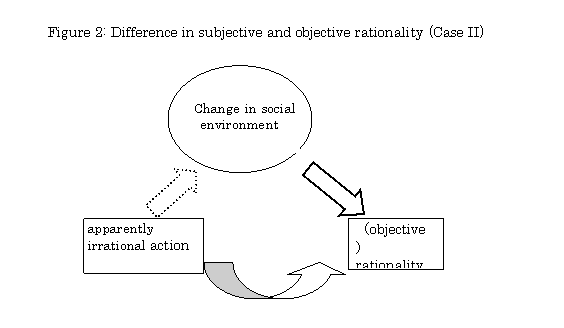
Or, we can remind us of the Weber's thesis of the relation between asceticism of Protestants and the 'spirit' of capitalism. The frugality and industry of the middle class that fits the necessity of the accumulation of capital finely was not a consciously chosen life style, but the byproduct of the 'instrumentally irrational' belief of pious Christians. The ascetic life style was not fitted smoothly the traditional life and volatile commerce in the early modern age. Probably it needs an irrationally strong belief to maintain it at that time. However, after the all round commercialization of the society, a disciplined life style has become functionally rational to the economic conditions of the people. The cumulative effect of the stubborn asceticism of the mass of Protestants contributed to the transformation of the society. Thus, along with the change of the economic environment, the instrumentally irrational asceticism produced 'unintended outcomes' of capitalism and transformed itself into a functionally rational life style under capitalism. It survives now as such and is diffused widely under the pressure of competition of the capitalist economy.
As shown in the Figure 2, such an argument has an evolutionary structure that is characterized by the cumulative effect and unintended outcomes. However, probably, Weber did not think it an 'evolutionary' thesis, since the 'selection and adaptation' appears only in the later phase of the transformation.
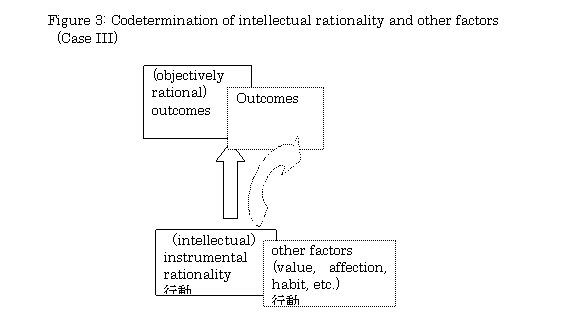
The third text (III) is also of importance, since it admits that an intellectually rational motivation is not sufficient to explain the real direction and the intensity of action on which the result (success and failure, and its form) depends. It is often the case that a hidden and unconscious element is the mightier co-determinant. We can count various sorts of element in such co-determinants: affection, habits, tradition, sense of duty, punctuality, honesty, pride, rivalry, respect, enthusiasm, etc. (Figure 3.) In the real social life, most regularity is guaranteed by a combination of conscious and unconscious motivations.
In the Figure 1, 2, and 3, structures of these three cases of deficient explicability of intelligible 'instrumental rationality' are shown. They are indispensable supplementary structures for 'interpretative sociology' that focuses the attention mainly on the meaningful relations of actions.
3.2. From Irrationality to Value-Rationality
In the "Basic Terms of Sociology", Weber coined a new concept of rationality, i. e. 'value-rationality' (Wertrationalität). According to his definition, a value-rational action is "determined by a conscious belief in the value for its own sake of some ethical, aesthetic, religious, or other form of behavior, independently of its prospects of success."[16] When we read Weber's explanation of this concept, we notice that a considerable part of the (instrumentally) 'irrational' action in "Some Categories" is transferred into this category. In the concept of 'objectively correct rationality' or 'functional rationality', the subject that recognizes the rationality is the observer (researcher) of action. In the case of 'value-rationality', it is the actor (or actor that is constructed by an observer (researcher) as an 'ideal type') that judge the rationality of the action. In this sense, this shift reflects the progress of Weber's 'interpretative sociology' toward a subjectivist direction.
Value-rational action may thus have various different relations to the instrumentally rational action. From the latter point of view, however, value-rationality is always irrational. Indeed, the more the value to which action is oriented is elevated to the status of an absolute value, the more 'irrational' in this sense the corresponding action is. For, the more unconditionally the actor devotes himself to this value for its own sake, to pure sentiment of beauty, to absolute goodness or devotion to duty, the less is he influenced by considerations of the consequences of his action. The orientation of action wholly to the rational achievement of ends without relation to fundamental values is, to be sure, essentially only a limiting case.[17]
In Weber's terminology, 'value-rationality' is supposed to be incompatible with 'instrumental rationality.' This reflects probably the emergence of the concept 'value-rationality' from Weber's efforts to explain (instrumentally) irrational actions rationally. However, if we consider the text II in previous section, 'instrumental rationality' is often not sufficient to guarantee the regularity of actions in real life. To explain the regularity of action, we need to suppose the area where 'value-rationality' or other reinforcing factor (traditionalism or emotional power of charisma) coincide with the intellectual element of 'instrumental rationality.' So far as the actor is in this area, his/her action achieves its rationality even if the actor is not fully aware of the end-means relation of the action. The real subjective motivation may be such an irrational one that is depicted in text I in the former section. Thus, this area is the most appropriate area for which the method of 'ideal type' construction is successfully applied.
In this article we cannot deal with other two concepts ('affectual action' and 'traditional action') that Weber coined also to explain actions in his 'interpretative sociology.' We focus our attention to the significance of 'value-rationality' that has close relationship with cultural elements of society.
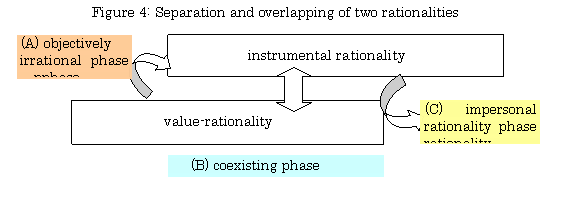

To analyze the stability of social orders, in other words, the regularity of social actions, we need the overlapping area of both 'value-rationality' and 'instrumental rationality.' This is also the area where institutions can assert their functional rationality. Then, we can also suppose areas where only one of the two is equipped. (See Figure 4.) In the area (A), where 'instrumental rationality' is missing, the action guided by 'value-rationality' appears irrational from outside. In the area (C), where 'value-rationality' is missing, 'instrumental rationality' loses the personal subjectivity and transforms itself to an impersonal formal rationality.
In the years after the war (World War I) Weber worked for the revision of his article of the "Protestant Ethics." Interestingly enough, Weber added to it his own view of this article, which is well fitted to the emergence of the concept of 'value-rationality' from the rational analysis of 'irrational' actions.
Brentano ……. takes this remark as an occasion to criticize the later discussion of "that rationalization and discipline" to which worldly asceticism has subjected men. That, he says, is a rationalization toward an irrational mode of life. He is, in fact, quite correct. A thing is never irrational in itself, but only from a particular rational point of view. For the unbeliever every religious way of life is irrational, for the hedonist every ascetic standard, no matter whether, measured with respect to its particular basic values, that opposing asceticism is a rationalization. If this essay makes any contribution at all, may it be to bring out the complexity of the only superficially simple concept of the rational.[18]
This text shows that Weber placed the main argument in his Protestantism article in the phase (A) of Figure 4. Further, by using the term 'rationalization' instead of 'rationality', this text provides the 'value-rationality' with a transforming power of the real life of the pious mass.
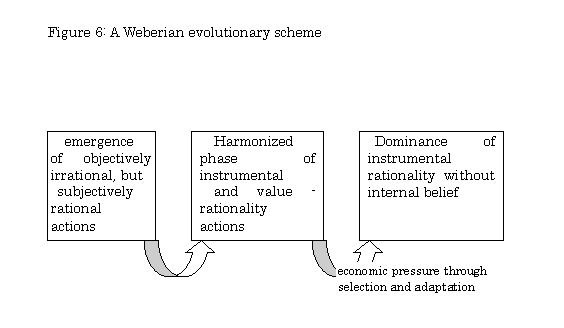
Then the question where the phase (C) is arises. The answer is easy for us: In the Protestantism article, this phase is dealt with as the problem of economic selection and adaptation under capitalism. Rational economic action is imposed on individual actors from outside by the pressure of competition in market economy. In the analysis of political domination, it is dealt with as the problem of the formal rationalization under the increasing bureaucracy. The impersonal rationality that individuals acquire through adaptation lacks the base of internal belief. Such a 'rationalization' intensifies the gap between 'formal rationality' and 'substantial rationality.' This is the problem of 'reification' accompanying 'rationalization' in which Lövith saw the affinity with Marx's diagnosis 'self-alienation' of men under capitalism.
In the age of advanced capitalism, the rationalistic order of capitalist economy is a "solid frame in which individuals are born and to which they have to adapt themselves."[19]
Thus the capitalism of to-day, which has come to dominate economic life, educates and selects the economic subjects which it needs through a process of economic survival of the fittest.[20]
In the original version of the Protestantism article, Weber's pessimism of the ever-advancing coercive rationalization (disciplinalization) was remarkable. He found in the social movement that was to relieve laborers from the cage of capitalism the appeal to the discipline of the same sort with the capitalist enterprise.
If one comments on the impressive phrase of the party congress of Social Democrats, "Leave the party who wouldn't follow the discipline!" colored as a military barrack, he is tremendously mistaken. Resistants couldn't flee out of the barrack but were caught in the arrest chambers. In reality, what laborers find again in the party and endure is the economic destination, which they have to experience gradually. The discipline in the party is the reflex of the discipline in the factories.[21]
As we have seen before, 'selection' mechanism is a way by which a materialistic view of society is applied to the real process of the society. However, Weber concluded that the persuasiveness of the 'selection' argument itself proves its own insufficiency for the explanation of the historical process.
But here one can easily see the limits of the concept of selection as a means of historical explanation. In order that a manner of life so well adapted to the peculiarities of capitalism could be selected at all, i. e. should come to dominate others, it had to originate somewhere, and not in isolated individuals alone, but as a way of life common to whole group of men.[22]
The whole process that is composed of phase (A), (B), and (C) represents the total life history of an institution, say the institution of capitalism. Weber's complaint over the historical materialism or its evolutionary version is that the determinate pressure of a 'selection' mechanism can explain only the phase (B) and (C). To explain the emerging phase (A), researchers have to go beyond the boundary of economy in proper.
In the introductory article of the renovated journal, Archiv für Sozialwissenschaft und Sozialpolitik, that Weber wrote as its responsible coeditor, he declared that his journal is guided by the idea of 'social economics' that covers not only the field of economic phenomena in proper but also those of social phenomena that are conditioned by economic process and those that are relevant to economic process.[23] It is natural to regard the Protestantism article that he published almost simultaneously in this journal as an exemplifying article of the idea of 'social economics.' We show the coverage of the Weberian concept of 'social economics' by Figure 5.
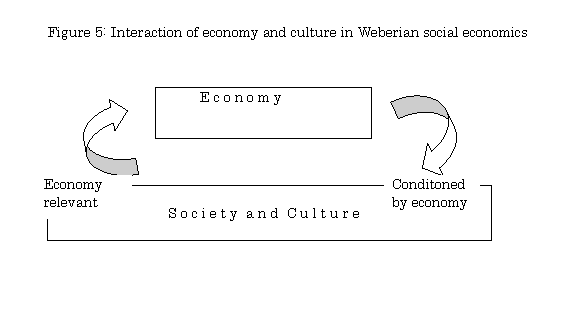
Now, we can compare Figure 2, 4, 5 and discover a similar structure among them. First, Weber mentioned cultural history as appropriate field where the evolutionary emergence of the 'functional rationality' is found. Then, Weber suggested that his Protestantism article was intended to demonstrate the complex nature of 'rationality,' in particular the significance of 'rationalization' oriented to 'value-rationality.' Lastly, Figure 5 shows that the phase (A) corresponds with the field of 'social economy' where social (cultural) element influences the economic process. Thus, we can have a Weberian evolutionary scheme, Figure 6, out of the materials in the cultural history.
originated in social and cultural elements
4. Concluding Remark
4.1. From the Viewpoint of Evolutionism
In the previous section, we explored an evolutionary scheme in Weber's 'interpretative sociology' and his works in 'social economics.' The result is that a scheme of evolutionary development is found in the interaction of diversified concepts of 'rationality' in Basic Terms which reflect the interaction between social (cultural) factors in socio-economical process. In this section we would make three critical comments on this scheme of Weberian evolutionism. Apparently all of them are directed to the intellectualist tendency of Weberian thinking.[24]
i) Judging from the contemporary knowledge of evolutionary theory in biology, Weber's complaint over the 'selection' argument is too naïve. As the standard neo-Darwinian theory tells us, 'selection' is just one step of the evolutionary process that consists of the three steps: emergence of variation - (natural) selection - conservation (heredity). The evolutionary theory in biology in the 20th century has developed with the progress in the mechanism of the emergence of variation (mutation) and its conservation in genes. However, at the age of Weber, evolutionary thought was too closely combined with the Social Darwinian idea of the 'survival of the fittest' that focused attention solely on the 'selection' mechanism. Weber's solution was to look for the origin of emergence of novelties in cultural field, particularly in religion. This is promising, since a religious movement can easily attain the critical mass over which a variation can penetrate to the wider population and realize a society-wide evolution.
Looking for the origin of new type of economic action in cultural field is, however, no more than a transfer of the problem from economy to culture (religion). Since the pressure of 'selection and adaptation' has effect also in the cultural field (religion), the emergence of novelty remains as unsolved problem in this field, too. The introduction of the concept of 'charisma' in Weber's later works is worth to note in this respect.[25]
ii) One of the most essential conceptual frames for the assimilation of modern evolutionary thought is 'population thinking.'[26] Darwin denied the unchangeable nature of species and replaced it by the concept of population, a group of individuals with variations in qualities, thus vulnerable to the change. Evolution of a species is nothing other than the change of its population through generations with varying composition of individuals of variable qualities. Without this conceptual frame the dynamics of the variation, selection, diffusion, and conservation is not thinkable.
If the typology of actions signifies the set of variations, it is compatible with 'population thinking.' The evolution of a certain type will occur through the real process of changing population. Contrastingly, the construction of 'ideal type' is an imaginary development of typology that keeps aloof over the real process. We don't deny the usefulness of imaginary construction (Gedankenexperiment) of Weberian sort that is intended to clarify the meaningful relationship of actions. However, we should not forget that what emerges in the real historical process and receives the hard trial of 'functional rationality' or 'selection and adaptation' is not an imaginary 'ideal type' but a real type individual.
iii) The concept of 'value-rationality' is one of the last theoretical ideas that Weber invented. This 'rationality' is not an objective concept neither in the sense of 'functional rationality' nor in the sense of collective ideology. It is purely individualistic concept that is related to the mind and action of individual actor. However, it is oriented not towards the external world (the result of action), but towards internal world (the action itself). R. Boudon characterized it correctly as 'non-consequential type of rationality' and proposed to develop 'axiological theory' of sociology in the extension of this concept.[27] As many game theoreticians argue, emergence of a social order ant its maintenance is very difficult in the society of pure egoists. In this respect, the existence of value that binds actors is the factor that stabilizes the order of a society. Almost all institutions have some sorts of intrinsic value that controls the action of relevant actors.
However, in Weber's case, value seems to reside in ideal zone that has no relations with the real world. According to the neo-Kantian philosophy on which Weber grounded his methodology, values are transcendental in the sense that are not derived from any other being in the real life. Weber often compared the conflict of value judgment to a 'struggle of gods' (Götterstreit).' I personally wonder whether a misconception between the real conflict within the mind of actors and the competitive criterions of the observer (researchers) in evaluation and research exists in Weber's methodological reflection. At least I believe what we need is an endogenous theory of value by which we can understand the emergence, maintenance, and transformation of values and the actions that are guided by them. An idealistic value philosophy is not fitted to an evolutionary thinking.
4.2. Returning to 'Marx-Weber Problem'
Before closing this article, we return to the 'Marx-Weber Problem' and confirm the implication of our previous reading of Weber for it.
The 'Marx-Weber Problem' in Japan was roughly consists of discussions in the following three issues.
i) Weber's stress on the interaction of material interest and ideas as a criticism against the Marxian historical materialism
ii) Weber's critical diagnosis of the universal 'rationalization' and its affinity with Marx's criticism against the 'self alienation' under capitalism
iii) Weber's methodology of 'value freedom' and 'ideal type' and criticism of Marxists against it
Based on our reflection in previous sections, we are able to integrate the issue i) and ii) into an evolutionary reading of Weber. Weber chose the mind and action of individuals as the referential view point of his 'interpretative sociology' but prepared also an evolutionary scheme for the emergence, maintenance, and decay of institutions to supplement it. The issues relating i) and ii) are included in this evolutionary scheme. We appreciate Weber's vision of the evolution of capitalism that is based on the historical investigation into the interaction of cultural factor and economic factor highly. We can learn much from his efforts to clarify the concepts of 'rationality' and their use in the understanding of the socio-economical development.
However, we have to admit that in the area related to the issue iii) contemporary evolutionary social scientists stand more close to Marxists than to Weber. This closeness comes from the vision of endogeneity of value and the priority of the real evolutionary process than an imaginary construction of 'ideal type.' Both are the two sides of the same coin. With the progress in the research in the endogenous theory of value, we hope an evolutionist turn of 'Marx-Weber Problem' from its intellectualist version.
[This is based on the talk at the joint symposium of Kyoto University and Heidelberg University, "Max Weber and the Modernity," Kyoto, on March 17, 2006 and the presidential address at the 10th annual meeting of Japan Association for Evolutionary Economics, Sapporo, on March 26, 2006.]
|
REFERENCE
Andersen E. S. (1994) Evolutionary Economics: post-Schumpeterian contributions. Pinter: New York and London.
Barshay, A. E. (2004) The Social Sciences in Modern Japan: The Marxian and Modenist Tradition. University of California Press: Berkley, Los Angels, London.
Boudon, R. (1997) "The Present Relevance of Max Weber's Wertrationalität (Value Rationality)." In P. Koslowski ed. (1997).
The Origin of Values: Sociology and Philosophy of Beliefs. Transaction Publisher: New Brunswick (USA) and London (UK).
Elster, J. (2000) "Rationality, Economy, and Society." In S. Turner ed. (2000).
Granovetter, M. (1985) "Economic Action and Social Structure: The Problem of Embeddedness." American Journal of Sociology, 91.
Koslowski, P. ed. (1997) Methodology of the Social Sciences, Ethics, and Economics in the Newer Historical School. Springer: Berlin, Heidelberg.
Lövith, Karl (1932) "Max Weber und Karl Marx". Archiv für Sozialwissenschaft und Sozialpolitik, Bd. 67.
Mayr, E. (1988) Toward a New Philosophy of Biology: Observations of an Evolutionist. Belknap Press of Harvard University Press: Cambridge MS.
Menger, C. (1883) Untersuchungen über die Methode der Socialwissenschaften, und der politischen Oekonomie insbesondere. Duncker & Humblot: Leipzig.
Orihara, H. (1999) "Max Webers Beitrag zum 'Grundriss der Sozialökonomik: Das Vorkriegsmanuskript als ein integriertes Ganzes." Kölner Zeitschrift für Soziologie und Sozialpsyuchologie, 51.
Parsons, T. (1937) Structure of Social Action. MacGrow-Hill: New York.
Schluchter, W. (1998) "Max Webers Beitrag zum 'Grundriss der Sozialökonomik': Editionsprobleme und Editionsstrategieen." Kölner Zeitschrift für Soziologie und Sozialpsyuchologie, 50.
"Psychophysics and culture," in S. Turner ed. (2000).
Schumpeter, J. A. (1911) Theorie der wirtschaftlicher Entwicklung. Duncker & Humblot: Leipzig.
Schwendker, W. (1998) Max Weber in Japan: eine Untersuchung zur Wirkungsgeschichte . Mohr-Siebeck: Tübingen.
Shionoya, Y. (2006) "Schmoller and Modern Economic Sociology," Schmollers Jahrbuch, 126 Jg., Heft 2.
ed. (2001) The German Historical School: The historical and ethical approach to economics. Routledge: London and New York.
Swedberg, R. (1998) Max Weber and the Idea of Economic Sociology. Princeton University Press.
and Smelser, N. eds (1994) The Handbook of Economic Sociology. Princeton and New York: Princeton University Press.
Sumiya, K. (1999) "Karl Marx und Max Weber: Sichtweisen der japanischen Forschung." In W. J. Mommsen und W. Schwentker Hg., Max Weber und das Moderne Japan, Vandenhoeck & Ruprecht: Göttingen, 1999.
Turner, S. (2000) The Cambridge Companion to Weber. Cambridge University Press: Cambridge.
Uchida, Y. (1999) "Otsuka Hisao und Max Weber." In W. J. Mommsen und W. Schwentker Hg., Max Weber und das Moderne Japan, Vandenhoeck & Ruprecht: Göttingen, 1999.
Weber, M. (1904; 1951) "Die >Objektivität< sozialwissenschaftlicher und sozialpolitischer Erkenntnis". Archiv für Sozialwissenschaft und Sozialpolitik, Bd. 19. In Weber (1951), SS.146-214.
-----; 1920) "Protestantische Ethik und der >Geist< des Kapitalismus". Archiv für Sozialwissenschaft und Sozialpolitik (Bd. XX u. XXI). Revised version in Gesammelte Aufsätze zur Religionssoziologie, Bd. I, 1920. J. C. B. Mohr (Paul Siebeck): Tübingen.
---; 1924) "Methodologische Einleitung für die Erhebungen des Verein für Sozialpolitik über Auslese und Anpassung (Berufswahlen und Berufsschicksal) der Arbeiterschaft der geschlossenen Grossindustrie". In Gesammelte Aufsätze zur Soziologie und Sozialpolitik. J. C. B. Mohr (Paul Siebeck): Tübingen.
---; 1951) "Über einige Kategorien der verstehenden Soziologie". Logos, Bd. 4. In Weber (1951), SS. 427-474.
---; 1951) "Soziologische Grundbegriffe". I. Teil Kap. I. Wirtschaft und Gesellschaft. In Weber (1951), SS.527-565.
-----The Methodology of the Social Science. Translated and edited by E. A. Shils and H. A. Finch. The Free Press: Glencoe, Ill.
-----Gesammelte Aufsätze zur Wissenschaftslehre. Zweite durchgesehene und ergänzte Auflage, besorgt von J. Winckelman. J. C. B. Morh (Paul Siebeck): Tübingen.
-----The Protestant Ethic and the Spirit of Capitalism. Translated by Talcott Parsons, with a foreword by R. H. Tawney. Charles Scribner's Sons: New York.
-----Economy and Society: An Outline of Interpretative Sociology, edited by G. Roth and C. Wittich. University of California Press: Berkley, Los Angels, London.
-----"Some Categories of Interpretative Sociology" (Translation of Weber (1921) by Edith Graber). The Sociological Quarterly, vol. 22. no.2.
Yagi, K. (1997) "Carl Menger and the Historicism in Economics," in P. Koslowski ed.(1997).
----"Anonymous history in Austrian economic thought: From Carl Menger and Anton Menger to Friedrich von Wieser," in Y. Shionoya ed. (2001).
-----"Karl Knies, Austrians, and Max Weber: a Heidelberg connection?" Journal of Economic Studies, vol. 32 No. 4.
[1] See Uchida (1999) and Sumiya (1999).
[2] The whole process of Max Weber's reception by Japanese social scientists was explored by Schwentker (1998). Schwentker mentioned Masao Maruyama and Takeyoshi Kawashima in the same group ('Modernist') with Otsuka. See also Barshay (2004) on the debate between 'Marxists' and 'Modenists.'
[3] See Granovetter (1985), Swedberg (1998) chap. 6, and Swedberg's introduction chapter of Swedberg & Smelser eds (1994).
[4] "We shall speak of 'action' in so far as the acting individual attaches a subjective meaning to his behavior -- be it overt and covert, omission or acquiescence. Action is 'social' insofar as its subjective meaning takes account of the behavior of others and is thereby oriented in its course." (Weber 1978, p. 4)
[5] Parsons (1937) p. 81f.
[6] On Weber's relation to the Historical School and the Austrian School, see Yagi (1997), (2001), and (2005). See also an interesting parallel view of Schmoller's economic sociology with the 'new economic sociology' in Shionoya (2006).
[7] Menger (1883).
[8] Weber (1908).
[9] Schluchter (2000).
[10] On its editorial problem, see the discussion in Schluchter (1998) and Orihara (1999).
[11] Weber (1981) p.152, (1951) S.429.
[12] Weber (1981) p.151, (1951) S. 428.
[13] Weber (1981) p.155f., (1951) S.435.
[14] Weber (1981) p.156, (1951) S.435.
[15] Weber (1981) p.156, (1951) S.435.
[16] Weber (1978) p.24f., (1951) S.551.
[17] Weber (1978) p.26, (1951) S.552.
[18] Weber (1920) Bd. I, S.35, (1958) pp,193f.
[19] Weber (1968) p.55, (1904-05) S.18, (1920) S.37.
[20] Weber (1968) p.55, (1904-05) S.18, (1920) S.37.
[21] The author's translation from Weber (1904-05) S.19. The reason why this comment was deleted is not clear. My guess is that the turbulent revolutionary movement in 1918-19 may have broken this view.
[22] Weber (1968) p.55, (1904-05) S.18, (1920) S.37.
[23] Weber (1949) pp.64f.,(1951) S.161f. It is interesting that Weber mentioned W. Roscher and K. Marx as precursors of Social Economics.
[24] I fully agree to John Elster (2000) when he writes "Weber's analysis of action and rationality display a stunning depth of insight,"(p.39) but "The basic problem in Weber's writings on these issues is perhaps his failure to see how objective success and subjective rationality can deviate from each other."(p.40)
[25] Schumpeter (1911) assigned the role of creating novelties in the area of economy to his heroic 'entrepreneurs.'
[26] Cf. Mayr (1988) and Andersen (1994).
[27] Boudon (1997), (2000).
