

Партнерка на США и Канаду по недвижимости, выплаты в крипто
- 30% recurring commission
- Выплаты в USDT
- Вывод каждую неделю
- Комиссия до 5 лет за каждого referral
О ВЫПОЛНЕНИИ УСЛОВИЯ СТРОГОЙ СИММЕТРИИ ТЕНЗОРА НАПРЯЖЕНИЙ НА ТОЧНЫХ РЕШЕНИЯХ УРАВНЕНИЙ НАВЬЕ-СТОКСА
Брянск e-mail mikl5353@mail.ru
Любой тензор Т может быть тождественно представлен так:
T=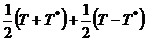 . Введем обозначения S =
 , A =
, A =
тензор S-симметричен, т. е. Si j =Sj i. А – асимметричен, т. е. Ai j= - Aj i , причем A22= A11=0.
При постоянной вязкости дифференциальный вид уравнений Н-С для строго симметричного тензора напряжений (далее ТН) и строго асиметричного ТН одинаков. Однако в большинстве случаев предпочтение отдается предположению о строго симметричном ТН. При решении задач вязкой несжимаемой жидкости для того, чтобы быть уверенным, что реализуется строго симметричная форма ТН необходимо потребовать выполнения равенства
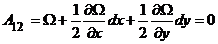 (1)
(1)
где dx, dy – параметры ( dx, dy не совпадают с элементарными перемещениями частиц жидкости, происходящими за бесконечно малый промежуток времени t [1, стр.53]), завихренность Ω =∂u/∂y-∂v/∂x, где и и v — компоненты скорости. Заметим, что решение уравнений Н-С, записанных с учетом второго приближения, требуют знания dx, dy.
Рассмотрим выполнение (1) на точном решении классической задачи развития течения вблизи колеблющейся плоской стенки (вторая задача Стокса [2]). Предполагается v=0. Точное решение при колебаниях стенки U(0, t)=U0cos nt при y=0 имеет вид u(y, t)=U0e-kycos(nt-ky), где k= ) . Для завихренности Ω=∂u/∂y , вводя переменную η=ky, получим
Ω(y, t)=  kU0e-ηsin(nt-η-π/4) (2)
После подстановки (2) в (1) получаем уравнение для нахождения dy
(1-kdy)sin(nt-η)=cos(nt-η) (3)
Простой анализ показывает, что при nt-η=0 уравнение (3) не имеет конечного решения для dy. Можно принять, что при nt-η=0 мы имеем в течении критические слои, где ТН не может быть строго симметричным и появляется асимметричная составляющая. С одной стороны этот вывод позволяет утверждать, что общепринятое предположение о симметричности ТН в вязкой несжимаемой жидкости даже в простейших случаях некорректно. С другой стороны решение Стокса все-таки верно, что связано с тем, что уравнения Н-С в своей дифференциальной записи полностью одинаковы как для строго симметричного ТН так и асимметричного, что можно учесть при записи обобщенного закона Ньютона. В развитие представлений полезно аналогично проанализировать решения для течения Куэтта.
Литература 1. . Механика жидкости и газа.- М.: Наука, 1973, 847 с.
2. Г. Шлихтинг. Теория пограничного слоя, Москва, Наука, 1974, с.94-95.
ABOUT PERFORMANCE OF THE CONDITION OF STRICT SYMMETRY OF THE STRESS TENSOR ON EXACT SOLUTIONS OF THE NAVIER-STOKES EQUATIONS
M. N.Zakharenkov
Bryansk, e-mail *****@***ru
Any tensor of T can be identically presented so:
T= . We will enter designations S =, A = the tensor S-is symmetric, i. e. Si j =Sj i. and A– it is asymmetric, i. e. Ai j = - Aj i, and A22 = A11=0.
At constant viscosity the differential form of the of N-S equations for strictly symmetric stress tensor (further ST) is identical to strictly asymmetric ST. However in most cases the preference is given to the assumption of strictly symmetric ST. At the solution of problems of viscous incompressible liquid to be sure that the ST symmetric form is realized strictly it is necessary to demand equality performance
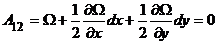 (1)
(1)
where dx, dy – parameters (dx, dy don't coincide with elementary movements of particles of the liquid, occurring for an infinitesimal time period [1, p. 53]), a vorticity Ω = ∂u / ∂ y-∂ v / ∂ x, where u and v — velocity components. We will notice that the solution of the N-S equations which have been written down taking into account the second approach, the knowledge of dx, dy demand.
We will consider performance (1) on the exact solution of a classical problem of development of a current near a fluctuating flat wall (Stokes's second task [2]). v=0 is supposed. The exact solution at fluctuations of a wall of U(0, t) =U0cos nt at y=0 has appearance
u(y, t) =U0e-kycos (nt-ky), where k = √ (n / (2ν). For a vorticity Ω = ∂u / ∂ y, entering a variable η = ky, we will receive
Ω (y, t) = √2kU0e-ηsin (nt-η-π/4) (2)
After substitution (2) in (1) we receive the equation for finding of dy
(1-kdy) sin (nt-η) = cos (nt-η)
The simple analysis shows that at nt-η = 0 equation (3) has no final decision for dy. It is possible to accept that at nt-η = 0 we have a critical layers where ST can't be strictly symmetric and there is an asymmetric component. On the one hand this conclusion allows to claim that the standard assumption of symmetry of ST in viscous incompressible liquid even in the elementary cases is incorrect. On the other hand Stokes's solution after all is right that is connected with that the N-S equations in the differential record are completely identical as to strictly symmetric ST and asymmetric ST and it linear combination that it is possible to consider at record of the generalized law of Newton [1]. In development of representations it is useful to analyse similarly the solutions for Couette's flow.
Literature
1. L. G.Loytsyansky. Mechanics of liquid and gas. - M.: Science, 1973, 847 pages.
2. G. Schlichting. The theory of boundary layer, Moscow, Science, 1974, page 94-95.
