

Партнерка на США и Канаду по недвижимости, выплаты в крипто
- 30% recurring commission
- Выплаты в USDT
- Вывод каждую неделю
- Комиссия до 5 лет за каждого referral
ЧИСЛЕННОЕ ИССЛЕДОВАНИЕ ЯВЛЕНИЙ ГИДРОДИНАМИЧЕСКОЙ НЕУСТОЧИВОСТИ В ВЫСОКОЭНЕРГЕТИЧНОЙ ПЛОСКОЙ НЕСТАЦИОНАРНОЙ РЕЛЯТИВИСТСКОЙ СТРУЕ
Объединенный институт высоких температур РАН, Москва
Выполнено численное моделирование плоской затопленной нестационарной ультрарелятивистской струи. От расчетов релятивистских струй, имеющих отношение к астрофизическим приложениям [1,2], рассматриваемая постановка задачи отличается высокой плотностью окружающего вещества (5∙10-2 в единицах плотности массы покоя инжектируемой струи) и высокой внутренней энергией, как струи, так и окружающего вещества (до 103 в единицах c2, где c-скорость света). Первое условие обеспечивает формирование развитого релятивистского вихря при взаимодействии струи с окружающим газом, второе обуславливает ряд особенностей высокоэнергетичных релятивистских струйных течений [4], в частности, высокие значения Лоренц-фактора, которые достигаются в расширяющейся сверхзвуковой части струи. Граничные условия ставятся таким образом, чтобы скорость струи превышала ультрарелятивистский предел скорости звука для используемого в расчетах уравнения состояния, поэтому, в структуре взаимодействия струи с окружающим газом присутствует область сверхзвукового течения и система ударных волн. Максимальное значение фактора Лоренца в такой струе достигается непосредственно перед внутренним скачком торможения (положение скачка см. на рисунке 1, где показано распределение плотности массы покоя в последовательные моменты времени). Исследуется нелинейная стадия развития неустойчивости Кельвина-Гельмгольца и дальнейшего взаимодействия возникающей вихревой структуры с внутренними ударными волнами и релятивистским вихрем, приводящего к турбулизации последнего (рисунок 1). Расчеты показывают, что в процессе перемешивания струи с окружающим газом интенсивность внутреннего скачка торможения остается высокой, что объясняется разгоном потока в расширяющейся части струи перед скачком до достижения больших значений Лоренц-фактора. Обнаружено взаимодействие пульсаций в тыльной части вихря со струей, приводящее к возбуждению в струе возмущений в виде поперечных волн (см. рисунок 2, где показан случай недорасширенной струи).
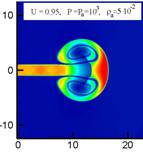
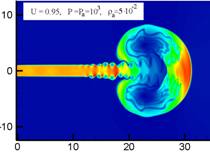
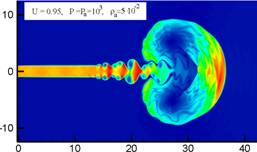
Рисунок 1. Развитие неустойчивости плоской затопленной релятивистской струи
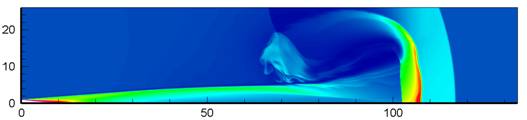
Рисунок 2 Возбуждение возмущений в области взаимодействия струи с вихрем
Расчеты выполнялись на основе уравнений релятивистской гидродинамики [3] в двумерной постановке, применялся метод высокого разрешения, основанный на локально-характеристическом подходе и неосциллирующих схемах третьего порядка аппроксимации [4]. Применялись расчетные сетки с количеством ячеек 106-107. В расчетах использовалось уравнение состояния p=(g-1)(e-ρc2) при g=5/3, где p, e – давление и плотность энергии в собственной системе координат, ρ – плотность массы покоя.
ЛИТЕРАТУРА.
1. Marti J.-.M., Muller E. Numerical hydrodynamics in special relativity// Living Rev. Rel. 2003. 6: 7.
2. Marti J.-M., Perucho M., Hanasz M. Stability of Relativistic Hydrodynamical Planar Jets: Linear and Nonlinear Evolution of Kelvin-Helmholtz Modes Astrophysics and Space Science, Vol. , Issue 1-2, pp 139-147.
3. Landau L. D., Lifshits E. M. Theoretical physics. VI. Hydrodynamics. M.: Nauka, 1988.
4. Konyukhov A. On shocks in high energy relativistic jets: numerical simulation, In: Physics of Extreme States of Matter-2013, Moscow 2013, 126-129.
NUMERICAL INVESTIGATION OF HYDRODINAMICAL INSTABILITY PHENOMENA IN HIGH ENERGY PLANAR NON-STATIONARY RELATIVISTIC JET
A. V. Konyukhov
Joint Institute for High Temperatures of RAS, Moscow
Numerical simulation of plane non-stationary ultrarelativistic jet has been performed. The jet is injected into the half-space x>0, which contains a matter being at rest in the coordinate system attached to the boundary. Unlike the calculations of the relativistic jets relevant to astrophysical applications [1, 2], the problem formulation is characterized by high density of the surrounding matter (5∙10-2 in units of the rest mass density of the jet) and high internal energy of both jet and surrounding gas (up to value 103 in the units of c2, where c is the speed of light). The first condition leads to formation of developed relativistic vortex, being the result of the interaction between the jet and the medium. The second one provides the characteristic features of high energy relativistic jet [4]; particularly, very high values of Lorentz factor can be reached in the expanding supersonic part of such jet. The boundary conditions ensure that the injection velocity exceeds the ultrarelativistic limit of speed of sound for the adopted equation of state. Therefore, the flow field includes supersonic regions and a system of shocks. The local Lorentz factor has the maximum directly in front of the internal shock in which the jet decelerates (see figure 1, where the distributions of rest mass density is shown in the successive points in time). The non-linear stage of the Kelvin-Helmholtz instability development and interaction of the arising vortex structure with the internal shocks and the relativistic vortex is investigated; this interaction leads to turbulence formation in the vortex (figure 1). The calculations have shown that the intensity of the internal shock, in which the gas of the jet decelerates, remains high in spite of the mixing of the jet with surrounding gas. This can be explained by additional acceleration of the jet in its expansion part. The interaction of pulsations in the backward part of the vortex with the jet leads to excitation of the perturbations, which have the form of transverse waves in the head part of the jet (see figure 2, where rest mass density in the underexpanded jet is shown).


Figure 1. Development of the instability of plane relativistic jet
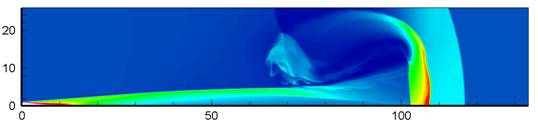
Figure 2. Excitation of perturbations in the region of jet-vortex interaction.
The calculations have been performed on the basis of relativistic hydrodynamics equations [3] in two-dimensional formulation. High resolution numerical method [4] based on the local characteristic approach and non-oscillatory third order scheme has been putational grids with number of cells 106-107 were used to provide fine resolution of the flow field structures. The relativistic hydrodynamics equations were closed by the equation of state p=(g-1)(e-ρc2) with g=5/3, where p and e are the pressure and the energy density in the rest coordinate system, ρ is the rest mass density.
ЛИТЕРАТУРА.
1. Marti J.-.M., Muller E. Numerical hydrodynamics in special relativity// Living Rev. Rel. 2003. 6: 7.
2. Marti J.-M., Perucho M., Hanasz M. Stability of Relativistic Hydrodynamical Planar Jets: Linear and Nonlinear Evolution of Kelvin-Helmholtz Modes Astrophysics and Space Science, Vol. , Issue 1-2, pp 139-147.
3. Landau L. D., Lifshits E. M. Theoretical physics. VI. Hydrodynamics. M.: Nauka, 1988 [in Russian].
4. Konyukhov A. On shocks in high energy relativistic jets: numerical simulation, In: Physics of Extreme States of Matter-2013, Moscow 2013, 126-129.
