


8.1. Fonts in Equation Editor (or MathType)
Make sure that your Equation Editor or MathType fonts, including sizes, are set up to match the text of your document.
8.2. Points of style
8.2.1. Vectors. Bold italic characters is our preferred style but the author may use any standard notation; for example, any of these styles for vectors is acceptable:
‘the vector cross product of a and b is given by  …’, or
‘the vector cross product of a and b is given by  …’, or
‘the vector cross product of  and
and  is given by
  …’.
…’.
8.2.2. The solidus ( ). A two-line solidus should be avoided where possible; for example, use
· 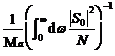 instead of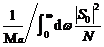
·  instead of
8.2.3. Roman and italic in mathematics. Variables should be in italic; however there are some cases where it is better to use a Roman font:
· Use a Roman d for a differential d, for example, 
· Use a Roman e for an exponential e; for example, 
· Use a Roman i for the square root of –1; e. g., 
· Certain other common mathematical functions, such as cos, sin, det and ker, should appear in Roman type.
· Subscripts and superscripts should be in Roman type if they are labels rather than variables or characters that take values. For example in the equation

m, the z component of the nuclear spin, is italic because it can have different values whereas n is Roman because it is a label meaning nuclear.
8.3. Alignment of mathematics
The preferred style for displayed mathematics in Journal of Physics: Conference Series is to centre equations; however, long equations that will not fit on one line, or need to be continued on subsequent lines, should start flush left. Any continuation lines in such equations should be indented by 25 mm.
Equations should be split at mathematically sound points, often immediately before =, + or – signs or between terms multiplied together. The connecting signs are not repeated and appear only at the beginning of the turned-over line. A multiplication sign should be added to the start of turned-over lines where the break is between two multiplied terms.
8.3.1. Small displayed equations: Some examples:
 (1)
(1)
 (2)
(2)
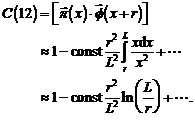 (3)
(3)
However, if equations will fit on one line, do so; for example, (5) may also be formatted as:
 (6)
(6)
8.3.2. Large display equations: examples. If an equation is almost the width of a line, place it flush left against the margin to allow room for the equation number.
 (7)
(7)
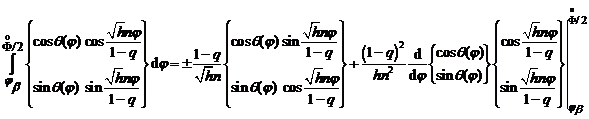
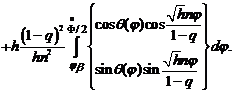 (8)
(8)
8.4. Miscellaneous points
· Exponential expressions, especially those containing subscripts or superscripts, are clearer if the notation  is used, except for simple examples. For instance,
  and
and  are preferred to
  and
and  but
but  is acceptable. Similarly the square root sign
  should only be used with relatively simple expressions, e. g.
 and
and  but in other cases the power
  should be used.
· It is important to distinguish between  and
and 
· Braces, brackets and parentheses should be used in the following order: {[()]}. The same ordering of brackets should be used within each size. However, this ordering can be ignored if the brackets have a special meaning (e. g. if they denote an average or a function).
· Decimal fractions should always be preceded by a zero: for example 0.123 not .123 (note, do not use commas, use the decimal point).
· Equations that are referred to in the text should be numbered with the number on the right-hand side.
8.5. Equation numbering
Equations may be numbered sequentially throughout the text (i. e., (1), (2), (3),ј) or numbered by section (i. e., (1.1), (1.2), (2.1) ,ј) depending on the author’s personal preference. In articles with several appendices equation numbering by section is useful in the appendices even when sequential numbering has been used throughout the main body of the text: for example, A.1, A.2 and so forth. When referring to an equation in the text, always put the equation number in brackets—e. g. ‘as in equation (2)’ or ‘as in equation (2.1)’—and always spell out the word ‘equation’ in full, e. g. ‘if equation (5) is factorized’; do not use abbreviations such as ‘eqn.’ or ‘eq.’.
9. Appendices
Technical detail that it is necessary to include, but that interrupts the flow of the article, may be consigned to an appendix. Any appendices should be included at the end of the main text of the paper, after the acknowledgments section (if any) but before the reference list. If there are two or more appendices they should be called appendix A, appendix B, etc.
Numbered equations should be in the form (A.1), (A.2), etc, figures should appear as figure A1, figure B1, etc and tables as table A1, table B1, etc.
10. References
As part of the production system for Journal of Physics: Conference Series, online versions of all reference lists will, wherever possible, be linked electronically using IOP Publishing’s HyperCite™ technology. Consequently, it vitally important for all the references to be accurate and to be carefully formatted using the guidelines below, enabling your paper to be available online with the minimum of delay.
A complete reference should provide the reader with enough information to locate the article concerned, whether published in print or electronic form, and should, depending on the type of reference, consist of:
· name(s) and initials;
· date published;
· title of journal, book or other publication;
· titles of journal articles may also be included (optional);
· volume number;
· editors, if any;
· town of publication and publisher in parentheses for books;
· the page numbers.
Two different styles of referencing are in common use: the Harvard alphabetical system and the Vancouver numerical system. For Journal of Physics: Conference Series, please use the Vancouver numerical system as described below.
10.1. Numerical system
In the numerical system references are numbered sequentially throughout the text. The numbers occur within square brackets, like this [2], and one number can be used to designate several references. The reference list gives the references in numerical, not alphabetical, order.
10.1.1. References to printed journal articles. A normal reference to a journal article contains three changes of font (see table 6).
Points to note
· There should be a 5 mm gap between the reference number (e. g., ‘[8]’) and the start of the reference text. Second and subsequent lines of individual references should be indented by 5 mm. For example:
[1] Aderhold J, Davydov V Yu, Fedler F, Klausing H, Mistele D, Rotter T, Semchinova O, Stemmer J and Graul J 2001 J. Cryst. Growth 222 701
· the authors should be in the form surname (with only the first letter capitalized) followed by the initials with no periods after the initials. Authors should be separated by a comma except for the last two which should be separated by ‘and’ with no comma preceding it.
· The article title (if given) should be in lower case letters, except for an initial capital, and should follow the date.
· The journal title is in italic and is abbreviated. If a journal has several parts denoted by different letters the part letter should be inserted after the journal in Roman type, e. g. Phys. Rev. A.
· Both the initial and final page numbers should be given where possible. The final page number should be in the shortest possible form and separated from the initial page number by an en rule ‘– ‘, e. g. 1203–14, i. e. the numbers ‘12’ are not repeated.
Table 6. Font styles for a reference to a journal article. | |
Element | Style |
Authors | Roman type |
Date | Roman type |
Article title (optional) | Roman type |
Journal title | Italic type |
Volume number | Bold type |
Page numbers | Roman type |
Here are some examples taken from published papers:
[1] Strite S and Morkoc H 1992 J. Vac. Sci. Technol. B 10 1237
[2] Jain S C, Willander M, Narayan J and van Overstraeten R 2000 J. Appl. Phys. 87 965
[3] Nakamura S, Senoh M, Nagahama S, Iwase N, Yamada T, Matsushita T, Kiyoku H and Sugimoto Y 1996 Japan. J. Appl. Phys. 35 L74
[4] Akasaki I, Sota S, Sakai H, Tanaka T, Koike M and Amano H 1996 Electron. Lett. 32 1105
[5] O’Leary S K, Foutz B E, Shur M S, Bhapkar U V and Eastman L F 1998 J. Appl. Phys. 83 826
[6] Qian Z G, Shen W Z, Ogawa H and Guo Q X 2002 J. Appl. Phys. 92 3683
[7] Guo Q X, Okada A, Kidera H, Tanaka T, Nishio M and Ogawa H 2002 J. Cryst. Growth 237– 239 1032
[8] Aderhold J, Davydov V Yu, Fedler F, Klausing H, Mistele D, Rotter T, Semchinova O, Stemmer J and Graul J 2001 J. Cryst. Growth 222 701
[9] Mamutin V, Veskin V, Davydov V, Ratnikov V, Shubina T, Inanov S, Kopev P, Karlsteen M, Soderwall U and Willander M 1999 Phys. Status Solidi 176 247
[10] Jenkins D W and Dow J D 1989 Phys. Rev. B 39 3317
[12] Tansley T L and Egan R J 1992 Phys. Rev. B 45 10942
[13] Wessel R, Koch C and Gabbiani F 1996 Coding of time-varying electric field amplitude modulations in a wave-type electric fish J. Neurophysiol. 75 2280–93
10.1.2. References to preprints. For preprints there are two distinct cases:
1. Where the article has been published in a journal and the preprint is supplementary reference information. In this case it should be presented as:
[1] Kunze K 2003 T-duality and Penrose limits of spatially homogeneous and inhomogeneous cosmologies Phys. Rev. D 68 063517 (Preprint gr-qc/0303038)
2. Where the only reference available is the preprint. In this case it should be presented as
[1] Milson R, Coley A, Pravda V and Pravdova A 2004 Alignment and algebraically special tensors Preprint gr-qc/0401010
10.1.3. References to electronic-only journals. In general article numbers are given, and no page ranges, as most electronic-only journals start each article on page 1.
· For New Journal of Physics (article number may have from one to three digits)
[1] Fischer R 2004 Bayesian group analysis of plasma-enhanced chemical vapour deposition data New. J. Phys. 6 25
· For SISSA journals the volume is divided into monthly issues and these form part of the article number
[1] Horowitz G T and Maldacena J 2004 The black hole final state J. High Energy Phys. JHEP02(2004)008
[2] Bentivegna E, Bonanno A and Reuter M 2004 Confronting the IR fixed point cosmology with high-redshift observations J. Cosmol. Astropart. Phys. JCAP01(2004)001
10.1.4. References to books, conference proceedings and reports. References to books, proceedings and reports are similar to journal references, but have only two changes of font (see table 7).
Table 7. Font styles for references to books, conference proceedings and reports. | |
Element | Style |
Authors | Roman type |
Date | Roman type |
Book title | Italic type |
Editors | Roman type |
Place (city, town etc) of publication | Roman type |
Publisher | Roman type |
Volume | Roman type |
Page number(s) | Roman type |
Points to note
· Book titles are in italic and should be spelt out in full with initial capital letters for all except minor words. Words such as Proceedings, Symposium, International, Conference, Second, etc should be abbreviated to Proc., Symp., Int., Conf., 2nd, respectively, but the rest of the title should be given in full, followed by the date of the conference and the town or city where the conference was held. For Laboratory Reports the Laboratory should be spelt out wherever possible, e. g. Argonne National Laboratory Report.
· The volume number, for example vol 2, should be followed by the editors, if any, in a form such as ‘ed A J Smith and P R Jones’. Use et al if there are more than two editors. Next comes the town of publication and publisher, within brackets and separated by a colon, and finally the page numbers preceded by p if only one number is given or pp if both the initial and final numbers are given.
Examples taken from published papers:
[1] Kurata M 1982 Numerical Analysis for Semiconductor Devices (Lexington, MA: Heath)
[2] Selberherr S 1984 Analysis and Simulation of Semiconductor Devices (Berlin: Springer)
[3] Sze S M 1969 Physics of Semiconductor Devices (New York: Wiley–Interscience)
[4] Dorman L I 1975 Variations of Galactic Cosmic Rays (Moscow: Moscow State University Press) p 103
[5] Caplar R and Kulisic P 1973 Proc. Int. Conf. on Nuclear Physics (Munich) vol 1 (Amsterdam: North-Holland/American Elsevier) p 517
[6] Cheng G X 2001 Raman and Brillouin Scattering—Principles and Applications (Beijing: Scientific)
[7] Szytula A and Leciejewicz J 1989 Handbook on the Physics and Chemistry of Rare Earths vol 12, ed K A Gschneidner Jr and L Erwin (Amsterdam: Elsevier) p 133
[8] Kuhn T 1998 Density matrix theory of coherent ultrafast dynamics Theory of Transport Properties of Semiconductor Nanostructures (Electronic Materials vol 4) ed E Schцll (London: Chapman and Hall) chapter 6 pp 173–214
[9] Kuhn T, Binder E, Rossi F, Lohner A, Rick K, Leisching P, Leitenstorfer A, Elsaesser T and Stolz W 1994 Coherent excitonic and free-carrier dynamics in bulk GaAs and heterostructures Coherent Optical Interactions in Semiconductors: Proc. NATO Advanced Research Workgroup (Cambridge, UK, 11–14 August 1993) (NATO Advanced Study Institute, Series B: Physics vol 330) ed R T Phillips (New York: Plenum) pp 33–62
10.2. Reference lists
Up to ten authors may be given in a particular reference; where there are more than ten only the first should be given followed by et al.
Abbreviations of the names of periodicals used by IOP Publishing are usually the same as those given in British Standard BS 4148: 1985. If an author is unsure of an abbreviation it is best to leave the title in full. The terms loc. cit. and ibid should not be used.
Unpublished conferences and reports should generally not be included in the reference list and articles in the course of publication should be entered only if the journal of publication is known. A thesis submitted for a higher degree may be included in the reference list if it has not been superseded by a published paper and is available through a library; sufficient information should be given for it to be traced readily.
11. Cross referencing
· References. References should be cited in the text using square brackets; for example, ‘[3]’.
· Figures. Figures should be referenced in the text as ‘figure 1’, ‘figure 2’ etc.
· Tables. Tables should be referenced as ‘table 1’, ‘table 2’ etc.
· Sections, subsections and subsubsections. For example ‘section 3.1’ not ‘sec. 3.1’.
· Equations. Equations references should contain the equation number in parentheses, such as (3.1). Note that it is not normally necessary to include the word ‘equation’ before an equation number except where the number starts a sentence. The word ‘equation’ should not be abbreviated.
Acknowledgments
Authors wishing to acknowledge assistance or encouragement from colleagues, special work by technical staff or financial support from organizations should do so in an unnumbered Acknowledgments section immediately following the last numbered section of the paper.
Appendix A. Inserting footnotes with Microsoft Word
Suppose you need to format an author list as follows:
J Mucklow1,4, J E Thomas2,5 and A J Cox3,6
where superscripts 1, 2 and 3 refer to addresses and superscripts 4 and 5 are to provide further information, via footnotes, such as to indicate the corresponding author (4) and details of research funding (5). So, we need to have the first footnote as number 4. Fortunately, Word allows you to set the number at which footnotes start.
From the Insert menu option, select Reference (or the equivalent option if you are not using Word XP) to display a dialog box that controls the insertion of footnotes and endnotes:

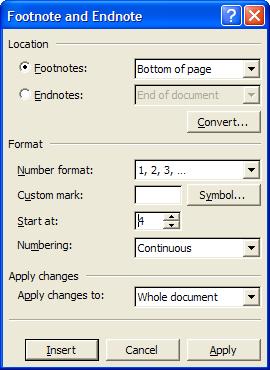
Because we need the first footnote to start at 4, type ‘4’ in the ‘Start at:’ text box as shown above.
Click Apply to restart the numbering.
[1] To whom any correspondence should be addressed.
[GMD1]

|
Из за большого объема этот материал размещен на нескольких страницах:
1 2 3 |
