

Партнерка на США и Канаду по недвижимости, выплаты в крипто
- 30% recurring commission
- Выплаты в USDT
- Вывод каждую неделю
- Комиссия до 5 лет за каждого referral
Arto Mustajoki
University of Helsinki; Academy of Finland
Research universities as producers of new knowledge and innovations
In society there are four major user groups for new knowledge: the business sector, public sector, media, and ordinary citizens. As the picture on the next page shows, the impact of new knowledge may be seen in the prosperity of nature, the prosperity of the economy, wise decision-making, a well-functioning society, and the proper behaviour of citizens. All of these contribute to the ultimate goal of society, which is the well-being of people. All knowledge users can benefit from any kind of research, regardless of whether it is about nature, the human-made physical environment, human institutions, humans as a biological species, or humans as social actors.
With regard to the business sector as a user of innovations and new knowledge, we often think that it is about new products which are based on advanced technology and new materials. But other matters are often even more important for the success of enterprises: for example, a proper understanding of the needs of society/consumers (“green thinking”, new living trends, new customer sequence, a cheaper or faster production process), a better leadership concept (e. g. paying attention to the needs of multicultural personnel), a more effective distribution channel (logistics, opportunities of mobile distribution), or a better localization of the product by taking into account cultural features of the country concerned.
In the public sector we can use new knowledge in evidence-based decision-making (legislation, statutes, rules, top-down regulations and guidance) and in the planning of various administrative procedures and public services (education, healthcare, transport, courts, culture, leisure services, etc.). While in the business sector one can calculate the benefit on the basis of profits or the number of employees, in the public sector wise decision-making and effective planning of services save taxpayers’ money and have an impact on all kinds of activities in society. Societal innovations and other optimising administrative processes are problematic in a society which demands numerical data to show the exact benefit we gain. There are three challenging factors here. First, the financial gain often comes only in the long run (even in 20–30 years). Second, research is never the only factor which influences decisions and people’s behavioural choices. Third, the consequences (benefits) are, as a rule, too enormous to calculate. One example is enough: if, due to a new teaching method, school children learn mathematics 10% better than earlier, 10–15 years later we will have more accomplished engineers. This will lead to a substantial growth of opportunities in the business sector, based on knowledge in technology and engineering.
You may ask why citizens should be regarded as an important target group for new knowledge. The answer is quite obvious: “good, intelligent citizens” are able to use any kind of knowledge in building up their skills and their world picture. They are wise educators at home and effective and creative workers wherever their work. They are also smart consumers and wise voters, and overall they behave in a constructive way and do not destroy their own lives, society, or nature. In every user group there are obstacles to deriving benefit from new knowledge. For ordinary citizens a major problem is clinging too tightly to traditions. A new obstacle is the mass media, which often boosts non-scientific information and humbug.
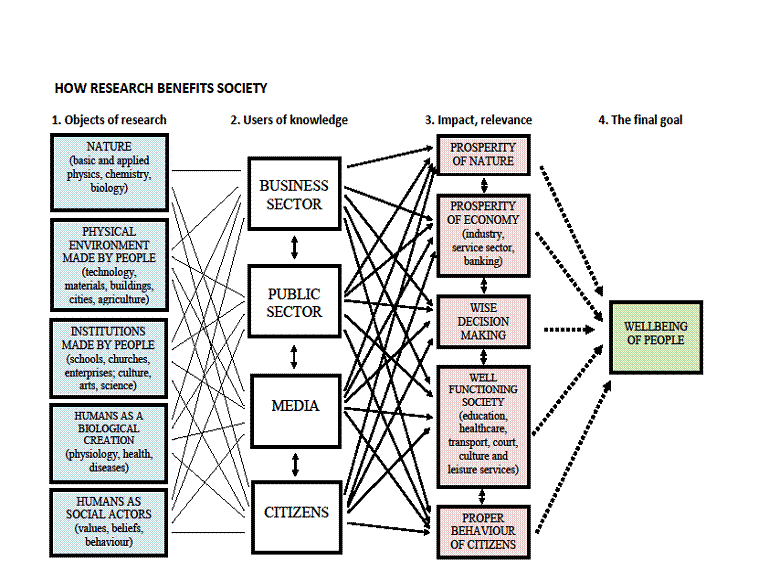
As to the forms of creating new knowledge and innovations, we often think that the main way to do this is to carry out high-level research in universities and then disseminate the results to the knowledge users. This is, of course, possible, and every modern society is trying to boost such research. But in actual fact the majority of innovations are made in enterprises themselves. This is possible only if the people working there are capable of creative and innovative thinking and practical solutions. Here we come to the role of university education. Considering the role of universities as a whole (including research-oriented ones), we can easily conclude that the most important part of their societal impact comes through the alumni they “produce”.
The same concerns influence on the public sector. University professors and teachers write reports for authorities and take part in committees and working groups. Nevertheless, the most powerful way of influencing society is by educating future workers, employees, and employers. Or to take another concrete example: writing textbooks and other teaching materials is a major tool in building up the knowledge that young people acquire, but teacher education is even more effective.
Researchers (especially the best ones in scientific terms) tend to think that it is enough for them to carry out high-quality research. From the point of view of the career of an individual researcher it is indeed enough, and as we all know, it is also important for the reputation and ratings of universities and entire countries. But if we consider the role of research and universities in society, we must also think of the dissemination of research. As was mentioned above, students are the main channel for this. In both teaching and other kinds of dissemination of knowledge, the original source of the knowledge is not relevant from the user’s point of view. Even a big country produces only a small fraction of the total amount of scientific output in the world (in the case of Russia, less than 3%). This means that the task of a university teacher is to disseminate to students and to the whole of society new knowledge which is produced by the entire global research community, i. e. also by researchers abroad who produce the remaining 97% of publications. Thus, the idea of a research university is not that teachers should teach only those things that they themselves have investigated. High level research is important in another way: only those who are prominent, experienced researchers are able to collect and critically analyse knowledge produced by their colleagues in different parts of the world.
Finally, one can ask why research and universities are so vital in a modern society. Among a variety of important explanations, there are three major factors which emphasise the special need for new knowledge and research in a modern globalised world:
1. Success in business is more and more based on the results of top-level research => WE NEED world-class research in high-tech fields (nanotechnology, bioinformatics, new materials, etc.).
2. All human activities are based on interaction between people (at home, in administration, in enterprises, etc.). In the contemporary world, interaction often takes place between people from different backgrounds. => WE NEED research and understanding of cultures and human interaction.
3. We live in a changing world. The facilities provided by new technology (Internet, social media, etc.) strongly affect people's behaviour, the way they think and act. => WE NEED research on the consequences of the behavioural pattern change of (young) people: what they know, what they are able to do, and how their brains work.
