

Партнерка на США и Канаду по недвижимости, выплаты в крипто
- 30% recurring commission
- Выплаты в USDT
- Вывод каждую неделю
- Комиссия до 5 лет за каждого referral
Globalization and Synergistic Philosophy of History
Vladimir BRANSKY
Svyatoslav POZHARSKY
Introduction
Globalization is an important modern phenomenon which has penetrated different spheres of our life (economic, political, cultural, etc). Its complex character is difficult to understand without seeking an explanation in the philosophy of history. Globalization is a special type of social self-organization, so its analysis is better made on the basis of the general theory of social self-organization, which is social synergetics (Haken, 1999; Nazaretyan, 2001; Sagatovsky, 2003; Yegorov, 2002; Mosiongnik, 2003; Knyazeva, Kurdyumov, 2005, etc). Hence, for a successful analysis of globalization we need a synergistic philosophy of history (synergistic historicism). Theory of social self-organization studies general laws of the relationship between order and chaos, the tendency of overcoming the opposition of chaos and order, and it gives a clue to the explanation of an arising tendency of humankind to create a global unity on the basis of ever-growing local diversity in the last quarter of the 20th century. The synergistic theory of globalization gives not only an explanation to the observed process of globalization, but also can predict the development of this process in the future. Although globalization as a phenomenon is connected with such well-known processes as integration (amalgamation of social structures into structures of a more complicated type), modernization (the use and spread of advanced technologies), glocalization (the spread of some local institutions, ideals and values on a planetary scale)[1], nevertheless it cannot be reduced to these processes only.
Globalization as a form of integration (it is necessary to distinguish different aspects of integration) is characterized by the following main terms and features: integration of social institutions (establishments, organizations); integration of functions of these institutions and knowledge necessary for their functioning; integration of ideals (value references) defining motives for the functioning of the institutions; integration of norms of behaviour according to the ideals; and integration of sets of values created by such activities based on the corresponding ideals (value references, ideological outlook). Among the main features of globalization we want to emphasize the following: comprehensiveness (many aspects) showing the tendency to integration in three main spheres of human activities (economic, political and socio-cultural) (Utkin, 2002; Chumakov, 2005; Yakovets, 2003; Panarin, 2003; Friedman, 2000; Robertson, 1992, etc), mass participation (‘democratization’), i. e. involvement in the process and a tendency to participate actively in this process by all social layers; planetary character (‘global’), i. e. the tendency of all the above-mentioned integration processes to cover the whole world; spontaneity (self-organization, spontaneous character), i. e. the lack of the external sources functioning as a special organizer; chaotic character of the process, i. e. no orderly arrangement of integration processes and the presence of occasional fluctuations.
1. Synergistic Philosophy of History
The synergistic philosophy of history[2] consists of three parts, which answer three main questions: how, in general, self-organization takes place (phenomenology of self-organization), why it takes place (essenceology of self-organization) and where it eventually leads (eschatology of self-organization, from the Greek word ‘eschatos’ meaning ‘last’ and ‘logy’ meaning ‘the study of’).
As the basic concept of social synergetics is a ‘dissipative structure’[3], the phenomenology of self-organization can be reduced to two alternative processes: hierarchization and de-hierarchization.
Both of these processes are connected with such important elements of self-organization as bifurcation[4] and attractors. Due to bifurcation the processes of hierarchization and de-hierarchization can evolve differently using different channels (scenarios). This results in self-organization acquiring a ‘branchy’ (non-linear) character. In addition, owing to the presence of attractors, self-organization has a ‘wavy’ form (it oscillates between marginal states of opposite types: between the so-called ‘simple’ and ‘strange’ attractors[5]).
The driving force of this process is social selection. Its main factors are: ‘thesaurus’ (the multitude of new possible bifurcation structures resulting from the transition of quantitative changes into qualitative ones in the depths of a currently existing structure); ‘detector’ (inner interaction of the original system); ‘selector’ (the principle of stability, on the basis of which the detector chooses such a new structure from the thesaurus which is the most stable in a given environment). Thus, essenceology of self-organization is, in fact, a synergistic theory of social selection.
In order to have a complete picture of social self-organization it is necessary to answer the question whether the alternation of hierarchization and de-hierarchization is simply a circulation of the same processes resulting in nothing new (in other words, whether we are always confined within the same ‘fussy fuss’), or in the alteration of above-mentioned processes there is some qualitatively new tendency leading us outside the limits of that circulation. It is the answer to this question which constitutes the content of eschatology of self-organization.
The analysis of the alternation of order and chaos shows that this process essentially differs from the alternation of different types of order or different types of chaos (considered separately from each other). Unlike alternation of ‘pure’ order and ‘pure’ chaos, the alternation of forms of order and chaos necessarily brings something new (in a general case). The thing is that bifurcation and strange attractors are inevitably connected with the appearance of new possible structures. That is why the circulation of social chaos and social order generally turns out to be unstable. Prigogine[6] considered that the loss of freedom by mankind didn’t seem to be the best way out of a new bifurcation but, on the other hand, a world in which everything was decided by chance would hardly satisfy anyone. Thus, the question is where to find a compromise and whether another trajectory is possible. Prigogine comes to the conclusion that nobody can give an exact answer if to consider mankind from the position of the theory of processes far from equilibrium[7], but it is possible to say, for sure, that globalization and network revolution lead not only to greater connectedness between people but to the increased role of an individual in the historic process (Prigogine, 2000: 73).
It is not difficult to notice that Prigogine speaks about two opposite tendencies in the development of modern mankind: a stable growth of dependency of each individual from the surrounding planetary socium is accompanied by a stable growth of dependency of the planetary socium from every individual living in it. The first tendency is the attraction to total programming (i. e. to the cult of order, or totalitarianism), the second is the attraction to total permissiveness (i. e. to the cult of chaos, or anarchism).
Thus, a simple alternation of social order and chaos is not only interrupted by the existence of some domineering tendency, but these two tendencies (order and chaos) lead in opposite directions (in fact, excluding each other). A similar contradictory situation to which a social self-organization leads has a special name ‘Prigogine’s paradox’ (Bransky, Pozharsky, 2004: 330-332). So, eschatology of self-organization faces a very important problem: how can Prigogine’s paradox be overcome?
The clue to the solution is in the concept superselection, which implies the selection of the very factors of selection (i. e. the search for new thesauruses, detectors and selectors). The key element is that there is a feedback between the results of selection and its factors. New bifurcations and new attractors form new possibilities permitting the appearance of any number of complicated and puzzling structures (in other words, essentially modifying thesaurus for selection). Thus, a new game is born which has its own rules for selection (new selectors changing the old ones). New value references, i. e. social ideals, perform the role of these rules.
With their help, quite new structures arise from this renewed thesaurus and are realized (become a reality).
From all what was said above, it becomes clear that the modification of selection rules (principles of stability in the corresponding external environment) creates the basis for the functioning of the law of self-organization of social ideals, because in socium the role of a selector for the selection is played by corresponding social ideals. In fact evolution (modification) of selectors turns out to be equivalent to the evolution (modification) of ideals[8].
It is well-known that evolution of ideals presupposes their interaction (‘struggle’), and in the course of struggle we can observe a tendency of discarding features typical for individual ideals, leaving only the core ideals common to all humanity (independent from individual modifications).
The formation of a common ideal (absolute) out of the individual (relative) ideals in the course of struggle excludes not only the cult of order (totalitarian ideal) and the cult of chaos (anarchist ideal), but also incomplete harmony (distorting shift in one or the other direction) of chaos and order (freedom and responsibility in liberal ideals of different kind, for example).
The most important normative criterion for this ideal is the requirement of complete harmony of freedom and responsibility (chaos and order).
Thus, in the course of self-organization we can observe a tendency of formation and realization of a common ideal which realizes a complete synthesis of chaos and order. It means that the law of superselection makes their alternation unstable and leads to the gradual ‘dying out’ of this process. In the end a complete synthesis of chaos and order, which is expressed in the subjective form of the absolute ideal, receives an objective implementation in the form of a special dissipative structure.
A social system implementing such synthesis turns out to be a maximal result of social self-organization, stable not only to some local but also to a global chaos of the environment. It can be considered as ‘the ceiling of the complexity of a system’, i. e. the limit of cultural development of mankind capable to neutralize and compensate any unfavourable impacts of the environment. Such a system can be considered as a global attractor, or superattractor, to which all local attractors tend to go directly or indirectly.
However, though it is possible to approach the superattractor, it is not possible to reach it in any historic time. It means that history must have an end, but the way to it is infinite.
The cause of such paradox of ‘reaching what is not possible to reach’ (Knyazeva, Kurdyumov, 2005) is in the following: every time, while realizing some individual ideals, we overcome some social contradictions[9], but the process itself gives birth to new contradictions which demand new ideals for the solution. So, through this potentially infinite chain of individual ideals, a common human ideal is understood as some point which mathematicians call ‘asymptote’[10] and which plays a role of a ‘star showing the way’ for human beings.
Hence, Prigogine’s paradox can be solved in the superattractor. As the superattractor is an objective synthesis of chaos and order where the distinction between these objective states disappears, it is not surprising that two opposite trends (trying to attain either an absolute order or an absolute chaos) are realized in parallel.
It is evident that without admitting that there is a superattractor, Prigogine’s paradox cannot be solved in principle. Moreover, the concept ‘superattractor’ not only helps to solve Prigogine’s paradox, but also predicts the possibility of the creation of absolute values (not subject to the ‘vanity of being’).
As a consequence the history of mankind acquires a deep sense without going out of the framework of the scientific approach. The infinite approach to the superattractor is not deficient at all, but the advantage of a synergistic perception of the world both from the philosophical point of view and from worldly wisdom implies that the ‘meaning of history’ (hence, the meaning of an individual life and death) is qualitatively unlimited and can never be lost.
2. Synergistic Model of Global Progress (SMGP)
After briefly outlining the subject of the study in the synergistic philosophy of history related to our paper, we can use it now for the analysis of such a unique phenomenon as globalization. Under consideration now is the question of human aspiration for global unity which revealed itself at the turn of the 20th-21st centuries. On the basis of the conception of synergistic historicism described earlier in this paper, a Synergistic Model of Global Progress (SMGP) can be constructed (Figure 1).
In Figure 1 the objective tendency towards global self-organization is depicted: the alternation of states of social order and chaos gradually ceases to exist as a result of overcoming the opposition between order and chaos (in their synthesis) in the superattractor C. This tendency is objective not in the sense that it does not depend on human actions, but that it is the result of spontaneous interactions between these actions. Figure 1 shows how the chains of bifurcations and local attractors step by step push mankind to the superattractor C. The spirality of movement illustrates the asymptotic character of this process, i. e. on the one hand, the presence of a special point C (‘singularity’[11]), but, on the other hand, the potential infinite number of approaches to C; the wavy line denotes the equilibrium of the global social system between simple and strange attractors (alternation of processes of hierarchization and de-hierarchization), simplification and complication of these structures; the ‘branchiness’ denotes the nonlinear character of the movement connected with bifurcations of different types (coincident and not coincident with attractors).
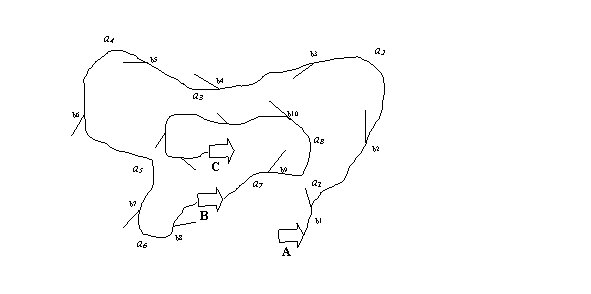

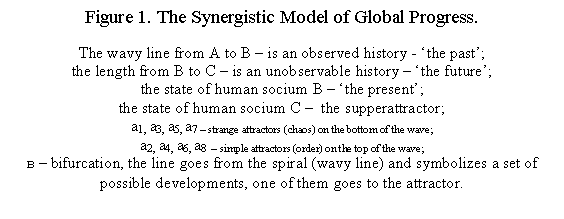
Point A denotes conditionally the beginning of a social history known to us; point B is the modern state of global socium; point C is its end state (superattractor). Bifurcation (‘branchy’ line) and attractors (‘wavy’ line) in Figure 1 show visually where the diversity of dissipative structures comes from which characterizes self-organization. A gradual approach of the trajectory of self-organization to the point C (spirality and singularity) also demonstrates visually the movement of global social variety to the unity.
So, the synergistic philosophy of history reveals the essence of globalization in such a way: globalization is observed because there is a movement of socium to the superattractor with movement to the unity taking place on the basis of a dynamic diversity but not a static one. The Synergistic Model of Global Progress ‘addresses’ us with the slogan: “Go ahead to the global unity on the basis of potentially infinite (not finite) local diversity!”
3. Characteristic features of a globalization process
Synergistic approach to globalization allows us to predict a number of characteristic features of the process which have not been observed clearly yet, but which are almost certain to have to be dealt with in the future. We want to draw your attention to the most important ones in our opinion.
Globalization will reveal itself first of all in the tendency towards integration of social structures (institutions, enterprises), social ideals (value references) and social values based on such ideals at the planetary scale and associated with the information revolution in communication technologies (computerization and the Internet). This integration will acquire a synergistic character, i. e. to be expressed in hierarchization of dissipative structures leading to the formation of upper dissipative structures of higher order (‘networkization’) built on the top of the previous ones.
We should discern, first of all, one-dimensional globalization from comprehensive globalization. One-dimensional globalization takes place only in one sphere of social life (for example, economic). Comprehensive globalization covers all spheres of activities – economic, political, socio-cultural, etc. Though at the turn of the 20th-21st centuries globalization is predominately economic, there is a tendency of its penetration into political and socio-cultural spheres.
Also, homogeneous (not mixed) globalization should not be confused with heterogeneous (mixed) globalization. The former implies integration of dissipative structures in the framework of one social sphere (for example, only economic structures or only political structures), the second is connected with the integration of structures belonging to different spheres (for example, economic and political, economic and socio-cultural, political and socio-cultural and so on). Thus, in the future, mankind will inevitable come across the tendency of mixed dissipative structures of very different types and the formations of ‘network’ structures on the basis of them at the upper level, perhaps, of some unusual and extravagant character.
There are also two types of globalization related to stability criterion: stable and unstable. We come across unstable globalization very often in our life. The specificity of stable globalization evidently consists in the economic foundation of economic globalization connected with new information technologies. As such this type of globalization (especially as seen in the formation of a lot of transnational corporations – TNC) is the consequence of economic self-organization. But this type of globalization is only possible on the basis of interaction between economic order (planning, business plans of companies) and economic chaos (market, market competition, which is taken into account in business plans). Hence we have a synergistic character of the market economy, and hence a counterposing or an absolutization of both a planned economy and a market economy is inadmissible because both market fundamentalism and planning fundamentalism are inconsistent.
In the synergistic philosophy of history, it is especially important to distinguish relative and absolute globalization. According to the phenomenological alternation of processes of hierarchization and de-hierarchization of dissipative structures, planetary globalization will one day reach the unstable state leading to de-globalization (disintegration of global structures into many new local structures). But this new social chaos (combining elements of economic, political and socio-cultural elements) will show the tendency to a new globalization due to the creative function of chaos. Due to the superselection alongside with instability of any new global order, the instability in the alternation of order and chaos itself will appear.
Consequently, there will again be the movement to the superattractor, i. e. to such a state where any de-globalization becomes impossible. Hence the absolute globalization is not a conitnuous process but it is implemented according to the method of successive approximations.
Perhaps, the most important expectation about the future of globalization is that due to the inevitability of the co-evolution of an individual (a man) and socium (mankind), the globalization of mankind will lead to the globalization of an individual (‘the problem of a supraman’). The concept of a superattractor implies such meanings as ‘suprahumanity’ and a ‘supraman’. The law of self-organization of social ideals implies evolution of not only the ideals of socium but those of an individual. In other words, in the course of social self-organization we deal not only with people but also with their ideals what kind of people they must be. So the ideal of a totalitarian man emerges (who meekly follows all state’s orders), the ideal of an anarchist (who, on the contrary, rebels against all state’s orders), the ideal of a liberal man (who supports a certain balance of freedom and responsibility) and so on.
In the course of the evolution of different individual ideals of a man, the tendency appears to lead to the gradual formation and realization of ideals common to all humanity (‘absolute’) reflecting in itself the common human basis in any man – the common spiritual basis for all human generations (past, present and future). Synergistic conception of a supraman implies the conformity of a real man formed at the end of history with an ideal of a man common to all (absolute).
In other words, in reality, a supraman is the embodiment of the common human ideal of a human being which is, in its turn, the product of the whole world history. Only in such a man it is possible to achieve an absolute harmony of freedom responsibility, rights and duties[12].
Globalization of socium can produce a different impact upon the change of human nature in a short term and in a long term. In the short term, globalization of socium can make the nature of man worse instead of improving it. It can produce a degrading effect upon the personality (which can be observed in a number of regions and layers of our society now). Hence we distinguish a socially responsible globalization and socially irresponsible globalization.
So the practical question is how to make a globalization process humanistic (and how to avoid an alternative scenario)? An analysis of this question from the synergistic position demands that we first answer what a historical meaning of economic growth so much spoken about by governments is.
There are two approaches to the solution of this problem. In the first the demand in economic growth is connected with the need of survival of humanity, in the second with the growth of material well-being for as many layers of society as possible. Evidently without economic growth it is not possible to guarantee both ‘survival’ and ‘well-being’. However, if synergistic philosophy is applied, the ‘meaning of history’ is not limited in any way by the solution of narrow tasks: it is the movement to the superattractor, in other words, it is connected with the formation of a supraman and suprahumanity (i. e. suprahumanization[13]). It means that for the definition of the meaning of history the decisive role belongs to spiritual values but not utilitarian ones. The creation of utilitarian values is not the aim, it is a means for providing the necessary conditions for a spiritual creativity connected with the perfection of the human nature itself.
Thus, the only justification for economic growth (which can be discovered only in the long term perspective) is the need to finance suprahumanization. Hence, globalization must be channeled into a humanistic direction, it is necessary to spend the greater part of global macroeconomic profits received by the world community on suprahumanization in the long term perspective. The synergistic philosophy of history connects globalization of humanity with the solution of an eschatological problem: whether social history has an end or whether there cannot be any end at all. The answer is paradoxical but not illogical – there is an end but the movement to it is infinite.
4. A synergistic scenario of globalization
What is a practical significance of the synergistic theory of globalization? It gives us a hint what to do next. The clue to the solution of social problems under globalization lies in changing human behaviour and values. Hence, two other questions will follow: what transformation of a man is optimal and how to implement it in practice? The choice out of many possible ones can be determined with the help of the synergistic theory of globalization. We must decide which modification is the shortest way to the realization of the ideal common to all human beings in the image of a supraman (suprahumanization). In this image the full (‘absolute’) harmony of rights and duties (freedom and responsibilities) is achieved which implies unconditionally the priority of spiritual values over material ones. Only a man, who is neither totalitarian nor anarchic man, inspired by the idea of the harmony between freedom and responsibility and who treasures spiritual values more than material ones can become an important preliminary stage in the formation of a supraman.
But the transformation of a man presupposes the formation of many supramen around. So the question is how to transform the consciousness of so many people? Though the natural way for the change of ideals and the transformation of a man is the change of generations, for the formation of a supraman it is not enough: a new system of education, up-bringing and empathy (the reform of humanistic activities) must be created. It will also demand the reform of social institutions which is not possible without political and economic reforms. The transformation of a man demands his new attitude to nature and the use of its resources.
Thus, the transformation of a man is not possible without the transformation of his surrounding world. However, not all transformations of the world are connected with the positive transformation of a man (‘positive’ means leading him to a supraman); it is possible that some transformations of the world can produce a negative effect upon a man (degradation in scientific, ethical, aesthetical and other fields). The question arises: what is the form of a society which can realize on a mass scale the ideal of a supraman? What must be the social structure which will be able to combine a high stability of socium with high ‘quality’ of all its individual representatives?
It is the society in the economy of which the socio-cultural services prevail. Only they, thanks to their specificity, can provide the stable improvement of ‘qualities’ of an individual. These services are connected mainly with education, up-bringing and empathy. The ‘quality’ of man depends, first of all, on the quality and quantity (volume) of his knowledge and skills which he uses or develops. Secondly, it depends on his world outlook, social ideals and moral norms based on his world outlook and the ability in implementing the ideals. Thirdly, it depends not only on his rational but also emotional development (i. e. the degree of empathy towards other people expressed directly or experienced indirectly through art). The institutions which provide services for the development of such qualities are educational, scientific, medical, ideological[14], sport and art institutions.
Researchers often use such terms as post-industrial, network, informational society and so on, which is misleading. Socium is a dissipative structure and such a structure cannot exist without a regular exchange with its surroundings (nature and society) via substance and energy in any case. But such an exchange is not possible in a modern society without industrial machinery. Thus the ‘post-industrial’ society contrary to ‘pre-industrial’ society, cannot exist, in principle, according to synergistic theory. The same can be said about information society: any society is an information dissipative structure, it cannot exist without an exchange of information.
The best name for a society with the predominance of socio-cultural services will be post-utilitarian society. It best expresses the most important feature of this society: the shift from the financing of utilitarian ideals to the financing of the realization of spiritual ideals (the production of spiritual values).
Thus, in the solution of the problem of how to create a supraman (in our specific meaning) and post-utilitarian society, a socio-cultural shift should be subsidized from global macro-economic profits. Different social forces will suggest their different variants how to do it.
Nowadays the struggle between globalists and anti-globalists is in fact the struggle for the optimal way of globalization (Panarin, 2003). Everyone supports globalization on the basis of one’s own social ideals and is against globalization on the basis of the other’s ideals. One wants to transfer his local ideals to the global level. In this case it is especially important for societies to use such a selector as a ‘principle of minimization of violence in the dialogue’.
Conclusion
Speaking about the optimal choice of the scenario for globalization, the question of the possibility of governing the process naturally arises. But globalization is a special type of social self-organization, and self-organization and governance are conflicting processes.
If we consider this paradox within the framework of synergistic historicism, this paradox will turn out to be illusory. According to the synergistic theory of social choice the moving force of self-organization is a social selection (the interaction of a thesaurus, detector and selector). The role of a detector is usually played by the inner interaction of elements of the system (the ‘balance of power’ determining the direction of the change of the whole system).
So, the contradiction between self-organization and governance will take place until the governor acts as an external element towards the self-organizing system. When he gets inside the self-organizing system the situation changes radically. Now, his activity is an important element in a process of self-organization. The governor becomes a part of a detector and begins to participate actively in the inner interaction between elements of the system influencing the selection of possible bifurcational scenarios of the evolving system (owing to his influence upon the balance of power). But the governance is the choice of one out of many possible decisions. Influencing the selection of possible scenarios (resulting from bifurcation) and in the (preferable for him) direction the former external observer becomes a participant of governance of self-organizing system.
Thus it is possible to govern globalization if a governor is inside the self-organizing global system and becomes a participant in the inner interaction which takes place in the system (‘interiorization’ of governance). However, the governance of a globalization process within both a short and long term has its own peculiarities. In a short term, a governor can provoke new bifurcations and new acts of selection, consequently, he can produce an impact upon the direction of a globalization process. As far as a long period of time is concerned he can only speed up or slow down the process in a certain direction, but he cannot change the direction itself. It may happen that in the long-term perspective there is a great probability of ‘getting into the detector’ (interference in the inner interaction) by other governors influencing the inner interaction not only in various directions but in various opposite directions. As a result, a globalizing process can be unstable during a short period of time, but becomes stable during a long period of time due to intercompensating fluctuations and counterfluctuations caused by different governors.
Thus globalization can be better understood within the framework of the synergistic philosophy of history. The complete unity is not possible to reach in the limited (finite) diversity. Such unity can be reached only in the potentially infinite diversity and it cannot be static: it is always dynamic both horizontally (enlargement of variants on the qualitatively same level) and vertically (appearance of new variants on the qualitatively higher level). Any globalization leads to a new de-globalization, and new de-globalization leads, in its turn, to a new globalization. However this process must have an end and the movement to the end is asymptotic (infinite approximation).
[1] The term ‘glocalization’ is the blending of the terms ‘globalization’ and ‘localization’. It generally means the interaction of local and global forces: ‘the global’ becomes local and ‘the local’ becomes global (ed.).
[2] There is a narrow and wide explanation of synergetics, but all agree that the subject of it is the study of the laws of self-organization. Self-organization can take place both in a human society and in nature. Social self-organization includes the conscious attitude of human beings to the process. The narrow understanding of synergetics is the birth of order out of chaos. When we deal with social self-organization we have a series of movements from chaos to order. The process of hierarchization and de-hierarchization is very important in this case (see more about synergetics in Editor’s Notes).
[3] The dissipative structure is a structure which can exist only if there is a constant exchange of some substance, energy and information between the structure and environment (in a general case).
[4] Bifurcation means the splitting of a main body into two parts. This term can also be applied to the sets of diverging directions as a result of splitting.
[5] A simple attractor is the end state of hierarchization of a social structure (maximal order); a strange attractor is the end state of de-hierarchization (maximal chaos).
[6] See Editor’s Notes.
[7] synergetics
[8] It means that the law of self-organization of social ideals is a necessary consequence of the law of superselection.
[9] Idealization of reality is, in fact, the liberation of it from objective contradictions (in the meaning of interconnectedness of opposite qualities or interaction of counteracting factors).
[10] A linear asymptote is a straight line that a graphed curve becomes closer and closer but never becomes identical to (ed.).
[11] ‘Singularity’ near which a function exhibits extreme behavior.
[12] The concept of a ‘supraman’ in the synergistic interpretation is possible to trace to Feuerbach, Nietzsche, and Solovyov. However, their interpretations of a ‘superman’ are essentially different from ours.
[13] Suprahumanization is such a process of social self-organization the result of which is the formation of a new man who is the absolute human ideal of a man.
[14] We also include philosophical and religious organizations into ideological category.
