

Партнерка на США и Канаду по недвижимости, выплаты в крипто
- 30% recurring commission
- Выплаты в USDT
- Вывод каждую неделю
- Комиссия до 5 лет за каждого referral
RECENT RESULTS IN STUDIES OF THE T-ODD ASYMMETRY OF LIGHT PARTICLE EMISSION IN COLD POLARIZED NEUTRONS INDUCED TERNARY FISSION
A. Gagarski a, G. Petrov a, T. Zavarukhina a, F. Gonnenwein b, P. Jesinger b, M. Mutterer c,
J. von Kalben c, W. Trzaska d, S. Khlebnikov e, G. Tyurin e, S. Soloviev e, V. Nesvizhevsky f, A. Petukhov a, f, E. Lelievre-Berna f
a Petersburg Nuclear Physics Institute, Gatchina, RUSSIA
b Physikalisches Instituit, Tubingen, GERMANY
c Institut fur Kernphysik, TU Darmstadt, GERMANY
d Department of Physics, University of Juvaskyla, FINLAND
e Khlopin Radium Institute, St. Peterburg, RUSSIA
f Institut Laue-Langevin, Grenoble, FRANCE
1. INTRODUCTION
In 1998 we have started to study an angular correlation in ternary nuclear fission induced by cold polarized neutrons of the type:
W(W) ~ 1 + <D>×s×[ pf x pa] ,
where pf – momentum of the light (heavy) fission fragment (FF), pa – momentum of the light ternary particle (TP), s – neutron spin. The correlation is formally T-odd and the idea to study it was put forward in the context of possible test of the Time Reverse Invariance (TRI) in neutron reactions in analogy to the similar correlation s×[ pe ´ pn] in the polarized neutron beta decay [1,2]. However, in non elastic processes nonzero value of such an asymmetry does not mean breaking of the TRI in fundamental processes, it can also arise as a result of the particles interaction in the initial and final states of the reaction [13]. In fission reaction it can be closely connected with fission mechanism.
In the first experiments at the cold polarized neutron beam () unexpectedly high values of the asymmetries were obtained for 233U and 235U ternary fission [3,4,5,6]:
<D> | 233U : –(2.52±0.14)´10-3 | 235U: (+0.83±0.11)´10-3 |
Also in those experiments it was revealed that the absolute value of this asymmetry strongly increases with the TP energy for both isotopes and the asymmetry coefficient for ternary α- particles and hydrogen isotopes appeared to be identical within the experimental accuracy.
Obviously it can’t be TRI violation, but rather some interplay of all angular momenta involved into the reaction. That is less sensational interpretation, but, because of its close connection with the fission mechanism, looks very promising. Probably, studying of the correlation may serve us as a tool to study fission process.
In theoretical model proposed by V. Bunakov [7,8,9] the correlation is explained in statistical approach. In the respective projection of FFs spin at the scission point there is a contribution from the incident neutron spin, also, there is a contribution from the angular momentum carried away by TP. In our experimental geometry, where the directions of registration for TPs, FFs and the neutron spin orientation are mutually orthogonal, the orbital momentum of TP is directed in parallel or anti parallel with the neutron spin. Thus, we will have increase or reduction of the total residual angular momentum along the axis depending on the TP emission direction. The density of levels of FFs at scission depends on the momentum projection, but in Statistical model: the level density defines probability and, hence, one of the emission directions of TP appears more probable. Here is the formula obtained in Bunakov’s model for asymmetry coefficient of i - fission fragment:
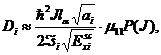
where J – the spin of compound nucleus, lα- - the angular momentum carried away by TP, ai - the parameter of levels density for FFs, P(J) - the polarization of compound-nucleus spin, μ11 - the factor of polarization transfer from the compound nucleus to the FFs at scission point,  - the fragment moments of inertia,
  - the internal excitation of FFs at the scission point.
The compound nucleus polarization for two neutron capture states:
P(J+) = (2I + 3 )/ [3×(2I + 1)]×Pn for J+ = I + 1/2 and P(J–) = –1/3×Pn for J– =I – 1/2,
where Pn is polarization of the incident neutron..
The neutron cross-section in low energy region is a superposition of resonances and, hence, the total asymmetry will be average weighted over involved resonances:
D = [D(J+)×σ(J+)+D(J–)×σ(J–)] / [σ(J+)+σ(J–)] ,
where σ(J±) are partial spin cross-sections.
This model satisfactorily describes the experimental results, at least, qualitatively. Recently Kadmensky and Bunakov have reported another theoretical approach based on inclusion of the Coriolis interaction between TP and the fissile nucleus spin within the quantum theory of fission [10]. The exact numerical calculations in this complex formalism are not yet finished, but raw estimation yields correct order of magnitude for the effect.
For to provide new experimental base for the development and checking of theories some new experiments on the asymmetry study were performed recently: (1) the improved experiment on studding the asymmetry in 233U ternary fission by cold neutrons; (2) the comparative measurements of the asymmetry for 239Pu and for 233U, and (3) the asymmetry measurement for 233U in ternary fission induced by neutrons with energy 0.16 eV.
2. EXPERIMENTAL SETUP
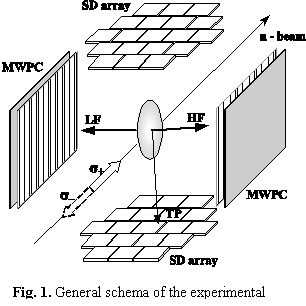 The general schema of the setup, which was more or less similar in all our experiments, is shown on Fig.1. Special features of the individual experiments will be described further. The installation consists of two arrays of silicon detectors (SD) for registration of TPs, two low pressure multi-wire proportional counters (MWPC) for registration of FFs. The fissile target is located in the centre of the detectors assembly and parallel to the beam axis (under a small angle for to minimize neutron absorption). Characteristic distance between the detectors planes is 20 cm. The characteristic size of all detectors is 15 cm. The arrays of SDs are covered by ~30 μm aluminium foil against α-particles of natural activity and FFs. While the natural α’s and FFs are completely stopped, TPs lose only ~1 MeV in this foil. The whole assembly is placed into ~40 litres chamber filled with ~10 mbar of CF4 gas for the MWPCs operation.
Neutrons are polarized along the beam axis. The spin direction and the axes of registration are mutually perpendicular, what is optimum for measurement of the asymmetry of interest.
The experimental value of asymmetry is defined as follows:
<D>expik = (Nik(¯) – Nik(¯))/(Nik(¯) + Nik(¯)),
where Nik(¯) are count rates of the TP–FF coincidences for different directions of registration of light fragment and TP – i (left or right) and k (top or bottom), () (¯) – directions of neutron spin which is periodically (~1 Hz) reversed by spin flipper device. The 4 measured experimental quantities <D>expik in case of s×[ pf x pa] correlation would have same absolute values and different signs depending on the combination of registration directions – ik. Averaging of these quantities with the correct signs gives the experimental estimation for <D>еxp. While the averaging without change of the signs gives estimation of possible false experimental asymmetry <Z>еxp (should be 0 for the T-odd correlation). Additional possibility to control false effects is changing of the guiding magnetic field direction (change of the initial spin situation). Difference in the measured asymmetry absolute values for the two field directions indicates to presence of false instrument effect. In all described experiments the instrument asymmetries were absent within the statistical errors.
In fission two main fragments (light and heavy) are emitted. Evidently, that the signs of asymmetry for them are opposite because of approximately opposite directions of their emitting, and, hence, it is required to separate FFs by mass – at least, to light and heavy groups. For the mass separation we used Time of Flight method (the light fragment is faster according to the momentum conservation law). Having time marks from FFs and TPs it is possible to calculate and plot such times differences:
(tfragment1(or 2) – tTP) (a) or [(tfragment1 – tTP) – (tfragment 2 – tTP)].= (tfragment1 – tfragment 2) (b).
The mass group separation is better for the variant (b), but it is possible to use this only when the target is transparent for FFs and both of them are registered. We used both ways of separation in our experiments. Due to hazard of radioactive contamination of the chamber in experiments with highly active targets we could not use targets on thin fragile foils and we were forced to use thick non-transparent for FFs backings. In this case small ~6% overlapping of the light and heavy FF groups presents.
3. EXPERIMENT ON DETAILED STUDING OF THE T-ODD CORRELATION in 233U TERNARY FISSION BY COLD POLARIZED NEUTRONS
The experiment was performed on the cold neutron beam PF1 of the ILL High Flux Reactor in Grenoble. Capture neutron flux at the exit of the super-mirror neutron polarizer was ~6´108 n/cm2s. The average neutron wavelength was ~ 4.5Å and the polarization was ~94%. Approximately ~3.4 mg of 233U (uranium tetra fluoride) were evaporated as a thin layer ~100 μg/cm2 on a thin titanium foil (~100 μg/cm2) transparent for fragments.
Each SD array for the TPs registration consist of 12 PIN Diodes with size 30 ´ 30 mm each and effective thickness 380 μm. There was an option to determine TP type by measuring of the diode signal rise times together with their amplitudes [15]. In the two dimensional plots the ternary α’s and hydrogen isotopes were nicely separated.
The MWPCs had position sensitivity. The resolution was about 2 mm for both coordinates.
Together with the angular size of individual diodes it made possible to determine all angles between particles and the fission position on the target. Using the time marks from TP and both FFs (tfragment1, tfragment 2, tTP), the reconstructed geometry of fission event and the measured TP energy one can determine real FF times of flight T1 and T2. Despite of not so good relative time resolution (DT/T~1/10), the FFs masses and their total kinetic energy were determined with such formulas:
M1/M2 » T1/T2, E=E1+E2 » L2×A/2T1×T2,
where L is flight path and A is mass of the compound nucleus.
The resulting average asymmetry values for α’s and for hydrogen isotopes are:
<D>a = –3.9±0.12´10-3, <D>p-d-t = –2.9±0.5´10-3
The values were corrected for polarization of neutron beam and for finite solid angle of registration. The total correction factor was ~1.2.
The asymmetry for α-particles as a function of various parameters is shown on Fig.2. Dependence of the asymmetry on α-particle energy (Fig.2a) coincides with one obtained in our previous experiments, but the experimental accuracy was improved. The dependence is well explained in Bunakov’s model by taking into account known anti-correlation between the energy of internal excitation and the TP energy [18]. Higher α energies occur from compact fission configurations where the internal excitations of FFs are small. Because stands in the denominator of Bunakov’s formula, we have increase of the asymmetry with increase of α- particle energy.
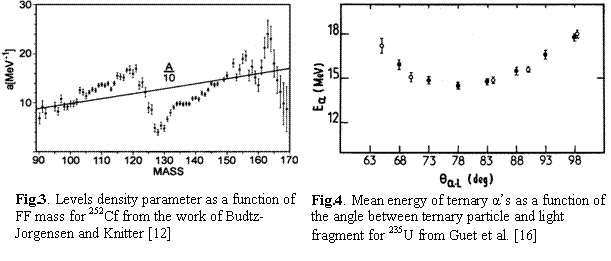
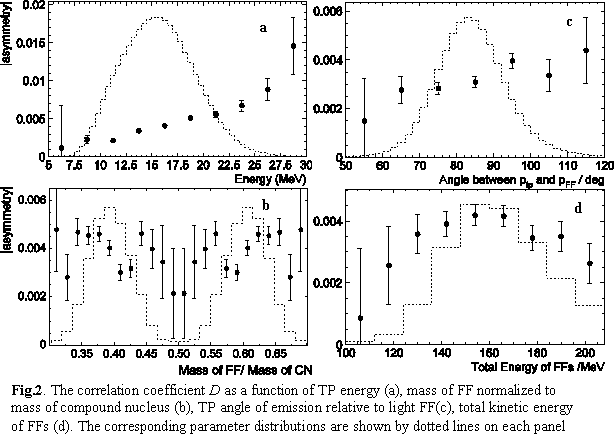 Quite strong fragments mass dependence was observed (Fig.2b). It is still very much washed out by poor mass resolution of the present setup! Such a dependence can be expected in the Bunakov model. The level density parameter and the moment of inertia in the formula are strongly dependent on FF masses [19,11,12].See Fig.3. The minimum around mass ratio 0.56 (FF mass ~130 a. m.u.) in asymmetry coefficient correlates with the minimum in level density parameter. It is known also that just for these masses the deformation and, hence, collective exaltations of FFs are small.
Here we should notice that the average values we have reported after our first experiments [5] are ~1.5 times smaller then we have now. It can be due to the fact that in previous experiment we had not so good performance of our multi-wires counters, not 100 % of their efficiency. It is very probable, that fission events with high mass asymmetry were cut out. We can see that just for these events the asymmetry coefficient is highest. In the present experiment the performance of the detectors was significantly improved and we integrate over whole FF parameters range.
The asymmetry dependence on angle between directions of FF and TP (Fig.2c) should be sine as follows from the correlation formula. It can have some traces from the dependence on TP energy (Fig.2a), because there is known correlation between the angle of TP emission relative to FF and the TP energy [16]. See Fig.4
 The dependence on FF total kinetic energy (Fig.2d) (if one exists…) is not very strong and also can be due to anti-correlation of the TP energy and the total kinetic energy of FFs [17].
4. EXPERIMENT ON COMPARATIVE MEASUREMENT OF THE ASYMMETRY COEFFICIENT IN TERNARY FISSION OF 233U AND 239Pu BY COLD POLARIZED NEUTRONS
The experiment was performed on the same neutron beam PF1 at ILL, with similar neutron polarization, and flux. In this experiment we used two one side targets on a thick 0.3 mm titanium foils non transparent for FFs. One target contained ~0.5 mg of 233U (layer with thickness ~140 μg/cm2), another contained ~1.1 mg of 239Pu (layer thickness ~300 μg/cm2). Both targets were put into the chamber simultaneously as a sandwich.
So, one side time difference (tfragment1(or 2)– tTP ) was used for FFs mass separation.
Two arrays with 4+4 Surface Barrier Diodes were used. Each diode has 70 mm in diameter and their thickness was ~350 μm. There was no rise time discrimination of the particle type and no coordinates on MWPCs. Only integral asymmetry coefficients were compared.
As a result of ~30 days of measurements the following results were obtained:
<D> exp | 233U(I=5/2): (–4.6 ± 0.7)´10-3 | 239Pu (I=1/2): (–0.2 ± 0.3) ´ 10-3 |
The values were corrected for the registration geometry, overlapping of light and heavy FFs mass groups and the neutron polarization – overall factor ~1.3. The data are preliminary and offline data evaluation is not finished yet.
The virtually zero value for 239Pu can be understood in the Bunakov’s model [19].
J-=0 in 239Pu. If no spin – then no asymmetry! For J+=1 state the compound nucleus polarization is high (~0.67), but the resulting spin is small, and then the resulting projection, which defines the level densities of FFs and, hence, final states probabilities, is formed mainly(!) by the orbital momentum of TP. The mutual orientations of the TP momentum and the small component of initial compound nucleus spin are not anymore important. No reason for large T-odd asymmetry!
5. EXPERIMENT ON MEASUREMENT OF THE ASYMMETRY COEFFICIENT FOR 233U TERNARY FISSION BY NEUTRONS WITH ENERGY 0.17 eV
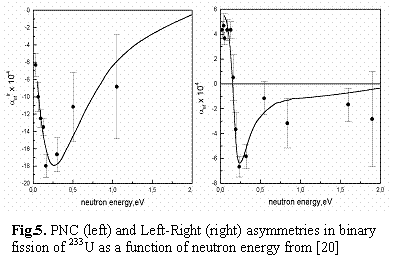 In the most recent experiment (April 2004) we have measured the asymmetry for 233U but for 0.16 eV polarized neutrons. The idea was to check if p-wave resonances are playing role in the T-odd correlation mechanism. Remember, that well known P-odd (PNC) and P-even left-right (LR) asymmetries in fission formed as a result of s- and p- resonance interference in compound nuclei. For 233U they have strong energy dependence for this energy range (Fig.5). What indicates that there is p-resonance in vicinity of 0.16 eV. So if the T-odd correlation is also related to s-p interference, one can expect an amplification of the effect up to 10 times.
The setup was quite similar to previous. The detector assembly was exactly the same like in the Plutonium experiment. Approximately ~15 mg 233U were put on both sides of a thick 22 μm aluminum foil non transparent for FFs. The layers thickness was ~500 μg/cm2.
The experiment was performed on D3 diffractometer at ILL, where monochromatic polarized neutrons were obtained by reflection from magnetized Heusler crystal. Neutron flux for wave length <λ> ~ 0.711Å was ~1´107 n/cm2s. Neutron polarization was ~82%. Iridium harmonic filter was used to cut off higher orders of reflection. Preliminary value of the asymmetry coefficient obtained in ~15 days of measurements is:
–2.4 ± 0.8´10-3
(the value was corrected for the registration solid angles, overlapping of the light and heavy FFs mass groups and the neutron polarization – roughly estimated correction factor ~ 1,4).
The value is only less than 2 standard deviations smaller than for 4.5Å cold neutrons. So, we can say, that there is no strong wave length dependence of the asymmetry. It means that unlike the PNC and LR asymmetries the T-odd asymmetry is not an interference effect of s - and p- states in compound nucleus! This confirms the existing model for the T-odd correlation where the asymmetry (in contrast with the PNC and LR asymmetries) arises in exit channel of the reaction.
6. SUMMARY AND CONCLUSIONS
For better joint description of all available experimental material on the T-odd correlation, further development of the theoretical models required. Such a description necessarily should base on all currently available information about binary and ternary fission. From the other side, studying of the T-odd correlation (and probably other correlations) can itself be an additional source of information on fission mechanism.
We understand that it is necessary to increase quality of the experimental data and to obtain new ones. For example, in is very important to repeat more precisely the measurement of the asymmetry value for. It is isotope where the contributions of individual spins to the cross section are known [14] and the theory can give more exact predictions. The value obtained in our former experiment for 235U should be, very likely, multiplied to ~1.5, because, as it was mentioned above, due to some reason in that experiment we had 1.5 times underestimated value for 233U. We are planning more precise measurements of the asymmetry dependence on FF masses and other characteristics.
Also would be nice to perform precise measurements of the correlation for ternary tritons. There is indication that the value for them is smaller than one for α- particles.
ACKNOWLEDGMENTS
Authors thank the personal of technical services of the ILL, who have done the utmost for these experiments with quit specific safety requirements were carried out.
Authors are grateful for financial support to foundations INTAS (Brussels) (Grant #6417) and RFBR (Moscow).
REFERENCIES
1. K. Schreckenbach, Internal ILL Report 88SCO9T, ILL, Grenoble, 1988
2. K. Schreckenbach et al., in Time Reversal Invariance and Parity Violation in Neutron Reactions, C. R.Gould et al (Ed.), World Sci., Singapore, 1994, 187
3. P. Jesinger et al., Proc. of International Workshop “Nuclear fission and fission product spectroscopy”, Seyssins, France, AIP Conference Proceedings 447, Woodbury, New York, 1998, 395
4. P. Jesinger et al., NIM, A, 618
5. P. Jesinger et al., Yad. Fiz.,, 662 [Phys. At. Nucl.,, 630]
6. Gagarski et al., Proc. Intern. Seminar ISINN-9, Dubna, Russia, 2001, 214-218
7. V. Bunakov et al., Internal ILL Report ILL01BU03T, ILL, Grenoble, 2001
8. V. E.Bunakov, Yad. Fiz.,, 648 [Phys. At. Nucl.,, 616] )
9. V. E.Bunakov, F. Gonnenwein, Yad. Fiz.,, 2096 [Phys. At. Nucl.,, 2036]
10. V. E.Bunakov, S. G.Kadmensky, Yad. Fiz., 66(2003), 1894 [Phys. At. Nucl., 1846]
11. E. M.Rastopchin et al., Yad. Fiz.,, 310
12. C. Budtz-Jorgensen, H.-H. Knitter, Nuclear Physics, A, 307
13. V. Bunakov, L. Pikelner, Prog. Part. Nucl. Phys.,, 337
14. Yu. Kopach et al., Yad. Fiz.,., 900 [Phys. At. Nucl., 840]
15. M. Mutterer et al., IEEE Trans. Nucl. Science,, 756
16. C. Guet et al., Nuclear Physics, A, 1
17. Pannicke J. et al., Proc. Journees d’Etudes sur la Fission, Arachon, France, Report CENBG 8722, 1987, D13
18. P. Heeg et al., in “Proc. Conf. on 50 Years with Nuclear Fission, Gaithersburg, 1989” (La Grange Park, IL:American Nuclear Society), Vol.1, p.299
19. V. E.Bunakov Proc. Intern. Seminar ISINN-12, Dubna, Russia, 2004, this book
20. V. P.Alfimenkov, G. V.Val’ski, A. M.Gagarski et al., Yad. Fiz.,, 799
