


Партнерка на США и Канаду по недвижимости, выплаты в крипто
- 30% recurring commission
- Выплаты в USDT
- Вывод каждую неделю
- Комиссия до 5 лет за каждого referral
Uzbekistan: resuLTS of the REFORMS and further strategy of higher education SECTOR development
1. Main Changes of Policy, Economy and Social Sector
On 1 September 1991 the Republic of Uzbekistan became a sovereign country and faced such challenges as its own way of development and capacity building for reforming of education sector and revision of education content.
Social and economic development of the republic by the beginning of radical reform was characterized by the following:
- During the government managed to stabilize macro-economy, provide economy growth and improve living standards of the population. In 1997 there were increases in GDP (5,2%), in capital investments (by 7% and 17% accordingly), industrial production (by 6% and 6,5%), pay services to population (by 10% and 22,3%). The process of the market economy and legal basis formation of was completed.
- Normative, legislative acts and decisions adopted by the government to regulate tax, financial and monetary-credit policy enabled implementation of a targeted economy policy aimed at market infrastructure development and radical reforms of social sector – education and training in particular.
- A class of owners emerged in the republic; private sector strengthened and began to play an important role in the economy. More than 4,500 joint-stock companies, about 100 thousand small and private ventures were established. A large-scale restructure of privatized companies started. As a result of the reforms the proportion of private sector amounted to 68,9% in net product, 53,4% in industrial production, 97,7% in agriculture output. Proportion of employment in this sector exceeeded 70%. Investment activity revived, proportion of capital investments, which increased by 60%, was directed at development of high priority branches. Foreign investments increased due to implementation of favorable policy for investments attraction. Implementation of structural reforms resulted in development of high priority economy sectors.
In accordance with the Cabinet of Ministers’ Decree № 000 issued on February 28, 1997 called “About Results of Social and Economy Development in 1996 and Priorities of Economy Reforms Deepening” the government decided to design a National Human Resources Training Program.
President Karimov played critical role in the development of the National Model of Human Resources Training Program. His participation identified the system and scientific substantiation of the model.
The Law on the National Human Resources Training Program was adopted on 29 August 1997 at the 9th Session of the Oliy Mazhilis (Parliament) of Uzbekistan.
On 6 October 1997 the president of Uzbekistan signed a Decree on Radical Reform of Education and Training Sector and Perfect Generation Upbringing. The document provided for measures directed at implementation of the National Program for Human Resources Training.
Implementation of the National Program includes the following three phases:
1st Phase () provides for creation of legal, scientific and methodology, financial and material conditions for education system reform and development based on retaining of the existing training system positive potential.
2nd Phase () includes a large-scale implementation of the National Program, its adjustment taking into account accumulated experience of performance, labor market development and actual social and economy conditions.
3rd Phase (2005 and next years) plans perfection and further development of the human resources training system based on analysis and generalization of gained experience in accordance with prospects of social and economy development of the country.
The government’s official education policy is based on the Constitution of the Republic of Uzbekistan (adopted 8 December, 1992) and the Republic of Karakalpakstan (9 April, 1993) and the Laws On Education and on National Policy for Human Resources Training (adopted 29 August, 1997) as well as on some other Presidential and the Cabinet of Ministers’ decrees and guidelines.
The State Education Policy is based on the following principles:
- humane, democratic character of education and upbringing;
- continuousness and succession of secondary special, vocatiopnal, higher and post-graduate education;
- secular education system;
- accessibility of the state standards education for all;
- common and differential approach to education programs selection;
- promotion of gifted and brilliant students;
- combination of public and social management in education system;
- integration of higher education with science and industry.
2. Review of Higher Education System
Higher education system based on secondary special, professional education is an independent modality of continuous education system. Higher education is implemented in accordance with the Laws on Education and on the National Program for Human Resources Training.
The two-step system of training introduced in HEI includes Baccalaureate and Master Degree department.
There are 139 specialties in the Baccalaureate and 1,145 specialties in the Master Degree Department.
There are 62 HEIs in Uzbekistan. 34 HEIS are reportable to Ministry of Higher and Secondary Special Education. The rest 28 are reportable to line ministries and departments.
Admission of students to HEIs is performed via system of tests and some other official procedure of examinations.
Higher education sector students have a legislative right to receive state grants. There are also contract students who pay for their education.
Number of HEIs and Academic Staff
Today national system of higher education is composed of 62 HEIs which enroll 190 thousand students.
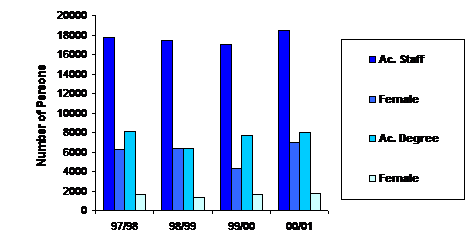
The total academic staff of all HEIs is about 18,5 thousand persons including 1,397 doctors of science and 6,641 PHDs that make up 43,3%.
The diagram below shows number of academic staff and academic staff to student ratio.
Number of Higher Education Academic Staff and Academic Staff to Student Ration
Diagam 1.
Higher Education Institutions Student to Academic Staff Ratio
Table 1
1997 | 1998 | 1999 | 2000 | |
HEI Academic Staff Number (‘000) | 19.5 | 17.8 | 17435 | 18432 |
HEI Students to Academic Staff Ratio (persons) | 10,5 | 8,9 | 9,5 | 10 |
Higher Education Institution by Responsible Ministry
As it is shown in Table 2 below most number of HEIs (32) are reportable to the Ministry of Higher and Secondary Special Education. The Ministry implements all education and methodology activity including design and provision of normative and legal base for all HEIs of the country regardless their responsibility to different ministries. Diagram 2 demonstrates proportion of students enrolments by responsible ministry.
Table 2
№ | Ministry/Department | Number of HEIs |
Total Number of HEIs | 62 | |
1 | Ministry of Culture | 4 |
2 | Ministry of c | 7 |
3 | Agency for Mail and Telecommunication of Uzbekistan | 1 |
4 | Ministry of Agriculture and Water Resources | 4 |
5 | The State Association of Railways "Uzbekiston Temir Uyllary" | 1 |
6 | Ministry of Higher and Secondary Special Education | 34 |
7 | Ministry of People’s Education | 5 |
8 | The State Committee for Sport | 1 |
9 | The Cabinet of Ministers | 1 |
10 | Ministry of Justice | 1 |
11 | Academic of Fine Arts of Uzbekistan | 1 |
12 | Ministry of Foreign Affairs | 1 |
13 | The Kizilkumredmetzoloto | 1 |
Proportions of Student Enrolment by Responsible Ministry/Department
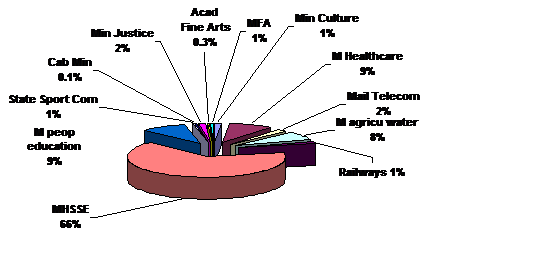
Diagram 2.
Finance Resources and Budget
The system of higher education attract various sources and combinations of finance (governmental and private funds including foreign investments). Today HEIs generate finance resources through development of pay education services, enterprising, consultory, publishing, production, scientific and other activity.
A mechanism of education loans allocation to citizens is being designed that will include a flexible repayment system.
In 2001 goventment’s spending on education made up 11,4% of GDP. The proportion of spending on higher education amounted to 15,8%.
International Cooperation and Ratification of Conventions on Mutual Acknowledge
The Republic of Uzbekistan develops multilateral cooperation in education area with other countries of the world, international organizations and NGOs.
An international and legal base is being designed for cooperation in area of human resources training. International cooperation is implemented in high priority directions. Joint education structures are developed and exchange of scientific and pedagogic resources, academic staff and students is being enhanced.
Many international organizations operate in Uzbekistan implementing education and traing projects. They are: UNESCO, TACIS, ADB, EFE, DTZ, the Soros Fund, the Peace Corps and some others.
Interested ministries and departments, Uzbekistan embassies oversea stir up their activity directed at attraction of foreign investments in education and training sector.
A basis is being created for international acknowledge of national education certificates. Necessary documents are being prepared to join the Lisbon Convention on Higher Education Qualifications Acknowledge 1997.
3. Basic Indicators Taken into Account in Higher Education Sector Reform and Their Efficiency for the Last Decade
Adopted Legislation
The top priority education issue is an efficient and timely implementation of the National Program for Human Resources Training providing for measures to improve education system and form qualitative structure of human potential via implementation of state strategy of continuous education in all its subsectors.
Over 50 governmental decisions have been adopted to achieve the purpose through implementation of the program. These decisions include Presidential decrees and guidelines, resolutions and instructions of the Cabinetof Ministers, decisions of the Commision for Implementation of НППК and of other official bodies. They covered all levels of education and were directed at primary objectives of the education sector development. The following of them are aimed at the education system reform:
- The Law on Education of the Republic of Uzbekistan issued 29 August, 1997;
- The Law on the National Program for Human Resources Training dated 29 August, 1997;
- The Cabinet of Ministers’ Resolution № 000 on Establishment of Fund Naned Uztoz, adopted 30 December 1997;
- The Cabinet of Ministers’ Resolution № 000 on Increase in Salary of Academic Staff of Higher Education Institutions, dated 2 Decembe, r 1997;
- The Cabinet of Ministers’ Resolution № 5 on Design and Introduction of State Education Standards for Continuous Education System issued 5 January 1998;
- The Cabinet of Ministers’ Resolution № 4 on Improvement of Provision of Continuous Education System with Text-books and Learning Resources issued 5 January 1998;
- The Cabinet of Ministers’ Resolution №48 on Measures to Accellerate Formation of Education services Market and Marketing in the Sector of Human Resources Training adopted 28 Juanuary, 1998;
- The Cabinet of Ministers’ Resolution № 000 on Establishment of the Human Resources Training Quality Monitoring, Education Institutions and Teachers Attestation Department, dated 11 March, 1998;
- The Cabinet of Ministers’ Resolution № 000 on Establishment of the Tashkent Islam University, issued 6 May 1999;
- The Presidential Decree № 000 on Measures for Implementation of Political, Economy and Spiritual Reforms and the State Security dated 2 June 2000;
- The Program of Primary Goals Achivement Stated in the Presidential Report on Measures for Implementation of Political, Economy and Spiritual Reforms and the State Security dated 15 June 2000;
- The Cabinet of Ministers’ Resolution № 000 on Improvement of Official Documents Production, Registration, Filing and Issue; Regulation on Procedure of Acknowledge and Equivalent Identification of Education, Scientific Degrres Certificates Issued in Foreign Countries, dated 25 July 2000;
- The Cabinet of Ministers’ Resolution № 000 on Allocation of Education Loans for Contract Students of Higher Education Institutions issued 26 July 2001;
- The Cabinet of Ministers’ Resolution № 000 on Approval of the State Education Standards and Higher Education Sector Normative Documents dated 16 August 2001.
- The Regulations on Higher Education;
- The Regulations on Academic Staff Recruitment by Higher Education Institutions;
- The Regulation on Master Degree Departments;
- The Qualification Requirements to Bachelors by Specialties of Higher Education;
- The Standard Regulations on Qualification Practical Work for Students of Higher Education Institutions of the Republic of Uzbekistan;
- The State Education Standards for Specialties of Higher Education.
Quantitative Increase in Higher Education Including Changes in Numbers of HEIs, Students, Faculties and Education Programs
HEIs Students Enrolment Variations for
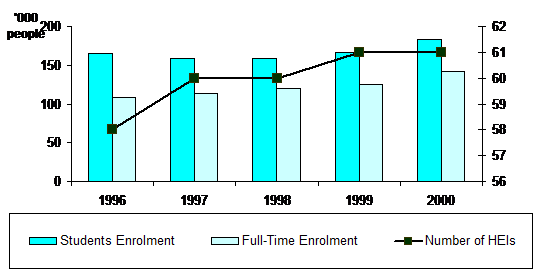
Diagram 3.
In there were 58 HEIs in the higher education system of Uzbekistan. The number included 16 universities and 42 institutions that enrolled 163,7 thousand students.
In 2002 the higher eduaction system was composed of 62 HEIs and their students enrolment amounted to 190 people.
In 1999 new HEIs were established in the country due to new demand in high qualified human resources according to prospects of the state development; new departments for training in new specialties were opened under existing HEIs; additional quotas were fixed for top priority directions in production of specialists. The examples are: establishment of the Tashkent Islam University, nurse departments under medical higher education institutions, the International Journalism Faculty in the Uzbek State University of the World Languages and the International Tourism faculty in the Tashkent Economy University.
In 2002 the International Westminster University was established. The institution will produce specialists in Economy, management, Information Technologies and Law.
Mechanisms and Standards Developed for Purposes of Accreditation, Quality Provision and Mutual Acknowledge of Graduates Qualification
The State Education Standard of Higher Education and the Classificator of Higher Education Specialties and Directions were designed to provide quality of education in accordance with international requirements.
Monitoring of the education content quality is carried out through application of ranking control that includes current, intermediate and final monitoring as well as periodic testing of students implemented by internal inspection of higher education institution.
Customers also evaluate professional appropriateness and qualification of HEIs graduates.
Attestation of HEIs and their academic staff is implemented by the Department for Inspection of Education Quality, Attestation of Teachers and Education Institutions under the State Center of Testing despite their reportability to ministries and ownership status in accordance with the Resolution № 000 dated 11 March 1998 approved by the Cabinet of Ministers.
Any HEI might be deprived of the state license according to the attestation procedure results.
Autonomy and New Relations between the Government and Higher Education Institutions
The implementation process of structural reforms is also aimed at independency and broad autonomy of education institutions, introduction of market mechanisms, improvement of education services market, efficiency and interactivity of managerial bodies.
Absolutely new system of education institutions management is introduced now via establishment of guardian and observatory councils composed of representatives from founders, local authorities, businesses, voluntary organizations, foundations and sponsors. HEIs will be able to solve their problems through these councils without participation of the higher education central executive body. The examples are: the Samarkand State University, the Navoyi Mining Institute, the Tashkent State Technical University and many other sectoral HEIs.
According to special resolution of the Cabinet of Ministers the Tashkent State University was transformed into the National University of Uzbekistan that has authority to take its own decisions to solve organizational and financial issues.
The structure of administrative control over education system of Uzbekistan includes the following bodies:
· The Cabinet of Ministers;
· The Ministry of People’s Educatiom;
· The Ministry of Higher and Secondary Special Education;
· Ministries and departments that have reportable education institutions ( i. e. the Cabinet of Ministers, the Ministry of Healthcare, the Ministry of Culture, the Ministry of agriculture and Water Resources, the Ministry of Communication, the Ministry of Justice, the Ministry of Internal Affairs, the State Committee for Sports and some others);
· Local executive authorities (i. e. the Council of Ministers of the Republic of Karakalpakstan, khokimiats of oblasts and the Khokimiat of Tashkent City);
· Territorial departments of people’s, secondary special and vocational education.
Thus the education system is controled by the governmental bodies according to the Legislation of the republic.
Increase in Higher Education Sector Funding
Funding of HEIs increased due to pay education services provided by the institutions, their entrprising, consultory, publishing, production. Scientific and other activity in accordance with their charters.
Government’s Spending on Education in
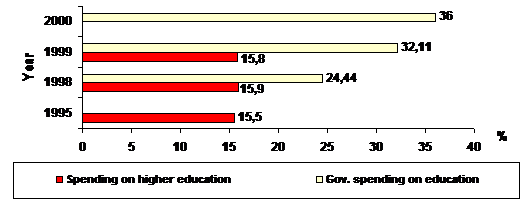
Diagram 4.
The government’s spending on education amounted to 24,27 % in 1997 and 36% in 2000 of the state budgets.
Higher Education Sector Expenditures and Finance Sources in
Table 3
Finance Sources | 1996 | 1997 | 1998 | 1999 | ||||
| Million summs | % | Million summs | % | Million summs | % | Million summs | % |
Budget (republican and local) | 3560,0 | 78 | 4043,2 | 65 | 6743 | 66 | 8841 | 53 |
Non-budgetary sources | 980 | 22 | 2196 | 35 | 3457 | 34 | 7733 | 47 |
Total: | 4540,6 | 100 | 6239,6 | 100 | 10200 | 100 | 16574 | 100 |
The Asian Development Bank (ADB) allocated about 250 million USD as loans and grants, the Korean Fund of Economy Cooperation Development allocated a loan for the amount 35 million USD, the Japanese government allocated a lax credit for the amount of 58 million USD.
Diverse assistance is rendered as projects and grants provided by TACIS Program, the European Education Fund, the British Council, the German Socity for Technical Cooperation.
Changes in Higher Education Finance Sources
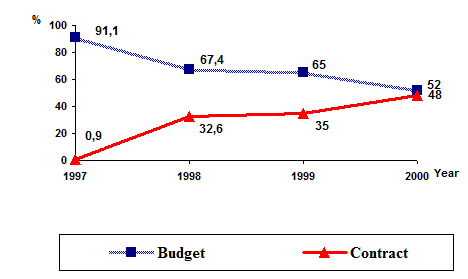
Diagram 5.
Labor Market Demand and Supply, Employment and Unemployment of Graduates
The demand in specialist with higher education made up 60,5 thousand people in 2002 whereas the graduation of 2001 amounted to 31 thousand people. The diagram below shows students enrolment to graduation ratio for .
HEIs Students Enrolment and Graduation in
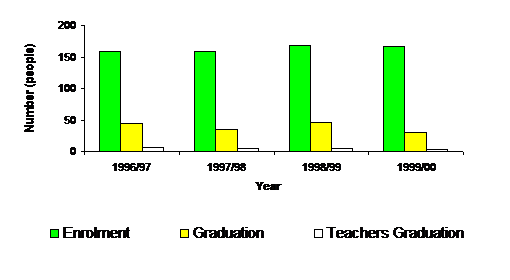
Diagram 6.
Education Programs and Courses Revision and Innovations
Introduction of the State Education Standards of new generation engendered revision of education curricula and programs of Baccalaureate and Master Degree departments as well as all disciplines programs.
A new special course called the Idea of National Independence has been introduced into the Constitution of the Republic of Uzbekistan course. Content of all text-books was revised to comply it with the spirit of national independence spirit idea. New generation education literature concept has been designed, that reflects modern trends in higher education development, information technology progress and introduction of these achievements into education process. Much attention is paid to electronic text-books design.
Production of teachers is one of critical issues. Purposeful education programs have been designed to develop academic staff and reach an appropriate level of critical thinking and pedagogic technology development.
Recruitment of Academic Staff and Salary of Academic and Administrative Personnel
All individuals having respective higher education, qualification and high spiritual qualities can carry out pedagogic activity.
Recruitment of academic staff by HEIs is implemented through advertisement in accordance with the Regulations approved the Cabinet of Ministers.
Academic staff of HEI upgrades their qualification under programs of state grants and agreements concluded between individuals, organizations and higher education or scientific institutions.
1-4 weeks training courses for academic staff in these education institutions are carried out once every three years.
Academic staff of HEIs are trained according to the following modes:
- training in academy, HEI, center, faculty or at training courses;
- training in basic education institution;
- training in companies;
- practical work at enterprises, organizations and scientific-research institutes;
- text-book or education aid writing;
- PHD or doctorate thesis dependence;
- monograph writing;
- probation in foreign education or research institutions;
- training/retraining by correspondence.
All graduates of training/retraining courses receive state standard certificates.
Presently academic staff training and retraining is implemented in 139 education institutions including 29 HEIs, 37 faculties, 73 centers and training courses reportable to 23 line ministries and departments.
In December 1997 the Republican Fund called Ustoz was established to provide oversea training and retraining of high qualification academic staff. Over 400 pedagogues have been trained in 25 leading education and scientific centers of England, Germany, USA, Canada, France, and South Korea under this program.
Mechanism and Incentives to Stimulate Scientific Researches in HEIs
HEIs of the republic are involved in implementation of scientific research, programs, projects under agreements and contracts with the government and other organizations and grants allocated by the Center for Science and Technology of Uzbekistan, the Soros Fund, TACIS-TEMPUS, the European Education Fund and other international foundations.
Scientific-research laboratories, centers, institutes as well as chairs are established under HEIs attracting gifted students of Baccalaureate, Master Degree Departments and post-graduate students.
Policy of Private HEIs Establishment and Accreditation, Provision of Education Quality and Management
Both public and private HEIs are created under laws of Uzbekistan and accredited by the Cabinet of Ministers.
International Cooperation, Education Programs Exchange and Graduates Qualification Mutual Acknowledge
Close cooperation is being set up to implement joint projects aimed at development of higher education sector.
The Presidential Fund called Umid was established in January 1997 to support gifted students that study abroad. The fund provides financial support to 500 Uzbek students to study at Bachelor and Master Degrees departments of leading HEIs world-wide.
The Umid Fund and the Westminster University (UK) established the International Westminster University in 2002 to provide higher education in accordance with international standards, built up capacities for implementation and gifted youth potential and broaden cooperation with leading HEIs of developed countries.
The International Westminster University will produce Bachelors and Masters in Economy, management, Information Technologies and Law in compliance with international requirements to higher education, goals and objectives of the National Program for Human Resources Training.
The Republican Fund called Ustoz was established in December 1997 to train high qualification academic staff of HEIs in-country and oversea, study education experience of developed countries and new pedagogic technologies.
Over 400 teachers of HEIs have been trained under this program in 25 education and scientific centers of England, Germany, USA, Canada, France and South Korea. All of them share their experience with colleagues in national HEIs.
The Distance Education Project of the ADB for 1 million USD is implemented together with the London Economy School. Under the Project of the Fund and the Open Society 84 virtual libraties with the total stock of 3,500 well-kown periodicals will be supplied at disposal of Uzbek educators, researchers and scientists. The project is estimated at 6 million USD.
Cooperation with the Maryland University (USA) is aimed at implementation of training/retraining projects.
An affiliation of the Moscow Plekhanov Economy University has been established in Uzbekistan.
Accumulated Experience and Lessons of the Last DecadeThus the first phase macro objectives of the National Program have been achieved.
The new model of education system has been designed and impleneted for a short period of time. Initial normative and legal norms, material, organizational, managerial and methodological conditions have been provided to ensure its activity.
The National model and the program are a thouroughly elaborated concept that took into account all trends and peculiarities of the country social and economy development. The national model encourages development of most efficient ways of implenetartion.
At the same time it is necessary to design and carry out targeted regional and local programs to ensure implementation of the National Program’s priorities.
The Governmental Decree on Stipends is a good example. This a step to provision of students’ social security as well as an opportunity to stimulate students (both the contract ones and those who receive state grants), enhance education quality and graduates qualification that is a priority of the second phase.
The following can be regarded as positive outcomes of the reform at all levels of education:
· National education system development as of one education, scientific and production complex based on public and private education institutions, formation of competitive education and training environment attracting all sources of finance (government and private ones), design and introduction of non-budgetary funds attraction including foreign investments in continuous education and training;
· Reform of education system and its subsectors ensuring continuousness and succession of all education levels, enhancing quality and efficiency of education and students achievements. Improvement of the normative and legislative base and creation of favorable financial conditions for sustainable improvement of the education system efficiency in accordance with international standards;
· Orientation to ensure human guaranteed rights and freedoms to education with equal opportunities and access to education complying with the state education standards. The orientation that encourages education and gifted students and provides social security allowances to students from low income families;
· Establishment of normative, information, material and technical base providing required education level and quality, guarantees of sustainable development, priority of training system in new social and economy conditions;
· Revision of education content, introduction of new advanced methodologies directed at enhancement of education quality;
· Design and introduction of state education standards at various levels of education regulating necessary requirements to general education and professional grounding of students and to indicators system and methods of students achievements monitoring;
· Implementation of measures directed at timely provision of education institutions with education, methodology literature via production of revised and new text-books and education programs;
· Pedagogic education content revision based on humanitarian synthesis of all education disciplines, deepening of psychological and pedagogic training directed at realization of inner logic and regularities of education process;
· Building capacities for competitive environment creation in the system of education, training, and retraining, improvement of some education levels, education institutions network distribution caused by former arrangement of the education system (institutions reportable to different line ministries), first of all it regards vocational education taking into account local and national interest;
· Provision of education institutions with qualified academic staff, conduction of their ranking evaluation, attestation and training/retraining;
· Implementation of measures directed at introduction of development monitoring and evaluation of continuous education efficiency that would enable to remove disproportions between the education structure, of enrollments of students and demand at the labor market;
· Implementation of measures to provide integration of education with science and industry, design of mechanisms to identify demand of the state, private organizations and enterprises in young specialist;
· Improvement of finance mechanisms of education institutions, i. e. giving institutional autonomy to education institutions, attraction of additional finance sources, stimulation of their innovative activity;
· Strengthening of relation with the international community in human resources training, retraining, attraction of foreign investments in text-books, learning resources, methodology aids production and supply to education institutions of the republic, improvement of material and technical base of the education system, managerial and administrative staff efficiency enhancement, implementation of respective joint pilot projects.
The following can be regarded as successful experience of education funding:
Education system is funded according to state norms from central and local budgets and other sources that include payments of companies, enterprises, and organizations for contract students and for tuition fees from individuals.
Besides other funds can be attracted: revenues from education and commercial activity, investments of founders and sponsors, bank loans, financial surpluses, donations from voluntary and charity organizations, other legal finance sources.
Funds from the state budget are allocated based on estimates. Stipends and social security allowances are paid to students from the state budget. These funds are a part the education system budget.
The governmental policy for education system funding provides for the following guarantees:
· development and activity of education institutions according to established norms;
· production of high qualified specialists according to projections of the government based on grants allocated by the government in accordance with priority specialties, education levels and economy sectors supported by the government;
· salary to education sector employees in accordance with the Legislation;
· social security subsidies (i. e. stipends and reduced fees for dormitory).
Problems and Weaknesses:
- lack of the education system multilateral funding;
- lack of efficient marketing in education services and training sector;
- inefficiency of the management system, duplicating of administrative bodies, insufficient performance of administrative bodies;
- administrative staff insufficient knowledge of management and international experience;
- absence of education management information system;
Ways to Solve the Problems:
· introduction education institutions ranking evaluation system and monitoring of education/ training quality and demand in young specialists;
· establishment of an efficient education management system connecting national and local levels;
· implementation of education system management democratization providing transition to governmental and public form of education management;
· design of a methodology packet including materials on education institutions modern management based on international experience;
· training, retraining of administrative personnel;
· design and production of education and methodology literature dedicated to issues of education management;
· establishment of education management information system including design and production of manuals;
· establishment of public and guardian councils at education institutions with participation of makhala committees and other voluntary organizations and sponsors.
The system of students admission to education institutions also should be revised.
1. No doubt test should be used as objective criteria of students knowledge evaluation but the content of these test has to be revised. Monotone character of these tests is obvious. Many of them are oriented to identify erudition and memory ability of testees. They lack questions to test logic thinking and intellectual abilities.
2. Entrants have no chance to express their own opinion regarding various process and events that decreases development of their oral and written language, ability to defend personal opinion, independent critical thinking.
3.Efficiency of practical measures to implement НППК is hindered by the pending normative and legal base. Some clauses regulating activity of governmental structures, voluntary organizations and foundations, businesses, scientific organizations have to be designed and added.
5. Formulation of New Visions, Goals, Objectives and Future Strategy
The 1st phase has completed. It was aimed at implementation of strategic plans and permitted some mistakes in tactics.
During next decade the republic will implement the 2nd phase () and the 3rd one. The 2nd phase includes elaboration of education process details that provide projected quality of education. This phase accounts for implementation of the National Program, achievement of its goals and objectives.
Detalization and concretization of measures and mechanisms to implement the National Program are differences of the 2nd phase.
The primary goal is to obtain high quality of education and training.
1. It is necessary to design scientifically grounded system of implementation decisions and measures, timing, performers, finance and resources that are necessary to implement the 2nd pahase of the National program.
2. It is also necessary to provide implementation of solidarity and true partnership between all stockholders of the education process. That is critical for education and training and enables to realize the role of qualified human resources in society development.
In 21st century education would have to identify future society world outloook. Education defends values and ideals of the world culture that requires mobilization of inner potential, study and distrubution of best international and domestic experience of education institutions and training system operation.
Education should be considered and used as a catalyst of the entire democratic and market reforms system.
3. Of course academic staff of education institutions is another critical issue since much of the quality and reputation of education systen depends on the personnel who work in education sector. To continually upgrade and develop these staff a comprehensive personnel development programs designed by ministries are necessary as well as introduction of efficient moral and material stimulation mechanisms.
4. The 2nd phase of the reforms should include development of special designated programs directed at radical improvement of financial and material provisions of the reforms. The following can be regarded as implementation measures:
· enhancement of efficiency of state budgetary funds allocated to education and training sector;
· introduction of diverse (budgetary and non-budgetary) funding of education and training system;
· development of education sector self-finance system;
· promotion of private and foreign investments attraction in education sector;
· imorovement of education loans mechanisms providing flexible repayment system;
· strengtening of donors and sponsors role in support of continuous education and training;
· increase of education institutions incomes through pay education services, enterprising, consultory, expertise, publishing, production, scientific and other activity;
· strengthening of material and information base of education institutions, provision of education process with high quality literature and advanced pedagogic technologies;
· implementation of continous education informatization via establishment of local and republican information networks and education literature supply to the libraries;
· launch of education services market formation mechanism.
The 3rd phase (2005 and next years) provides for the following:
· further strengthening of human resources, information and finance base of education institutions, complete provision of education aprocess with modern education and methodology sets, advanced pedagogic and information technologies;
· formation and development of national (elite) education institutions, provision of their autonomy and self-management;
· education process maximal informatization, continuous education system coverage with world-wide computer information networks.
E. Z. Imamov, Professor, Director of the IHSSP *
Sh. A. Safarova, Chief of the IHSSP Dept.
O. S. Butaerov, Director of the Gifted Students Dept. of the IHSSP
* The Institute of Higher and Secondary Special School Problems.
