

Партнерка на США и Канаду по недвижимости, выплаты в крипто
- 30% recurring commission
- Выплаты в USDT
- Вывод каждую неделю
- Комиссия до 5 лет за каждого referral
аналіз термомеханічних процесів у локально опроміненому сталевому диску з врахуванням мікроструктурних перетворень
*Васильєва Л. Я.,
Миколаївський національний університет, Україна
Інститут механіки НАН України, Київ
Розробка лазерних та імпульсних систем мікрообробки вимагає детального дослідження зв’язаних термомеханічних процесів, які відбуваються при опроміненні, розігріві і подальшому охолодженні матеріалу. Зокрема для евтектик типу сталей такі історії зміни температури супроводжуються мікроструктурними перетвореннями, які впливають на залишковий напружено-деформований стан і, отже, на міцносні і втомні характеристики приповерхневих шарів матеріалу. Коректне описання мікроструктурних перетворень в околі дії імпульсу є важливим при оцінці довговічості сталевих елементів конструкцій і виборі оптимальних параметрів процесу для прогнозування бажаних властивостей. Моделювання динамічних процесів, що супроводжують опромінення, також важливе при використанні методів акустичної діагностики мікроструктури матеріалу, в яких для ґенерації зондуючого імпульсу напруження використовується лазерний імпульс.
Розглядається тонкий диск радіусу  і товщини
  ,
,  , із сталі 35ХМ. На поверхні
  діє короткочасний тепловий імпульс, який задається тепловим потоком через границю і моделює за формою і тривалістю лазерне або пучкове опромінення. Після закінчення дії імпульсу опромінення частина поверхні примусово охолоджується. Теплообмін із зовнішнім середовищем відбувається згідно механізму конвективного теплообміну з високим коефіцієнтом тепловіддачі. Вся інша поверхня диску вважається теплоізольованою.
В роботі для описання складної реакції матеріалу використовується зв’язана динамічна постановка задачі термомеханіки із залученням узагальненої узгодженої з термодинамікою необоротних процесів моделі фізично нелінійної поведінки металічних матеріалів в широкому інтервалі температур [1]. Модифікація моделі з метою врахування мікроструктурних перетворень внаслідок швидкого нагріву і наступного охолодження виконана в роботах [1,2]. Осесиметрична постановка задачі також містить співвідношення Коші, рівняння руху і рівняння теплопровідності з відповідними граничними і початковими умовами [2,3].
Задача розв’язується в динамічній постановці із застосуванням скінченноелементної методики, розвиненої для зв’язаної термо-механічної поведінки фізично нелінійних матеріалів [2,3].
Визначено, що в результаті дії теплового імпульсу відбувається суттєве підвищення температури в зоні опромінення, що призводить до перетворення початкової бейнітної мікроструктури в аустенітну. Через примусове охолодження, температура в опроміненій зоні знижується достатньо швидко для того, щоб крива охолодження обійшла зони перлітного, феритного, бейнітного, тощо мікроструктурних перетворень на термокінетичній діаграмі. Як результат, переохолоджений аустеніт безпосередньо перетворюється в мартенсит (рис. 1). При остаточному охолодженні диска в опроміненій зоні формується залишковий напружено-деформований стан (рис.2), який спричинений двома факторами: непружним квазістатичним деформуванням внаслідок розігріву і різницею в питомих об’ємах мікроструктурних фаз (аустеніт має найменший, а мартенсит – найбільший питомий об’єм мікроструктур сталі).
Відзначимо присутність полоси з достатньо високими розтягуючими напруженнями, яка відповідає границі зони мартенситного перетворення. Саму зону зжених напружень можна назвати зоною впливу мікроструктурних перетворень. Підвищені напруження в глибині диску в порівнянні з суттєво меншими напруженнями на поверхні опроміненої області можуть спричинити передчасне руйнування матеріалу.
Рис.1. Залишкова мартенситна фаза. |
Рис.2. Залишкове поле напружень. |
ЛІТЕРАТУРА
1. К Термомеханическая модель растущих цилиндрических тел из физически нелинейных материалов // Прикл. механика. – 2005. – т. 41, № 9. – С. 118-126.
2. , Червінко О. П., Васильєва модель структурних перетворень в тонкому сталевому циліндрі при тепловому опроміненні торця // Доповіді НАН України. – 2007. – № 4. – С. 53–58.
3. , , Червинко генерации упругих волн при тепловом облучении стального образца и учете аустенитно-мартенситного преобразования // Теор. и прикл. механика. – 2009. – Вып. 46. – С. 98-103.
BIOTHERMOHYGROMECHANICS: BIOMIMETIC COMPOSITES WITH OPTIMAL PROPERTIES
Kizilova N. 1, Szekeres A.2
1 V. N.Karazin Kharkov National University, Ukraine
2 Budapest Technical University, Hungary
The biological molecules like proteins, lipoproteins, vitamins, enzymes, RNA and DNA, phospholipids of the cell membranes, receptor molecules and others are large and their conformation is important for the biochemical, electrical, adhesive and aggregation properties and abilities. Folding of the large molecules and their steady shapes are described by the minimal Gibbs energy dG=0, d2G>>0 at given constant temperature and pressure. Unfolding of the large polymer molecules by the fluid flow is important for instance, for the fibrin polymerization and the blood clot formation. Folding and unfolding accompanied by the conformation changes and entropy variation resulted in different chemical and physical properties of the molecules. Visualization of the protein molecules is based on determination of the minimal Gibbs energy state of a long chain of amino acids. Determination of the Van-der-Vaals surface, position of the active centers are important for different biomedical and biotechnological applications including computer modeling of drags, fiber and structure formation, genetic modification technologies and tissue engineering.
Molecular motors like dynein, kinesin, myosin, actin, DNA and RNA polymerase, bacterial cilia and flagella consume energy, for instance the chemical free energy released by the ATP hydrolysis, and converts it into mechanical work. They operate at the conditions when the fluctuations due to thermal noise are not insignificant [1].
Motion of amebas is determined by the gel-sol phase transitions, contraction of the cytoskeleton and the motion of the liquid contents of the cell in certain direction forming a pseudopodium. Motion of the flagellates is determined by active deformation of the flagellum/flagella, wave propagation along each flagellum sometimes accompanied by their rotation. Molecular motors are more energetically efficient than the man-made motors. The ratio of the wave propagation along the flagellum (U) and the cell velocity (V) for the unicellular is approximately U/V~0.2. The type of motion is very effective, so nature extended it to the multicellular organisms like threadlike worms (U/V~0.4), annelid worms, leech and water snakes (U/V~0.3).
Molecular motors are mechanochemical systems transforming chemical energy into mechanical work. The cyclic motion of actin and myosin bundles, sliding fibers in cilia and flagella, contraction of the cytoskeleton are examples of transformation of the chemical energy accumulated in ATP molecules into macroscopic motion and deformation. When the length L of a polymeric fiber depends on concentration of some chemicals and enzymes, pH of the solution or external electric field producing the tensile force , the mechanical work is connected with variation of the internal energy
  of the system

where T, S, p, V are temperature, entropy, pressure and volume,  is the chemical potential of the j-th substance with concentration
  ,
,  is electrical work.
If the work is provided by a single reactive component forming a fiber with varying length at p, T=const, the mechanochemical cycle can be described in both  and
and  variables and the efficiency of the work is

and is quite high for the muscles, ~50% [2].
Then the Gibbs energy variation is

where  and
and  are affinity and extent of reaction, which gives that affinity depends on the length of the contracting fiber

When electric field is important for the mechanochemical system, the electrochemical potential must be taken instead of  . In experiments with contracting muscles and muscle cells the dependencies and
  , where
  are preferable for measurements. The isotonic force-velocity relationship of the contracting muscle was founded by A. V. Hill
 ,
,  (1)
(1)
where  and
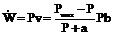
and  are external load and maximal isometric tension. The mechanical power produced by the muscle may be obtained from (1) in the form
The heat produced by the contracting muscle consists of the activation heat  connected with
  -dependent activation of the actomyosin system, heat of contraction
  :
:  . When a muscle becomes shorter, the produced energy is bigger, than for the isometric contraction (Fenn effect) [3]. Then the efficiency is determined as
  . For the contraction phase
  in frogs and
  in tortoises, exhibiting significant importance of the molecular mechanics of muscle contraction on thermodynamics.
In this paper the principles of reinforcement of the biological composite materials summarized in [5] are studied as applied to the optimal fiber reinforced biomimetic composites.
REFERENCES
1. Thomas N., Imafuku Y., Tawada K. Molecular motors: thermodynamics and the random walk. // Proc. R. Soc. Lond. B. – 2001. - vol.268. – P..
2. Volkenstein M. Biophysics. Moscow: Nauka– 592 p.
3. Szekeres A., Kizilova N. Bio-Thermo-Hydro-Dynamics: Theory and Applications. // Book of abstracts of the International school-conference “Tarapov’s readings”. Kharkov– P.251-252.
4. Kizilova N., Szekeres A. Nature Inspired Optimal Composites. // Course and conference on continuum physics and engineering applications. Book of abstracts. – 2010. – P.35-36.
5. Kizilova N. Long-distance liquid transport in plants. //Proс. Estonian Acad. Sci. Ser. Phys. Mathvol.57. - P.179-203.
