

Партнерка на США и Канаду по недвижимости, выплаты в крипто
- 30% recurring commission
- Выплаты в USDT
- Вывод каждую неделю
- Комиссия до 5 лет за каждого referral
NATIONAL AVIATION UNIVERSITY
Institute of Aerospace Control Systems
Department of Flying Vehicle Control Systems
Manufacturing Technologies of the Devices
for On-Board Control Systems
Laboratory work #1
Study of the design and operation principal
of the ring laser gyroscope
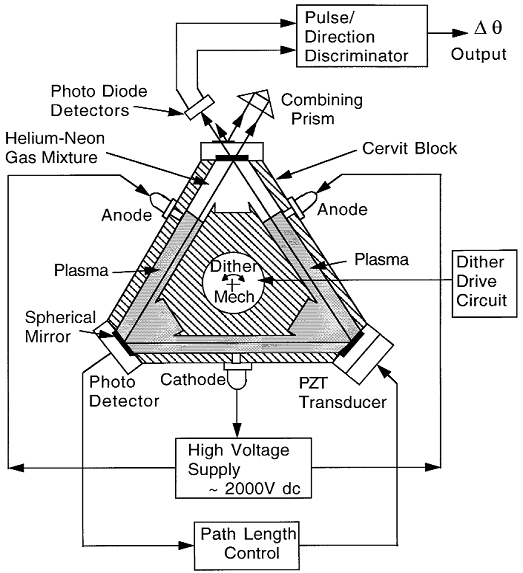
Ring laser gyroscope (RLG) is made of glass ceramic or cervit, in which the channels for light propagation are drilled and polished. The channel diameter is about 3 mm. Three (for triangle design) flat surface are polished under laser mirrors. The surface roughness must be no more, than 100 nm. Three mirrors are mounted on these surfaces by using deep optical contact process. Two mirrors are flat and the third is spherical one. Ring laser gyro contains two anodes and one cathode to provide and sustain gas discharge. Active mixture consists of two gases – He and Ne in ratio 1:22. Deep vacuum (10-7atm) is sustained in the channels. There is the getter in the laser gyro to provide long life vacuum in the cavity made in monolithic glass ceramic. On one of the flat mirror the combining prism is mounted with use of glue to align of two counter propagating rays together in order to obtain interference pattern. The interference pattern is formed on the sensitive square of the photodiode. Output signal of the photodiode is periodical one the frequency of which is proportional to the angle rate measured.
The second flat mirror is used for power or path length (resonator perimeter) stabilization of the laser radiation. For this aim piezoelectric (piezoceramic) transducer is glued on the flat surface of the opposite side of the mirror. During the self-heating process, when the resonator perimeter is changed, tuning on maximum amplification curve of laser radiation is violated. This violation results in laser light power reduction. Laser light power is measured by the second photodiode which is glued on the third mirror and provide the signal to the piezoceramic transducer. Piezoceramic transducer bends making the mirror concave or convex and, thus, increasing or reducing resonator perimeter to drive the laser light power to the maximum of amplification curve of laser radiation. Gas discharge current is usually about 3 mA.
Operation principal of the laser gyroscope is based on Sagnuac effect. The essence of the Sagnuac effect is that in rotating closed contour around which propagates two counter-propagating waves. The phase difference of these waves arises proportional to the angle rate of this contour. In a resonator, created by three or four mirrors propagates two counter-propagating light waves. These waves are generated by creation of inverted population of the energy levels in active medium, that is He-Ne mixture. Inverted population is created for the account of current flowing through the He-Ne mixture, for this high voltage of about 1.5-2.0 kV is applied to the cathode and two anodes.
A major problem which has had to be overcome with the RLG is the phenomenon known as ‘lock-in’. This arises because of imperfections in the lasing cavity, mainly in the mirrors, which produce back scattering of one beam into the other. The resulting coupling action tends to pull the frequencies of the two beams together at low rotation rates producing a scale factor error. For input rates below a threshold known as the ‘lock-in rate’, the two beams lock together at the same frequency so that there is zero output and a dead zone results. The figure below illustrates the effect of lock-in under steady input rate conditions. This lock-in dead zone is of the order of 0.01 to 0.1◦/s compared with 0.01◦/hour accuracy required for an INS. A very effective method of overcoming this problem is to mechanically dither the laser block about the input axis at a typical frequency of about 400 Hz with a peak velocity of about 100◦/s (corresponding to amplitude of 1.5 arc min (approximately). The amplitude of the dither rate and acceleration are chosen so that the dwell time in the lock-in zone is so short.

Under rotation of the laser gyroscope around the axis perpendicular to the laser beams running plane the phase difference appears, which, in ring resonator, turns into frequency difference proportional to angle rate. This frequency difference is measured by photoreceiver. Coefficient of proportionality K between frequency difference and angle rate is referred to as scale factor of the laser gyro. For ideal laser gyro output signal frequency F is determined by the formula:
F=KW ;
K=4S/lL;
Here, S – square of the resonator, l - wave length of the laser radiation, L - resonator perimeter. For triangle resonator gyro with side length 10 cm and l = 0.63mm, K= 0.45 Hz/(arc sec/s).
Ring laser gyroscope main applications
The Honeywell (USA) GG 1320 AN Digital Laser Gyro is now a most popular gyro for high accuracy INS. This gyro is used in Air Data Inertial Reference Systems, installed in many civil airliners. It is also used in the INS systems Honeywell produce for military aircraft.
High accuracy autonomous strapdown navigation and attitude and heading reference system for aircrafts and rockets and ships. In these systems signals from orthogonal RLG triad are integrated for sample time Dt, which are angle increments for this sample time, and are used to define attitude and heading. Together with dead reckoning system information, attitude and heading are use to compute position.
Control Systems
One of the important applications of RLGs is control systems of the aircrafts, rockets and ground vehicles.
RLG performance characteristics.
The general performance characteristics of a ring laser gyro are summarized below.
• High accuracy – The RLG meets the dynamic range for a pure IN system of
being able to measure angular rates from 0.01◦/hour to 400◦/s to the required
accuracy – a dynamic range of 108:1.
• Insensitivity to acceleration – The RLG has no acceleration sensitive bias errors,
as it is based on optical effects rather than inertial effects.
• Very high rate range – This is limited only by the noise/bandwidth characteristics
of the read out electronics: ±1,000◦/s is no problem.
• Very high scale factor accuracy – Error is from 5 to 10 ppm.
• Negligible warm up time – Full gyro operation from the instant of turn-on.
• Excellent turn-on to turn-on performance – Performance capabilities can be
maintained over several years without calibration.
• Random noise uncertainty – This is measured in ‘degrees per√hour’, and is
one of the RLG’s most important error characteristics. The error is significantly
higher than experienced with rotating wheel gyros. It affects the system
heading determination in the gyro compassing phase during the initial alignment
process. This is because it extends the time required to filter the Earth’s
rate signal from the gyro noise in order to determine the initial heading.
• Very high reliability – MTBFs in excess of 60,000 hours are being demonstrated
in large scale service.
• Life – The laser beams ultimately destroy the mirrors but this is over a very
long period.
• Volume – This is determined by the path length, typically 20-30 cm for inertial
performance.
Test questions:
1. What are the main components of the RLG?
2. What is operation principal of the RLG?
3. What are the main applications of the RLGs?
4. What are the main performance characteristics of RLG GG 1320?
