

Партнерка на США и Канаду по недвижимости, выплаты в крипто
- 30% recurring commission
- Выплаты в USDT
- Вывод каждую неделю
- Комиссия до 5 лет за каждого referral
Software and Hardware Complex for “Tagged” Neutron Experimentations
M. D. Karetnikov, A. I. Klimov, K. N. Kozlov, E. A. Meleshko, I. E. Ostashev,
N. A. Tupikin, G. V. Yakovlev
Russian Research Center “Kurchatov Institute”, Moscow, Russia
Abstract
The “tagged” neutron technology (TNT) is used for detection, identification, and localization of explosives. It is based on “tagging” the neutrons by recording the associated alpha - particle originated in T(d, n)He reaction. TNT provides the possibility to trace the individual neutrons and select the useful events against the background. The paper deals with the software and hardware complex intended for testing and debugging the TNT based devices. The complex includes the time spectrometer with the self - resolution of 0.2 ns, 10-digit amplitude spectrometer, fast logic for selection of time window for gamma-ray recording, power supplies, computer interface, and software for data acquisition and control.
The results of experimental testing of the software and hardware complex are presented. The sealed tube neutron generator with built-in scintillating detector of alpha-particles, gamma-ray and neutron scintillating detectors were used. The time resolution was obtained as low as 3.5 ns for alpha-gamma coincidences and 1 ns for alpha - neutron coincidences.
Last years the interest to the experimental researches on Tagged” Neutron Technology (TNT) is stimulated by its potentialities for solving such tasks as the detection, identification, and localization of high explosives (HE).
The typical scheme of TNT is given in Figure 1. The neutron and alpha-particle are emitted at the T(d, n)He4 reaction when deuteron beam bombards the tritium target of the neutron generator (NG). The vectors of neutron and alpha- particle escape are uniquely correlated. The position - and time-sensitive alpha - detector measures the time and position of incident alpha-particles. It provides the angle and time of neutron escape (“tagging” the neutron). The inelastic scattering of tagged neutrons by the nuclei of investigated object induces the gamma-rays with discrete (characteristic) energy. While recording, they give the information on the presence of carbon, nitrogen, and oxygen (the basic chemical components of explosives) in the object. The detector arrays record these gamma-rays with binding to the associated alpha-particles. As far as the positions of detectors and the velocities of tagged neutron and gamma-ray are defined, the location of gamma-ray escape along the tagged neutron trajectory can be determined by the time of gamma-ray recording with respect to the time of certain tagged neutron generation (time of associated alpha - particle recording). The Data Acquisition and Control (DAC) unit (lower right corner of Fig.1) traces the gamma-ray energy and recording time tg, as well as pixel number Ra and recording time ta of alpha-particle being the “tags” for puter processes the data and displays the 3D image of reduced elemental composition of the object on the monitor.
The essential feature of TNT is as follows. The gamma-rays induced by “non-tagged” neutrons (emitted at high angles about the tagged neutron paths, the associated alpha-particles are not detected by the alpha-detector; they include also gamma-rays originated directly in the gamma-detector by neutron impact) are not recorded as the event. It makes possible to increase the signal/noise ratio by 2-4 orders of magnitude.
For practical realization of TNT, the detectors and front-end electronics should provide a very small (nanosecond) time resolution [1]. The serious problems are associated with the built-in alpha-detector. During the manufacturing and operation, the detector is exposed to high temperature (up to 400 C°), optical and X-ray radiation, neutrons, charged-particles, etc. The electromagnetic noise induced by NG in the output channel of alpha-detector can also affect the proper recording.

Fig. 1. Principle of tagged neutron technology
The measuring module (MM) and supporting software for testing the NG with built-in alpha-detectors were developed in RRC “Kurchatov Institute” by the order of All-Russia Research Institute of Automatics (Moscow). The diagram flow of MM is given in Fig.2. It is implemented by backbone - modular principle. MM receives input signals from built-in alpha-detector (one channel) and external control detector (time and amplitude channels). The neutron and gamma-detectors of various types can be used as the control detector. For adjustment of the polarity and duration of the control detector signal, the inverting amplifiers and electronic keys are used.
The delay line-1 compensates the delay of time of signal of control detector with respect to the alpha-detector signal. This delay can be varied from several dozen ns (relatively slow BGO gamma-detector) to 0 ns (fast plastic neutron detector). The constant fraction discriminator CFD-1 generates:
· C1 pulse for commutator;
· C2 pulse coming to the Time-Digital Converter (TDC) as a STOP pulse;
· C3 pulse that is used in conjunction with the C4 pulse (from the control detector) to issue the C5 pulse marking the presence of alpha-gamma or alpha-neutron coincidences.
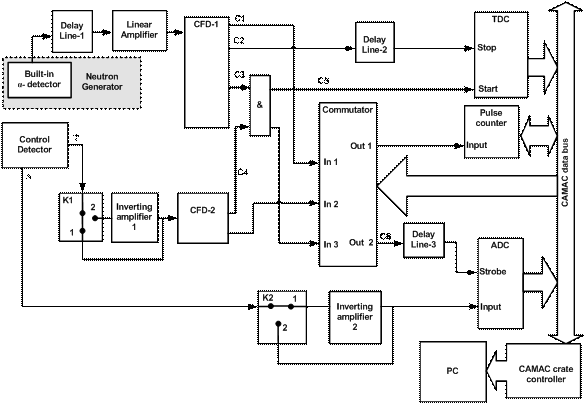
Fig. 2. Flow diagram of MM
The signal from input time channel of control detector triggers the measurement of timing of coincidences. The start is counted out of the pulse T of control ing to the CFD-2, it induces the C4 signal. At the presence of alpha-detector signal during the time gate, the C5 pulse from “&” unit provides the start of TDC. The commutator unit produces C6 pulse to generate the strobe signal setting the proper time of ADC acquisition (measuring the amplitude of the control detector signal). The MM includes also high voltage supplies for detector and controller for PC interfacing. Each event (coincidence between alpha - and control detectors) is represented by 4 bytes (2 bytes - amplitude, 2- time). The MM can work also in the “non-coincidence” mode recording all signals coming to the amplitude input of control detector. The software provides the acquisition of events, on-line display of accumulated data and their storage.
During the tuning of MM, the intrinsic time resolution of the device was measured. The signals from detector were simulated by pulses from high-stable pulse generator passed through integrating - differencing circuits. MM did not exceed 0.2 ns for wide range of amplitude of input signal (30 mV - 300 mV for alpha-channel, 30 mV-3000 mV for control detector channel).
For testing the MM, the experimental model of explosives detection device was designed. The model included all the basic units of TNT detection system. The layout of the model is given in Fig.3. The NG with the sealed neutron tube had been developed in VNIIA. It provided the continuous neutron emission with the intensity up to 4∙107 1/s. The 4-pixel built-in alpha-detector was developed in JINR, Dubna, Russia [2]. It consists of four YAlO3 (YAP(Ce)) scintillators installed near the neutron production target. The optical radiation induced by alpha-particles was transmitted through the glass window to the ultra-fast PMTs. Only one pixel (one alpha-channel) was used in experiments. The gamma-rays were recorded by gamma-detector incorporated BGO scintillator, fast PMT and electronic unit for output signal processing. It provides the time (up to 2.5 V, 50 ns rising time) and amplitude (up to 5 V, 500 ns rising time) signals. The pulses from alpha - and gamma - detectors were discriminated by amplitude and by time of coincidence. The width of time gates for measuring the coincidences was as high as 100 ns. While the signals from both detectors within this time interval were put forward, the “event” was recorded and stored in memory. The explosives were imitated by graphite or melamine (C3N3(NH2)3- nitrogenated substance of 1.2 g/cm3 bulk density). A portion of tagged neutrons scattered at the copper holder of target and NG casing inducing background gamma-rays. They are also recorded as “events”, and their intensity is much higher then the intensity of “useful” events. To prevent this “correlated” background, the lead shielding between NG and gamma-detector was used.
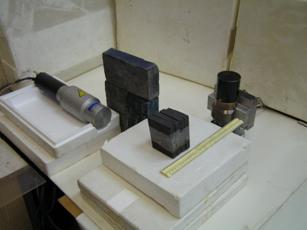
Fig. 3. Layout of experiment with the gamma-detector
The time spectrum of alpha-gamma coincidences is given in Fig. 4. A good separation of “useful” events from “correlated” background at the 30 cm distance between the object and NG can be seen. The time resolution is about 3.5 ns. When the distance is 15 cm, the “correlated” background overlaps the “useful” events that results in broadening the time distribution.
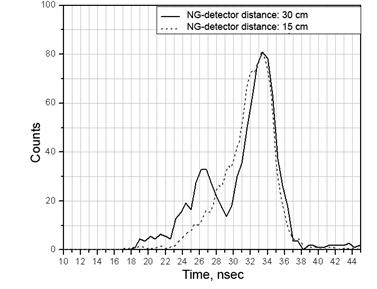
Fig. 4. Time spectrum of alpha-gamma coincidences
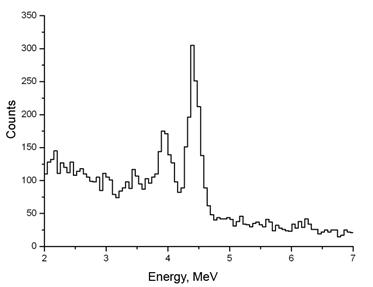
Fig.5. Gamma-spectrum from graphite in the TNT mode
Fig.5 displays the amplitude gamma-spectrum taken from graphite in the TNT mode. The main 4.4 MeV and annihilation single escape SE (3.9 MeV) peaks sufficiently exceed the background level in the spectrum from graphite.
Conclusions
The experimentations show that the hardware measuring module (MM) provides stable and accurate measurements of events. The intrinsic resolution of MM does not exceed 0.2 ns. The experimental resolution for alpha - gamma coincidences is 3.5 ns, for alpha-neutron coincidences: 1 ns. The experimentations demonstrated that the TNT technology provides effective (by 2-4 orders of magnitude) suppression of background by spatial and time discrimination of events.
The authors are grateful to Dr. G. V.Muradyan, Yu. D.Molchanov, and V. F.Apalin for technical support and fruitful discussions.
References
[1] M. D. Karetnikov, E. A. Meleshko, G. V. Yakovlev, Implementation of Hardware Processing of Events for Recording of Alpha-Gamma Coincidences at Associated Particle Technology. Proceedings of the International Scientific and Technical Conference “Portable Neutron Generators and Technologies on their Basis”, VNIIA, Moscow, 2004, p.335.
[2] V. stritsky, N. I. Zamiatin, V. G. Kadyshevsky et al., Studying of Nuclear Methods of Identification of the Hidden Substances in JINR. Ibid, p.283.
