

Партнерка на США и Канаду по недвижимости, выплаты в крипто
- 30% recurring commission
- Выплаты в USDT
- Вывод каждую неделю
- Комиссия до 5 лет за каждого referral
Xenos Christian Fellowship
Christian Leadership 1
Ecclesiology 1
Week 1 - What is the Church?
Introduction
Goal of Christian Leadership Classes
Our goal is to provide one aspect of the training of our home group workers toward becoming deacons. A deacon is a leader in many respects – models of attitude, service etc. Deacons are the second layer of leadership in the church and play one of the most important roles in the church. The body of deacons in our church is called the Servant Team. We have only eight elders and make no distinctions between clergy and laity, therefore we need a strong and effective servant team or we will not be able to do anything.
Discuss: Why study theology of the church (ecclesiology)? It sounds boring, irrelevant…
If we don’t have a good understanding of the theology of the church we are going to be limited in our knowledge of how to effectively operate the church. We will be open to deviating from God’s plan for the church and completely dependent on doing what someone tells us to do. Each of us needs to be prepared to tell people why we do the things the way we do (visitors and new Christians many times have questions about this, even objections in this area).
Our church’s greatest trial was a division in the early 90’s. Much of the furor was over issues that would have never occurred with peoples’ greater knowledge of and commitment to God’s definition of the church.
What answers have you heard to the question, “what is the church”? (Take one answer, no critique.) At first, it may seem that defining the church might be a trivial matter. Quite the contrary, the way that you choose to define “the church” has everything to do with what your understanding of the Christian life will be.
Defined one way the Christian life is primarily a matter of very formalistic worship services. Define it another and you have the basis for a significant role in God’s work.
There are two sources of confusion when it comes to defining the church:
· Being bound by the traditional framework
· Blurring the distinction between the Old and New Testament
Traditional Framework
Read and critique: (in Socratic style) Ryrie, A Survey of Bible Doctrine, chapter called “What Is the Church?,” pp140ff
What is a local Church?
“There is a good deal of discussion today about what is necessary to constitute a local church. Is a church simply a gathering of two or three believers in the name of Christ? How much or how little organization is required? Is baptism necessary for church membership? Unfortunately the New Testament does not provide a definition of a local church, but it does describe the normal features of a functioning local assembly. And it is from these regular characteristics of local churches that we can formulate at least a descriptive definition. Taking together the features of local churches we see in the New Testament, we might propose the following definition: A local church is an assembly of professing believers in Christ who have been baptized and who are organized to do God’s will. Notice: (1) There must be a profession of faith - not just anyone can belong to a church. (2) The New Testament knows nothing of unbaptized church members. (3) Churches were always organized as soon as possible (Acts 14:23) - an informal, unorganized fellowship of believers does not constitute a church. (4) There is purpose - doing God’s will which is expressed in many ways (like observing the ordinances, being open and available for ministry to all age groups in all parts of the world, etc.)”
“If this be a reasonably good working definition of the local church, then two or three gathered for fellowship is not a local church since such assemblies are generally not organized nor anxious to minister to all age groups even in their own neighborhoods. Furthermore, a Christian school or extra-church Christian organization does not qualify because of its selective ministry; that is, all professing believers would not be permitted to associate with the institution or organization. Can you imagine a Christian school throwing open its doors to all without any admission requirements? Or can you imagine the problems a youth work would have if retirees could freely enter into its activities? Have you noticed that often today the criticism of the church is coming from those who are associated with organizations whose work would be seriously affected if they had to open their doors to everybody? Naturally, you can be more effective and “successful” if you can be selective, but if you have to try to help people without restrictions, then, like some local churches, you won’t always be successful.”
“Of course, this definition does allow for some flexibility. It does not require that a local church meet in a building specially set aside for such a purpose. It does not indicate what kind of or how many meetings are required to constitute a church. Actually it does not specify the mode of baptism or the particular kind of officers (though perhaps it could and should - more of that later). Principally it tries to differentiate the local church from other groups, even church-related ones.”
We want to react on 2 levels - the biblical level & the practical.
Critique of Ryrie
His main problem is that he attempts to define the church with an external definition. He suggests that the New Testament doesn’t offer a definition, so he will. Is this true? Does the New Testament offer a definition of the local/universal church? Yes, the New Testament does give a definition of what constitutes both the universal and the local church.
This is the first source of confusion about what the church is: confusing its definition with the institution it has become (confusing what the church is with what it should do). Analogous to the being and well-being of a Christian (what he IS versus what he should DO).
It is customary in many theologies to construct a restrictive definition of what constitutes a local church. Sometimes several conditions, such as the proper observation of the sacraments, the presence of duly established clergy, a formal government, and ministry to all ages are given before a group can be called a church.
Regarding #2 in 1st paragraph (baptism) – this is an argument from silence. There is nothing in the New Testament that links water baptism with church membership.
Regarding #3 – that passage really shows the exact opposite – those churches existed for months before the appointment of elders. IE – the “organization” didn’t make it a church, something else did.
His freedoms or flexibility’s referenced in paragraph 3 are biblical, but he shouldn’t stop there on what is flexible. Why isn’t that flexibility applied in paragraph 1?
This is not an ivory tower discussion. Xenos Christian Fellowship 1972-76 –We would not be here today if we hadn’t made the distinction between what the church IS and what the church DOES. i. e. Several people told us in the early 70’s that we were not a church because we didn’t have elders etc. But, because we understood we were a church, we built on what we knew.
Basically, what is Ryrie’s problem? Ryrie is starting from what is, a traditional, but not biblical, definition of the church, and seeking to defend it.
He is writing from within the seminary institution, and doesn’t seem to want to rock the boat.
Possibly, he is also looking for a definition of the church that allows him to relegate a certain subset of Christian groups out of the category of “church”, so that he doesn’t feel the need to listen to their critiques.
The New Testament Definition of the Church
How do we go about defining the church?
We look at two things:
· Our primary biblical argument comes from the direct New Testament teaching on what the church is.
· Secondarily, we should look at the words and metaphors that the New Testament uses to describe the church. This will shed additional light on the nature of the church.
What Is the Universal Church?
 |
 |
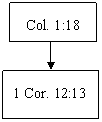
Col. 1:18 teaches that the church is Christ’s body.
1 Cor. 12:13 teaches that we become part of Christ’s body through the baptism by the HS.
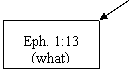
Eph. 1:13 teaches that we are put into Christ by the HS the moment we believe the gospel.
THEREFORE, the Universal Church is the collection of all true believers who are in Jesus Christ. This would include Christians alive and dead, on earth and in heaven, baptized and unbaptized, etc.
Contrast institutional vs. God’s definition: If the Dispatch did an article on the number of people in Columbus who belong to the church, it would consult local membership rolls, and conclude that there are 300,000 church members in Columbus. God, on the other hand, looks into the heart of all people in Columbus and sees that there are 200,000 true believers. Some of these 200,000 may also be official local church members; others may not (see diagram).
 |
Words and metaphors used for the church in the New Testament
1.“Church” The word translated "church" in the English Bible is ekklesia. This word is the Greek words kaleo (to call), with the prefix ek (out). Thus, the word means "the called out ones."
However, the English word "church" does not come from ekklesia but from the word kuriakon, which means "dedicated to the Lord." This word was commonly used to refer to a holy place or temple. By the time of Jerome's translation of the New Testament from Greek to Latin, it was customary to use a derivative of kuriakon to translate ekklesia. Our word church probably comes from the German word Kirke which was their translation of kuriakon, so it would be normal to understand the word church as a building.
Therefore, the word church is a poor translation of the word ekklesia since it implies a sacred building, or temple. A more accurate translation would be "assembly" because the term ekklesia was used to refer to a group of people who had been called out to a meeting. It was also used as a synonym for the word synagogue, which also means to "come together," i. e. a gathering.
MAKE THE POINT: We don’t go to church, we are the church. What might it mean when we hear people in Xenos saying we are going to church this morning?
2. "Body of Christ" Since believers have been united with Christ through spiritual baptism, they are sometimes corporately referred to as the body of Christ. (Romans l2:4-5; 1 Corinthians. l2:12-21,27; Colossians l:l8; Ephesians 5:30) The idea seems to be that the group of Christians in the world constitute the physical representation of Christ on earth. It is also a metaphor which demonstrates the interdependence of members in the church, while at the same time demonstrating their diversity from one another. (Romans 12:4; 1 Corinthians 12:14-17)
3. Other Metaphors and allusions that describe the church.
The Temple of God - 1 Corinthians 3:l6; Ephesians 2:2l,22; 1 Peter 2:5)
The Jerusalem From Above or The Heavenly Jerusalem - Galatians 4:26; Hebrews l2:22. Both of these terms (as well as "temple") illustrate how the Old Testament notions of outward sanctuary have been replaced with the literal dwelling of God in his people.
Bride of Christ or Christ's Betrothed - (Ephesians 5:25-32; 2 Corinthians 11:2). These titles refer to the love and loyalty existing between Christ and believers.
What is the "Local Church?"
In this discussion exercise, ask the students to describe the scope or area encompassed by each of the following references. The point is that in each reference, the word "church" is in the singular. Since the scope of what is meant by each reference is different, we can draw conclusions about what constitutes a local church.
For each of the following verses, answer the question: "What geographical area is being described?"
Colossians 1:18 He is also head of the body, the church; and He is the beginning, the first-born from the dead; so that He Himself might come to have first place in everything. Church throughout the world
Acts 9:31 So the church throughout all Judea and Galilee and Samaria enjoyed peace, being built up; and, going on in the fear of the Lord and in the comfort of the Holy Spirit, it continued to increase. Church throughout a region
1 Corinthians 1:2 to the church of God which is at Corinth, to those who have been sanctified in Christ Jesus, saints by calling, with all who in every place call upon the name of our Lord Jesus Christ, their Lord and ours: Church in a city
Romans 16:5 also greet the church that is in their house. Greet Epaenetus, my beloved, who is the first convert to Christ from Asia.
Philemon 1:1-2 Paul, a prisoner of Christ Jesus, and Timothy our brother, to Philemon our beloved brother and fellow worker, {2} and to Apphia our sister, and to Archippus our fellow soldier, and to the church in your house: Church in a house
Matthew 18:20 “For where two or three have gathered together in My name, there I am in their midst.” Corporate presence of Christ
 |
Question: What are some implications we can draw from these passages concerning what size or structure a group must have to be considered a local church?
Answer: The word "church" is not a technical designation of a local group of any particular size or structure. Instead, it apparently described any extent of locality under discussion. The word “church” is not used for any specific size or structure.
"What constitutes a local church?" The scriptural answer is that any part of the universal church which is somehow local can be said to be a local church. We would suggest this holds even down to the level where ". . . two or three have gathered together in my name. . . " (Matthew 18:20). This seems to be Christ's version of what is necessary to have a local church.
Is your home group a church? Your cell? Your work Bible study?
A church of two or three may not be a very good church in that it is not able to fulfill all of the functions that are appropriate for a local church according to the New Testament, but this does not mean that it is not a church. A distinction must be made between that which determines the "being" of the church versus the "well-being" of the church.
Our “home church” is exactly that – a true church and is why we use that name.
This is why we don’t have formal church membership in XCF! It’s not because we’re rebellious or non-conformist for the sake of non-conformity. It is because we should not go beyond what is written and create a membership that God does not have. If you have received Christ, you are already a member of the church—the question is: Are you going to get involved in Body-life? Local church membership tends to produce nominal involvement (EXPLAIN).
This brings us to the second area of confusion: What parts of the Bible are we allowed to use to “build” the church?
The Origin of the Church
Teaching Goals:
§ To understand the biblical basis for viewing the church as a distinct program from Israel.
§ To understand the practical importance of viewing the church as a distinct program from Israel.
The second foundational question in formulating our doctrine of the church is:
What parts of the Bible are we allowed to use to “build” the church? May we use the material in the Old Testament? What about the gospels? Our answers to these questions have a number of important implications. Our answers to these questions depend on our understanding of when the church began.
Protestants have tended to answer this question in two basic ways:
· Some (Reformed) define the church as comprising all believers from Adam on. Accordingly, they feel the freedom to include Old Testament material in their understanding of the church. This is also the position of Roman Catholicism and Orthodoxy. Reformed Protestants inherited this view from Roman Catholicism and Orthodoxy.
· Others (Dispensational) define the church as comprising all Christians from Pentecost on. They therefore see the church as a distinct program from Israel. Israel is a nation of people who descend physically from Abraham; the Church is an international body of people who are united with Jesus. Israel functioned under the Old Covenant; the Church functions under the New Covenant. Israel served God during the time of promise; the Church serves God during the time of fulfillment.
 |
According to this view, the primary biblical materials which define the church and explain how it should function are Jesus' explicit teaching about the church (e. g., Matthew. 13; 16:18; 18:15-17; 28:18-20), Acts, the epistles, and Revelation 1-3.
We believe the latter view is correct for the following reasons:
· Colossians 1:18 - The church is Christ's body.
· 1 Corinthians 12:13 - The baptism by the Holy Spirit is the means by which believers in Christ are incorporated into his body.
· A
 |
cts 1:5; 2:1-4 - The baptism by the Holy Spirit began on the day of Pentecost after Christ's resurrection. (see John 7:38-39; 14:26 which clearly teach that this ministry of the HS was a future reality during Jesus’ public ministry)
THEREFORE, the church began on the day of Pentecost after Christ's resurrection.
This is not just an ivory tower discussion. It has a huge impact on how the church functions and how we live our lives. We call the former view “The Old Testament captivity of the church.” We believe that it is seriously out of step with God’s salvation history plan.
Confusing the Old Covenant and the Church
Because some churches feel the freedom to use Old Covenant material in their understanding of the church, they have an inherent tendency to incorporate Old Covenant structures into church life. Consider the following examples. The first five concern the way God’s people are to relate to God; the last three concern the strategy God’s people are to pursue in being his witnesses to the world.
DIRECTIONS FOR WORKSHOP
1. Break the class into 6 groups (remember you’ll do #1 as an example & #4 will wait until week 4).
2. Instruct them that they will have 15 minutes to prepare:
· Review Old Covenant purpose of that structure
· Read New Covenant passages and explain the New Covenant status of this structure
· Application: dangers if we ignore the changes, value of the changes, etc.
3. Tell them to choose their presenter wisely as they will have only 5 minutes to present.
· Let them know you’ll need to stop them at 5 minutes.
· Let them know you’ll be adding some content if needed.
· Let them know you will provide a handout with the material AFTER class, so not to worry about taking notes on the presentations.
1. (Instructor’s example) Tabernacle/Temple
Old Covenant Purpose: The tabernacle was a prophetic picture of God's intent to dwell in his people; his presence dwelt in the building in a unique way. The symbolic events conducted in the tabernacle explained why God could not indwell his people (because of their sins) and how he would one day overcome this problem (by making atonement for their sins through his chosen substitute).
New Covenant Status: Now this prophetic picture has been fulfilled. God dwells in every Christian and in the church corporately; the church is the temple of God. (1 Corinthians 3:16; Ephesians 2:20-22; 1 Peter 2:4,5) Thus, it is no longer proper to regard any building as the place where God dwells in a special way. See also Exodus 29:43-46; Genesis 26:3; 31:3.
Discussion: What negative effects can result from ignoring this distinction?
Possible Answers: Most people view the church as a building rather than the people indwelt by God.
Many people superstitiously believe the church building (or the sanctuary therein) is "God's house" in that his presence is localized there more so than anywhere else. For this reason, people often speak in hushed tones when entering a sanctuary, even when no one else is there! Parents tell children not to run or play in the sanctuary because "this is God's house." Not only does this suggest God is anti-fun; it also communicates that God is still unable to indwell us personally as we come to him through Christ.
We don’t “go to church”—we are the church! Does it bother you when people in Xenos say they “went to church” last week? It should, because this betrays a seriously inadequate view of what the church is! Words matter, because words communicate ideas—and ideas (especially about God and his plan) are super-important.
Other possible effects:
If we leave church, we can leave God.
Portrays God as distant not wanting to dwell with us on a personal level.
Puts God in a box, somehow He is contained.
2. Priesthood
Old Covenant Purpose: The high priest was a type of Christ. (Hebrews 3:1; 4:14) For this reason, he alone was permitted to enter God's presence with a sacrifice for the people's sins. The other priests were a type of Christians in that they could draw near to God and communicate the knowledge of God to the people. The rest of the people were essentially passive participants in the service of God.
New Covenant Status: This clergy-laity distinction which was valid in the Old Covenant period is now invalid. Because of Jesus' sacrifice, all believers have equal access to God and equal privilege to communicate the knowledge of God to others. (Hebrews 2:17; Hebrews 4:15,16; Hebrews 10:19-22; 1 Peter 2:9)
Discussion: What negative effects can result from ignoring this distinction?
Possible Answers: The effect of the clergy-laity distinction has usually been to discourage unordained Christians from ministering in significant ways.
Church members often think it is the minister's job to reach out to others, teach the Bible, give spiritual counsel, etc.
With no significant ministry purpose to pursue, many church members by default become enmeshed in materialism, which offers a counterfeit significance. This is a tragic squandering of the resources of the church. i. e. most of the spiritual gifts will be unused.
How does this affect the way we do baptisms? What does it communicate if it is only the leader of the church that does this?
Who does the discipleship?
3. Sabbath and Festival Calendar
Old Covenant Purpose: God gave the Israelites a full calendar of "holy" days. The Sabbath and the prescribed festivals were largely prophetic pictures of the salvation which Jesus would accomplish. (Colossians 2:16,17)
New Covenant Status: Every day is holy in the sense that salvation has occurred once and for all. Paul makes it clear in Romans 14:1-5 that only those Christians who are "weak in faith" ascribe intrinsic spiritual significance to the observance of the Sabbath. In Galatians 4:1-11, he says that Christians who go back to observing the festival calendar are regressing rather than progressing spiritually.
Discussion: What negative effects can result from ignoring this distinction?
Possible Answers: Many people erroneously believe that what matters to God is that we go to church on Sundays, or at least on Christmas and Easter. The effect of this formalistic approach to God is to reinforce the impression that an impersonal relationship with God is what he desires.
The norm can become the “weak in faith” as Paul calls them.
Qualification: we’re not saying, as the Jehovah Witnesses do, that it is wrong to have family traditions around the holidays, but we don’t hold that there is something missing with our relationship with God if we don’t do these things.
4. Liturgical Worship Service [skip this until week three]
Old Covenant Purpose: The Old Covenant worship of God was highly ritualistic. This was because it was designed to be an elaborate predictive picture of the work of Christ. (Hebrews 8:5) The content and order of this ritual observance was highly regulated because it taught that we must come to God in the way he prescribed - by faith in his Substitute.
New Covenant Status: Now that these pictures have been fulfilled, they are obsolete. (Hebrews 8:13) Not only does the New Testament not describe or command a worship service for the church; there is also a positive reinterpretation of this whole concept (Rom. 12:1, see section on "Worship in the New Testament"). Also, the number of prescribed rituals has been drastically reduced (from hundreds to two) and the regulation of how to observe them has been minimized.
Discussion: What negative effects can result from ignoring this distinction?
Possible Answers: Those who subscribe to the necessity of liturgical worship invariably communicate an impersonal relationship with God when the way is now open to have an intensely personal relationship with him. (Orphan & Pictures illustration)
In addition, it is all too easy to continue to observe ritual even when the reality of the relationship is not there. This is why we have so many ritualistic churches today where the members do not know God personally. This ritualism is a turn-off to those who long for personal contact with God.
5. Infant Circumcision
Old Covenant Purpose: Infant circumcision was a ritual given by God to Abraham and his physical descendants. (Genesis 17:9-14) Circumcision was to be the sign that Israel was God's people. It was also a symbol of their need to be liberated from the bondage of their sin- natures. (Deuteronomy 10:16; Jeremiah 4:4) God predicted that when Messiah came, he would "circumcise your heart. . . to love the Lord your God." (Deuteronomy 30:6)
New Covenant Status: The symbolism of physical circumcision was fulfilled in the death of Christ through which he disarmed the authority of our sin natures. (Colossians 2:11) In spite of the fact that all clear examples of baptism in the New Testament are adult believers, many churches see infant baptism as the church's counterpart to infant circumcision.
Roman Catholic doctrine states that it removes the guilt of original sin, thus teaching that spiritual regeneration comes through baptism. Many Protestant denominations erroneously believe that passages like Romans 6:4 and Colossians 2:11 refer to water baptism, and thus almost seem to teach baptismal regeneration.
Discussion: What negative effects can result from ignoring this distinction?
Possible Answers: When asked if they will go to heaven, people commonly answer "yes" because they were baptized as infants. Infant baptism has the effect of de - emphasizing the necessity of personal conversion to Christ. Instead, it communicates that salvation is something entered into on the basis of parental decision or ritual observance. This is a formalistic definition of Christianity which leads to whole churches full of nominal Christians (in name only).
NOTE: Old Covenant ritualism vs. formalism: These five features of OT worship are ritualistic (the primary way to relate with God is through ritual). However, they were never to be formalistic (going through the motions) but there is an inherent tendency for ritualism to digress into formalism (Is. 29:13,14, Is. 1:11-17; Amos 5:21-24). This is one of the reasons why the author of Hebrews calls the Old Covenant inferior to the New Covenant (Heb. 7,8). Therefore, since ritualism tends toward formalism, and the Bible does not require the church to be ritualistic, we shouldn’t be! It is not an accident that churches that emphasize rituals largely become formalistic.
6. Relationship Between Church and State
Old Covenant Purpose: In the Old Testament, the nation of Israel was both a spiritual and national entity. The government of Israel was originally a theocracy, eventually replaced by a theocratic-chosen king. God needed a nation where he could preserve the witness he was accumulating about himself. It was entirely in order for God to call on the government of ancient Israel to operate the nation in a just and godly way.
New Covenant Status: In the New Testament, the church is not expected to function as a nation state. On the contrary, the program is clearly different as witnessed by the call to submit to, and obey the Roman government--one of the most godless and brutal governments in history. (Romans 13:1; Matthew 22:17-21; Matthew 13:30; John 18:36)
The New Testament is devoid of any call to take over society or to run society God's way. Unfortunately, many Bible interpreters continue to read the Covenantal promises and warnings addressed to Israel in the Old Testament as though they apply either to the church, or to the United States (or other countries).
A very common example of this confusion is the often quoted passage in 2 Chronicles 7:13--"If I shut up the heavens so that there is no rain, or if I command the locust to devour the land, or if I send pestilence among My people, and My people who are called by My name humble themselves and pray, and seek My face and turn from their wicked ways, then I will hear from heaven, will forgive their sin, and will heal their land."
It is a mistake to apply this passage to the United States. It refers to the cursing/blessing section in the book of Deuteronomy. The people who are called by God's name are Israel. There is in fact no such promise extended to other countries.
One qualification is needed on this point. In the ancient world, there was no opportunity to vote on government issues or candidates. We do not know what God would have said if there was. Probably, a good ethical case can be made for Christian activism in politics as long as it falls short of attempts to establish a Christian state.
Discussion: What negative effects can result from ignoring this distinction?
Possible Answers: History is full of examples of catastrophic results when the church has concluded that it is to run the state (Inquisition and Crusades, slaughtering of Anabaptists in 16th century, Cromwell’s slaughter of Irish Catholics, etc.). A nation state often has to operate in the area of compulsion, punishment and even war. All of these things are inappropriate for the church.
Manipulators use values similar or even identical to those in the Bible to get Christians to back their agendas. For instance, no two themes are more universal in world religions than the sanctity of the family and the sacredness of the given cultural-national heritage. Oriental religion often actually worships parents and ancestors. Islam views the state as an expressly religious entity, and authorizes the use of force to convert people. Most oral religions are one and the same as the government of the tribe. This has tended to be true of Christianity as well in Europe. The medieval church was convinced that the state was to operate under the spiritual authority of the church.
Linking the universal appeal of blood and soil values with patriotic values and religion leads to the formation of a civil religion which is sometimes only nominally Christian. For instance, the implication of a prominent evangelical leading whole football stadiums in prayer before games is clear - - all or most of those present must be Christians. It is easy to see why people begin to believe that Christianity is synonymous with American citizenship or church membership.
This nominal Christianity is one of the most deadly threats to real Christianity for two reasons.
In the first place, it causes people to believe that they are Christians when they are not.
Secondly, it misrepresents Christianity to the secular world. Instead of seeing real vibrant spiritual living on the part of the church, society sees a Christianity that is plagued by confusion and mediocrity.
“During almost fifteen centuries the legal establishment of Christianity has been on trial. What have been its fruits? More or less in all places, pride and indolence in the clergy, ignorance and servility in the laity, in both, superstition, bigotry, and persecution.” (Quoted in John Seel and Os Guinness, ed., No God But God (Chicago: Moody Press, 1992), p. 69)
7. Emphasis on the Law
Old Covenant Purpose: The Old Testament law code was a national contract with Israel which stipulated the conditions by which they could enjoy the land of Canaan. (see Deuteronomy 28) It also had a spiritual value in that it showed them their need for God's grace, which would be given when Messiah came. (Galatians 3:22-25) For both of these reasons, it was entirely proper for Israel to have a "law emphasis."
New Covenant Status: The church is not a national entity living in Canaan, but an international community. Furthermore, now that Christ has come, we have access to new ministries of the Holy Spirit, making it possible for us to serve "in the newness of the Spirit rather than the oldness of the letter." (Romans 7:6) The emphasis of the church should therefore be on the good news of God's grace, not on the Law and the threat of God's judgment.
Discussion: What negative effects can result from ignoring this distinction?
Possible Answers: Many denominations emphasize the Ten Commandments more than the grace of God. The effect is that many people grow up with the view that God is primarily a God of judgment rather than also a God of love who has provided a way to forever escape his judgment. Some respond to this emphasis by running from God altogether; others become self-righteous. In either case, the unchurched person does not get the impression that Christianity is about the grace of God.
Leads to defeat when we cannot meet the standard of the Law
Can lead to a focus on external behaviors, rather than internal transformation
8. Outreach Strategy
Old Covenant Purpose: God's strategy for reaching Gentiles in the Old Testament period was centripetal. As the Israelites stayed in the land and followed the Law, God granted them national security and material prosperity. Foreigners would notice this, and some would thus adopt YHWH as their God. (Deuteronomy 28:7-14; 1 Kings 10:1-12) The main reason for this "stay in the land" strategy was that the Holy Spirit was not operative in the same way he is today, so the Israelites needed to be a separate culture to prevent complete apostasy.
New Covenant Status: Since the coming of the Holy Spirit, the God's outreach strategy has changed from centripetal ("stay in the land") to centrifugal ("go into all the world" - see Matthew 28:18; Acts 1:8). God's people are no longer to be a distinct culture, but rather are commanded identify culturally with those that they seek to reach (1 Corinthians. 9:19-23).
Also, whereas material blessing was at times a legitimate national indication of Israel's obedience to God (although see Deuteronomy 8:11-14;31:20; Proverbs 30:8,9; Nehemiah 9:25.26; Hosea 13:6), this is not the case in the church (see 1 Corinthians 4:9-16; Revelation 3:14-19).
Discussion: What negative effects can result from ignoring this distinction?
Churches commonly emphasize "witnessing by your lifestyle" instead of teaching that every Christian is to actively reach out to the lost through verbal evangelism as well as through an attractive lifestyle. Many churches also have developed their own sub-culture which effectively isolates them from non-Christians.
In addition, many churches affirm the Old Covenant view of wealth and thus passively (or even actively) condone materialism. These features are clearly at odds with God's present strategy.
Conclusion
From these examples we can see why it matters what biblical material we use in constructing our understanding of the church! If we answer this question wrongly, we are far more likely to go astray in setting the whole tone for what Christianity is like.
Memory Verses
Understand the interrelationship of these memory verses to one another in the context of the definition of, and origin of the church.
Col. 1:18*
1 Cor. 12:13*
Eph. 1:13*
Acts 1,2**
Assignment
Read The ABC’s of Natural Church Development, Christian A. Schwarz (booklet). Take margin notes and be prepared for discussion.
Read “32 Strange Things about Xenos” and take margin notes in preparation for a class discussion.
Key Points to Know for Exam
1. Know the definition of both the universal and local church.
2. Know the 3-step proof that demonstrates what the church is.
3. Know the 3-step proof that demonstrates the church began at Pentecost.
4. Covenantal churches tend to bring Old Testament structures into the church. Be able to explain one of the eight areas discussed in class: What was the Old Testament purpose of the area? How has this area changed in the New Testament? What is a negative effect on the Christian life and/or the church of retaining this Old Testament practice?
5.
·
