


Партнерка на США и Канаду по недвижимости, выплаты в крипто
- 30% recurring commission
- Выплаты в USDT
- Вывод каждую неделю
- Комиссия до 5 лет за каждого referral
Торговая политика во время кризисов в демократиях и автократиях:
теория и эмпирика
Студент 2 курса магистратуры
Российская Экономическая Школа, Москва, Россия
*****@***ru
Профессор, к. ф.-м. н.
Российская Экономическая Школа, Москва, Россия
*****@***com
Многие исследования показывают, что демократические страны больше вовлечены в международную торговлю и проводят более свободную торговую политику, чем автократические[1]. Другие исследования отмечают склонность к протекционизму во время кризисов во всех странах[2]. Третье направление исследований изучает реакцию торговой политики на ухудшение условий торговли[3]. Данная работа изучает торговую политику демократий и автократий во время кризисов. В работе предложена простая микро-обоснованная модель общего экономического равновесия, которая демонстрирует основные результаты, полученные в названной выше литературе, а также более сильное ужесточение торговой политики автократий во время кризисов, по сравнению с демократиями.
Выводы модели успешно проходят эмпирическую проверку на панельных данных о торговле 75 стран в течение 1948-2006. Механизм и выводы модели также соответствуют результатам анализа нескольких ситуаций в автомобильной отрасли (General Motors, Crysler, Saab, Zastava, Автоваз).
Механизм модели. Негативный шок (спроса или технологий) снижает спрос на труд, что увеличивает безработицу и риск потерять работу. В демократиях несклонный к риску медианный избиратель голосует за протекционизм во время рецессий. В автократиях лидер не следует выбору медианного избирателя, но сталкивается с ростом риска революции, если безработица высока. При широком наборе параметров как уровень, так и прирост тарифов во время рецессии в автократии выше, чем в демократии.
Эмпирическая часть работы оценивает модифицированную гравитационную модель торговли[4], в которую добавлены дополнительные регрессоры: индексы демократии (Dem), рост ВВП (Gap), а также их произведение для обеих стран-торговых партнеров в каждой паре. Базовая спецификация:
 где X – стандартный для гравитационной модели вектор контролей.
Тестируемые гипотезы (выведены из модели): 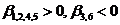
Результаты оценки представлены в таблице в приложении (все 6 гипотез подтверждаются).
Приложение.
Dependent variable: Import from the country of origin to the country of destination |
| |||||||
(1) | (2) | (3) | (4) | (5) | (6) | (7) | (8) | |
Dem_d | 0.213*** | 0.215*** | 0.221*** | 0.228*** | 0.167*** | 0.170*** | 0.0598 | 0.0622* |
(0.0398) | (0.0398) | (0.0398) | (0.0399) | (0.0379) | (0.0380) | (0.0369) | (0.0368) | |
Gap_d | 0.513*** | 0.514*** | 0.476*** | 0.472*** | 0.482*** | 0.475*** | 0.362*** | 0.405*** |
(0.0615) | (0.0615) | (0.0619) | (0.0619) | (0.0619) | (0.0619) | (0.0626) | (0.0630) | |
DemGap_d | -0.261*** | -0.263*** | -0.250*** | -0.248*** | -0.247*** | -0.241*** | -0.223*** | -0.197*** |
(0.0752) | (0.0752) | (0.0752) | (0.0752) | (0.0751) | (0.0751) | (0.0760) | (0.0766) | |
Dem_o | 0.329*** | 0.331*** | 0.339*** | 0.346*** | 0.349*** | 0.308*** | 0.319*** | 0.182*** |
(0.0429) | (0.0429) | (0.0431) | (0.0431) | (0.0431) | (0.0416) | (0.0419) | (0.0392) | |
Gap_o | 0.360*** | 0.361*** | 0.328*** | 0.327*** | 0.320*** | 0.327*** | 0.369*** | 0.262*** |
(0.0574) | (0.0574) | (0.0576) | (0.0575) | (0.0575) | (0.0576) | (0.0581) | (0.0592) | |
DemGap_o | -0.239*** | -0.234*** | -0.253*** | -0.265*** | -0.268*** | -0.275*** | -0.290*** | -0.304*** |
(0.0806) | (0.0807) | (0.0808) | (0.0807) | (0.0808) | (0.0810) | (0.0811) | (0.0825) | |
lgdp_o | 0.977*** | 0.978*** | 0.968*** | 0.978*** | 0.979*** | 0.977*** | 0.970*** | 0.875*** |
(0.0168) | (0.0167) | (0.0169) | (0.0168) | (0.0169) | (0.0169) | (0.0166) | (0.0130) | |
lgdp_d | 0.804*** | 0.804*** | 0.795*** | 0.805*** | 0.801*** | 0.802*** | 0.719*** | 0.701*** |
(0.0174) | (0.0174) | (0.0174) | (0.0173) | (0.0174) | (0.0174) | (0.0129) | (0.0127) | |
ldist | -1.169*** | -1.175*** | -1.207*** | -1.291*** | -1.296*** | -1.300*** | -1.281*** | -1.251*** |
(0.0369) | (0.0366) | (0.0368) | (0.0346) | (0.0346) | (0.0347) | (0.0345) | (0.0341) | |
lgdpcap_o | -0.200*** | -0.201*** | -0.206*** | -0.217*** | -0.219*** | -0.224*** | -0.243*** | |
(0.0235) | (0.0235) | (0.0237) | (0.0236) | (0.0236) | (0.0235) | (0.0232) | ||
lgdpcap_d | -0.190*** | -0.191*** | -0.195*** | -0.207*** | -0.212*** | -0.213*** | ||
(0.0250) | (0.0249) | (0.0250) | (0.0249) | (0.0248) | (0.0248) | |||
gatt_o | -0.162** | -0.163** | -0.149** | -0.164** | -0.164** | |||
(0.0676) | (0.0676) | (0.0681) | (0.0683) | (0.0683) | ||||
gatt_d | -0.239*** | -0.239*** | -0.222*** | -0.238*** | ||||
(0.0599) | (0.0599) | (0.0606) | (0.0608) | |||||
contig | 0.727*** | 0.744*** | 0.857*** | |||||
(0.129) | (0.127) | (0.133) | ||||||
comlang_off | 0.524*** | 0.522*** | ||||||
(0.0772) | (0.0771) | |||||||
col_hist | 0.312 | |||||||
(0.283) | ||||||||
Constant | -3.596*** | -3.537*** | -2.954*** | -2.185*** | -2.217*** | -2.233*** | -2.896*** | -3.769*** |
(0.349) | (0.346) | (0.351) | (0.333) | (0.335) | (0.336) | (0.333) | (0.324) | |
Observations | 109,343 | 109,343 | 109,343 | 109,343 | 109,343 | 109,343 | 109,343 | 109,343 |
R-squared | 0.538 | 0.538 | 0.535 | 0.532 | 0.532 | 0.531 | 0.527 | 0.520 |
Standard errors clustered by origin-destination country-pairs in parentheses |
| |||||||
*** p<0.01, ** p<0.05, * p<0.1 |
| |||||||
Литература
1. T. S. Aidt and M. Gassebner, Do autocratic states trade less?, The World Bank Economic Review, no. 1, 38.
2. J. E. Anderson, A theoretical foundation for the gravity equation, The American Economic Review, no. 1, 106.116.
3. J. E. Anderson and E. VanWincoop, Gravity with gravitas: a solution to the border puzzle, The American Economic Review, no. 1, 170.192.
4. R. E. Baldwin, The Political Economy of Postwar US Trade Policy. New York University, Graduate School of Business Administration, The Bulletin 4 (1976).
5. J. H. Bergstrand, The gravity equation in international trade: some microeconomic foundations and empirical evidence, The review of economics and statistics, no. 3, 474.481.
6. H. Bliss and B. Russett, Democratic trading partners: the liberal connection, 1962.1989, the journal of politics, no. 04, 1126.1147.
7. J. P. Choi, Protectionist response to import competition in declining industries reconsidered, European Journal of Political Economy, no. 1, 193.201.
8. W. M. Corden, Trade policy and economic welfare, Oxford University Press, USA, 1997.
9. J. Eaton and S. Kortum, Technology, geography, and trade, Econometrica, no. 5, 1741.1779.
10. B. Eichengreen and D. A. Irwin, The slide to protectionism in the Great Depression: Who succumbed and why?, NBER Working paper (2009).
11. C. L. Evans, The economic signi. cance of national border e¤ects, The American Economic Review, no. 4, 1291.1312.
12. C. Freund and C. Ozden, Trade Policy and Loss Aversion, The American Economic Review, no. 4, 1675.1691.
13. K. Gawande and U. Bandyopadhyay, Is protection for sale? Evidence on the Grossman-Helpman theory of endogenous protection, Review of Economics and Statistics, no. 1, 139.152.
14. P. K. Goldberg and G. Maggi, Protection for sale: An empirical investigation, American Economic Review, no. 5, 1135.1155.
15. P. Gray, H. 1973, ¸ SSenile Industry Protection: A Proposal, Southern Economic Journal 40, 569.74.
16. G. M. Grossman and E. Helpman, Protection for sale, The American Economic Review, no. 4, 833.850.
17. K. Head, T. Mayer, and J. Ries, The erosion of colonial trade linkages after independence, Journal of International Economics, no. 1, 1.14.
18. E. Helpman, M. Melitz, and Y. Rubinstein, Estimating Trade Flows: Trading Partners and Trading Volumes*, Quarterly Journal of Economics , no. 2, 441.487.
19. D. Kono, For Whom Does Democracy Free Trade?, Annual Meeting of the International Political Economic Society, Princeton, NJ, 2007.
20. D. Y. Kono, Optimal obfuscation: Democracy and trade policy transparency, American Political Science Review , no. 03, 369.384.
21. E. D. Mansfeld, H. V. Milner, and B. P. Rosendor¤, Why democracies cooperate more: Electoral control and international trade agreements, International Organization, no. 03, 477.513.
22. W. Mayer, Endogenous tariff formation, The American Economic Review, no. 5, 970.985.
23. H. V. Milner and K. Kubota, Why the move to free trade? Democracy and trade policy in the developing countries, International Organization, no. 01, 107.143.
24. D. Mitra, D. D. Thomakos, and M. A. Uluba¸soglu, " Protection For Sale" In A Developing Country: Democracy Vs. Dictatorship, Review of Economics and Statistics (2002), 497.508.
25. A. K. Rose, Do we really know that the WTO increases trade?, The American Economic Review, no. 1, 98.114.
26. K. Sonin, Provincial protectionism, Journal of Comparative Economics (2009).
27. J. Tinbergen, An analysis of world trade. ows, Shaping the world economy (1962).
28. M. Yu, Trade, democracy, and the gravity equation, Journal of Development Economics, no. 2, 289.300.
[1] Хороший обзор теории содержится в Helpman (1995). Модели начались с Baldwin (1979), Mayer (1984). Самая известная работа – Grossman and Helpman (1994). Эмпирика: Goldberg and Mayer (1999), Gawande and Bandyopadhyay (2000), Mitra (2002), Kono (2006 a, b), Bliss and Russett (1998), Milner and Kubota (2005), Mansfeld, Milner, and Rosendor (2002).
[2] Eichengreen (2009) получает этот результат для Великой Депрессии, Evenett (2009) – для глобальной рецессии 2007-2009.
[3] Работы начались с Gray (1973, 1975), Corden (1974). Более современные исследования: Long and Vousden (1991), Choi (2001), Freund and Ozden (2008).
[4] Ранние работы о гравитационной модели: Tinbergen (1962), Anderson (1979), Bergstrand (1985). Более поздние: Eaton and Kortum (2002), Anderson and Wincoop (2003), Evans (2003), Helpman, Melitz, and Rubinstein (2007). Политические переменные в гравитационной модели используют Rose (2004), Head, Mayer, and Ries (2010), Aidt and Gassebner (2007), Yu (2010), Kono (2006a).
