


Партнерка на США и Канаду по недвижимости, выплаты в крипто
- 30% recurring commission
- Выплаты в USDT
- Вывод каждую неделю
- Комиссия до 5 лет за каждого referral
Proceedings of ICHIT- 06
26 February – 5 March 2006, Moscow, Russia
ЗДЕСЬ И НИЖЕ НА РУССКОМ ИЛИ
АНГЛИЙСКОМ ЯЗЫКАХ
Igor B. Palymskiy
Modern Academy for Humanities, Novosibirsk Branch, Novosibirsk, Russia, 630064
*****@***ru
Abstract (РЕЗЮМЕ)
We explore the spectral characteristics of the numerical method for the calculation of convectional We explore the spectral characteristics of the numerical method for the calculation of convectional We explore the spectral characteristics of the numerical method for the calculation of convectional We explore the spectral characteristics of the numerical method for the calculation of convectional We explore the spectral characteristics of the numerical method for the calculation of convectional flows. These spectral characteristics compare with
introduction (ВВЕДЕНИЕ)
At last time many workers have studied thermal Rayleigh-Benard convection using numerical At last time many workers have studied thermal Rayleigh-Benard convection using numerical time many At last time many workers have studied thermal Rayleigh-Benard convection using numerical used spectral methods with periodic boundary conditions. In At last time many workers have studied thermal Rayleigh-Benard convection using numerical
Заголовок ПЕРВОГО УРОВНЯ
At last time many workers have studied thermal Rayleigh-Benard convection using numerical At last time many workers have studied thermal Rayleigh-Benard convection using numerical simulations were At last time many workers have studied thermal Rayleigh-Benard convection using numerical At last time many workers have studied thermal Rayleigh-Benard convection using numerical conditions. In numerical simulations were derived secondary stationary,
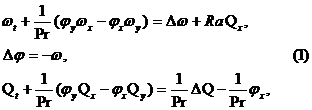
where φ is a stream function, ω is the vortex, Q is the temperature deviation from equilibrium profile (the total temperature being T = 1 - y + Q), Δf = fxx +fyy is the Laplace operator,
Ra = gβН3dQ/χν is the Rayleigh number,
Pr = ν/χ is the Prandtl number, g is the gravitational acceleration, β, ν, χ are the coefficients of thermal expansion, kinematics viscosity and thermal conductivity, respectively, H is the layer height and dQ is the temperature difference on the horizontal boundaries.
Заголовок второго уровня
We briefly describe our special spectral-difference numerical algorithm and testing [7]. Following a We briefly describe our special spectral-difference numerical algorithm and testing [7]. Following a steps.
Fig.1 represents the spectral characteristics for
m = 1,2 and 3, Ra = 1000·Ra, Pr = 1, N = 65 and
M = 17, the time step τ is equal to 4·10-4. Here solid line is differential problem, symbol ● – numerical method of present work and dash line – finite difference numerical method [8], curves 1,2 and 3 are first, second and third modes (m = 1,2 and 3), respectively.
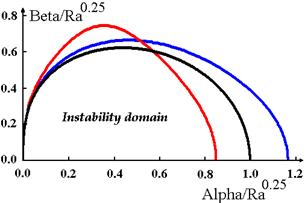
Figure 2
Instability boundary in spectral space
We can see from fig.1 and fig.2 that suggested We can see from fig.1 and fig.2 that suggested We can We can see from fig.1 and fig.2 that suggested more precision than finite-difference and We can see from We can see from fig.1 and fig.2 that suggested We can see from fig.1 and fig.2 that suggested precision than finite-difference.
CONCLUSION (ЗАКЛЮЧЕНИЕ)
The suggested numerical method exactly reproduce the spectral characteristics of differential problem, it The suggested numerical method exactly reproduce
REFERENCES (ЛИТЕРАТУРА)
1. Palymskiy I. B. Determinism and Chaos in the Rayleigh-Benard Convection // Proceeding of the Second International Conference on Applied Mechanics and Materials (ICAMM 2003), Durban, South Africa, 2003, p.139-144; http://palymsky. narod. ru/
2. Sirovich L., Balachandar S. and Maxey M. R. Numerical Simulation of High Rayleigh Number Convection // J. Scientific Computing, 1989, V. 4,
N. 2, p.219-236.
3. Paskonov V. M., Polezhaev V. I. and Chudov L. A. Chislennoe Modelirovanie Protzessov Teplo - I Massoobmena, Nauka, Moscow, 1984.
4. Babenko K. I. and Rachmanov A. I. Chislennoe Issledovanie Dvumernoj Konvektzii // Preprint 118 of Applied Mathematics Institute of RAS, Moscow, 1988, 20 p.
Igor Palymskiy is Professor of Modern University for Humanities, Novosibirsk Branch, Mathematics Department. His main scientific interests are Direct Numerical Simulation of Turbulent Flows and Flows with Hydrodynamical Instabilities.
