


Партнерка на США и Канаду по недвижимости, выплаты в крипто
- 30% recurring commission
- Выплаты в USDT
- Вывод каждую неделю
- Комиссия до 5 лет за каждого referral
ИССЛЕДОВАНИЕ ОПТИЧЕСКИХ СВОЙСТВ КОНИЧЕСКОЙ НАНОСТРУКТУРЫ
ДИЭЛЕКТРИК-МЕТАЛЛ-ДИЭЛЕКТРИК
,
Кубанский государственный университет, Краснодар
На границе между средами с положительной и отрицательной диэлектрическими проницаемостями могут возбуждаться плазмонные волны [1]. Поле данных волн сосредоточено вблизи границы раздела сред, а соответствующие им длины гораздо меньше длины волны света той же частоты в вакууме. Высокая локализация полей позволяет эффективно управлять светом в наномасштабах.
Исследование взаимодействия оптического излучения со слоистыми наноструктурами является одним из активно развивающихся направлений современной физики. В этом случае оптические свойства таких структур определяются не только свойствами самих материалов, но и геометрическими параметрами. Помимо обычных дифракционных эффектов, обусловленных наличием слоистой структуры, существенное влияние могут оказывать резонансные возбуждения колебаний электронной решетки на границе раздела сред, сопровождающиеся локальным усилением полей, и связанный с ними процесс самофокусировки электромагнитного поля. Интерес к этим исследованиям обусловлен тем, что процесс самофокусировки электромагнитных волн на микро - и наноструктурах, возникающий под воздействием поверхностного плазмоного резонанса (ППР), является одним из основных эффектов используемых при создании элементов солнечных батарей, фототермической терапии и микроскопии.
Данная работа направлена на моделирование гармонических полей при фиксированной частоте в окрестности наноструктур – в этом случае возбуждение моделируемой системы осуществляется монохроматической волной, а именно волной, имеющей ТМ-поляризацию. Как показано в ряде работ, наиболее подходящей структурой, для усиления и концентрации электромагнитного поля в окрестности наноструктур, является двухслойный наноконус [2,3,5]. В качестве слоистой структуры была рассмотрена система диэлектрик-металл-диэлектрик, в качестве металлического слоя были рассмотрены медь, серебро и золото. Для описания системы использовались уравнения Максвелла в среде и соответствующие им краевые условия [1], следствием преобразования уравнений является система уравнений Гельмгольца, причем краевые условия остаются прежними. Решение уравнений Гельмгольца дает дисперсионное соотношение, подобное тому, что получается при моделировании однослойного конуса [2]. Численное решение позволяет определить оптимальную для возникновения ППР частоту внешнего электромагнитного излучения и диэлектрическую проницаемость металлической прослойки, рассчитываемой по модели Друде [5], для данных величин углов при вершине конуса. Поскольку характерные размеры структуры гораздо меньше длины волны, порядка 10-100 нм, для численного расчета электромагнитного поля в таких наноструктурах был использован метод конечных разностей во временной области (FDTD) [6].
В итоге для каждого из рассматриваемых металлов была получена область частот, в которой происходит ППР, т. е. интенсивность сфокусированного пучка достигает максимума. В частности установлено, что серебро является наиболее подходящим металлом для создания данных структур.
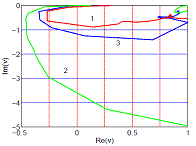
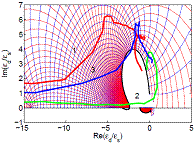
На рисунках показано конформное отображение дисперсионного соотношения для системы воздух-металл-кварц, кривые 1,2,3 соответствуют диэлектрическим проницаемостям для меди, серебра и золота.
Работа выполнена при финансовой поддержке РФФИ (проекты № 12-08-00924-а, № 11-08-00480-а).
ЛИТЕРАТУРА.
1. , под ред. "Поверхностные поляритоны. Электромагнитные волны на поверхностях и границах сред”, «Наука», 1985.
2. Yu. Wang, F. Plouraboue, H.-C. Chang. “Broadband converging plasmon resonance at a conical nanotip”. Optics Express, 2013, 21(5), 6609-6617.
3. S.-W. Kim et all. “Plasmonic generation of ultrashort extreme-ultraviolet light pulses”. Nature Photonics. 2011, 10.1038, 1-5.
4. A. Bouhelier, J. Renger, M. R. Beversluis, L. Novotny. “Plasmon-coupled tip-enhanced near-field optical microscopy”. Journal of Microscopy, Vol. 210, Pt 3 June 2003, 220–224.
5. P. B. Johnson and R. W. Christy, “Optical constants of the nobel metals,” Phys. Rev. B,1972, 6, 4370–4379.
6. A. Taflove, S. C.Hagness “Computational Electrodynamics The Finite-Difference Time-Domain Method”, ARTECH HOUSE, INC, 2005.
A STUDY OF OPTICAL PROPERTIES OF A CONICAL INSULATOR-METAL-INSULATOR STRUCTURE
M. V. Chernov, G. S. Ganchenko
Kuban State University, Krasnodar
Plasmon waves can be excited at the boundary between media with positive and negative permittivities [1]. The corresponding field is concentrated near the interface, and the lengths of those waves are much smaller than that of the light of the same frequency in vacuum. High localization of that field allows effective nanoscale control on the light.
Investigation of the interaction of optical radiation with layered nanostructures is one of the rapidly developing areas of modern physics. The optical properties of such structures are determined not only by properties of the materials themselves, but also by the geometric parameters. Apart from the usual diffraction effects that occur due to the presence of the layered structure, resonant excitation of the electron lattice vibrations at the interface, accompanied by amplification of local fields, and the associated process of the self-focusing of the electromagnetic field can have a significant impact. The interest to such a research rises due to the fact that the process of self-focusing of electromagnetic waves at the micro - and nanostructures that arises under the influence of surface plasmon resonance (SPR) is one of the main effects used in creating solar cells, photothermal therapy and microscopy.
This work focuses on modeling of harmonic fields at a fixed frequency in the vicinity of structures; in this case, the excitation of the simulated system is performed by a monochromatic wave, namely that having a TM-wave polarization. As it is shown in several studies, the most appropriate structure for strength and concentration of the electromagnetic field in the vicinity of nanostructures is a two-layer nanocone [2,3,5]. The insulator-metal-insulator system has been considered as a layered structure with copper, silver and gold in the place of the metal. Maxwell’s equations have been used to describe this system along with the corresponding boundary conditions [1]; it is transformed to the system of Helmholtz equations, and the boundary conditions remain the same. The solution of Helmholtz equations produces the dispersion relation similar to that arising in modeling a single-layer cone [2]. Numerical simulation gives the optimal frequency of the external electromagnetic radiation for PPR occurrence and the permittivity of the metal layer, which is calculated by means of Drude model [5], for the given cone angles. Since the characteristic dimensions of the structure are much smaller than the wavelength, namely of the order of 10-100 nm, the finite-difference time domain (FDTD) method [6] has been used for numerical calculation of the electromagnetic field in such nanostructures.
As a result, the frequency region in which the PPR occurs, i. e. the intensity of the focused beam is maximized, has been obtained for each of the metals. In particular, it was found that silver is the most suitable metal for creation of such structures.
The figures show the conformal mapping of the dispersion relation for the air-metal-quartz system, the curves 1,2,3 correspond to the permittivities for copper, silver and gold.
This work has been supported by RFBR (projects № 12-08-00924-а, № 11-08-00480-а).
REFERENCES.
1. V. M. Agranovich and D. L. Mills, ed. “Surface Polaritons. Electromagnetic Waves at Surfaces and Interfaces”, Elsevier, 1982.
2. Yu. Wang, F. Plouraboue, H.-C. Chang. “Broadband converging plasmon resonance at a conical nanotip”. Optics Express, 2013, 21(5), 6609-6617.
3. S.-W. Kim et all. “Plasmonic generation of ultrashort extreme-ultraviolet light pulses”. Nature Photonics. 2011, 10.1038, 1-5.
4. A. Bouhelier, J. Renger, M. R. Beversluis, L. Novotny. “Plasmon-coupled tip-enhanced near-field optical microscopy”. Journal of Microscopy, Vol. 210, Pt 3 June 2003, 220–224.
5. P. B. Johnson and R. W. Christy, “Optical constants of the nobel metals,” Phys. Rev. B,1972, 6, 4370–4379.
6. A. Taflove, S. C.Hagness “Computational Electrodynamics The Finite-Difference Time-Domain Method”, ARTECH HOUSE, INC, 2005.
Проекты по теме:


 Основные порталы (построено редакторами)