

Открытый урок по теме «Телевидение» в XI классе.
Цели урока:
1 Совершенствовать умения и навыки практического владения английским языком по данной теме в монологической и диалогической форме.
2 Учить учащихся размышлять по теме, выражать свою точку зрения и обмениваться мнениями, используя речевой этикет.
3 Учить учащихся оценивать ответы одноклассников и обосновывать свои оценки.
4 Воспитывать у учащихся критическое отношение к телевидению и к просматриванию телепрограмм.
Оборудование урока:
Кафедра для председателя дискуссии, карточки Language-Support (Agreement – disagreement, Gaining time to think, Language of persuasion) для каждого участника дискуссии, карточка оценивания для учителя, карточки оценивания для слушателей (по 2 на каждого), эмблемы для участников: Chair (1), TV Fans (4), TV Foes (4), Audience (3).
Оформление доски:
В центре – название темы урока: A Nationwide TV Turn - off Week in Russia.
Слева на подвижной доске:
Objectives:
– to develop debating skills;
– to speculate on TV values.
Skills development:
– to practise giving arguments and counterarguments;
– to practise exchanging opinions;
– to practise peer evaluation.
Справа на подвижной доске:
Ideas to develop:
Entertainment
Educational values
Expansion of knowledge
Integral part of progress
Exposure to violent scenes
Imitating violent behaviour
Being addicted to TV
Distracting from duties
Violation of human rights.
На центральной доске:
Evaluation card for the teacher (у учителя есть копия, которую он(а) заполняет в ходе дискуссии) [2, с. 172]
Pupil’s name | Role | Content | Fluency | Accuracy | Participation | Average mark |
Подготовка:
На предыдущих уроках учащиеся обсуждали положительное и отрицательное воздействие телевидения на зрителей, писали сочинение-обращение к руководителям телекомпаний России против показа насилия по телевидению и, наоборот, сочинение-обращение к родителям о том, что насилие на экране не влияет на подростков, учились убеждать друг друга в правильности своей точки зрения.
Для проведения заключительного урока по теме ученики разделились по группам: председатель дискуссии, ответственный за проведение дискуссии (Chair); две группы участников дискуссии: одна из них – TV FANS(Pupil 1, Pupil 2, etc) – поклонники телевидения, другая – TV FOES –( Student 1, Student 2, etc) противники телевидения. Обе команды выбирают лидера группы и готовят тезисы (аргументы) своего выступления и предполагаемые контраргументы для защиты своей точки зрения. Есть и группа зрителей (Audience), которая внимательно слушает аргументы и контраргументы обеих команд, задает им свои вопросы и оценивает участие групп по 3 критериям [1, с. 84].
Evaluation card for the audience | Very poor Excellent |
How convincing is the argument? | |
How convincing is the counter-argument? | |
How well was the team prepared to answer the questions? |
В зависимости от подготовленности группы учитель может также участвовать либо в роли председателя, либо в роли одного из группы зрителей, оценивающей команды. (В нашем случае учитель представлял команду зрителей).
План урока
I. Вступительное слово учителя о теме, целях и задачах урока. Представление председателя дискуссии.
II. Дискуссия.
1. Председатель дискуссии представляет команды. Лидер группы и её представители представляют тезисы в защиту своей точки зрения по очереди.
2. Команды обмениваются контраргументами.
3. Группа зрителей задает вопросы командам.
4. Группа зрителей голосует согласно своей карточке, выставляя оценки по 5-балльной шкале по 3 критериям. Оценки зрителей либо суммируются, либо подсчитывается средний результат, и выявляется команда-лидер дискуссии.
5. Председатель объявляет итоги голосования.
III. Подведение итогов урока: объявление команды-победительницы, обсуждение участия каждого из учеников в дискуссии согласно карточке оценивания учителя. Учитель заполняет ее во время дискуссии. В заключение учитель может заполнить ее на доске, комментируя участие учащихся сам(а) или подключая к этому учащихся (в зависимости от степени подготовленности учащихся, в зависимости от времени, оставшегося в конце урока).
Ход урока
Teacher: Let me greet our audience, our guests and pupils. Today we are having a final lesson of the Unit “TV or not TV?” Let’s dot every “i” and cross every “t” when solving this problem.
We are going to have a debate: “Do we need a Nationwide TV Turn - off Week in Russia?” (It is an annual American tradition). The main objectives of the lesson are as follows: to develop debating skills and speculate on TV values.
Let me introduce the chair of the debates. His name is … He is responsible for the debate procedure. You are welcome (ученик, выбравший роль председателя дискуссии, встает за кафедру). I’ll join the audience team.
I. Debate procedure.
CHAIR: Good afternoon, ladies and gentlemen! Could I have your attention, please? Let me open the discussion “A Nationwide TV Turn - off Week in Russia”. Two teams will discuss the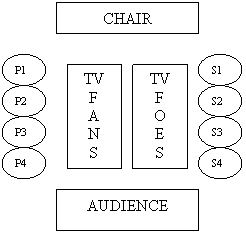 advantages and disadvantages of TV to make a final decision about whether if it is necessary to have A Nationwide TV Turn - off Week in Russia or not. Let me introduce the leader of the TV Fans team. Her (his) name is … Present your arguments on the topic, please.
(Председатель дискуссии уступает место за кафедрой капитану команды, остальные участники представляют свои аргументы, сидя на своих местах).
P1: Hello! My name is … I’m the leader of TV FANS. They are …
Whether we realize it or not, TV plays an important part in our lives. It’s the main source of information and a cheap form of entertainment for millions of people. It gives people an opportunity to “travel” all over the world, to “meet” different people and learn about their customs and traditions.
It has the power to educate and expand our knowledge. It helps us to relax after a hard day’s work and escape from reality.
There’s always a great variety of programmes on TV: news and sport programmes, talk shows and quiz shows, documentaries and action films, wild life programmes and music shows.
It is necessary to learn to control how much television you watch and use it intelligently. The ideal is to turn on TV only when there is a really interesting programme. If you don’t like a certain programme, why watch it? Thank you.
P2: I’d like to express my point of view on the topic. I have looked through the TV guide, and I should say that we have a lot of TV programmes for all kinds of tastes. If you like serious programmes you can watch news and documentaries. If you need relaxation after a working day, just tune into game shows or music shows, different series or sitcoms. As for me, I’m a sportsman and I want to know much about sport events in the country and abroad. I think they are broadcasted quite well, especially during championships and the Olympic games.
So, TV provides a lot of opportunities for entertaining and relaxing the audience.
P3: You should agree with me that TV is an integral part of progress. We can’t imagine our life without TV, we can’t avoid it in our life. It is obvious that TV helps us to broaden our minds, expand our knowledge of the world, and become a well rounded person. Thanks to TV, children improve their speech habits.
P4: As a matter of fact, TV keeps a person informed about current events, allows one to follow the latest developments in science and politics, and offers an endless series of programmes. The most distant countries and the strangest customs are brought right into our sitting room. It could be argued that radio fulfils this function as well, but on television it is much more real. Thank you for your attention.
Chair: Now I give the floor to the next team, TV Foes, and its leader. S1, welcome (уступает место за кафедрой капитану команды, другие участники выражают свою точку зрения, оставаясь на своих местах).
Student 1: Hello! My name is … I am the leader of TV Foes. I want to introduce the members of my team. They are …
Now I want to express the opposite point of view and say some words about the negative influence TV has on people.
Have you ever thought about what TV does to children? They become aggressive watching daily programmes about murders, violence, drugs and such things. I don’t need all of that stuff.
Do you know that 64% of all television violence takes place in cartoons? And how many parents would stop a child from watching a cartoon? In any case, few parents actually check up on what their children usually watch on TV. And that’s where the problems start. TV makes some children imitate the violent behaviour of their favourite lead characters.
The other reason why I don’t respect TV programmes is the fact that people become addicted to ing home from work, people sit in front of TV, watching endless TV serials and no more. They forget about a healthy mode of life, becoming more passive. My advice to people is to communicate more with family members and friends, not to forget about family duties and physical exercise. Thank you for your attention.
Student 2: I want to continue the theme of our conversation and express psychologists’ point of view on the problem. You know that TV negatively influences a child’s development. When children spend all day in front of TV sets they usually do not find the time to read, play games in the yard, or talk to their friends and parents.
Some teachers say that children who watch TV every day talk too much at school during the lessons.
TV also influences pupils’s creative abilities and their imagination in a negative way. Pupils who watch TV very often cannot understand easy stories without pictures, tables, or illustrations.
TV usually makes children passive. When a child watches TV, he lives the lives of TV heroes – he travels with them, does everything with them. But he is really just sitting in an armchair and watching TV, not doing anything. When a child watches TV, everything seems easy to him, and real life begins to seem easy. He cannot work hard, because watching TV does not take hard work.
Student 3: As for me, I have looked through a TV programme and judged it for its quality. For instance, if we take channel …, we’ll see that the majority of programmes are action films or TV serials with a lot of violent, sexual or degrading material. They make up 50% of TV time. Then come news and documentaries, which sometimes are quite depressiving and stressful for people. Those make up 30% of TV time. Entertaining programmes comprise 15% of TV time, among them talk shows, quiz shows and game shows which do not give much food for thought.
This TV channel has few child-oriented programmes (5% of TV time).
So, if you are a constant TV watcher, it will cause different nervous illnesses because the TV screen is full of stressful news and information, with a lot of violent and cruel scenes. It is dangerous for children’s health and psychology, as watching TV spoils children’s eyes, their nervous system and even their character. It’s not easy for children to determine the difference between reality and fantasy, and some of them begin to imitate the violent behaviour they see in their favourite programmes.
Student 4: I think that programmes containing violent scenes have a negative influence both on adults and children. I have some striking facts about it. Between 22 and 34% of young males imprisoned for committing violent crimes report having imitated crime techniques watched on TV.
I’d like to appeal to TV executives of Russia not to develop violent and sexual programmes. I want to see good family-oriented entertainment. I want the Russian television authorities to forbid violent programmes, as children imitate violent behaviour and crime techniques seen on TV. Violent TV programmes influence people’s nervous system. I think it is necessary to appeal to industry leaders in all mass media to forbid the practice of selling adult-oriented programmes to youth and large, these programmes cause the population to degrade. Violent programmes are dangerous for our society.
Chair: Thank you, TV Foes. And now be ready to present your counterarguments.
(Представляя контраргументы, ученики могут использовать карточки 1 и 2 (Language Support)).
Student 1: I quite agree with TV Fans, but only to a certain extent. It is obvious that TV is an integral part of progress, it expands our minds, it is the cheapest way of educating and amusing people. In spite of its good sides TV has a bad influence on people. I mean that it distracts people from their family and home duties; TV distracts children from doing homework and other useful things.
Pupil 1: What do you mean by saying this? People need to relax after a hard working day. Children also should have a rest. TV gives this opportunity, making our life happier, more exciting, more thrilling with a number of various programmes to suit every taste.
Student 2: I am afraid I am not of the same opinion. Most programmes are adult-oriented, with a lot of violent, sexual and degrading material. It is dangerous for our nation, for our population. It is bad for children, as they imitate their favourite characters’ violent behaviour, and imitate crime techniques. You say that TV gives a lot of opportunities, but they are mostly negative. I insist on my point of view that much TV is dangerous for children’s health and psychology, as children are too small to determine the difference between child - and adult-oriented programmes, between reality and fantasy.
P2: Perhaps you are right, but what about parents? I mean parents should control children and check up on what their children watch, they should try to limit their time in front of the TV and help children to choose better, age-appropriate programmes, without violent and cruel scenes. They should help them to develop their tastes watching TV.
Pupil 4: Excuse me, but I want to interrupt you and say that it is impossible to keep children away from all the horrors that happen in the world. In my view, TV shows teenagers a real life. Violence is not only present on the screen, but also in our everyday life. TV helps teenagers to distinguish good people from bad ones. When a teenager watches violent scenes, he realizes that it is bad and forbidden by the law. As a result, sooner or later, a criminal is held responsible for his actions and is punished by the state.
Student 3: I can see your point. We can’t imagine our life without TV because of its numerous advantages. But I’m sure you’ll agree with me if I say that a lot of advertisement is tiresome and irritates everybody. People have to watch a lot of advertisements about things they are not interested in, like alcohol (beer-drinking). Therefore, our population becomes more addicted to bad habits.
Pupil 3: But you need to think more about disabled people or those who live alone, perhaps, they have nobody to talk to, nobody to support them, but they are interested in the world around them.
So, TV is helpful when a person lives alone and it becomes a member of the family. TV is useful for disabled people as well.
Student 4: The trouble is that TV begins to dominate our lives. It often happens that if your TV set has broken down, you suddenly find that you begin to talk to each other again. It makes a person read more, think more and do other interesting things as well.
Student 1: (TV Foes leader): In conclusion, I should say that it is obvious and we can’t deny the fact that TV is an essential part of our life. At the same time, grown-ups mustn’t allow young people to regard violence as acceptable behaviour by showing much violence on TV.
One more thing. The more intelligent people, however, choose their programmes very carefully. They find out what they really want to watch by studying printed programmes, and do not allow themselves to waste too much time watching merely light entertainment.
Pupil 1 (TV Fans leader): Summing up, I want to say that we have a lot of TV programmes made in good taste and with great professional skill.
Some people argue that TV is a terrible waste of time. It is true that some TV addicts spend hours in front of the TV watching whatever’s on – from second-rate soap operas to silly commercials.
As I have already said, we should learn to control TV and use it intelligently.
Violence on TV is another problem that worries people. As George Mikes once said, TV teaches us “how to kill, to rob, to shoot and to poison”. But the same can be said about computer games and many films and books. But we don’t refuse to read books or play computer games. Why should we refuse to watch TV then?
Chair: Thank you, both teams. Now I give the floor to the audience. Does the audience have any questions?
Возможные вопросы зрителей обеим командам:
1. Which is your favourite channel? Why?
2. The average Russian teenager spends about 20 hours a week in front of the TV set. What about you?
3. Do you agree that television has the power to educate?
4. What do you think of commercials? Do they annoy you?
5. Do you believe that violence on TV may turn people into criminals?
6. Some people say that television kills conversation. Do you agree?
7. Do children know which programmes are suitable and which are inappropriate for them?
8. What are the advantages of a TV-free life?
9. What are the disadvantages of TV?
10. Do you think TV executives should be more careful with the choice of programmes?
11. What would happen in your life if we had a Nationwide TV Turn-off Week in Russia?
12. What would you change in the TV industry if you were the Minister of Culture (if you were the General Director of Channel I)?
Отвечая на вопросы, ученики могут использовать карточку 3 (Language Support). Члены обеих команд отвечают на вопросы зрителей, зрители оценивают ответы обеих команд по трём критериям (см. Evaluation card for the audience).
Chair: Now I invite the audience to vote for the decision whether we need a Nationwide Turn - off the TV Week in Russia or not. Vote according to your evaluation cards, please.
A1: In my opinion, TV Fans (Foes) were more (less) convincing in their arguments (counterarguments). I think TV Fans (Foes) were well prepared to answer the questions. So, the score is … to … in favour of …
A2: As for me, I think that better (worse) reasoning was provided by … than by … Their utterances were more (less) coherent. Their answers to the questions were more (less) exact. The score is …
Зрители выражают своё мнение об участии команд в дискуссии, подводят итоги голосования (либо суммируют результаты, либо вычисляют средний результат, о чём договариваются в начале дискуссии).
Chair: Let me announce the results. The total score is … to … in favour of … So, we need (don’t need) a Nationwide TV Turn off Week in Russia. Let me close the discussion.
Teacher: Now let’s discuss the debate and its results. The … team is stronger than the … team according to the audience evaluation cards. My best congratulations to you. Now let me introduce the results of the group according to the teacher evaluation card, using the following criteria: content, fluency, accuracy, participation (Учитель оценивает участие каждого ученика в дискуссии).
Teacher: By and large, I enjoyed the discussion. It’s our first experience and I am satisfied with the work you have represented. Thank you, everybody.
Приложение. Language Support [1, с. 50, 80]
Card 1.
Agreement You are not sure Disagreement
Yes, that’s right. Yes, but … I don’t agree.
Just so. On the other hand … I don’t think so.
I quite agree here. I’m afraid I don’t agree … You can’t say that.
Certainly. I don’t think you are right. That’s not the point.
Exactly. I can’t agree with you there. On the contrary.
I should think so. I’m not sure. Certainly not.
I think so, too. Don’t be so silly.
It’s true. Just the other way round.
I see your point.
Card 2.
Language of persuasion
Believe me …
The truth (fact, trouble) is that …
You need to think about …
You can take my word for it that …
As I am sure you’ll agree …
I appeal you to …
I call upon you to …
I urge you to …
I can assure you that …
Card 3.
Gaining time to think
Well, let me see …
Well, let me think …
Let’s put it this way …
I’ll have to think about that …
How shall I put it?
The best way I can answer that is …
That’s a good (difficult) question …
If my memory serves me right …
Just a moment, please.
Литература
1. и др. New Millenium English. Student’s book, 11. –Титул, 2003.
2. и др. New Millenium English. Teacher’s book, 11. – Титул, 2003.
3. , Упражнения, грамматические задания и устные темы по английскому языку для старшеклассников и поступающих в ВУЗы. – М.: Астрель, 2000, с. 398 – 400.
4. Поздеева Е. К. Reading for Pleasure. – М.: Просвещение, 1990, с. 41 – 42
5. Speak Out. – 2001 - №3- с. 28.
, учитель английского языка,
МОУ СОШ №25, г. Златоуст, Челябинская обл.
(«ИЯШ», № 5,2007)
