

Партнерка на США и Канаду по недвижимости, выплаты в крипто
- 30% recurring commission
- Выплаты в USDT
- Вывод каждую неделю
- Комиссия до 5 лет за каждого referral
Дом Учителя Уральского федерального округа
XI Международная Олимпиада по основам наук
Второй этап. Премьер лига
Научный руководитель проекта по предмету: , доктор филологических наук, профессор кафедры английского языка, методики и переводоведения Института иностранных языков УрГПУ, г. Екатеринбург
Автор заданий: Елена Сергеевна Надточева, доцент кафедры английского языка, методики и переводоведения Института иностранных языков УрГПУ, г. Екатеринбург
Английский язык 10 класс
Проводится в честь Стивена Хокинга
Время выполнения работы 1 час 15 минут
____________ ________ __________ ___________ ____________ __________ _________
Фамилия Имя Отчество Нас. Пункт Область ОУ № код участника
Таблица ответов
Задание | 1 | 2 | 3 | 4 | 5 | |||||||||||||
Задание | 6 | |||||||||||||||||
Задание | 7 | |||||||||||||||||
Задание | 8 | |||||||||||||||||
Задание | 9 | |||||||||||||||||
Задание | 10 | |||||||||||||||||
Задание | 11 | 1 | 2 | 3 | 4 | 5 | ||||||||||||
Задание | 12 | 1 | 2 | 3 | 4 | 5 | ||||||||||||
Задание | 13 | 1 | 2 | 3 | 4 | 5 | ||||||||||||
Задание | 14 | 1 | 2 | 3 | 4 | 5 | ||||||||||||
Задание | 15 | 1 | 2 | 3 | 4 | 5 | ||||||||||||
Задание | 16 | |||||||||||||||||
Задание | 17 | |||||||||||||||||
Задание | 18 | |||||||||||||||||
Задание | 19 | |||||||||||||||||
Задание | 20 | |||||||||||||||||
Задание | 21 | |||||||||||||||||
Задание | 22 | |||||||||||||||||
Задание | 23 | |||||||||||||||||
Задание | 24 | |||||||||||||||||
Задание | 25 | |||||||||||||||||
Инструкция по выполнению работы
На выполнение олимпиадной работы отводится 1 час 15 мин. Работа состоит из 4 частей и включает 25 заданий.
Часть 1 состоит из 5 заданий (1 – 5), оцениваемых в 1 балл. В данных заданиях необходимо выбрать один правильный ответ из нескольких предложенных.
Часть 2 состоит из 5 заданий (6 – 10), оцениваемых в 3 балла. В данных заданиях (6 – 10) необходимо выбрать три правильных ответа из нескольких предложенных.
Часть 3 состоит из 10 заданий (11-20), оцениваемых в 5 баллов, из которых: 5 заданий (11-15) – на установление соответствия и 5 заданий (16-20) – на последовательность. В заданиях 11–15 необходимо установить соответствие между содержанием первого и второго столбцов. В заданиях 16-20 – нужно установить правильную последовательность.
Часть 4 состоит из 5 наиболее сложных заданий (21–25) открытого типа, оцениваемых в 6 баллов. Ответы записываются в таблицу ответов, начиная с первой клеточки (без артикля). Каждую букву пишите в отдельной клеточке, буквы должны быть печатными. При записи ответов пробелы и другие символы не используются. Баллы, полученные вами за выполненные задания, суммируются.
Постарайтесь выполнить как можно больше заданий и набрать наибольшее количество баллов. Внимательно прочитайте каждое задание и проанализируйте все варианты предложенных ответов. Постарайтесь выполнять задания в том порядке, в котором они даны. Для экономии времени пропускайте задание, которое не удается выполнить сразу, и переходите к следующему. К пропущенному заданию вы сможете вернуться после выполнения всей работы, если останется время.
В случае выполнения заданий на бумажном носителе, заносите ответы в специальную таблицу ответов. В заданиях на соответствие ответы нужно вписывать таким образом, чтобы буква из второго столбца соответствовала цифре первого столбца. В заданиях на последовательность и хронологию ответ нужно записывать в виде правильной последовательности цифр (без пробелов и других символов). В заданиях открытого типа ответ записывается в таблицу ответов печатными буквами, начиная с первой клеточки. Каждую букву необходимо писать в отдельной клеточке. Рекомендации внесения ответов даются к каждому заданию открытого типа.
Первая часть. Задания, оцениваемые в 1 балл.
1. Choose the correct variant:
When in college Stephen Hawking …
1) was a member of the college football team.
2) played for college golf team.
3) was a member of the college athletics club.
4) coxed a rowing team.
2. Where did Hawking obtain his PhD degree?
1) in London
2) in Harvard
3) in Cambridge
4) in Oxford 5) in Princeton
3. Choose one sentence with a mistake.
1) Life exists in the most surprising places.
2) From freezing mountain tops to deserts where it hardly ever rains, living creatures have made their homes. 3) Perhaps the most liked place on Earth to find life is at the bottom of the ocean. 4) Most biologists used to believe the lack of light and the extremely high water pressure made life impossible down there.
5) However, discoveries have recently been made of plants and fish near hot water springs at a depth of over 2,500 metres.
4. What piece of writing doesn’t belong to Stephen Hawking?
1) The Large Scale Structure of Space-Time
2) A Brief History of Time
3) Late Night with Conan O'Brien
4) The Grand Design
5) The Universe in a Nutshell
5. Find a verb which is not a synonym to the verb ‘tell’?
1) report
2) utter
3) inform
4) communicate
5) inquire
Вторая часть. Задания, оцениваемые в 3 балла.
6. Choose 3 words which can be used with raise.
1) sun
2) prices
3) volume
4) children
5) excuse
6) stock market
7. Choose 3 correct sentences where the relative pronoun which can be used.
1) I don’t know anyone … can breakdance.
2) The children enjoy activities … are varied and fun.
3) The new school uniform, … everybody hates, is very old-fashioned.
4) A police officer … parked his car at the next corner stopped and arrested them.
5) Parents … work long hours don’t pay enough attention to their children.
6) Do you know the shop … sells souvenirs?
8. Choose 3 sentences in which adjectives formed from the words in brackets end with – ed.
1) Singing in public for the first time is … (terrify).
2) I am… that so many people are here for the meeting (amaze).
3) There are not enough after-school clubs so it’s not surprising that teenagers are … (bore).
4) It’s really … listening to music when you’re doing homework (relax).
5) The teachers are always … when students don’t do their homework (annoy).
6) It was really … to get such low test results (disappoint).
9. Which 3 of these sentences about Stephen Hawking are true?
1) Stephen Hawking went to university when he was 16.
2) The book ‘George's Secret Key to the Universe’ was co-written with his daughter Lucy.
3) He has no children.
4) Stephen Hawking started experiencing problems with his health before he got his PhD degree.
5) His parents were university professors.
6) He has never won a Nobel Prize.
10. Read the text. Choose 3 true sentences below it.
The Teenage Brain
Scientists have a new explanation for the behaviour of teenagers: their brains are too big!
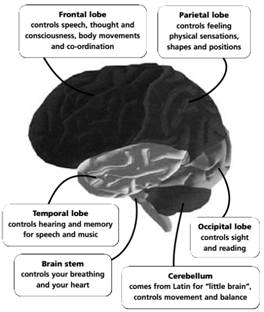 Teenagers have big brains. Scientists used to believe that our brains were fully developed by early childhood. New research shows that the brain grows very quickly between the ages of 10 and 12, when it is at its biggest. During the teenage years your brain shrinks bit by bit until it is the size of an average adult’s.
Explaining Teenage Behaviour. The frontal and parietal lobes are the last to finish developing. The frontal and parietal lobes manage judgment, reasoning, planning for the future and visual/spatial ability. This may explain why teenagers are sometimes more impulsive, emotional and clumsy than adults. It’s not your fault, your brain’s too big!
Building a better brain. The teenage years are an important time in your brain’s development and you can build a better brain. The activities of the teenager influence which cells disappear and which cells remain as they get older. Dr Giedd, a psychiatrist, says, “If you’re lying on the sofa or playing video games your brain gets programmed for that.” His advice: Test your brain. “If you exercise a muscle, you make it stronger. The brain works like that. Try a foreign language, music, games – anything that makes the brain work hard.” How you’re using your brain now influences the kind of brain you have when you’re an adult. Don’t say we didn’t warn you!
1) Scientists believe that young children have fully-developed brains.
2) The teenage brain is bigger than the adult brain.
3) The brain of a young person between 13 and 19 years old is getting smaller.
4) The brain doesn’t stop developing during the teenage years.
5) The number of cells in your brain never changes.
Третья часть. Задания, оцениваемые в 5 баллов.
11. Match the phrasal verbs 1 – 5 with their meanings A – F. There is one extra variant.
1. See off | A. When a plane departs or leaves the ground. |
2. Take off | B. Go to the airport or station to say goodbye to someone. |
3. Set off | C. Delay when travelling. |
4. Get off | D. Start a journey. |
5. Hold up | E. Leave a bus, plane, train. |
F. Pay the bill when leaving the hotel. |
12. Match the words with the sentences to complete them. There is one extra variant.
1. Nobody ever ... at my joke. | A. judge |
2. I try to … people by their behaviour not by their appearance. | B. stared |
3. He was so angry he started... at her. | C. blamed |
4. I can’t... of any good reason for having a tattoo. | D. shouting |
5. She … her new hairdresser for her ink hair. | E. laughs |
F. think |
13. Complete the sentences with the phrases. There is one extra variant.
1) John is … at the moment because he is studying for his exams. | A) likes a challenge |
2) Naomi’s new course is difficult and stressful but she … | B) look right |
3) I’m not keen on wearing smart clothes but I know it’s important to …in the job. | C) be a success |
4) He is training very hard as a singer because he wants to … in the future. | D) working on my own |
5) I like learning languages but I have problems with the grammar and never seem to | E) under pressure |
F) get it right |
14. Fill in the gaps with one word. Choose from the words given below.
A good start to a holiday
I had never been to Denmark before, and when I set out to (1) … the ferry in early May, I little suspected that by the end of the trip I’d have made such lasting friendships.
I wanted to use my time well, so I had planned a route which would include several small islands and various parts of the countryside. I arrived in Esbjerg, a (2) … port for a cyclist’s arrival, where tourist information can be obtained and money changed. A cycle track leads out of town and down to Ribe, where I spent my first night.
In my experience, a person travelling alone sometimes meets with unexpected hospitality, and this trip was no (3)… . In Ribe I got into conversation with a cheerful man who turned (4) … to be the local baker. He insisted that I should join his family for lunch, and, while we were eating, he contacted his daughter in Odense. Within minutes, he had (5)… for me to visit her and her family. Then I was sent on my way with a fresh loaf of bread to keep me going, and the feeling that this would turn out to be a wonderful holiday.
A. out | B. exception | C. arranged | D. catch | E. agreed | F. convenient |
15. Fill in the gaps, using phrases A–F. There is one extra sentence you don’t need to use.
Solar energy – the sun’s gift to humanity
by Andy Groves
Scientists tell us that our sun is dying. It will, in time, run out of fuel, cool down and expand into a red giant. But as that is going to take approximately five billion years, we have plenty of time to take advantage of the solar energy which it currently provides.
The sun is a huge ball of atomic activity, which emits solar energy in the form of light and heat. This energy travels through space to the planets providing us with daylight and warmth. It is an incredible free gift.
(1) … Early civilisations learned, for instance, how to use the sun’s heat for drying meat, fruit or fish to keep them for later eating; the sun baked clay into bricks for building; animal skins were dried for clothing.
Later, when people started living in purpose-built houses, the value of solar energy for heat was understood and eventually became incorporated into the design. In many medieval castles there was at least one room called the ‘solar’ which faced south and had as big a window as could practically be made in those days. (2) …
In more recent times, the term ‘solar energy’ has taken on a somewhat different significance. Modern man uses energy in many forms and ever-increasing quantities. Generally, this energy has been obtained from fossil fuels, such as coal, oil or gas, extracted from under the ground or beneath the sea. (3) … Burning them is also having a terrible effect on the environment of our planet.
Because we in industrialised societies have become used to such a high level of energy usage in our everyday lives, the thought of doing without is no longer considered a realistic option. (4) … Fortunately, the good old sun can provide one, and solar energy is becoming crucial to our future requirements.
Solar energy is renewable, non-polluting, available everywhere, is not (yet) owned by anyone or any country and is free. It can be used directly to heat air and so provide heat for buildings in a way that is similar to how greenhouses work. Alternatively, the heat can be collected by solar panels and passed on to heat water for washing or central heating. Light sensitive devices can convert the light from the sun into electricity. (5) … Initially, it was mainly used for pocket calculators, but now it powers radios, pumps, lights, and even cars.
A. Many thousands of years ago, humans were already using solar energy in a variety of ways.
B. These natural resources, we now realise, are not going to last forever.
C. Lots of it, however, still gets through to us.
D. Clearly, alternative sources of energy are needed.
E. It was one place where our ancestors could be warm, thanks to the sun.
F. This process enables solar power to drive an increasingly wide range of appliances.
16. Put the parts of the sentence in the correct order.
1) where he was named to one
2) the Lucasian Professor of Mathematics,
3) the position once held by Sir Isaac Newton.
4) of teaching's most renowned posts:
5) In 1979, Hawking found himself back at Cambridge University
17. Put the parts of the e-mail in the correct order:
1) That would be great! It will be the best holiday I’ve ever had. I’ll send you a postcard.
Bye for now,
Theo
2) Dad says it’s as fast as going by plane, but I don’t believe him! Still, by this time tomorrow afternoon we’ll have arrived and I’ll be swimming in the hotel pool. Generally, I would rather have an active holiday, but Mum and Dad prefer to relax.
3) I think windsurfing will be more fun than sailing, don’t you? Hopefully by the end of the week I will have learnt how to windsurf really well.
4) I expect they will be sitting by the pool while I am swimming! Luckily for me there are some watersports on the beach.
5) Hi Alex,
I’m going on holiday in the morning. We’ll be staying in a big hotel in Crete for a week. It will take a few hours to get there as we’ll be travelling by car and by ferry.
18. Read the text and put the parts of it in the logical order:
1) Later, I spotted a small child who was sobbing because he has lost his mother. When we found is mother she was grumbling because she was cross with him for running off.
2) Luckily we found his teeth for him but they were really dirty. Yuck! Life is never dull at the theme park!)
3) The weather is perfect so the theme park where I work has been really busy recently. Hundreds of visitors pour in through the gates each day. Today was another hectic day. As usual several noisy and excited groups of schoolchildren were shrieking and yelling to each other all the time.
4) She said she’d prefer to go home rather than chase him around! I was working on the roller coaster this afternoon. One grandfather had a terrible ride. First his grandson was sick over him, and then he realized that his false teeth had fallen out at the top of the roller coaster. It was hard to understand what he was saying because he was mumbling.
5) My friends asked me to go to the cinema at 9 pm but I will have gone to bed be then because I’m exhausted! Sometime I’d rather have a quieter job, but I’ll be working on the water splash tomorrow morning. It might be fun! By the end of next week I will have earned enough money to buy an amazing new bike.
19. Put the events and historical periods in the chronological order:
1. Tony Blair was elected Prime Minister.
2. Gun Powder Plot
3. Victorian Age
4. The Great Fire of London
5. Wars of Roses
6. English Reformation
20. Put the parts of the sentences in the correct order.
1) with a responsible company
2) as an eco-tourist, you can help
3) and showing respect for local customs
4) when you arrive.
5) by booking your holiday
Четвертая часть. Задания, оцениваемые в 6 баллов.
21–25. Read the sentences and make words from those given in brackets.
21. There is a pen mark on this cushion, but it’s not very … (notice)
22. Thomas is very … – he usually saves his pocket money (sense)
23. When I’m tired, I sometimes feel cross and … (mood)
24. I’ll buy a cheap second-hand computer game. They’re really … (afford)
25. Meg had suffered needlessly for hours because she had done something …– after promising she wouldn't (care).
