


Партнерка на США и Канаду по недвижимости, выплаты в крипто
- 30% recurring commission
- Выплаты в USDT
- Вывод каждую неделю
- Комиссия до 5 лет за каждого referral
1. УМК под редакцией Н. «English» для учащихся 4 классов общеобразовательных учреждений с углубленным изучением английского языка (М.:Просвещение,2013) : учебник в 2 частях, рабочая тетрадь и приложение на электронном носителе
2. Стандарт начального образования по иностранному языку Примерная программа начального образования по иностранному языку
3. Программы общеобразовательных учреждений с углубленным изучением иностранных языков 2-11 классы. . Москва, Из-во «Просвещение» 2006 г.
4. Журнал « English» приложение к газете « Первое сентября »
5. Интернет – поддержка учебников и дополнительные материалы
· на сайте www. titul. ru
· на интернет – портале www. englishteachers. ru
6. Ю. Галицынский « Грамматика» сборник упражнений для школьников г. Санкт –
Петербург, Из-во «Каро», 2006 г.
Алфавит (настенная таблица) Касса букв и буквосочетаний (по возможности) Транскрипционные знаки ( таблица) Грамматические таблицы к основным разделам грамматического материала, содержащегося в стандарте начального образования по иностранному языку Наборы тематических картинок в соответствии с тематикой, определенной в стандарте начального образования по иностранному языку |
Карты на иностранном языке:Географическая карта/ы стран/ы изучаемого языка Географическая карта Европы |
Классная доска с набором приспособлений для крепления таблиц, постеров и картинок Настенная доска с набором приспособлений для крепления картинок. Телевизор (по возможности) Мультимедийный проектор (по возможности) Компьютер (по возможности) Экспозиционный экран (по возможности) |
Стол учительский с тумбой Ученические столы 2-х местные с комплектом стульев |
Аудиозаписи к УМК, используемым для изучения иностранного языка Видеофильмы, соответствующие тематике, данной в стандарте начального общего образования по иностранным языкам (по возможности) Мультимедийные (цифровые) образовательные ресурсы, соответствующие стандартам обучения (по возможности) |
Развивающие игры на иностранном языке. |
Контрольные работы. Английский язык 4-й класс
I четверть
I. Задание: раскройте скобки и поставьте глаголы в нужную форму. Выпишите
глаголы, обозначая их цифрами.
Last Sunday Mr. Brown and his son Jack 1) (to go) to the Zoo.
The weather 2) (to be) warm. They 3) (to put on) their sweaters, jeans and boots. They 4) (to look) great.
Mr. Brown and Jack 5) (to go) to London’s Zoo every spring. They 6) (to like) to go there because in spring Zoo animals 7) (to have) their cubs. They 8) (to think) it is very interesting. The little ones 9) (to be) very funny because they always 10) (to run), 11) (to jump), and 12) (to play).
Jack and his father 13) (to think), that they 14) (to go) to the Zoo next spring too. Their mother says that she 15) (to go) with them next year.
II. Possessive Case of Nouns
Задание: выберите вариант, соответствующий русскому
переводу: а, в, с
1) мамин зонтик
a) mothers umbrella; b) mother’s umbrella;
c) mothers’ umbrella.
2) книги родителей
a) parent’s books; b) parents books;
c) parents’ books.
3) яблоко сестры
a) sister’s apple; b) sisters’ apple;
c) sisters apple.
4) конура собак
a) dogs house; b) dogs’ house;
c) dog’s house.
5) фотоаппарат сына
a) sons’ camera; b) sons camera;
c) son’s camera.
6) кассеты братьев
a) brothers’ cassettes; b) brother’s cassettes;
c) brothers cassettes.
The Verb “to have”
Задание: выберите и вставьте в предложение нужную форму глагола “to have”:
a, b, c
1. My mother … a sunhade.
a) have; b) has got; c) have got.
2. I … a walkman.
a) has; b) have; c) hasgot.
3. His daughter … a computer.
a) have got; b) has got; c) have.
4. We … bicycles.
a) has got; b) have; c) have got.
5. The girl … a walkman.
a) has got; b) has got; c) have got.
6. The cats … a basket.
a) have; b) has; c) has got.
Have/has got
Задание: подберите к русскому варианту английский перевод предложения:
1 – h;
1. У меня есть два хомяка.
2. У моей сестры есть фотоаппарат.
3. У него есть попугай и черепаха.
4. У девочки есть зонтик.
5. У моих родителей есть плеер.
6. У котят есть корзинка.
7. У попугая есть клетка.
8. У Петра есть магнитофон.
a) The girl has an umbrella.
b) Peter has a cassette-recorder.
c) My sister has a camera.
d) My parents have got a walkman
e) He has got a parrot and a tortoise.
f) The parrot has a cage.
g) I have got two hamsters.
h) The kittens have got a basket.
II четверть.
I. What do Nick and the members of his family usually do or what are doing at the moment?
Example: Nick’s parents usually (to watch TV ) in the evening.
Nick’s parents usually watch TV in the evening.
1. Look, Nick's sister (to go) for a walk in the evening.
___________________________________________________________________________
2. She never (to go) for a walk in the evening.
___________________________________________________________________________
3. Nick’s cousins (to drink) apple juice now.
___________________________________________________________________________
II. What did the people do yesterday (last week, 3 days ago …)?
Example: She buys bread.
She bought bread yesterday.
1. He has coffee for breakfast.
___________________________________________________________________________
2. My cousin is late for school.
___________________________________________________________________________
3. They don't come to school at 11 in the morning.
___________________________________________________________________________
4. The lessons begin at 8.30.
___________________________________________________________________________
III. Compare people, animals and objects.
Example: Sue’s desk isn’t very big. Ann’s desk is … .
Sue’s desk isn’t very big. Ann’s desk is bigger.
1. Nelly’s brother is clever but his sister is … .
2. A tortoise is slow. It is … than a dog.
3. My dolls are not very nice. Your dolls are …
4. The potatoes are not very good. Buy some … potatoes.
5. That woman isn’t very beautiful. My sister is … .
6. “Much” or “many”.
1. There are … bright flowers here.
2. There isn’t … soup for dinner.
3. There aren’t … vegetables in the shop.
4. Are there … good books at school?
5. Is there … hot porridge?
6. There is … ice-cream for you.
7. There are … people in the street.
IV. Fill in the right prepositions (where necessary).
1. … Tuesday we usually get up rather early.
2. He never goes to school … car.
3. Our classes are over … half past two.
4. What happened … him … Friday?
5. This school is famous … its school museum.
6. There are many subjects … the timetable.
7. Bill is never late … school.
8. Will you join … me?
9. He never laughs … children.
10. We get … … Nick very well. We sit … the same desk.
V. Example: They can swim, … ?
They can swim, can’t they.
1. We can’t keep milk here, … ?
2. We shall join the P. E. class, … ?
3. He is never late for classes, … ?
4. They left for London 3 days ago, … ?
5. A little mouse lives under the floor, … ?
6. There is no blackboard in the classroom, … ?
III четверть.
1. Look at the picture and say when Andrew arrived there.
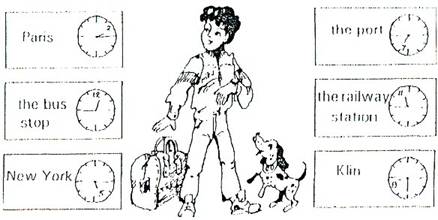
Example: Andrew arrived in Paris at a quarter past two.
1. ______________________________________________________________________________
2. ______________________________________________________________________________
3. ______________________________________________________________________________
4. ______________________________________________________________________________
5. ______________________________________________________________________________
2. Here are five short plete them.
Example: – Have you (see) “Hamlet”?
– Yes, (I have).
– Have you seen “Hamlet”?
– Yes, I have.
– When did you (see) it?
– I (see) it 2 years ago.
1. – What did you (buy) yesterday
_______________________________________________________________________________
– I (buy) some stamps, coins and badges.
_______________________________________________________________________________
– Where did you (buy) them?
_______________________________________________________________________________
– I (buy) them near the special shop.
_______________________________________________________________________________
2. – Have you ever (be) to the theatre?
_______________________________________________________________________________
– Yes, I (have).
_______________________________________________________________________________
– When (be) you there?
_______________________________________________________________________________
– I (be) there yesterday.
_______________________________________________________________________________
– Who (take) part in the performance?
_______________________________________________________________________________
– A lot of actors (do).
_______________________________________________________________________________
3. – Have you (be) to the children’s theatre?
_______________________________________________________________________________
– Unfortunately not. I (have) not (buy) tickets for the play yet.
_______________________________________________________________________________
4. – (Be) you at the theatre with your group three days ago?
_______________________________________________________________________________
– Yes, I (be).
_______________________________________________________________________________
– Where (be) your seats? (Be) they in the stalls?
_______________________________________________________________________________
– Yes, they (be). I could (see) the stage well.
_______________________________________________________________________________
5. – Have you ever (meet) any famous travellers?
_______________________________________________________________________________
– Yes, I have.
_______________________________________________________________________________
– When did you (meet) them?
_______________________________________________________________________________
– I (meet) them last January.
_______________________________________________________________________________
3. Give the names of the people who do the following.
Example: Somebody who writes books is … .
Somebody who writes books is a writer.
1. Somebody who translates books is … .
2. Somebody who reads books is … .
3. Somebody who teaches pupils is … .
4. Somebody who works at a factory is … .
IV четверть.
1. Fill in the blanks.
A) do B) does C) is
D) are E) have F) has
1. What subjects _____ she good at?
2. ____ your brother got a camera?
3. ____ your mother like cooking?
4. What floor _____ your bedroom on?
5. ____ your parents in France now?
6. Were _____ the nearest book-store?
7. _____ your friend have any money?
8. Where ____ your uncle work?
9. What sports ____ they fond of?
10. What bike ____ you got?
11. What ____ the weather like today?
12. What languages ____ you speak?
13. ____ you like science fiction?
14. What ____ your favorite pop group?
15. What bike ____ she got?
16. How many apples ____ you got?
17. What subject ____ you like best?
18. Where ____ the capital of your country?
19. ____ you know what time it ____ ?
20. How far ____ London from Liverpool?
2. Поставьте предложения в правильной последовательности так, чтобы получился связный рассказ:
1) He didn’t know what to do with him
2) Next day
3) the policeman said.
4) “Why didn’t you take him to the Zoo?”
5) “Now I am taking him to the cinema.”
6) The man did as the policeman had told him.
7) and took him to a policeman.
8) “Take him to the Zoo”.
9) The man still had the elephant.
10) “I did, said the man.”
11) One day a man was walking in the park and met an elephant.
12) “and he liked it very much”.
13) the policeman saw the man again.
14) asked the policeman.
3. Present / Past. Read the text. Fill in the blanks in the questions below.
People used to get water mostly from streams, lakes and rivers. Then cities started growing. This brought many people to one place. They needed more water for their homes and factories.
Sometimes it didn’t rain for a long time. Then the rivers had very little water left. People learned to save water for these dry times. They built places in which to store water. They called these places reservoirs.
Reservoirs hold water until people in cities need it. Large pipes carry water from reservoirs to the city. People also get water from wells.
Years ago, people lifted water out of wells in buckets. This was hard work and took a long time. Now they pump the water up. The pump makes it easier for people to get water they want it.
4. Укажите, какое слово можно употребить вместо подчеркнутого так, чтобы смысл предложения не изменился?
1) We usually drink much water in hot weather.
a) few
b) a lot of
c) many
d) little
2) This text is easy, there are not many new words in it.
a) little
b) not much
c) a lot of
d) few
5. Выберите нужное по смыслу слово:
1) Wе have … bread, please, go and buy some.
a) much
b) many
c) little
d) few
2) I have … time, I can wait.
a) little
b) a plenty of
c) many
d) few
6. Выберите правильное местоимение:
1) She wanted to tell me … interesting.
a) somebody
b) something
c) some
d) somewhere
2) I think we have met her …
a) somebody
b) something
c) some
d) somewhere
7. Соедините правильно две половины в одно предложение:
1) She plays tennis …
2) She is playing tennis …
1) … at this moment.
2) … an hour ago.
3) She has played tennis …
4) She played tennis …
5) She will play tennis …
3) … every Monday.
4) … next Monday.
5) … for two hours.
8. A) do B) did C) are D) have
I ____ not see Andrew yesterday. How long ____ you lived there? Why ____ you learning English? _____ you seen anybody today? What _____ you think of your new teacher? To my mind she is very nice. ____ you angry about what happened? ____ you read a newspaper yesterday? My mother knows Mrs. Dave better than I _____ . _____ you ever forgotten about your friend’s birthday?10. How _____ you get to the station when you are late?
11. ____ you disappointed with you exam results?
12. ____ you been abroad? _____ you enjoy it?
13. I ____ known Jane for three years, but I ____ not know what she’s thining.
14. They _____ a lot of crying last night.
15. You ______ always making mistakes.
9. Напишите вторую форму следующих глаголов.
eat – know – lose – burn – cost – teach – tell – read – say –10. make –
11. fly –
12. write –
13. begin –
14. run –
15. take –
16. steal –
17. choose –
18. drive –
19. show –
20. sing –
СОГЛАСОВАНО:
Заместитель директора по УВР
МБОУ СОШ №20
____________//

|
Из за большого объема этот материал размещен на нескольких страницах:
1 2 3 4 5 6 |
