

Партнерка на США и Канаду по недвижимости, выплаты в крипто
- 30% recurring commission
- Выплаты в USDT
- Вывод каждую неделю
- Комиссия до 5 лет за каждого referral
1. Position paper: supporting hi-tech investment in Ukraine
Position Paper:
Supporting hi-tech investment in Ukraine
Position Paper: Supporting hi-tech investment in Ukraine. 1
1. Brief 2
2. Why support hi-tech investment in Ukraine?. 2
3. Why electronics manufacturing?. 2
4. What’s wrong with current policies?. 3
4.1 Lack of strategy and consistency. 3
4.2 Challenges to investors. 4
4.3 The failure of the SEZ and TPD experiment 4
5. How stakeholders see it 5
5.1 What if there’s no new investment policy?. 6
6. Recommendations. 6
6.1 Support investment in hi-tech industries, especially electronics. 6
6.2 Establish better-regulated special investment regimes. 7
6.3 Improve the business environment 8
2. Brief
As part of its mandate, the Ukrainian government has committed itself to increasing the level of foreign investment in Ukraine. The new administration has shown the political will and determination to implement radical policy changes to combat both corruption and poverty in Ukraine.
However, the Government’s recent decision to abruptly cancel Special Economic Zones has left investment in Ukraine in an unusual state of uncertainty. On one hand, the suddenness of this decision is justified in terms of the government’s desire to finance a deficit Budget, to combat the widespread corrupt schemes associated with earlier investments specifically in these zones, and to establish a level playing field for all investors. On the other, the decision to cancel SEZs without providing for any compensatory mechanisms for those investors who were playing fair has breached commitments made by the state, and this can only weaken trust, confidence and loyalty among current investors. Moreover, some of these are hi-tech companies that have already invested or have plans to invest in Ukraine.
Ukraine should not reject the option of special investment regimes. International experience shows that industrial parks, a widespread form of SEZ, can be very successful in attracting foreign investment to hi-tech, in particular, in the manufacture of ccessful policy can lead to the creation of hi-tech clusters in Ukraine, the expansion of the country’s export potential and an end to the brain-drain.
The new Government should take immediate advantage of the international business community’s heightened interest in investing in Ukraine. Any serious delays in defining a new investment policy approach and making the necessary decisions could cause Ukraine to close the window of opportunity opened by the Orange Revolution and once again lose its competitive edge in attracting key investment to other developing countries.
3. Why support hi-tech investment in Ukraine?
The Government can spur sustainable economic growth by formulating a policy of securing investment in the hi-tech industry. The potential for Ukraine’s economy to expand based on remaining soviet industrial capacities will soon be exhausted.
The high technology industry is defined here as including any company that designs, manufactures, or services advanced technology: companies involved in radio/audio electronics, aerospace, bio - and nanotechnologies, and software development.
The result of the right investment policy will be a modernized industry that can ensure the country’s competitiveness in the years to come, and the establishment and development of “new economy” sectors that will offer long-term sustainable economic growth in the modern world.
One positive result of developing hi-tech production will be the transfer of new technological know-how and intellectual capital into other sectors of the economy. Innovative development will foster increased productivity, scientific and technological revolutions, and structural changes to the economy.
4. Why electronics manufacturing?
Ukraine has historical advantages that match current trends in global market development and favor the attraction of investment to the manufacture of electronics:
- A high-quality educational system and R&D institutes. Ukraine has a strong network of schools and universities, which is why it is known for having a generally better-educated population than other developing countries. Today, some 30% of Ukrainian students major in engineering, mathematics and information science. Good geographical location. Located close to the huge markets of the EU, Russia and Africa, Ukraine is quite attractive for full-scale electronic production for export. Locating part of a company’s manufacturing facilities in Ukraine and gaining an access to the Nº5 transport corridor (TC5) will make it possible for transnational companies with manufacturing in China to reduce the time to ship products to European markets by about 20 days. Global leaders in electronics manufacturing are showing interest in Ukraine. Key electronic manufacturers are keen to develop an alternative to Asia, meaning mainly China, by developing R&D and production capacities in Eastern Europe, especially in panies like Jabil Circuit and Flextronics are the leaders of a potential pack.
Once investment is attracted to the electronics industry, Ukraine will enjoy a number of benefits:
- Integration into the global economy. As top electronics makers begin to invest in Ukraine, suppliers will also come to Ukraine, which will further integrate Ukraine into the global economy. Ukraine has all the necessary materials and components to start a full scale production: steel (about 500,000 tonnes/year), alloys, chemicals, electricity, water, and so on. Growth and diversification of exports. Growing exports of hi-tech products will help diversify the range of Ukrainian exports, which are currently dominated by semi-processed goods. Development of educational facilities and R&D. The quality of education will improve as a result of growing demand for highly skilled personnel among hi-tech companies and the appearance of joint scientific, educational and production facilities. Generation of new jobs. Foreign investors plan to put capital into creating manufacturing infrastructure in electronics, which should generate about 50,000 jobs in the sector.
5. What’s wrong with current policies?
5.1 Lack of strategy and consistency
Ukraine has no strategy to attract foreign investment in the hi-tech industry:
· the Government has yet to even identify priority sectors and areas with the most growth potential that need some state support;
· existing investment policies are ineffective because of contradictory criteria and objectives and inconsistent implementation.
This ineffective policy is the result of several factors:
- No analysis has been made of the competitive advantages and potential in Ukraine’s various sectors and regions. State funding for science is scattered among numerous R&D institutes and across many sectors. Certain approaches to protecting domestic producers stifle development by substantially restricting competition.
- There are no effective mechanisms for monitoring the outcomes and impacts of government investment policy. Proper infrastructure in transportation, telecommunications, science, and education are lacking in order to attract investment and transfer know-how across the economy.
Indeed, Ukraine has attracted much less foreign investment per capita than other CEE countries.
Figure 1. FDI per capita by late 2003
USD
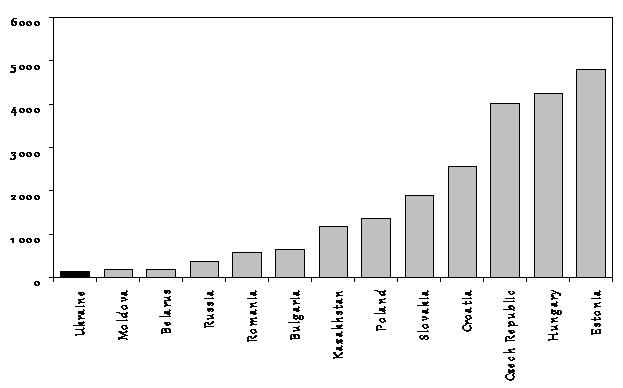
Sources: UNCTAD, World Bank; calculations by ICPS
5.2 Challenges to investors
Investors who are involved in exporting products made in Ukraine point to a number of problems in doing business here:
· high import duty;
· complicated customs procedures;
· lack of a supplier base;
· dilatory VAT refunds.
5.3 The failure of the SEZ and TPD experiment
The establishment of areas with special investment regimes began in early 2005, Ukraine had 11 SEZs and 72 TPDs that covered 10.5% of Ukrainian territory: 0.2% was covered by SEZs and 10.3% by TPDs.
The majority SEZs and TPDs were established for a 20–30 year period. Two SEZs were set up for 60 years.
Most SEZs and TPDs were designed to improve the difficult socio-economic situation in their respective regions. In addition, several SEZs were set up to take advantage of Ukraine’s transit potential.
Meanwhile, the Verkhovna Rada adopted a list of priority areas of activity for each SEZ and TPD: trade and manufacturing, foreign trade, tourism, and recreation. The legislation focused on manufacturing products involving advanced technologies and attracting investment to R&D.
Investors were exempted from corporate profit taxes, investment taxes, import duty and VAT on goods that were imported as part of an actual investment project. A number of these special areas included a special regime for importing/exporting goods that exempted them from import duty and VAT, and provided for a discounted tax rate on the incomes of non-residents.
5.3.1 Performance evaluation
In early 2005, the Ministry of Economy announced that the results the activities of SEZs and TPDs were unsatisfactory. Although investments in these special zones were growing at a relatively high pace, investor commitments were fully implemented in just 2 of 768 projects—less than 0.003%. Since the special investment regime was introduced, 2 of the 11 SEZs and 13 of the 72 TPDs did not even begin to implement any projects. Moreover, the investments that came in amounted to less than 50% of the figures projected when these special zones were set up. Investment inflows were particularly low in economically weak regions.
SEZs and TPDs: the real picture as of 1 January 2005
• SEZs and TPDs were implementing 768 projects budgeted at a total of US $6.67bn.
• SEZs and TPDs saw only US $2.1bn come in, 31.4% of projected budgets.
• FDI accounted for 28.5% of overall SEZ and TPD investments.
• Overall sales of companies operating in SEZs and TPDs was UAH 45.4bn.
• Exports were worth UAH 15.8bn or 34.8% of total sales.
SEZs failed to become centers where cutting-edge technologies became the focus. Moreover, they mostly attracted domestic rather than foreign capital.
Only three out of six SEZs with a special customs regime were export-oriented. As a result, specific domestic enterprises enjoyed unjustified exemptions, making the regional business environment uncompetitive.
Nor were these projects especially effective from a budget point of view. All the exemptions added up to twice Budget revenues in those regions. Worse, a large part of the tax breaks and exemptions were applied to imported materials and resources rather than to upgraded equipment, as had been anticipated.
Because of their unsatisfactory performance, the Government shut SEZs and TPDs down as of 31 March 2005, when the amended 2005 Budget law came into effect.
5.3.2 Why did SEZs and TPDs fail?
The Government’s explanation for why SEZs and TPDs did not meet expectations was that the inadequate infrastructure in many regions where special investment regimes were introduced. Exemptions and privileges were not enough to make most depressed regions attractive and serious investments channeled to SEZs and TPDs favored relatively developed regions. The lack of appropriate infrastructure also was the main reason why few hi-tech productions were established in SEZs and TPDs.
Another problem with the large volume of tax exemptions was that they were untargeted. Moreover, it became widespread practice to take advantage of customs exemptions not to implement investment projects, but to re-sell goods on the domestic market.
6. How stakeholders see it
Various stakeholders have divergent, even contradictory demands of investment policy:
- The Ministry of Finance wants to increase Budget revenues. The Cabinet of Ministers wants to combat corruption. Local governments want to attract investment. Domestic manufacturers want to keep getting state support and reduce competition. Investors want to have a good environment for doing business.
Still, the case for special regimes can be made, provided the necessary controls are in place:
Table 1. Arguments against and for providing preferences to investors | |
Con | Pro |
Special investment regimes distort the playing field | Duty-free zones or investors with duty-free status where companies produce and export 100% of goods manufactured from imported components do not harm competition among producers or importers of the same goods. |
The Budget loses revenues because of excessive privileges | International experience has shown many cases where Budget revenues have grown as a result of successful investment projects that were made possible thanks to preferential treatment. Exemptions and preferential treatment are a way to compensate economic and political risks in the short run that are typical for the majority of developing countries and that have a negative impact on the investment climate. |
Companies involved in export-oriented production do not offer high gross value-added (GVA) | If investment projects are successfully implemented in duty-free areas, the level of localization will increase as the network of local suppliers expands and cooperation with local research and educational facilities. |
Special investment regimes foster corruption | The real roots of corruption are the lack of effective checks and balances, as well as delays in administrative reform. The cost of administering complicated investment regimes should be compensated by the positive outcome of implementation. |
Special investment regimes contradict the requirements that international organizations set for Ukraine | Ukraine is likely to accede to the WTO in 2006, so it is important to meet the requirements of this organization. WTO members are not allowed to offer subsidies to encourage exports or to support local manufacturing by setting localization requirements for in-country production. However, special economic zones and industrial parks, including for regional development purposes, are not prohibited. In current agreements between Ukraine and the EU, the key requirements of the EU coincide with the requirements of the WTO. After Ukraine accedes to the WTO, it will have to restrict and alter the form of exemptions and preferences offered in SEZs, as happened in those countries that joined the EU in 2004. |
Source: International Centre for Policy Studies |
6.1 What if there’s no new investment policy?
If the Government fails to act to remedy this situation in terms of canceling privileges and exemptions for SEZs, it will have a negative impact on Ukraine both short - and long-term:
- Foreign investment will be channeled to other Eastern and Central European countries. Lack of investment in hi-tech industries will lead to skilled workers leaving Ukraine in greater numbers or losing their skills and qualifications.
7. Recommendations
7.1 Support investment in hi-tech industries, especially electronics
The main conditions for hi-tech investment in manufacturing electronics in Ukraine are:
- Simplified customs procedures. A high volume of in-country manufacturing will be possible if the necessary components can quickly be imported from around the world as well as from Ukraine. Manufacturers need a simplified customs process based on EU or other international standards. Changes in import and tax procedures. Goods produced in Ukraine for reexport should be exempt from the VAT and duty on imported materials and components. Current tariffs add to 5–10% of the total cost of imported components, making Ukraine uncompetitive to electronics manufactures, because the value of components in finished products is around 85–90% of costs and labor is only 5%. The requirement to pay VAT on importing new production equipment also discourages investments. State guarantees for investors. Investors need some protection against changes to canceling exemptions for SEZs and TPDs, the Government did breach its obligations to investors, which led to some of them initiating legal proceedings. Since companies that used their exemptions and privileges appropriately have a good chance of winning in court, the situation could develop in two possible ways. The Government can either renew exemptions and privileges for appropriate investors or pay compensation for canceling these exemptions and privileges. The second option could prove expensive, so the better option will be to renew special investment regimes for a handful of companies.
7.2 Establish better-regulated special investment regimes
International experience has shown that industrial parks can be an effective means of attracting specific investment to specific sectors and regions, increasing employment, and boosting the development of better technologies and infrastructure. Foreign investment could be attracted to the electronics industry in Ukraine through the establishment of duty-free areas for companies that manufacture in Ukraine and export 100% of their products.
Success Story: Industrial parks in Hungary
Foreign direct investment is important for integrating current and future electronics manufacturing firms into global production supporting the establishment of industrial parks, Hungary has positioned itself as a clear leader in attracting foreign investment over the past decade. As a result of its ability to attract FDI, Hungary experienced the greatest rate of economic growth in Central Europe, outpacing the European Union as a whole. Hungary has also enjoyed success specifically in the electronics industry. While 9% of FDI was directed towards this industry, Hungarian exports represented 50% of total electronics exports from Central and Eastern Europe in 2001.
The first Hungarian industrial parks were established in 1997 through initiatives of the central government. Primarily located in western Hungary, these parks attracted large international export-oriented firms and were highly efficient, developing rapidly and posting exceptional results. Since 1997, various municipalities have spearheaded industrial park development through regional economic development programs. The second generation of parks was largely dedicated to small - and medium-sized ventures that produced for domestic consumption.
Today, Hungary boasts over 160 different industrial parks that investors can choose from according to their business, professional, or cultural demands. Indeed, both the number and performance of Hungarian industrial parks in terms of revenues and exports more than quintupled their 1997 value, while the number of individuals employed in industrial parks has almost quadrupled. The Hungarian Investment and Trade Development Agency claims that industrial parks in Hungary currently account for 25% of total industrial output and 40% of total industrial exports. At the same time, productivity of industrial parks is more than 70% higher than the national average—and only 15% below average productivity in the EU.
Hungarian industrial parks provide investors with very favorable conditions, including support from municipalities, and various tax benefits. All industrial parks offer a number of key services:
− Basic infrastructure. This includes water, sewage, electricity, gas, paved roads, a ground telephone network, and public lighting. More developed parks include supplementary infrastructure such as internet, Integrated Services Digital Network (ISDN), Asymmetric Digital Subscriber Line (ADSL), fiber optics, and so forth.
− Support services. Industrial parks also provide investors with both administrative and innovation services. Administrative services include single point of contact administration, bank branches, management, operation, and legal representation of companies. Additional innovation services range from consulting to tender monitoring.
− Supplier base. Industrial parks work to promote the development of a strong supplier base.
− Professional cooperation. By linking similar technical operations among corporations, industrial parks can help lower production costs.
In addition to these services, Hungary also has a superb transportation system. Indeed, the majority of industrial parks have highways linked to the European highway network. Even more remote regions are accessible thanks to Hungary’s 60 operational airports.
With the help of the government, Hungarian industrial parks have also begun to pay more attention to R&D. Industrial parks now provide a wide range of financial incentives, such as tax allowances and credits, to develop R&D. Hungary has a number of solid academic institutions that provide organizations with well-educated and skilled individuals.
The Hungarian Government has actively participated in the development of industrial parks, both at the local and national levels. At the municipal level, regional development programs have helped local governments to initiate industrial park development and actively seek out potential investors. In addition, while previous incentives such as tax privileges or targeted subsidies are no longer allowed since accession to the EU, municipalities are allowed to reduce the general industrial tax rate, which is the local value-added tax in Hungary.
At the national level, the Hungarian Government has provided a series of incentives and financial aid packages to help develop industrial parks and attract investors. Once investors have earned the title of “industrial parks,” they can apply for various sorts of financial support, ranging from national subsidy funds to duty-free zones. The Government has also offered co-financing of various types of investment in industrial parks.
Investors can also receive financial aid through grant applications to the EU. Grants from the EU focus on job creation, environmental and infrastructure development, agricultural investment, training and retraining of workers, and support for innovations.
Industrial parks were developed in Hungary as a means to further economic development, in particular to create new jobs, improve technology, and reduce regional disparities. While the overall economy had benefited, the Hungarian Government admits that investments have not been evenly distributed throughout the country, and geographical differences remain. To remedy this situation, the Hungarian Government has pledged to continue support for industrial park development, setting a goal of attracting US $1.5bn to US $2bn per year of investment.
7.3 Improve the business environment
Several other problems have a direct negative impact on investment activity across all sectors of the Ukrainian economy and need remedying:
· Remove regulatory and administrative barriers that complicate access to markets and the development/export of new products;
· Simplify access to needed resources and infrastructure to raise productivity and competitiveness;
· Institute guarantees for the protection of property rights, including intellectual property. This will reduce the risk of investing in Ukraine significantly and spur the development of hi-tech sectors;
· Establish clear and fair rules of the game, which should considerably reduce the level of corruption in Ukraine.
In the long term, the Government must continue its strategy of creating political, economic and social stability and predictability. These general features are often more important to investors than any specific incentives or tax exemptions. This strategy should specifically aim at:
· Combating corruption. The Government must continue to develop policies and measures that will minimize corruption and protect business.
· Developing a positive investment image. Key steps include developing detailed Government Action Plans for promoting the country, providing state support to current investors in resolving problems or disputes, and monitoring the country’s standing in the global community. An investment promotion agency, a unified approach to investment, and greater personal commitment among top officials would help develop a positive investment image.
· Improving infrastructure, education, and the overall business climate. The Government must ensure that Ukraine has appropriate capital and educational resources to promote an attractive business climate that can draw new foreign investment.
