

Партнерка на США и Канаду по недвижимости, выплаты в крипто
- 30% recurring commission
- Выплаты в USDT
- Вывод каждую неделю
- Комиссия до 5 лет за каждого referral
“Creating Resource Center and Policy Analysis Groups” Project
Training Component:
PROJECT MANAGEMENT
Module: “Project Management for Policy Analysis”
Author: А. Chemerys
 |
Introduction to the Project Management (PM)
A tool for small projects… Proposed PM-aid belongs to the “ad-hoc PM” type of support and was designed as a tool for small project development. Its core component is an instruction on using appropriate templates for PM. They could be immediately used or easily modified in line with your individual requirements. Having mastered an instruction “The Last Step to the Project Management”, which is an introduction to the systematic approach to problem resolution, and suggests numerous auxiliary specific decisions, you will master a simple and effective PM-tool. ...and introduction to the Project Management This PM-aid is addressed to those interested stakeholders, who · Want or have to undertake the smaller projects · Search for practical and brief materials for individual training. ... for developing the first draft project Professional project managers may use this file in a feasibility study of large projects for preliminary personal draft projecting. In this case you will not need bulk files or even a laptop, just templates, which you can copy in sufficient quantities. But this is only one of possible ways to work on the project, and you need not to refuse from computer forever. | Project management for policy analysts: instruction For getting this material, please, contact: International Center for Policy Studies 254070, Kyiv tel.(044)4624937 e-mail: *****@*** |
Problem Analysis
Any problem resolution puts forward two major questions:
· What is to be done? (Content?)
· How it should be done? (Process?)
Replying the first question, you need to develop “a map of ideas”, which will be helpful in your subsequent work, especially at the stage of problem structuring, work stage 3.
The second question raises a series of issues, covering the process of drafting:
| |
| |
| |
| |
| |
| |
| |
| |
Instead of reviewing a large manual in PM to resolve each problem in the course of project drafting, I suggest a concise discussion of the above mentioned issues. In our review we will focus on the most important issues that are a crucial “PM first-aid” to small projects. In some cases we will refer to the instruction “The Last Step to the Project Management”.
Are you in haste?
If you are in haste, please, jump over the following pages and go directly to “Project Development” section.
Part 1
Brief Instruction in Project Development | ||
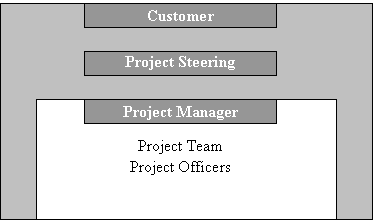
1.1 Division of responsibilities. Project goal and objectives Besides the customer, we also need project manager and project implementation team, and, depending on circumstances, the project steering committee. | ||
| ||
Work Stage 1 Customer (it might be a director of an institution) appoints the project manager and familiarizes him or her with the preliminary formulations of project goal and objectives. He or she can also create a project steering committee. The project committee should include people, who have both “influence and authority” within the institution, and will contribute to the project success and implementation. At least this function could be represented by the customer and project manager together. But still practice proves that in the case of small project it is more helpful to have a project steering committee, involving carefully identified individuals, who are able to push the project forward. | See “Specifications of Project Development and Template Package” in Part 2 | |
Work Stage 2 The project steering committee, headed by a moderator, or project manager (if there is no committee): · Reviews the goal and formulates project objectives · Appoints project officers (needed skills of the staff could be easily defined if the general objectives are transformed to individual terms of reference (TORs) · Defines the project organization · Defines tasks, competencies and responsibilities | Template 1 (specifications: see a PM instruction) Template 2 Template 3 Template 4 |
Brief Instruction on Project Development | |
1.2 How to Structure the Project? | |
Work Stage 3 | Template 5 |
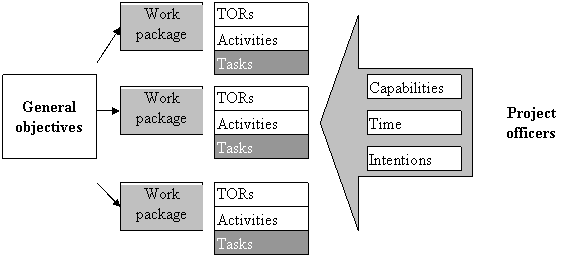
Project manager divides general tasks into practical work packages, and translates the last into TORs (if you heard about task division according to the subject or according to the fulfillment, please, forget all those theories, and just use the common sense). Then the project manager considers who fits into each activity, and divides the tasks in accordance with these considerations. But be careful! This direct and fundamental approach will not work in the case of the smallest projects. In reality, the project structure is defined not only by means of logical considerations, but also in accordance with real available resources. It means, that project manager needs to define what time, capabilities and intentions to work on the project his or her staff really have. On the ground of these considerations he or she adjusts work division packages and TORs, activities, etc. And only afterwards he or she can get the staff busy with a clear consciousness. | |
|
Brief Instruction on Project Development | |
How to find your bearings? How to control expenditures and timing? | |
Work Stage 4 | Template 6 |
Project manager summarizes activities and TORs, with the names of identified officers from work stage 3, and puts them down to the Template 6 “Resources and Schedules”. He or she identifies timing for each task and activity, certainly, after consultations with identified officers. Then he or she develops a preliminary budget and includes expenditures to the appropriate template columns. Then project manager develops work blocks harmonized in time and content, and logically synchronizes them with the project duration. Results of this operation he or she also puts down to the “Duration” column (e. g. as a bar chart). Prospective intermediate project deliverables are marked as “project reference points”. Then he or she informs all involved staff about the output of the work. Periodical checking up of intermediate reference points contributes to timely elimination and correction of deviations from original plan. Still, an absence of actual indices in the columns of small projects is not a serious drawback. | |
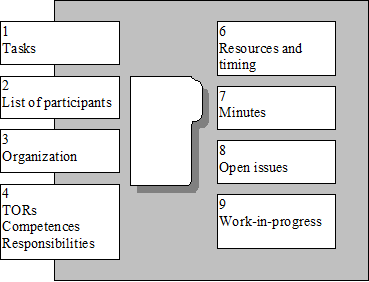
Work stage 5Since this very moment the project manager needs to start keeping the project file. The project file consists of more or less static stage of the project, covered by templates 1-5, and more dynamic project stage, covered by templates 6-9. | The “Project File” Cover Sheet should be used as a content page |
|
Brief Instruction on Project Development | |
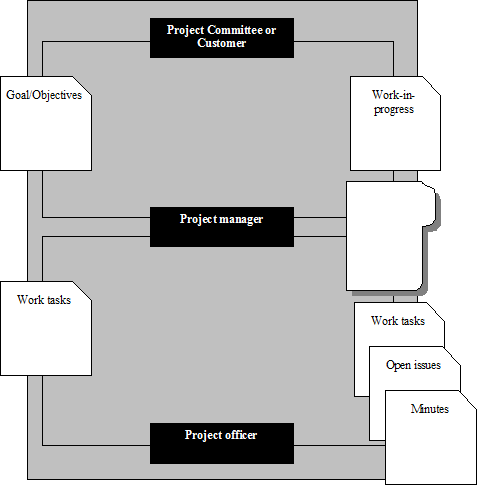
1.4 What is the role of information circulation within the project participants? Properly operating informational network is a crucial precondition for successful project implementation. The more complete and fast are information flows, the more surely will project leaders control the situation, and therefore, the more satisfied will the project team be with its output and motivation. Fluent informational exchange of ideas (both horizontal and vertical) between all project participants could greatly contribute to the problem resolution, and therefore, it should be supported by all possible means (coffee breaks, interdisciplinary meetings beyond the project activities, etc.) | |
The figure bellow demonstrates official informational flow within the project stakeholders. | |
|
Brief Instruction on Project Development | |
Interim Stop Here we need to stop for a while to summarize the work done by now. After filling the templates 1-5 the following aspects have become clear: n Project goal and objectives n Project team n Project organization n Division of tasks, competencies, responsibilities n TORs of the project participants Now our project has a sufficiently developed structure. Roles and tasks are identified. What we are still lacking for successful project start is a resource and time allocation plan and appropriate performance evaluation and project control system. |
Informational System | |
Work Stage 6The project manager schedules all work and informational meetings. Then he or she takes care of ensuring attendance, keeping minutes and managing outstanding issues. List of outstanding issues (template 8) has to cover the entire project. Some outstanding issues ought to be numbered and crossed out after decisions on them are taken. Lists of resolved issues should be stored as “The Project Biography”. Thus information about the project will be located in one place. Regularly, for instance, on a monthly basis, the project manager informs steering committee (or the customer, if there is no committee) about work-in-progress, difficulties and other processes, etc. (template 9). | Templates 7, 8, 9 |
Part 2 | ||||
Project Development and Template Package | ||||
Stage | Who? | Does what? | By what means? | Done Ryes o no |
1. | Customer | He or she appoints project manager and familiarizes him or her with preliminary formulated project objective. He or she also creates a project committee, if necessary. | Orally. See section 1.1 | o |
2. | Steering committee/ project manager | Reviews and formulates project goal and objectives | T 1: Goal / objectives of the project | o |
Identifies project team participants | T 2: Project participants | o | ||
Defines project organization | T 3: Project organization | o | ||
Develops TORs, identifies competencies and responsibilities | T 4: TORs, competencies, responsibilities | o | ||
3. | Project manager | Structures the project and divides written tasks | Section 1.2, T 5:Work task | o |
4 | Project manager | Plans allocation of personnel, money and time resources | Section 1.3, T 6: Resources and timing | o |
5. | Project manager | Starts keeping project file | Cover sheet of the Project File | o |
6. | Project manager | Organizes the project informational system | Section 1.4, Figure: Information within current project T7: Meeting /minutes T 8: Outstanding issues T 9: Work-in-progress | o |
7. | (Project Committee) Project manager Project officers | They all contribute to the project development in line with a project program | Section 1.5 Project File, F 1-9 | o |
8. | Project manager | Supervises the project Keeps the project file | T 9: Work-in-progress (T 6,T 7, T 8) Project File | o |
Project Organization | |
List of Tasks | |
Use the list below to define tasks and competencies in the chart of functions (Template 4) | |
Customer: | Done: Ryes o no |
· Divides project tasks between the project officers | o |
· Appoints project manager and members of steering committee | o |
· Approves | o |
- formulated project goal and objectives | o |
- project organization | o |
- division of tasks and competencies | o |
- resource allocations (including money, people and time) | o |
Steering committee or project manager: | |
· Reviews and formulates written project goal and objectives | o |
· Identifies project officers | o |
· Defines project organization | o |
· Develops tasks, responsibilities and competencies | o |
· Supervises project implementation and takes decisions on the framework of interim reports and recommendations of project manager. | o |
Project manager: | |
· Structures the project and divides responsibilities | o |
· Undertakes daily management of the project activities | o |
- plans, monitors and controls staff performance, timing and expenditures | o |
- keeps the project file | o |
- is responsible for the current informational system within the project | o |
- submits alternative decisions on problem solution to the steering committee’s consideration | o |
o |
Project File | |
Project Title: | Templates: 1.Commission / project goal |
Project manager: | 2.Project participants |
Customer: | 3. Project organization |
Customer’s address: (tel., fax, e-mail) | |
Date of commission: | 4.Tasks Competencies Responsibilities |
Project budget: | |
Termination date: | |
5. Work instruction | |
6. Resources and schedule | |
7. Meetings /minutes | |
8. Outstanding issues | |
9.Work-in - progress | |
Executor________________________ Name, signature ___________________________________ ( date) | Approved by:_____________ Name, signature _____________________________ ( date) |
1 Commission / Project Goal | |
Project: | Description: Why? What? How good? Not valid? Limits? Who? By what time? Field of activity? (Competencies and means) |
Executor________________________ Name, signature ___________________________________ ( date) | Approved by:_____________ Name, signature _____________________________ ( date) |
2 Project participants | |||
Project: | |||
Name: | Department, section: | Function: | Telephone and fax: |
Executor________________________ Name, signature ___________________________________ ( date) | Approved by:_____________ Name, signature _____________________________ ( date) |
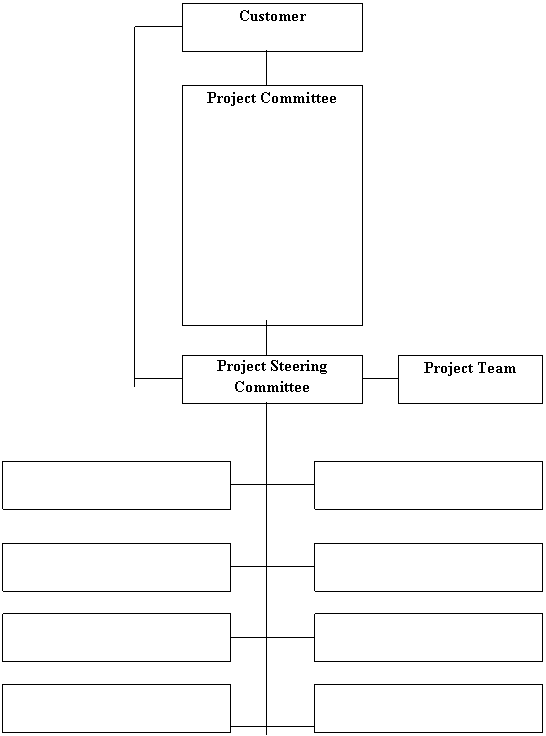
3 Project Organization
Project:
 |
Executor________________________ Name, signature ___________________________________ ( date) | Approved by:_____________ Name, signature _____________________________ ( date) |
4 Tasks, competencies, responsibilities | |||||
Project: | |||||
Chart of functions Р=decisions П=resolutions О=discussions В=implementation К=control | Customer | Project Steering Committee | Project Team | Project Manager | |
№ | Activities | ||||
Executor________________________ Name, signature ___________________________________ ( date) | Approved by:_____________ Name, signature _____________________________ ( date) |
5 Work Task | |
Project: Subproject: | |
Tasks: Task’s Number: | Description: |
Why? What? How much good? Valid for what cases? Limits? Who? By what time? Field of activity? (competencies and means) | |
Executor________________________ Name, signature ___________________________________ ( date) | Approved by:_____________ Name, signature _____________________________ ( date) |
Important decisions and events mark with the reference point A
6 Resources and Timing | ||||||||||||||||
Project: | Subproject: | |||||||||||||||
№ | Activities (works) | Person responsible | Duration: | |||||||||||||
Plan | ||||||||||||||||
Actually done | ||||||||||||||||
Plan | ||||||||||||||||
Actually done | ||||||||||||||||
Plan | ||||||||||||||||
Actually done | ||||||||||||||||
Plan | ||||||||||||||||
Actually done | ||||||||||||||||
Plan | ||||||||||||||||
Actually done | ||||||||||||||||
Plan | ||||||||||||||||
Actually done | ||||||||||||||||
Executor: | Date: Sheet: |
7 Meeting /Minutes | |||
Invitation Minutes № | |||
Topic: Data: Present: Absent: | Location: | Time: | |
Speaker: | |||
Executor________________________ Name, signature ___________________________________ ( date) | Approved by:_____________ Name, signature _____________________________ ( date) | ||
| 8 Outstanding Issues | |||
Project: | |||
№ | Work: | Responsible: | Deadline: |
Executor________________________ Name, signature ___________________________________ ( date) | Approved by:_____________ Name, signature _____________________________ ( date) | ||
| 9 Work-in-Progress | |
Project: | Project manager: |
Month under review: | |
Status and problems Measures needed | |
Next month | |
Further steps Schedule/Deadlines | |
Executor________________________ Name, signature _________________________________ ( date) | Approved by:_____________ Name, signature _____________________________ ( date) |
