

Партнерка на США и Канаду по недвижимости, выплаты в крипто
- 30% recurring commission
- Выплаты в USDT
- Вывод каждую неделю
- Комиссия до 5 лет за каждого referral
УРОК У 8 КЛАСІ НА ТЕМУ:
“ OUR ENVIRONMENT. IT’S PROBLEMS”
МЕТА УРОКУ:
практична – активізувати навички аудіювання та письма, удосконалити усно-мовленнєві вміння учнів;
освітня – розширити кругозір учнів у межах теми;
розвиваюча – розвивати вміння учнів здійснювати мовленнєву діяльність, розвивати самостійність у праці, навички само - та взаємоконтролю, працювати в парах;
виховна – виховувати любов до природи, заохочувати до пошуку нових знань.
ОБЛАДНАННЯ УРОКУ: картки із завданнями, малюнки, картки для парної роботи.
ХІД УРОКУ
І. Початок уроку
1. Greeting
2. Warm-up activity
1. Conversation
1. What is ecology?
2. What is the environment?
3. What pollutes and poisons air?
4. What do scientists do to reduce air and water pollution?
5. Do your worry about the environment?
6. What do you do to keep your town clean?
2. Quiz
Do you worry about the environment?
1. Imagine you are on holiday abroad. You eat lots of chocolate-covered sweets but there aren’t any rubbish bins to put their wrappers in. What do you do?
a) Keep the wrappers in your pocket until you see a bin.
b) Throw them on the ground. It's not your fault there aren't enough rubbish bins.
c) It depends, if there's a lot of rubbish on the floor, you might drop some accidentally.
2. On the way home you are very thirsty. What do you buy?
a) Something in a non-recyclable plastic bottle
b) Something in a glass bottle or aluminum can.
c) Something in a carton.
3. Your personal stereo always needs new batteries. What do you do?
a) Buy rechargeable batteries,
b) Put the old batteries in the bin and buy new ones.
c) Buy new ones and take the old ones to a recycling centre.
4. If you lived near a beach, how would you react if a fast food restaurant opened near the beach?
a) Be pleased but also worried about more rubbish on the beach.
b) Be pleased. Now you can eat burgers on the beach.
c) You never eat at fast food places because there's too much packaging.
5. You buy a couple of things in a shop. When you pay, the cashier is about to put the things in a plastic bag. What do you say?
a) "No, thank you". (You have brought your own bag from home).
b) Nothing.
c) It depends if you can carry the things easily without a bag.
6. There are a couple of flies in your bedroom. They are annoying you. What do you do?
a) Try to kill them with a newspaper.
b) Try to kill them with a horrible-smelling aerosol.
c) Hit the air with a newspaper so that they leave you alone.
7. You are writing a letter to a good friend. You have made several mistakes and need to cross things out. What do you do?
a) Start the letter again on another piece of paper.
b) Continue writing; your friend will excuse your mistakes.
c) Continue to write but if you make any more mistakes start again.
Your score: 1. a) 3; b) 1; c) 2;
2. a)1; b)3; c) 2;
3. a) 3; b) 1; c) 2;
4. a) 2; b) 1; c) 3;
5. a) 3; b) 1; c) 2;
6. a) 2; b)1; c) 3;
7. a) 1; b) 3; c) 3.
Analysis:
7-10: You do not worry about the environment at all! You think pollution is someone else's problem, not yours. You think recycling and saving resources are too time-consuming.
11-17: You take care of the environment and you have some good habits which help save it. However, there are probably a few other things you could do.
18-21: You definitely care for the environment. You think about it when you make everyday decisions. If more people in the world were as good as you, the planet would have fewer problems.
ІІ. Основна частина уроку
1. Vocabulary work
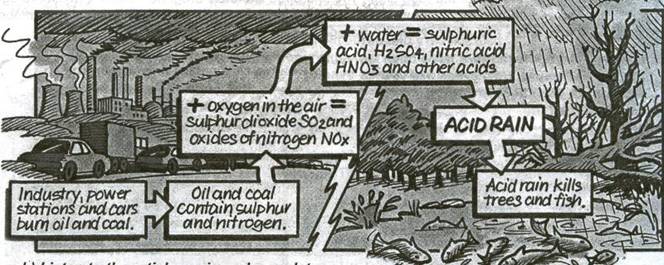
1) Look at the picture and try to describe it using the words below.
danger;
to damage;
acid;
to emit;
sulphur dioxide;
nitrogen oxide;
substance;
vapour;
poisonous;
oxidant;
(to threaten); oxygen
power stations
2) Make up short dialogues using these words.
2. Listening
1) Pre-listening task
Answer the questions:
1. How can human activities make the environment unhealthy?
2. What should every country do to protect nature and to clean the environment?
3. Why the ozone and acid rains so dangerous for us?
4. What should every human being do to make our planet a healthier place for all living things?
2) While-listening task
Listen to the article about the dangers to the trees and say which of following statements are true:
1. Today trees are in serious danger.
2. Factories, power stations and cars emit tons of smoke into the air.
3. Acid rain always falls on the countries which produce the pollution.
4. Trees are threatened by people.
5. The forests are the lungs of the planet.
6. If the trees die, we will, too.
3) Listening
 Millions of years before animals lived on land, there were trees on the Earth. But today trees are in serious danger.
In the 1970s, many of the elm trees in Europe were killed by Dutch elm disease. Now an even greater danger is threatening the forests and woods of Europe from northern Sweden to southern Italy. This new danger attacks all trees - deciduous trees like oak, beech and birch, as well as coniferous trees like fir and pine. First the branches turn yellow and brown. Then the trees' needles or leaves fall. The roots and the trunk shrink. Finally the trees die. In the Black-Forest in southern Germany 75% of the trees have been damaged or killed.
But what is killing the trees? Nobody knows exactly, but it is probably air pollution or acid rain. Factories, power stations and cars emit tons of smoke into the air. This smoke contains sulphur dioxide and nitrogen oxide. These substances mix with water vapour in the atmosphere and form sulphuric acid and nitric nlight turns these acids into poisonous oxidants which fall in rain or snow onto the trees.
What can be done about acid rain? Why don't governments do something to save the trees? Unfortunately acid rain doesn't always fall on the countries which produce the pollution. The wind carries the poisonous substances from one country to another. Why should the people of one country pay to save another country's trees?
In other parts of the world trees are threatened by people, not by pollution. The great rain forests of Asia and South America are being destroyed for firewood and building material. Something must be done. Trees are important because they provide a home for many other plants, and animals too. They protect the flowers which grow on the forest floor. They provide food for insects, reptiles, birds and mammals. They protect the soil from the wind and the rain. Most important of all, the forests are the lungs of the planet. Trees produce the oxygen which we breathe. If the trees die, we will, too.
4) Post - listening tasks
plete the following sentences:
1. Today trees are in...
2. 75 % of the trees...
3. Factories, power stations and cars...
4. Unfortunately, acid rain doesn't always fall.
5. The wind carries the poisonous substances from...
6. In other parts of the world trees are ...
7. The great rain forests are being destroyed for...
8. Trees provide...
9. They protect...
10. Most important of all, the forests are...
11. Trees produce …
2. Work in pairs
Make up an interview on the basis of the article you've been listening to.
Use the following questions:
1. What is killing the trees?
2. How many trees have been damaged in southern Germany?
3. What causes acid rain?
4. Does acid rain always fall on the country which produces the pollution?
5. What is happening to the great rain forests of Asia and South America?
6. Why are rainforests important?
7. What will happen if the trees die?
III. ЗАКЛЮЧНА ЧАСТИНА УРОКУ.
Home task. Get more information about the problems of the healthy environment and write a short article. Evaluation. Your marks are…