

Партнерка на США и Канаду по недвижимости, выплаты в крипто
- 30% recurring commission
- Выплаты в USDT
- Вывод каждую неделю
- Комиссия до 5 лет за каждого referral
Winter driving fun in the Mercedes-Benz GLK
Contents | Page |
Safer, more pleasurable driving on snow and ice The GLK 4MATIC gets to grips with winter 4MATIC control strategies for wintry road conditions Best traction, stable and safe handling Technology in detail The permanent all-wheel-drive system 4MATIC Strong characters The GLK-Class from Mercedes-Benz At a glance All-wheel-drive passenger car models from Mercedes-Benz | 2 6 14 17 18 |
The descriptions and information in this press kit apply to the international Mercedes-Benz
model range and may vary from country to country.
Safer, more pleasurable driving on snow and ice
The GLK 4MATIC gets to grips with winter
Stuttgart/Hochgurgl – Soon it will be time to head for the ski slopes again, and drivers of Mercedes models with the permanent all-wheel-drive system 4MATIC can rest assured as they set off en route to their chosen winter paradise. Because the performance of the drive configuration on roads affected by snow or ice is truly impressive. Mercedes-Benz is demonstrating the high traction reserves coupled with excellent directional stability and safety in the new GLK at its 4MATIC workshop. In extreme winter conditions at a height of 2500 metres on the Austrian Timmelsjoch High Alpine Road this compact SUV is demonstrating that its driving dynamics really are in a class of their own.
As is the case with 4MATIC’s fine-tuning on a dry or wet road, directional stability and therefore the active safety of the GLK models is always to the fore when wintry conditions prevail, too. The basic 4MATIC mechanism with a 45:55 percent torque split between the front and rear axles along with the multiple-disc limited-slip centre differential with a basic locking torque of 50 Nm adds up to an ideal solution. This basic design delivers high traction since, on the one hand, the dynamic shift in axle load toward the rear axle that occurs during acceleration
is used to deliver more drive torque to the rear. Meanwhile, the multiple-disc limited-slip centre differential can also variably shift the drive torque from 30
to 70 or 70 to 30 percent between the front and rear axle, whenever the road conditions so dictate. As such, the electronic control systems ESP®, 4ETS or ASR can intervene as late as possible; the bulk of the torque is converted into traction on slippery roads.
All interventions go virtually unnoticed, but the drivers are still informed immediately if they are driving on the limit. In this case a yellow warning light flashes in the instrument panel – a clear signal to adjust their driving style to
the road conditions.
The arrangement featuring a permanent design mechanism has key advantages over other systems that first need to diagnose a lack of traction before activating their 4x4 all-wheel drive. The 4MATIC on the GLK will have already made use of this valuable time to transmit drive torque via the wheels to the road.
4ETS: integrated “automatic start-off aid” for ice and snow
When pulling away in wintry conditions the engineers use the off-road algorithms on the GLK 4MATIC to develop optimum traction. Certain road conditions are automatically detected and the interventions of the 4ETS electronic traction control system adjusted so that as much acceleration as possible can be achieved with minimal wheel slip, providing optimum directional stability in the process. This strategy also allows the vehicle to pull away under adverse conditions, such as when one side of the vehicle is on an icy slope (the so-called
µ-split) or both wheels on the front or rear axle have limited grip (µ-jump).
Stable conditions on wintry roads
On winding roads covered with snow and ice, vehicle stability is primarily controlled by means of engine torque regulation in the acceleration skid control system ASR. Taking into consideration the longitudinal and lateral dynamics of the vehicle continuously determined by the ESP® sensor system, the ASR control thresholds are adjusted according to the driving situation. In order to ensure stable driving conditions, on winding roads the longitudinal force must be controlled via engine torque regulation in such a way that sufficient lateral force is always available. In order to comply with this law of physics, when driving on winding roads the control thresholds for engine torque regulation on the outer wheels are reduced considerably at low frictional coefficient, ensuring that the tyres can develop sufficient lateral force.
4MATIC: top performance in all areas
The 4MATIC drive system in the GLK is among the most powerful all-wheel-drive systems there are; its control systems break new ground. Advantages over other systems with a transversely installed drive unit are achieved thanks to the
basic compact, light and friction-loss-optimised design with its longitudinally positioned engine and integrated main and transfer case. Fuel consumption, for example, is at the same level as that of a comparable, conventionally driven vehicle, whilst noise and vibration levels are on a par with those in higher vehicle categories.
105 years of all-wheel-drive technology from Mercedes-Benz
The history of all-wheel drive from Mercedes-Benz begins way back in 1903, when Paul Daimler, the son of the company’s founder, creates the foundations for designing vehicles with all-wheel drive. Since then the accepted maxim has been that all-wheel drive is the number-one technology for making better and safer progress on poor roads. As the decades pass it is successfully introduced in a variety of Mercedes-Benz vehicles, in both passenger cars and commercial vehicles. Some models, such as the G-Class and the Unimog, have attained legendary status all over the world. But all-wheel drive has its benefits in everyday driving on asphalt roads too, as demonstrated by the saloons and
sports utility vehicles (SUV) from Mercedes-Benz.
4MATIC available in no less than 51 Mercedes models
The Mercedes-Benz all-wheel-drive line-up includes nine model series and offers an broad range of options: starting with the C-Class and E-Class, both available
as saloon and estate versions with 4MATIC, through the S-Class, the luxury CL Coupй and the R-Class touring SUV, the Stuttgart-based manufacturer offers the compact GLK SUV as well as the GL-Class and M-Class off-roaders. The evergreen G-Class off-roader, which really comes into its own off the beaten track, will be celebrating 30 years of loyal service next year. It has a reputation as being one of the world’s best cross-country vehicles and is just one of 51 passenger car models which Mercedes-Benz offers with permanent all-wheel drive.
Contacts:
Wolfgang Zanker, tel. +49 711 17-75847, email: wolfgang. *****@***com
Inka Halba, tel. +49 711 17-75849, email: inka. *****@***com
More information from Mercedes-Benz is available online at:
www. media.
4MATIC control strategies for wintry road conditions
Best possible traction, stable and safe handling
As is the case with 4MATIC’s fine-tuning on a dry or wet road, directional stability and therefore the active safety of the GLK models is always to the fore when wintry conditions prevail, too. The basic 4MATIC mechanism with a 45:55 percent torque split between the front and rear axles along with the multiple-disc limited-slip centre differential with a basic locking torque of 50 Nm adds up to an ideal solution. This basic design delivers high traction since, on the one hand, the dynamic shift in axle load toward the rear axle that occurs during acceleration is used to deliver more drive torque to the rear. Meanwhile, the multiple-disc limited-slip centre differential can also variably shift the drive torque from 30
to 70 or 70 to 30 percent between the front and rear axle, whenever the road conditions so dictate. As such, the electronic control systems ESP®, 4ETS or ASR can intervene as late as possible; the bulk of the torque is converted into traction on slippery roads.
All interventions go virtually unnoticed, but the drivers are still informed immediately if they are driving on the limit. In this case a yellow warning light flashes in the instrument panel – a clear signal to adjust their driving style to
the road conditions.
The arrangement featuring a permanent design mechanism has key advantages over other systems that first need to diagnose a lack of traction before activating their 4x4 all-wheel drive. The 4MATIC on the GLK will have already made use of this valuable time to transmit drive torque via the wheels to the road.
Kamm circle: the laws of physics sets limits
Just like any all-wheel-drive system, 4MATIC in the GLK has to abide by the laws of physics, a fact clearly illustrated in what is known as the “Kamm circle”. The fundamental rule is that a tyre is only able to transfer a certain level of overall force to the road surface. If a large amount of force is required in a longitudinal direction, for example when accelerating or braking, the lateral forces available are reduced. When cornering the reverse applies. In this case a particularly high degree of lateral force is needed for directional stability, whilst the longitudinal force potential is restricted. When designing the drive mechanism and fine-tuning the control systems, engineers’ skills are called upon to use this correlation in such a way that the very best possible handling is ensured in any conditions. The frictional coefficient µ describes the physical grip between the tyres and the road surface. On a dry road this figure is high (µ=0,9), and on a snow-covered road it is low (µ=0,3).
Despite the engineers’ best efforts, it is ultimately the drivers themselves who determine how safe they are on the road. They should always adapt their driving style in accordance with wintry conditions and ensure that their vehicle is suitably equipped; winter tyres are absolutely essential.
Balance of forces in the “Kamm‘s Circle”
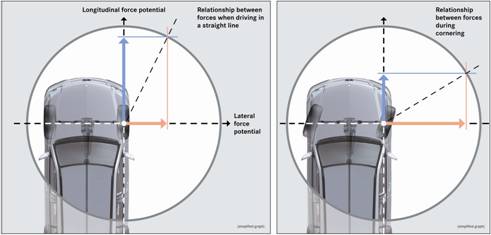
Like every other all-wheel-drive system, the 4MATIC on the GLK-Class obeys the laws of driving physics. These interrelationships are described in the “Kamm‘s Circle”. A basic law of physics states that a tyre can only transfer a certain total force onto the road. If a large amount of longitudinal force is required during acceleration or braking, the available lateral force is reduced (left-hand graphic).A large amount of lateral force is required during cornering to maintain directional stability; the longitudinal force potential is thus limited (right-hand graphic). The engineers‘art in designing the drive mechanism and fine-tuning the control systems is to exploit these interrelationships to ensure optimum handling characteristics whatever the conditions.
The employees at the Mercedes-Benz Technology Centre have a wealth of experience at their fingertips in this respect. The first all-wheel-drive system
was created over 100 years ago, and the engineers also occupy a leading position where the fine-tuning of all-wheel-drive control systems is concerned. 4ETS celebrated its world premiere in 1997 in the first generation of the M-Class, development work having begun as far back as 1993. Mercedes-Benz thus enjoys the most extensive experience of all car manufacturers with these systems.
4ETS: integrated “automatic start-off aid” for ice and snow
When pulling away in wintry conditions the engineers use the off-road algorithms on the GLK 4MATIC to develop optimum traction. Certain road conditions are automatically detected and the interventions of the 4ETS electronic traction control system adjusted so that as much acceleration as possible can be achieved with minimal wheel slip, providing optimum directional stability in the process. This strategy also allows the vehicle to pull away under adverse conditions, such as when one side of the vehicle is on an icy slope (the so-called µ‑split) or both wheels on the front or rear axle have limited grip (µ-jump).
So when starting off on µ-split one side of the GLK is on snow or ice and the other on asphalt. There are major differences in the coefficient of friction between the left and right-hand side of the vehicle. On all vehicles with open axle differentials the wheel with the lowest coefficient of friction limits the maximum transferable driving power. If the driving power rises above the maximally transferable power, the wheels on snow or ice start to spin, and the GLK would not be able to start off. This situation is immediately registered by 4ETS and the spinning wheels are baked by precisely the right amount of pressure build-up in the wheel brakes. As the wheel with the higher coefficient of friction is now supported via the brake force of the wheel with the lower coefficient of friction, the GLK starts to move. Following the start-off process, the wheel characteristics are observed very closely and the brake pressure controlled in such a way that, as far as possible, there is no difference in speed between the individual wheels. The braking force applied by 4ETS simulates, as it were, a higher coefficient of friction on the side with ice or snow, which, in an ideal case, corresponds to the coefficient of friction on the asphalt side. This produces an optimal transverse locking effect on the axle differentials, resulting in the maximum possible acceleration on µ-split.
Pulling away easily on different road surfaces (µ-split)
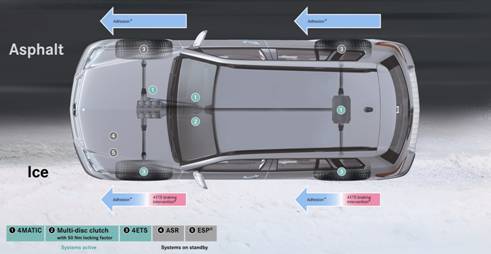
The adhesion between the tyres and road is considerably higher on the asphalt side than on the side of the road covered with ice. 4ETS detects this situation and prevents the wheels from spinning on the icy road by applying the brakes on specific wheels. The torque is thus balanced at the axle differentials because the same adhesion is simulated on the ice-covered side as on the asphalt side. The GLK manages to pull away.
Starting off on “µ-jump”, where one of the GLK’s axles is entirely on ice or snow and the other axle is on asphalt, is made more difficult by the large differences in coefficient of friction between the front and rear axle. On vehicles with an open longitudinal differential the axle with the lower coefficient of friction determines the transferable driving power. Whilst the multiple-disc limited-slip centre differential with its basic locking torque of 50 Newton metres does have a balancing effect, it is unable to even out these extreme differences in coefficient of friction. In these conditions, too, both wheels on the axle with the lower coefficient of friction start to spin if the driving power exceeds the maximum transferable driving power at this coefficient of friction. 4ETS helps here by immediately recognising and braking the spinning wheels. This enables the axle with the higher coefficient of friction to be supported by the braked axle with the lower coefficient of friction – and the GLK starts to move.
Pulling away easily on different road surfaces (µ-jump)
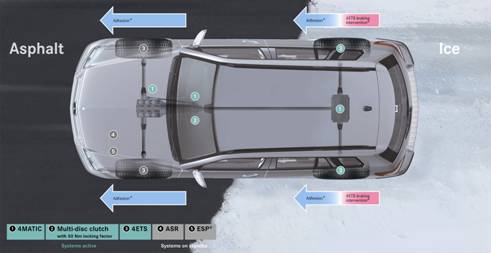
The adhesion between the tyres and road is considerably higher on the asphalt than on the road covered with ice. This situation is offset partially by the multiple-disc limited-slip centre differential, while at the same time the 4ETS detects the rear wheels spinning on the icy road and eliminates wheel spin by applying the brakes on specific wheels. The torque is balanced between the front and rear axle in the centre differential because the same adhesion is simulated on the icy road as on the asphalt. The GLK manages to pull away.
Stable conditions on wintry roads
On winding roads covered with snow and ice, vehicle stability is primarily controlled by means of engine torque regulation in the acceleration skid control system ASR. Taking into consideration the longitudinal and lateral dynamics of the vehicle continuously determined by the ESP® sensor system, the ASR control thresholds are adjusted according to the driving situation, as illustrated by the aforementioned Kamm circle. In order to prevent the vehicle from tail-skidding, on winding roads the longitudinal force must be controlled via engine torque regulation in such a way that sufficient lateral force is always available. In order to comply with this law of physics, when driving on winding roads at low frictional coefficient, vehicle stability is mainly controlled by means of intervention from ESP® and the acceleration skid control system ASR so
that a sufficient reserve of lateral force is always available. Initially, only sufficient engine torque is transferred to the outer wheels to ensure the tyres can develop sufficient lateral force. If this control function cannot generate directional stability, then ESP® applies the brakes to stabilise the vehicle.
Stable handling characteristics while cornering
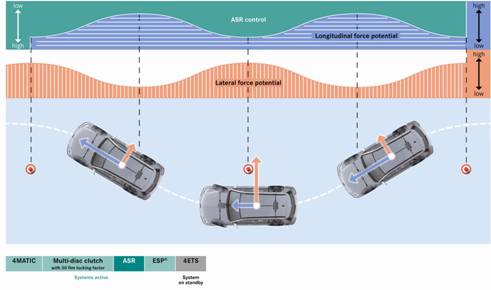
A tyre can basically only transfer a certain total force onto the road. If a large amount of lateral force is required to maintain directional stability on winding roads, the available longitudinal force is reduced. Conversely, limited lateral force is required when driving in a straight line. On winding roads covered with snow and ice, vehicle stability is mainly controlled by means of the ASR acceleration skid control system so that a sufficient reserve of lateral force is always available. If necessary, the ASR acceleration skid control system reduces the engine torque and, in turn, the longitudinal force to the point where the outer wheels can produce sufficient lateral force. If the ASR control function cannot generate sufficient directional stability, then ESP® applies the brakes to stabilise the vehicle.
In contrast to the control mechanisms operating when driving on winding roads, considerably more longitudinal force can be provided when accelerating in a straight line, as the tyres hardly have to transfer any lateral force. Here it is important that the tyres can work in the optimum µ-slip curve range. In order
to achieve this, in this driving situation the control thresholds for the engine torque regulation are raised. The multiple-disc limited-slip centre differential simultaneously works on the transfer case, locking the powertrain longitudinally with 50 Nm. This locking factor substantially increases traction, without compromising the control systems. The final drive ratios therefore allow the 150 Nm to be transferred to the wheels.
In certain wintry conditions it may be necessary to deactivate the control systems via the “ESP® OFF”-switch. This is the case where high slip values are required at the wheels – for example to get out of deep snow with or without snow chains. When braking drivers still have full support at their disposal, even in ESP OFF mode. Once back on a road surface with a normal covering of snow, drivers should then activate the control systems again.
Technology in detail
The permanent all-wheel-drive system 4MATIC
The 4MATIC drive system in the GLK is among the most powerful all-wheel-drive systems there is; its control systems break new ground. Advantages over other systems with a transversely installed drive unit are achieved thanks to the basic compact, light and friction-loss-optimised design with its longitudinally positioned engine and integrated main and transfer case. Fuel consumption,
for example, is at the same level as that of a comparable, conventionally driven vehicle, whilst noise and vibration levels are on a par with those in higher vehicle categories.
In cooperation with the dynamic handling control systems ESP®, acceleration skid control ASR and 4ETS, the basic 45:55 percent torque split between the front and rear axle ensures assured and predictable handling. When fine-tuning the control systems the engineers at the Mercedes-Benz Technology Centre placed particular importance on defined understeer characteristics, as displayed by all GLK models even in the most varied of road conditions: on dry roads, in rain, snow, ice or on unsurfaced roads.
A double-disc clutch achieving a basic locking torque of approximately 50 Nm between the front and rear axle is fitted to the central differential. The clutch pack is permanently preloaded via a plate spring. In the case of spinning wheels on one of the two axles, a friction torque is transmitted to the axle spinning more slowly by relative movement of the discs. A sustained improvement to traction and directional stability of the vehicle are achieved through this principle of variable torque shift. Particularly in the case of low coefficients of friction between the tyres and the road surface the traction and stabilising effect of
this so-called pre-lock clutch is clearly noticeable.
Adaptive Brake: state-of-the-art brake control system enables shortest stopping distances – even in wintry road conditions
The newly developed ADAPTIVE BRAKE control system encompasses the following basic functions: the anti-lock braking system ABS, acceleration skid control ASR and yaw moment control. ABS and ASR record and control the driving situation longitudinally, the yaw moment control the lateral dynamics.
If ADAPTIVE BRAKE diagnoses critical operating conditions, within the limits of the laws of physics traction and directional stability are retained or reinstated through precise brake actuation and drive torque control.
New additional functions make ADAPTIVE BRAKE even safer and more convenient. Hill Start Assist prevents the vehicle from rolling unintentionally in the opposite direction of travel wished by the driver. A function known as priming has also been added. If the driver quickly removes his or her foot from the accelerator, the system prepares for possible panic braking by placing the brake linings on the brake discs using little pressure. Through the indirect pressure build-up when operating the brake pedal this will then shorten the stopping distance if a full brake application does occur. Thanks to ADAPTIVE BRAKE’s ability to produce even the slightest amounts of brake pressure precisely, it is possible to remove the film of water which forms on the brake discs in wet conditions through brief, light brake actuation. This reduces even further the brake response time, and thus the stopping distance, in the wet. Intervention takes place as soon as the windscreen wiper has reached a certain number of wipe cycles and the driver has not braked of his or her own accord in the meantime.
The GLK is fitted with adaptive brake lights as standard. This system warns following traffic that there is a critical braking situation by initiating flashing
of the brake lights if the vehicle’s rate of deceleration is high. In the case of emergency braking from a speed of over 70 km/h the hazard warning lights
are automatically activated when the vehicle comes to standstill.
The “off-road” switch in the centre console helps the GLK-Class to make good progress on rough terrain if the equipment line with the “off-road engineering package” is selected. At the touch of a button a special drive program comes into operation; it varies the 7G-TRONIC’s shift points, “softens” the accelerator characteristic and activates the ESP® functions with off-road ABS and a special off-road 4ETS. A further switch turns on the DSR (Downhill Speed Regulation) which automatically keeps to a pre-selected speed between 4 and 18 km/h on steep downhill inclines. The driver can vary the speed at any time using the cruise control lever.
In addition to a tyre pressure loss warning system the GLK’s Electronic Stability Program ESP® comprises vehicle/trailer stabilisation as standard. This diffuses critical operating conditions through precise brake actuation as they arise. The maximum towing capacity is 2000 kilograms.
Strong characters
The GLK-Class from Mercedes-Benz
The new GLK is a strong character which enriches the world of compact SUVs. With its practical, attractively compact body style this distinctive multi-talented vehicle is in a class above its competitors, successfully combining qualities previously deemed to be conflicting: thanks to the AGILITY CONTROL suspension, outstanding driving dynamics go hand in hand with superb handling safety and excellent ride comfort. Working together with the electronic control systems the state-of-the-art variable all-wheel-drive system 4MATIC unites optimum on-road performance with high off-road suitability. It is precisely these connections that make the GLK so attractive: within the Mercedes-Benz SUV family this is one of the models characterised in particular by an impressive performance spectrum on surfaced roads, and yet at the same time that all-important “G” is part of its signature.
The four and six-cylinder engines, as powerful as they are economical and environmentally compatible, guarantee effortlessly superior performance. The GLK 220 CDI BlueEFFICIENCY model comes with the new four-cylinder diesel engine from Mercedes-Benz. The base engine mobilises 125 kW/170 hp and consumes 6.7 litres of diesel per 100 kilometres. The highly stable body forms the prerequisite for the vehicle’s groundbreaking passive safety, its quiet running and interior comfort complete with the hallmark Mercedes feel-good factor and its high value retention. An excellent level of interior equipment and appointments and attractive equipment packages help the GLK to stand out from the compact SUV crowd to an even greater extent. What’s more, systems such as the groundbreaking PRE-SAFE® safety concept and the Intelligent Light System ILS are available in this market segment for the first time.
At a glance
51 all-wheel-drive passenger car models from Mercedes-Benz
The Mercedes-Benz all-wheel-drive line-up includes nine model series and offers a range of options: starting with the C-Class and E-Class, both available as saloon and estate versions with 4MATIC, through the S-Class, the CL Coupй and the R‑Class touring SUV, the Stuttgart-based manufacturer offers the compact GLK SUV as well as the GL-Class and M-Class off-roaders. The evergreen G-Class off‑roader, a member of the range since 1979, completes the huge variety on offer, and is just one of 51 passenger car models which Mercedes-Benz offers with permanent all-wheel drive.
C-Class Saloon Estate | C 320 CDI 4MATIC C 320 CDI 4MATIC | 165 kW/224 hp 170 kW/231 hp 200 kW/272 hp 165 kW/224 hp | 4MATIC permanent all-wheel drive, ESP®, 4ETS; ASR; transfer case integrated in main transmission, central differential with double-disc clutch, basic locking torque front axle/rear axle 50 Nm; torque distribution front axle/rear axle 45:55 |
E-Class Saloon Estate | E 280 CDI 4MATIC E 280 CDI 4MATIC | 140 kW/190 hp 165 kW/224 hp 170 kW/231 hp 200 kW/272 hp 285 kW/388 hp 140 kW/190 hp 165 kW/224 hp 170 kW/231 hp 200 kW/272 hp 285 kW/388 hp | 4MATIC permanent all-wheel drive; 4ETS and ESP®; |
S-Class short and long wheelbase | S 320 CDI 4MATIC | 173 kW/235 hp 200 kW/272 hp 250 kW/340 hp 285 kW/388 hp | 4MATIC permanent all-wheel drive, ESP®, 4ETS; ASR; transfer case integrated in main transmission, central differential with double-disc clutch, basic locking torque front axle/rear axle 50 Nm; torque distribution front axle/rear axle 45:55 |
|
CL-Class | CL 500 4MATIC | 285 kW/388 hp | 4MATIC permanent all-wheel drive, ESP®, 4ETS; ASR; transfer case integrated in main transmission, central differential with double-disc clutch, basic locking torque front axle/rear axle 50 Nm; torque distribution front axle/rear axle 45:55 |
|
R-Class short and long wheelbase | R 280 CDI 4MATIC** | 140 kW/190 hp 165 kW/224 hp 200 kW/272 hp 225 kW/306 hp | 4MATIC permanent all-wheel drive; 4ETS and ESP® |
|
GLK-Class | GLK 220 CDI 4MATIC GLK 320 CDI 4MATIC GLK 280 4MATIC | 125 kW/170 hp | 4MATIC permanent all-wheel drive, ESP®, 4ETS; ASR; transfer case integrated in main transmission, central differential with double-disc clutch, basic locking torque front axle/rear axle 50 Nm; torque distribution front axle/rear axle 45:55, optional off-road engineering package with off-road ABS/4ETS, Downhill Speed Regulation DSR |
M-Class | ML 280 CDI 4MATIC ML 320 CDI 4MATIC ML 420 CDI 4MATIC ML 350 4MATIC | 140 kW/190 hp 165 kW/224 hp 225 kW/306 hp 200 kW/272 hp 225 kW/306 hp 375 kW/510 hp | 4MATIC permanent all-wheel drive; 4ETS and ESP® , Downhill Speed Regulation, start-off assist and off-road ABS. Optional off-road Pro engineering package with two-stage transfer case, “Low Range” reduction gearing, two manually selectable 100-percent locking differentials and AIRMATIC air suspension |
GL-Class | GL 320 CDI 4MATIC | 165 kW/224 hp 225 kW/306 hp 250 kW/340 hp 285 kW/388 hp | 4MATIC permanent all-wheel drive; 4ETS and ESP®, Downhill Speed Regulation, start-off assist and off-road ABS. Optional off-road Pro engineering package with two-stage transfer case, “Low Range” reduction gearing, two manually selectable 100-percent locking differentials and AIRMATIC air suspension |
G-Class Station Wagon short/long Cabriolet | G 320 CDI | 165 kW/224 hp 218 kW/296 hp 368 kW/500 hp | 4MATIC permanent all-wheel drive; 4ETS and ESP® , with “Low Range” reduction gearing and three manually selectable 100-percent locking differentials |
* model changeover 04/2009
** only available with short wheelbase
*** off-road Pro engineering package not available, AIRMATIC as standard;
**** only available as Station Wagon with long wheelbase
