


Партнерка на США и Канаду по недвижимости, выплаты в крипто
- 30% recurring commission
- Выплаты в USDT
- Вывод каждую неделю
- Комиссия до 5 лет за каждого referral
These conditions require execution of the following tasks:
- formulating questions which minimizes the influence of social expectations;
- using such question order and wording which minimizes direct commanders intrusion even in cases of anonymity violation;
- using sets of questions which crossvalidate each other therefore minimizing falsehood in answers.
The practice of our research showed that military servicemen are much more open to questions related to assessment of situation in general (like “What do you think about the social status of the military in Ukrainian society?”) then personalized questions (like “Do you trust military authorities?”). Thus, we use general questions in the direct manner, like in civilian polls. Personalized questions were formulated in “third person” perspective (“Do you know some fellow servicemen, who…”) or put in a special order: firstly we pose a question about reasons of socially welcomed attitudes and, secondly, immediately after them — a question about reasons of undesirable (or even unacceptable) attitudes. The latter goes without filter but with the option “there is no reasons for this”. In most cases the norm of full performance (answering all questions) helped to overcome resistance to undesirable reasoning. Also commanders, in most cases, overlooked such question combinations.
Below we present the wording of some of questions about the military readiness we used to poll the military personnel.
Is our Army able to protect Ukraine in case of real military threat?
- yes;
- more likely yes than no;
- more likely no than yes;
- no;
- hard to say
- other (specify) ________
Is … able to make right decisions in a combat situation?
President of Ukraine | Parliament | Government | Ministry of Defense and General Stuff authorities | |
yes; | ||||
more likely yes than no; | ||||
more likely no than yes; | ||||
no; | ||||
hard to say |
What are the most negative possible influences upon Ukrainian military units’ morale?
- social insecurity;
- misunderstandings in fellow servicemen relations;
- lack of dynamic combat training;
- the prevalence of egoist ambitions among servicemen;
- insufficient direct commanders’ organizational skills;
- rudeness and humiliation of personality;
- a real threat to life and health as a result of hostilities;
- hard to say
If any of your relatives or friends are subject to conscription during the hostilities in Ukraine, then you would prefer...
- he went to serve in the Army;
- would seek to avoid serving in the Army;
- hard to say.
How likely do you think that as a result of military conflict...
quite sure about this | there is a high probability of this | this is unlikely | this is impossible | hard to say | |
Ukraine would lose a part of its sovereign territory. | |||||
Civilians would suffer significant losses. | |||||
The Army would suffer severe casualties. | |||||
Ukraine would suffer considerable material losses (destruction of buildings, roads, natural objects, etc.) |
How would you rate your moral and psychological readiness to protect Ukraine from hazards (military threat, terrorist attacks, the effects of natural disasters), if it involves a risk to your life?
- completely ready
- mostly ready
- probably not ready
- not ready
- other (specify) ________
If you’re ready (mostly ready), specify what motivate your readiness? (You can choose several options)
- homeland defense is my duty
- I want to protect my state
- I want to protect my nation, culture
- I want to protect my family, house
- other (specify) ________
What cause your hesitation about your readiness? (You can choose several options)
- the state badly takes care of its defenders (low level of social guarantees)
- not confident in the ability of commanders to make the right decisions in a combat situation (their professional competence)
- not sure about professional training sufficiency of subordinates for combat
- Ukrainian army is not sufficiently equipped (armed) for the confidence in victory
- not sure about the state’s promises to take care of me and my family in case of death or injury
- I do not want to risk my health and life.
- Other (specify) ________
One of the organizational problems of military polls is time budget: filling questionnaires must not be time consumable activity which interferes with the performance of military duties. Thus, questions sets must not be very large, while being effective. At the same time it is essential to regularly check the level of military readiness, which is possible with use of small set of questions which are put in each questionnaire on different topics. After series of polls and assessing number of meaningful connections with other variables we came to conclusion that the most effective set of questions consists of only three of them: self-assessment of morale, reasons for readiness and hesitation. With the use of this set it is conceivable to create an index of morale military readiness which is calculated according to the formula 1.
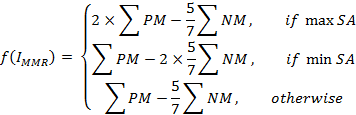 (1)
(1)
with  : index of morale military readiness;
 : positive motives of military readiness (i. e. conditions which motivate a serviceman readiness);
 : negative motives of military readiness (i. e. conditions which demotivate a serviceman readiness);
 : level of self-assessed moral and psychological readiness.
If a polled serviceman is absolutely sure about his readiness (“completely ready” and maximum level of ) we double the influence of positive motives quantity upon the index value. In case of absolute self-assessed unreadiness — negative motives quantity is doubled. Also the influence of negative motives is declined by a  fraction as there is bigger probability to choose them. Thus, the value of the index varies from 10 to –10. If the index equal 10, then a polled serviceman is absolutely sure about his readiness, all positive motives are important to him, and there are no causes of hesitation. If the index equal –10, then a polled serviceman is absolutely sure about his unreadiness, all negative motives are important to him, and nothing motivates him in critical situation.
We also propose four levels of readiness based on calculated index:
[10 – 5) : sufficient;
[5 – 0) : moderate;
[0 – -5) : insufficient;
[-5 – -10] : critical.
In the next section we present general results of morale index assessment in connection with other variables. In all polls quota sampling was used which represent permanent military staff (contracted servicemen) in branches of AFU, regions of military units deployment, categories of the military (senior and junior officers, contracted privates). Samples sizes are between 1150 and 1530 respondents (actual responses).
In table 1 final samples descriptive statistics of the morale military readiness index distribution is shown. As we can see, the index distribution is peaked with most values concentrated around moderate level. However, a positive value of skewness shows certain tendency towards insufficient level.
Table 1 — Descriptive statistics of the distribution.
Minimum | Maximum | Mean | SD | Skewness | Kurtosis | ||
Value | Std. Error | Value | Std. Error | ||||
–2.57143 | 4 | 0.362658 | 1.131269 | 0.289598 | 0.074159 | –0.09059 | 0.148183 |
Results confirm the ability of this question set and respectively calculated index to normalize idealized self-presentation in accordance with commanders’ expectations.
To find out possible meaningful connections between and demographic, social, and economic characteristics of servicemen we performed correlation analysis. All variables scales were recoded to ascending order. In table 2 significant Pearson correlations from the last survey are shown.

|
Из за большого объема этот материал размещен на нескольких страницах:
1 2 3 4 5 |
