

Партнерка на США и Канаду по недвижимости, выплаты в крипто
- 30% recurring commission
- Выплаты в USDT
- Вывод каждую неделю
- Комиссия до 5 лет за каждого referral
Vocal groups of the German minority in Poland and their songs as a marker of cultural identity
How is it possible that nowadays in Poland there exists a population who define themselves as German, although they all had to leave their home around 1945? To answer this question, one has to distinguish between two completely different areas.
1. The first category are regions like Lower Selesia, Lubuskie, Pomerania, West Prussia and East Prussia. In these regions the expulsion caused that today on a relatively large territory, one can only find a very scattered German population. The reasons that these people didn’t have to leave around 1945 are very individual. Some of them could stay because they were married with a Polish woman or a Polish man, some of them had lost their parents during the war so they were not able to go anywhere on their own, some lived in rural areas and nobody really paid attention to their presence, or in other words: they have been forgotten. Thus this small number of Germans could stay after 1945 in these areas, they became Polish citizens, but usually didn’t talk so much about their identity and what happened to them.
2. The second category is Upper Silesia: In Upper Selesia we are dealing with a completely different situation, because during a long time this area was a border region with Polish, German and Bohemian/Moravian influences concerning the culture and the language. A long time before the Second World War started, the population in Upper Silesia had a mixed or a flexible identity, in other words a “floating Ethnicity”. This means that a lot of people would not define themselves as a citizen of one nation but rather as Upper Silesians. They often spoke Polish and German sometimes even Czech, and used a specific dialect: the Silesian idiom or “gwara slaska”. I will refer to this once more later in detail.
Because of this “floating Ethnicity” it was very difficult for the Polish authorities in Upper Silesia after 1945 to determine who was German and who was not; who of them had to leave and who could stay. The result was, that a lot of these people – the so called autochthonous or “tutejszy” – remained in Upper Silesia. For this reason nowadays there exits a large number of people on a relatively small territory that define themselves as German or German-Silesians.
Concerning the musical activities of the German minority in Poland during the years from 1945-1990 as a whole, there is not so much to talk about. With the exception of a few areas and short periods, virtually no musical activities of the German minority took place, as well as the German language was forbidden in the public. Two exceptions of the rule were:
1. Singing folksongs in a private and secret circle (family or friends) during feasts such as Christmas, birthdays or occasionally even weddings.
2. Using music or rather songs as a code or a hidden message: Some musicians, belonging to the German minority – told me, that before 1990 they played German folksongs during public concerts but without the lyrics. So by the reactions of the spectators who knew those songs, they could find out who belongs to the German minority. This was a very dangerous thing to do and some them even got into problems (explain it to the Militia). But as far as I know it generally didn’t cause any serious consequences.
It is well known that in 1989/90 the political situation changed completely, not only but also in ddenly, the German minority was allowed to organize formally and legally – just as it was the case for the Ukrainian, Belarusian and other minorities of Poland. German organizations and societies “sprung up like mushrooms” in all those regions where a German minority still existed. As a part of the German organizations and societies, musical groups were founded, and many of them still exist to the present. One can divide these musical groups into 4 different categories:
1. Vocal groups (which I will explain later in detail yet).
2. Folk dance groups for children and teenagers.
3. Brass bands, which are limited exclusively to the area of Upper Silesia.
4. Groups that can not be ascribed to one of the previous categories; for example: some pop music bands, a few instrumental groups and even bands playing alpine folk music in a very hybrid way.
Due to time constraints, I will limit myself now to one aspect, namely the vocal groups. Especially here, it is important to draw a difference between vocal groups on the one hand, in Upper Silesia (with a high density of the German minority) and on the other hand vocal groups in the areas of Lower Silesia, Pomerania, West and East Prussia where a very low density of a German population exists. Let me start with the latter, and I will call theses regions for the sake of simplicity “the other areas” respectively the regions which are not (!) Upper Silesia.
Vocal groups in “the other areas”
One Characteristic of the vocal groups in the “other areas” is that they mainly consist of female members (about 90%) in a higher age (from 60 years upwards). Young people, children or men one can find only rarely in this context.
The number of members in these vocal groups is becoming constantly smaller, because of the above mentioned high age structure. New members can not be found, since the reference to history or fate is completely different for the younger generations.
These vocal groups mostly perform in the context of the German minority in Poland and at festivals in Germany and sometimes Austria.
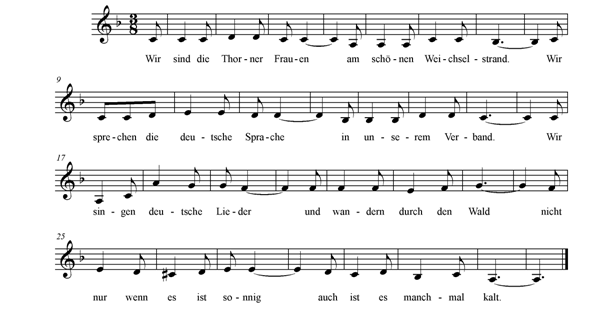
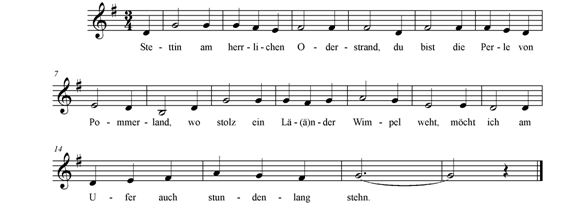
Of particular interest are the songs of these groups. The language of the lyrics is mainly (about 90-95%) German. The repertoire contains well known German "folk songs” like “Hoch auf dem gelben Wagen”, “Wenn alle Brünnlein fließen” and similar songs. On the other hand they use a lot of songs that are in some way specifically related to the region they live. Above this on the basis of field research it was possible to find out another – as I think – very interesting aspect: Most groups created one or even more songs by themselves, songs that deal with the city they live in or the individual situation of the group. Most of these – I will call them – “local hymns” are based on melodies of other well-known songs to which they composed new lyrics. I would like to present here 2 brief samples.
Transkription of the song „Wir sind die Thorner Frauen“. The melody is based on well known German „Volkslied“ „Mariechen saß weinend im Garten“. The text was composed by the leader of the group Helena Karbowska
The „Stettiner Lied“, often sung by the „Sedina-Chor“ from Szczecin (Stettin). The Composer of music and lyrics is unknown.
Because of these facts one can say that music – and especially the local and regional songs – are used to define the groups, to distinguish them from others, but not primarily to appeal to others. Many of the informants I was talking to even expressed and emphasized: “We sing our German songs, whether other people like them or not, we do not care about that.”
Thus Music or rather song in this specific context is not an integrating element, music as a universal language that everybody can understand, or should. Instead of music is here rather something to exclude, meaning “this is our music, our songs that we know from our childhood, which we were not allowed to sing for a long period of time, but which are very important to define ourselves as a group that doesn’t belong to the majority of the Polish population.”
Vocal groups in Upper Silesia
In Upper Silesia there also so-called “German vocal groups” exist. However, there are great differences compared to the “other regions”. In Upper Silesia one can find vocal groups with members in mixed-age classes, both (male and female) participants, pure children's choirs, all-women's or all-men's choirs, and a great variety concerning the number of members (4-40).
Also of a great variety are the occasions, in which the groups from Upper Silesia participate. This includes festivals of the German minority, village festivals (especially in small villages of Upper Silesia during the summer), but also at shows, where a Polish audience predominates. Equally variable are the categories under which the groups perform: They sometimes represent themselves as a vocal group of the German minority, but depending on the occasion also as a Silesian vocal group, or just as a group from a certain city without stressing a minority background.
The language of the songs also differs. They are sometimes in German, but also in Polish or even in the Polish-Silesian Dialect. Which language or idiom they use, depends from the event and the audience. A few additional comments on the Polish-Silesian Dialect which is also known as “water Polish” or “schlonsakisch”: It is Polish dialect, which might differ regionally, and usually contains some German and Czech words.
For the vocal groups in Upper Silesia it is not possible to name a certain percentage, concerning how much of the repertoire is in German, how much is in Polish and how much is in the Polish-Silesian dialect. This varies from group to group and to a great extent from the particular occasion and the audience. In Upper Silesia they also sing folk songs, plus songs with regional and local connotation but not only in German but also in Polish or in the Polish-Silesian dialect. I would like to present three samples from one and the same group, where the variety of different languages used for the lyrics can be seen very clearly. The name of the group is sometimes “Trachtenröcke” (englisch = dress skirts) but sometimes also “Mazelonki” (= the Polish-Silesian translation for “Trachtenröcke”).
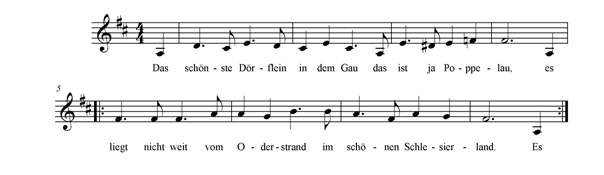
The first song is in German, has a local connotation and is called “Das schönste Dörflein” (english: “The most beautiful little village”). The lyrics deal with the hometown of the group which is Poppelau (in the western part of Upper Silesia). For the villagers this song functions as a local hymn.
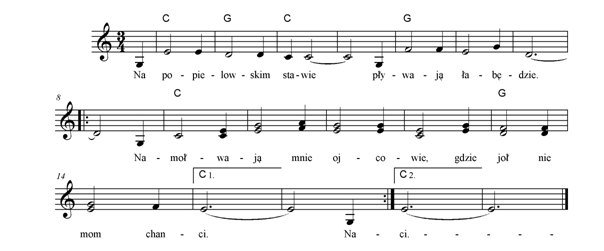
The second song also represents a local hymn and is called „Na popielowskim stawie“ (On the small lake or pond of Poppelau). This one is not in German but instead of in the Polish-Silesian dialect. I have underlined the Polish-Silesian words that differ from standard Polish with red colour.
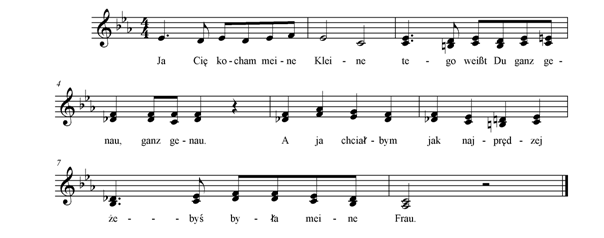
The third song is called “Meine Kleine” (english: “My little one” or “My girl”). But it is not in German, not in standard Polish and neither in the Polish-Silesian idiom. Instead of it is bilingual: Polish-German. The lyrics are a joke about the relationship between men and women in general.
Conclusion
In summary, one can say that vocal groups of the German minority in the two categories I reported about (“the other regions”, and Upper Silesia) differ to great extent: In the “other regions” a clear trend can be noted that the groups use music and songs to define themselves as a minority, what can also be seen by the fact that nearly all songs are in German. It is not their primary intention that everybody loves their songs and their performance. Much more important seems to be that they demonstrate, that they are a minority and are free to sing those songs they know from their childhood but couldn’t sing them officially for a period of about 40 years. Due to the high age structure, the vocal groups of the “other regions” will only exist for a few years more, a fact that they are also aware about.
For the vocal groups in Upper Silesia there exists a much greater flexibility concerning the language of the songs (German, Polish, Polish-Silesian), the performances, the audience and the members of the groups (regarding the age structure, the quote of women and men, and the total number of members). The most special feature in Upper Silesia is that the groups use the Polish-Silesian dialect in their songs. It is very likely that because of this hybridism and flexibility – in addition to the higher density of a population groups who describe themselves as German –, the vocal groups of the German minority in Upper Silesia will exist over a longer period of time. Thank you very much for your interest and attention.
