

Партнерка на США и Канаду по недвижимости, выплаты в крипто
- 30% recurring commission
- Выплаты в USDT
- Вывод каждую неделю
- Комиссия до 5 лет за каждого referral
УДК 621.763:717
D. Petryna
Ivano-Frankivsk National Technical
University of Oil and Gas
THE INCREASE OF THE STRENGTH OF
THE TOOTH - ROLLING CUTTER JOINT
© Petryna D., 2013
There have been investigated the strength of the tooth-rolling cutter joining which greatly affects the durability of the drilling bit. The increase of interference during the compression results to the increase of the stress concentration in the tight coupling tooth rolling cutter body. It has been shown that for the assembly with the maximal interference the contact pressure exceed the permissible, which is unacceptable. To avoid this the selective assembly of the tooth-rolling cutter body press-joint is proposed. The usage of the selective assembly allows to have more homogeneous joints. The reduction of difference between maximal and minimal values increases the homogeneity, and therefore, the quality of the joint.
В роботі досліджувалася міцність з’єднання «зубець-шарошка», яка в значній мірі впливає на довговічність бурових доліт. Збільшення інтерференції під час стиску призводить до збільшення концентрації напружень у з’єднанні з натягом зубця і тіла шарошки. Як було показано для такої конструкції при максимальних значеннях навантажень контактні напруження можуть перевищувати допустимі значення, що є недопустимим. Щоб запобігти цьому запропонована конструкція з’єднання «зубець-шарошка» за допомогою пресування. Такий тип конструкції дозволив отримати більш однорідні з’єднання. Зменшення різниці між максимальними і мінімальними величинами контактних напружень покращує однорідність і, як наслідок, якість з’єднання.
The crack resistant of cemented rolling cutter is closely connected to the strength of the tooth-rolling cutter joining which greatly affects the durability of a drilling bit. The increase in interference during the compression results in the increase of the stress concentration in the tight coupling tooth-rolling cutter body. It promotes cracks in the cemented layer. In the process of interaction with rock the teeth are subjected to the complex loads which further increase the stress concentration.
The existing methods of compression or soldering of hard alloyed teeth do not provide their reliable fixing in the rolling cutter body. Up to 25% of teeth fall out of the rolling cutter body in the process of drilling, and this leads to the decrease in efficiency of the bit work. Therefore, the problem of effective fixing of teeth in the rolling cutter body is very important now [1,2].
For the purpose of providing the strength of mating parts the accumulating of the permissible pressure  is done. According to the theory of maximal tangential stress, which corresponds to experimental data to the most extent, the condition of parts strength is the absence of plastic deformation on the contact surfaces of the hole and the shaft:
 (1)
(1)
for the cemented layer with 1% С,  =1800 MPa.
Thus,  1800 =1044 MPa. The exploitation pressure should not exceed the permissible one because the supporting power of fixing is decreased by the plastic deformation of the material of teeth and the rolling cutter body. It is especially important under conditions of the dynamical load.
The analysis of the tooth-rolling cutter body joint that was completed at Drogobych bit plant showed that interferences in joint vary from  to
to  = 0,058 mm. For this study the rolling cutters with to hole size Æ10+0,055 and teeth Æ10,14.-0,027 were used. It is known that the interference value determines both the ability of press joints to endure the necessary loads and the joint durability. The contact pressure on surfaces of the mating parts is the result of the interference. Their value is determined from this condition of equality of the sum of the absolute values of radial displacement of both parts to the difference between radiuses of mating surfaces before compression (the half of the diameter interference).
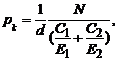
Taking into account that the tooth is shaped as a solid shaft, the final formulae for the contact pressure is:
 (2)
(2)
where: N - interference in the joint;
E1 and E2 - modulus’s of elasticity of male and female parts, respectively), E1 = E2 =2×10¹¹ Pa;
d - diameter of mating surface; d=10 mm.
C1, and C2 - ratios, that are determined using the Poisson's rations  and
and  of male and female parts, respectively; C1 =0,7; C2 = 1,3.
Inputting the values into the formula (2), the values of contact pressures have been derived:
 for Nmax= 0,14 mm,
  = 1400 MPa; for Nmin =0,058 mm, pk = 580 MPa.
Thus, for the assembly with the maximal interference the contact pressure pk = 1400 MPa exceeds the permissible pk = 1044 MPa, which is unacceptable. In this case the cracks in the cemented layer of rolling cutter will already appear in the process of compression. The decrease of interference during compression results in the increase of the probability of tooth dropping.
To avoid this the selective assembly of the tooth-rolling cutter body press-joint is proposed. The usage of the selective assembly allows to have more homogeneous joints: in press fit the maximal interference decreases, the minimal interference increases, and both of them approach the intermediate value. The reduction of difference between maximal and minimal values increases the homogeneity, and therefore, the quality of the joint.
For studying of the impact of the selective assembly on the preciseness of the press joint of the hard alloyed tooth - the rolling cutter, the determining of the part preciseness characteristic was done at Drogobych bit plant.
The sample of hole sizes in rolling cutters Nhol=100 and teeth Nt=100 was taken from the big group of rolling cutters and teeth of mentioned sizes. The parts were measured with a horizontal projection optical caliper with the value of a division 1 mkm. The obtained real dimensions Di (the diameters of holes) and di (the diameters of teeth) were set in the order of the growth of their values (table 1 and 2).
We have received the set of random discrete numbers using the method mentioned above. For our investigation the results dispersal range was divided into 9 intervals. There was determined the average value of sizes in the interval (li); as well as empirical (ni) and theoretical ( ) frequencies.
The arithmetical average of real sizes is:
 (3)
(3)
for teeth  = 10,12644 mm, for rolling cutter hole
  hole=10,02808 mm.
Standard deviation is:
 , (4)
, (4)
for teeth s = 0,0046; for rolling cutter hole s = 0,0094.
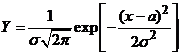
The normal distribution curve is defined by the formulae:
 , (5)
, (5)
where  - standard deviation;
a - average of random quantity totality;
x - random quantity.
Using the Laplace's function there have been determined the theoretical frequencies for interval centers.
Table 1. Preciseness characteristics of teeth di-
The interval of sizes (diameter) dj, mm | Average value of sizes in the interval li, mm | Empirical frequencies ni | Theoretical frequencies
|
10.113-10.116 10.116-10.119 10.119-10.122 10.122-10.125 10.125-10.128 10.128-10.131 10.131-10.134 10.134-10.137 10.137-10.140 | 10.1145 10.1175 10.1205 10.1235 10.1265 10.1295 10.1325 10.1355 10.1385 | 1 4 10 23 28 18 10 5 1 | 1 4 13 20 25 20 11 4 1 |

Table 2. Preciseness characteristics of holes in rolling cutters Di
Ths interval of sizes (diameter) Di, mm | Average value of sizes in the interval li, mm | Empirical frequencies ni | Theoretical frequencies
|
1 | 2 | 3 | 4 |
10.000-10.006 10.006-10.012 10.012-10.018 10.018-10.024 10.024-10.030 10.030-10.036 10.036-10.042 10.042-10.048 10.048-10.054 | 10.003 10.009 10.015 10.021 10.02 10.033 10.039 10.045 10.051 | 1 3 11 17 26 24 10 6 2 | 1 4 10 19 25 22 13 5 2 |
The empirical and theoretical distribution functions have beet compared. On the basis of the obtained, results the empirical and theoretical distribution curves were plotted (fig 1). The displacement of grouping centers is insignificant, and therefore the distribution curves are very close to Gauss’s one. And thus, the quantity of the tooth - rolling cutter joint in each group is approximately the same.
It is important to mention that the selective assembly can be used as the method that allows to have the necessary joint preciseness. As the result, the optimal value of interference (Nopt = 0.1 mm) is obtained. Inputting this value into the formulae (2), we found out that the value of the contact pressure is  = 1000MPa. This value is in the permissible limits.
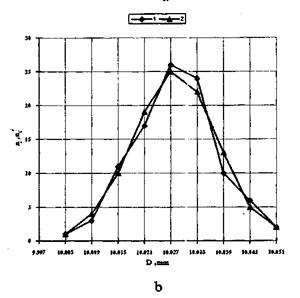
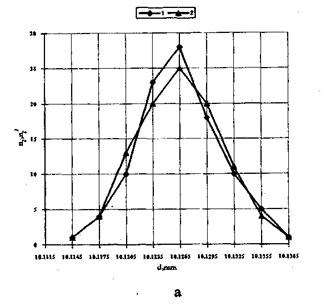
Fig. 1 Normal distribution curves of sizes:
a -in teeth; b - in rolling cutter holes;
1 - diagram of empirical frequencies; 2 - diagram of theoretical frequencies.
1. Яким ія і практика забезпечення якості експлуатаційних показників цементованих деталей шарошкових бурових доліт/ , Ю. Д. Петрина. – Івано-Франківськ: Видавництво ІФНТУНГ, 2011. – 189с.
2. Яким практичні основи технології виготовлення три шарошкових бурових доліт та підвищення їх якості і ефективності/ , , І. С. Яким. – Івано-Франківськ: Видавництво ІФНТУНГ, 2011. – 384с.
