

Партнерка на США и Канаду по недвижимости, выплаты в крипто
- 30% recurring commission
- Выплаты в USDT
- Вывод каждую неделю
- Комиссия до 5 лет за каждого referral
Potential Difference and Resistance
|
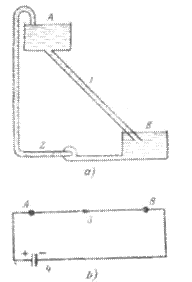
If we were asked: "How can electric charges be made to flow and what factors influence their flow?" The analogy to the flow of water in a pipe would certainly help to make some of the principles clear.
If one considers the conditions necessary for the water flow through a pipe, it will not be difficult to understand that there must be a pump somewhere in the pipeline, or else a difference in level must evidently exist between the two ends of the pipe.
In case we are dealing with electricity, the requirements necessary for current flow are similar in that there must be in the circuit an electromotive force (a battery or a generator), or else a difference of potential should exist between the two ends of the conductor.
Fig. An analogy between water flow and flow of charge. 1 — pipe; 2 — pump; 3 — conductor; 4 — battery. |
Let us picture what would happen provided there was a conducting wire between two points of unequal potential. It is clear that in such a case there must be a flow of electrons from one of the points to the other. Since the electrons in the wire constitute the current flow, they will certainly tend to flow from the point of lower potential towards that of higher potential.
Imagine that an electric current flows from point A to point В through the conductor in fig. In electrical terms this means that there is a potential difference between A and B, the potential at A being greater than that at B. unless there were a flow of current between A and В in any direction, A and В would doubtless be at the same potential.
Let us return to our analogy, to the flow of water in a pipe (see fig. a). There is a difference in level (or potential energy) between the water at the ends A and В of the given pipe AB. This difference in level is supported by a pump which raises the level (or potential energy) of the water at В to that at A.
The flow of water per second through the pipe AB depends first on the difference in level between points A and B, just as in the electrical case the current in the conductor AB depends on the potential difference between point A and point B. The other factor that is to be considered before one is able to say how much water does flow through the pipe is the resistance offered by the pipe to the flow of water. In the same way, an electrical conductor, say a wire, offers some resistance to the flow of charges passing through it.
In the case we have just considered, where a conductor is connected between two points of unequal potential, we have a momentary motion of charges. The charges move until they come to a static equilibrium state, then they stop; there is no steady current, therefore. When we have such a case of static equilibrium, the surface of a conductor is equal in potential everywhere. Naturally, it does not mean that there is an equal distribution of charge over the whole surface of the conductor but it does mean that all points of the conductor are alike with respect to potential.
If we have a conductor carrying a steady current, we obviously find that the situation is different. The current flowing there must be caused by a difference of potential from one point to another along the wire. Otherwise, there would be no cause that might make charges move along the wire.
Dealing with potential and potential difference, mention should also be made of the volt, since it is the volt that is the unit used for measuring potential and potential difference.
EXERCISES
I. Answer the following questions:
1. What is this article about? 2. Does this article deal with resistance only? 3. Do electrons flow from the point of higher potential to the point of lower potential? 4. What analogy is considered in fig.? 5. What is the difference in level supported by? 6. What does the flow of water through a pipe depend on? 7. What requirements are necessary for current flow? 8. What does the current in the conductor AB depend on? 9. Does a conductor offer resistance to the flow of charges? 10. What factors influence the flow of charges?
II. Translate the following sentences, paying attention to the modality:
1. If two of the three quantities were known, the third would be found by Ohm's Law. 2. Was there a conducting wire between both points of unequal potential, the electrons would flow from one of the points to the other? 3. It was the diameter of the wire that we did change to obtain better results. 4. It was the analogy between the electron flow and the water flow that helped us to understand the principles mentioned in the article. 5. The electrons do tend to flow from the point of lower potential to that of higher potential. 6. If the pipe has a small cross-section, the water flow per second will be also small. 7. Mention should be made here that the volt is the unit used for measuring potential difference. 8. A redistribution of charges will take place, provided two charged conductors are connected by a wire. 9. Potential in a point is equal to the work that would be required to transfer the unit charge from infinity to that point. 10. Had our pipe a small cross-section, the water flow per second would be certainly small. 11. The water flow per second will be small unless the pipe has a large cross-section.
