

Партнерка на США и Канаду по недвижимости, выплаты в крипто
- 30% recurring commission
- Выплаты в USDT
- Вывод каждую неделю
- Комиссия до 5 лет за каждого referral
NATURALIZATION OF HIPPOPHAE RHAMNOIDES L. ON THE RUSSIAN FAR EAST (MARITIME PROVINCE)
Moskaliuk Tatiana
Botanical Garden-Institute FEB RAS
St. Makovskii, 142, Vladivostok, Maritime province, Russia, 6920024
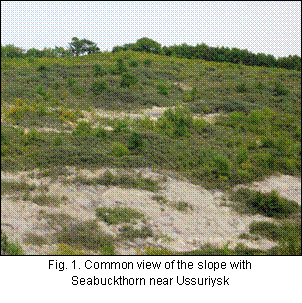 A changing in the natural landscape which accompanies any development of the new lands results in the changes of that the alien species seems to be as adapted to the new environment as aboriginal ones, forming rather productive and sustainable communities. In the Russian Far East just a natural species Seabuckthorn (Hippophae rhamnoides L.), grows in the wild mountainous regions of Eurasia with continental climatic environment. In Maritime province the Seabuckthorn does not grow in nature, only cultivated. It was introduced from Siberia to the experimental plots of the Mountain-Taiga Station FEB RAS (Samoilova[1], 1957) in the middle of the last century, and quickly it became one of the most common berry crop on the homestead lands. It’s anthropogenic communities have been found out in a suburban area of Ussuriisk. They cover almost all the surface on the southern slope of the Przewalski Ridge, from the foot to the watershed on area of about 50 hectares (Fig. 1).
A history of the Seabuckthorn settlement on the above mentioned slope is connected with the building two large city-forming enterprises in 1992-1993: Ussuriisk Thermal Energetic Center and Ussuriisk Carton Factory. To build them the suburban territories on the lower valley places of the Rakovka River have been chosen. The remained plantings on the former country houses land have become resources of the Seabuckthorn seeds. A ground for building has been got on the nearby hillside. While preparing a place for the construction a soil-plant cover of the hillside – the secondary oak forest with Hazel (Corylus mandshurica) and Bushclover (Lespedeza bicolor) undergrowth and herb-sedge tier, was destroyed up to the soil-forming layer. This was facilitated by the summer typhoons with heavy rainfalls and very strong wind typical for the monsoon climate of the Russian Far East.
Ecology of the Seabuckthorn. The climate of the Ussuriisk region is more severe and continental in comparison with the coastal regions of Maritime province (Vytvitsky[2], 1969). It is better protected from the sea influence; summer is hot (+45°C maximum), winter is cold (-40°C and lower), with little snow. An average annual temperature is 3-3.5°С; sharp fluctuation of average monthly and daily temperatures is denoted. In the late spring a short-term drought and late spring frosts are common.
So we can say that the studied environmental conditions are similar to the natural environmental habitats of the Seabuckthorn especially on the southern slopes that are much warmer and drier than the slopes of the other exhibits. They fully coincide with the Seabuckthorn environmental demands characterized by a high drought and frost resistance; in summer it is easy enough can tolerate temperatures up to +40°C and withstand winter temperatures down to -43°C. In addition, the Seabuckthorn is exclusively light-requiring and patient to the soil fertility.
The ooccurrence of the Seabuckthorn on the slope was carried out in two stages. At first the birds brought its diaspores, and then during 10-15 years it grew vegetatively. The Seabuckthorn communities on the different plots varies in the composition of the secondary species, coenotic structure and life state of the in accordance of the certain environmental conditions of the habitats.
Environmental conditions for growing on the slope and coenotic organization of the vegetation cover. The use of the heavy building machines in the places of the ground development and summer typhoons effect have caused a formation of the wavy microrelief; the repeated narrow furrows and roller-like hills along the slope have been formed. The wind erosion due to the wet monsoon climate is enhanced by the chemical eolation. On the flat areas a microrelief is not expressed and the surface is smoothed, but the soil-plant cover was also destroyed on them.
The habitats are characterized by the varying steepness, moisture conditions, soil fertility and drainage in the valley and on the slopes in dependence on the technology of the ground production. In the result of study four habitats types have been defined: in the Rakovka valley, lower, middle and upper parts of the slope. The characteristics of each habitat type are clearly shown in the vegetation cover.
 In the low places of the former country houses land (the Rakovka valley), hence the Seabuckthorn initiated, a basic area is very wet and even swamp land. The surface, beside foots of the slop, leveled by diluvium, taken down from the upper parts of the slope. Here the best fertile and wet soils have been formed, but at the same time a siltation took place and still going on, deteriorating soil drainage. The separated compact clumps of the Seabuckthorn, surrounded by the meadow vegetation, are typical for the valley. The clumps of the good life state up to 2.0 m in height are near to the casual canals or technogenic hills. On the silted plots the Seabuckthorn is very much depressed. On the dry places Sonchus oleraceus, Melilotus suaveolens, Hieracium umbellatum, Onagra muricata, etc. are, on the wet ones species as Typha laxmannii, Carex uda and Scirpus sp dominates. In the valley a maximum Seabuckthorn age was 18 years in 2009.
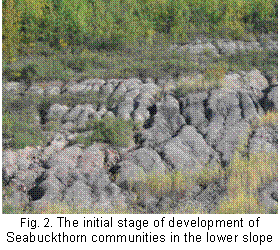
The lower part of the slope, most disrupt, is characterized by steepness in 30-40° inclination. A speed of the rainwater flows is very high here and soil erosion appears quicker than in other places, located above. These places due to the complex environmental conditions are most unfavorable for the vegetation restoration, at least (Fig. 2).. More 50% of its area is a structure less stony substrate with fine silt fractions The vegetation is presented by the single small plants and scattered groups (0.7-1.2 m height and 2-3 m diameter) of the Seabuckthorn 3-10 years of age. However, the Seabuckthorn role in the erosion control is rather quite high. The roots penetrate microelevations, fastening a loose friable soil. Little by little the furrows are filled up by the dead leaves and undifferentiated mass, and xerophilous herbs-pioneers (Thesium chinense, Hieracium umbellatum, Sonchus oleraceus, Artemisia gmelinii, etc.) begin to settle there.
An inclination of the surface in the middle part of the slope is much smaller than in the lower part, up to 15°. The habitats of two types are defined: 1 – habitat with inclination from 5 to 15° and smooth or slightly curved surface; 2 – habitat with not too deep cavities.
The habitats of the first type are usually formed in the places of the surface inflection from the middle part to lower. The character of the vegetation restoration varies in the lower and middle parts very little – percent cover by herbs is less than 5%, but the microrelief in the middle part is much less pronounced, because due to a less steep slope of the surface a rate of the transit water flow eroding the substrate is less. In addition to the Seabuckthorn Populus coreana is introduced here.
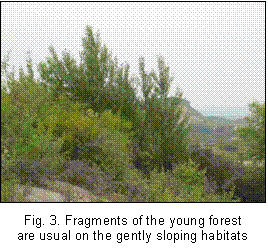 The habitats of the second type occupy no more than 10% of the area of the slope. A smooth surface with a slight inclination and even concave downward is typical for them. They are characterized by better moisture and high humus content in alluvial soils than anywhere else in the slope. These sites were occupied simultaneously by the Seabuckthorn, Bushclover and different types of trees: Populus coreana, P. pyramidalis, P. tremula, Salix sp., Ulmus parvifolium (Fig. 3). Artemisia gmelinii and A. rubripes, Phragmites australis and Sonchus oleraceus are common in the rare herb layer. Under the closed canopy of the young trees there is a strong suppression of the Seabuckthorn due both to a surface shading and competition in the underground area for moisture and nutrients. We can assume that a very photophilous Seabuckthorn would disappear from under the canopy of the stand in a short time.
 On the associate degree a vegetation cover of the aligned and slightly concaved sites consists of the combination with some fragments of young forest and one meadow (grass) phytocoenoses. In contrast to the fully developed plant communities it is characterized by the absence of a single edificator; interinfluence of the fragments is revealed only in their outer parts.
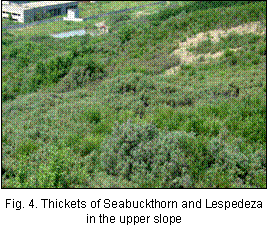
In the upper part of the slope a humus layer was destroyed partially. The surface inclination is 5-7°, so soil erosion is not even on the mineralized areas (Fig. 4). The Seabuckthorn and Bushclover grew successfully from the very beginning of the vegetation restoration that caused the development of the shrubberies of both pure and mixed types. Along with the pioneering species, the typical herb species (Artemisia stolonifera, Atractylodes ovata, Carex cf reventa, Dictamnus dasycarpus, Doellingeria scabra, Hemerocallis middendorfii, Poa sp., etc.) at the watershed oak forest are being introduced. An annual addition of the rich leaf litter of the Seabuckthorn and xerophyte Lespedeza bicolor, its coedificator, makes soil more fertile. On its height and vital state the Seabuckthorn shrubberies are slightly worse than those in the Rakovka valley. The creeping-rooted individuals of 6-7 years of age and 1.5-1.8 m in height dominate. An age of the largest mother individuals is 15 years; maximum length of the branches is 5.1 m, the shrub of 2. 5 m in height.
Seabuckthorn ecobiomorphs. It is impossible to identify an individual in the Seabuckthorn thickets or clumps; so a root-sucker plant (except final simple suckers) was taken in the capacity of elementary unit. The forms of the growth, or ecobiomorphs, of the root-sucker plants differ substantially in the habitus features caused by unequal environmental conditions within the slope. There are two types of the ecobiomorphs: a small tree and shrub-like type.
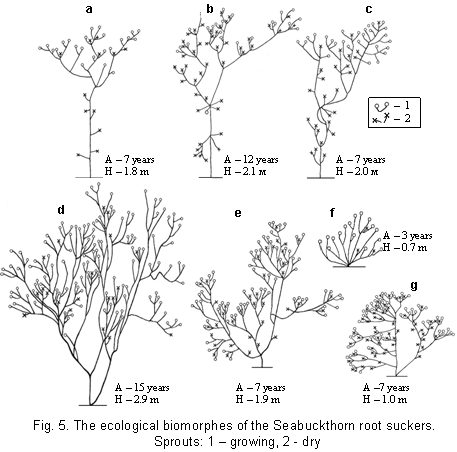 A Seabuckthorn small tree grows in the dense clumps and thickets. The following varieties are typical for this type:
- with a compact flat crown and small number of dry shoots in the crown (Fig. 5, a) – root suckers 7-11 years of age in the dense clumps and thickets (a well drained area in valley);
- with one-sided elongated crown and lots dry shoots in the crown (Fig. 5, b) – root suckers 12-15 years of age are under the young tree canopies (middle part of the slope);
- with compact crown and lots of dry shoots on trunks and frequent changes of the peaks (Fig. 5, c) – root suckers not older than 10 years of age in the thickets (middle and upper part of the slope);
- tree-like shrub (Fig. 5, d) – maternal individuals 13-15 (18) years of age in the clumps and thickets (the slope upper part and valley).
Shrub-like type of the Seabuckthorn is typical for the loose clumps in the valley and on the mineralized areas, i. e. for pessimal environmental conditions. It is represented by the following species:
spreading bush with a complex system of shoots of the xero-mesomorphic shape (Fig. 5, e) 7-10 years of the age, formed on microelevations in the valley;
- compact bush with a complex system of shoots of xeromorphic shape (Fig. 5, g) 7-10 years of age; "maternal individuals" in the clumps of the lower slope part;
- much suppressed bushes with a simple spear system – constantly renewed root spears (not more 0.5 m height and 3 years of age) on the oversetting silted areas in the lowland and extra-dry areas of the slope(Fig. 5, f).
- bush with simple shoot system of the mesomorphic shape – root suckers or a young individual – ontobiomorpha of spreading bush with high vitality to 5 years of age.
CONCLUSIONS
he result analysis of the long-term experiment of the Seabuckthorn (Hippophae rhamnoides) naturalization has shown as follows
1. Occurrence of the Seabuckthorn on the south slope of the Przewalski Mountains has been caused by combination of some casual factors as it is:
– complete destruction of the soil-plant cover on the slope, resulting in absence any competitors on econiches;
– presence of the Seabuckthorn, seed source, on the former country house lands;
– similarity in the conditions of adaptation on the south slope Maritime province with the Seabuckthorn natural area;
– habitation of the bird, eating Seabuckthorn berries;
– intensive creeping-rooted multiplication of the species.
2. The spottiness structured-functional organization of the vegetation cover within the slope is caused by differing degree of the anthropogenic territory destroyed and by relief-forming activity of the typhoons.
3. The results of the investigations are the base for monitoring coenotic structure to find out the regularities in the formation of the forest communities on the south slopes in Maritime province, restored by the primary succession of adventive species Hippophae rhamnoides;
4. The differences in the environmental conditions within the slope have influenced on the biomorphs of the Seabuckthorn root sprays. Two types of biomorphs have been defined: small tree and shrub-like. The biomorphs of the first type have been formed under influence of the coenotic factors, biomorphs of the second type – under influence of the ecological factors.
5. Taking into consideration an important property of the Seabuckthorn to resist soil erosion, caused by its active vegetation development, and high adaptation to draught and frost, it would be recommended for the recultivation of the completely destructed landscapes in the south-west area of the Maritime province.
Статья опубликована:
Moskaliuk T. Naturalization of Hippophae rhamnoides L. on the Russian Far East (Maritime province) // SBT – a fresh look at technology, health and environment: Mat. of the 6th Conference of the International Seabuckthorn Association / Potsdam, Germany, 2013. Pg. 103-106).
[1] Samoilova, 1957: Ягодный сад в Приморье. – Владивосток: Прим. кн. изд-во, 1957. 276 с.
[2] Vytvitsky, 1969: Климат // Южная часть Дальнего Востока. – Москва: Наука, 1969. С. 70-96.
