


Партнерка на США и Канаду по недвижимости, выплаты в крипто
- 30% recurring commission
- Выплаты в USDT
- Вывод каждую неделю
- Комиссия до 5 лет за каждого referral
Внеклассное мероприятие по иностранному языку
для 7 «Б» класса на тему «Лимерик - поэтическое произведение»
Цель: познакомить учащихся с лимериком и научить отличать его от других стихотворений.
Задачи: продолжить формирование фонетических и лексических навыков, языковой догадки; обеспечить усвоение понятия «лимерик» и его структуры; развивать умение аудирования и чтения; прививать интерес к культуре Англии; воспитывать чувство взаимопомощи и внимания друг к другу. Формировать у учащихся умение сравнивать, преодолевать трудности, самостоятельно мыслить.
Оснащение: доска, карточки двух вариантов с tongue twisters для формирования команд, карточки с рифмующимися словами (2 экз.), стихи с пропущенным словом (2 экз.), картинки к лимерикам (6 шт.), «испорченный лимерик» (2 экз.), опорная схема лимерика для аудирования, жетоны (выдаются за правильный ответ), ножницы, скотч.
Форма проведения: соревнование между группами.
Список литературы: Кагилева – игра для седьмого класса по теме «Лимерик – поэтическое произведение»// ИЯШ. – 2006/8 – С. 42 - 45
Ход урока.
I. Организационный момент.
Т: Good morning dear friends. Today the theme of our lesson is the Limerick. What is a limerick? Do you know? Is it interesting for you to get to know about it? Today we shall have a limerick-competition and do different tasks in groups so that to learn about limericks. But first of all let's practice our phonetics.
II. Фонетическая зарядка (Т → Cl).
Soap and water
Son and daughter
Hot and cold
Young and old
Eat and drink
Pen and ink
Late and soon
Sun and moon
Black and white
Day and night
Fur and feather
Wind and weather
What a lot of words
Go about together!
T: Now let's make two e to this table, take a tongue twister under the letter a or b, practice it for one minute in your groups and say it all together.
(Учащиеся выбирают скороговорку а или b и занимают места за своими столами, согласно выбранным вариантам, тренируют скороговорку и произносят ее хором, представляя свою команду.)
a) Which is switch? Which switch is which? - 1-я команда
b) He was sad that day he said: I am awfully upset. - 2-я команда
III. Задание 1: подобрать рифмующиеся слова
Team 1 | Team 2 | ||
face | wax | clear | sea |
kiss | talk | call | son |
joy | pace | again | dear |
warm | this | rose | zoo |
clean | let | blue | rain |
get | toy | nine | salad |
live | storm | lane | tall |
sad | mean | run | nose |
tax | mad | tea | dine |
walk | give | ballad | main |
Задание 2: найти нужное рифмующее слово и правильно прочитать стихотворение.
My Teddy's fur is soft and brown
His legs are short and fat,
He walks with me all round the town
And wears a ... (nose. hat. tree).
My Teddy keeps me warm in bed
I like his furry toes,
I like his darling little head.
His pretty little... (go, no, nose).
F is for fish
Swimming in the sea
I wish for a goldfish
To come back to... (her, them. me).
Q is for Queen
Whom I've never seen
She is like a star
So high and ... (low, far, red).
Задание 3: прослушать рассказ учителя о лимерике и его структуре, описать лимерик по опорной схеме.
(Текст для аудирования)
What is a Limerick?
Edward Lear, 19th century
Edward Lear was a famous English poet. He made limericks popular in the 19th century. A limerick is a short funny poem. It has five lines. A limerick is not just a short poem. The form of a limerick is always the same. The first line rhymes with the second one. The third rhymes with the fourth one. The first and the second lines rhyme with the fifth line. Lines three and four are shorter than the other lines. A limerick usually begins with “There was a...” (текст читается два раза)
Scheme
Edward Lear
↓
Popular
↓
Funny
↓
Form
 1st line

 rhymes
2nd line
 3rd line rhymes
 rhymes
4th line
 5th line
Задание 4: прослушать два стихотворения и определить, какое из них является лимериком, а какое - нет (задание обеим командам).
I
There was a little girl, and she had a little curl
Just down the middle of her forehead;
When she was good, she was very, very good.
And when she was bad, she was horrid.
II
There was an old lady who said
When she found a thief under her bed,
"Get up from the floor:
You are too near the door.
You may catch a cold in your head."
(Второе стихотворение согласно строению является лимериком.)
Задание 5: рассказать о лимерике, используя опорную схему.
Задание 6: подобрать лимерики к картинкам.
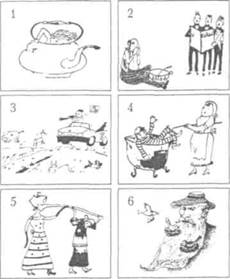
There was an old man with a beard,
Who said, "It is just as I feared! -
Two Owls and Hen,
Four Larks and a Wren.
Have all built their nests in my beard!"
There was an Old Person of Fife,
Who was greatly disgusted with life;
They sang him a ballad,
And fed him a salad,
Which cured that Old Person of Fife.
There was an Old Man of the North,
Who fell in a basin of broth;
But a quick-witted cook
Fished him out with a hook.
Which saved that Old Man of the North.
There was a Young Lady whose nose
Was so long that it reached to her toes;
So she hired an Old lady
Whose conduct was steady,
To carry that wonderful nose.
There once was a man from Harare,
Who bought a brand new Ferrari.
Now the buck and the gnu
And the elephant too
Hide away when he goes on safari.
There was an Old Man, who when little,
Fell casually into a kettle;
But growing too stout,
He could never get out,
So he passed all his life in that kettle.
Задание 7 «Испорченный лимерик». Составить из разрезанного по строчкам лимерика осмысленное стихотворение.
I
At breakfast he said:
Who spoke with a terrible stutter
There was a man of Calcutta
And b-b-b-butter!"
"Give me b-b-b - bread
Правильный вариант:
There was a man of Calcutta
Who spoke with terrible stutter
At breakfast he said,
"Give me b-b-b-bread
And b-b-b-butter!"
II
"I save gallons of ink
He said with a wink
By simply not dotting my i's"
There was a clever old miser who tries
Every method to e-co-no-mize
Правильный вариант:
There was a clever old miser who tries
Every method to e-co-no-mize.
He said with a wink,
"I save gallons of ink
By simply not dotting my i 's."
IV. Подведение итогов.
T: Boys and girls! Today you’ve got a lot of information about limericks. What did you know?
P1: Now I know that limerick is a short funny poem.
P2: That it was made by Edward Lear.
P3: That it usually begins with “There was a...”
T: Was it useful for you?
P: Yes, it was.
T: Everybody get excellent today. I wish you good luck. Good bye!
P: Good bye!
V. Домашнее задание:
а) выучить один из предложенных лимериков;
б) сделать литературный перевод любого лимерика.
Приложение
Подборка лимериков
There was a young lady of Niger,
Who smiled as she rode on a tiger.
They ended the ride
With the lady inside -
And the smile on the face of the tiger.
There was a young lady named Esther:
She lived in the County of Leicester.
She went for a walk,
Had a great talk,
And found she had gone right to Chester.
In the capital town of Peru,
Everyone walked two by two.
They all asked each other,
Are you my brother?"
And it ended with "How do you do?"
There was an Old Person of Wick,
Who said, "Tick-a-tick, Tick-a-tick,
Chickadee, Chickadee,"
And he said nothing more,
That laconic Old Person of Wick.
There was an Old Man from Eire,
Who stuck his feet in the fire,
Although he got burnt,
He never learnt
It was quite the wrong way to get drier!
There was an Old Person of Deal,
Who, in walking, used only his heel;
When they said, "Tell us why?"
He made no reply,
That mysterious Old Person of Deal.
There was an Old Lady of France.
Who taught little ducklings to dance:
When she said, "Tick-a-tack!"
They only said, "Quack!"
Which grieved that Old Lady of France.
There was a young fellow in Pealing
Devoid of all delicate feelings.
When he read on the door,
"Don't spit on the floor,"
He immediately spat on the ceiling.
There was an Old Man of Peru,
Who dreamt he was eating his shoe:
He woke in a fright
And he turned on the light,
And found it was perfectly true!
