

Партнерка на США и Канаду по недвижимости, выплаты в крипто
- 30% recurring commission
- Выплаты в USDT
- Вывод каждую неделю
- Комиссия до 5 лет за каждого referral
ISSN 1993-3916 | |||||
Том | 16 | Номер | 5 (45) | Спецвыпуск | 2010 |
Volume | Number | Special issue |
РОССИЙСКАЯ АКАДЕМИЯ НАУК
RUSSIAN ACADEMY OF SCIENCES
АРИДНЫЕ ЭКОСИСТЕМЫ ARID ECOSYSTEMS
Журнал освещает фундаментальные исследования и результаты прикладных работ по проблемам аридных экосистем и борьбы с антропогенным опустыниванием в региональном и глобальном масштабах. Издается с 1995 года по решению Бюро Отделения общей биологии Российской академии наук.
The journal is published by the decision Department of Biological Sciences of Russian Academy of Sciences (RAS). The results of fundamental and applied investigations on the problems of arid ecosystems and on struggle against anthropogenic desertification are published on its pages. Principles of system study of arid territories and the dynamics of their biology potential changes in global and regional aspects are put into basis.
МОСКВА: Товарищество научных изданий КМК
MOSCOW: KMK Scientific Press Ltd.

2010
RUSSIAN ACADEMY OF SCIENCES
DEPARTMENT OF BIOLOGICAL SCIENCES
DAGHESTAN SCIENTIFIC CENTER
PRICASPIYSKIY INSTITUTE OF BIOLOGICAL RESOURCES
Water problems institute
Section ”Problems of arid ecosystems and combat against desertification”
Scientific council "Problems of ecology and biological systems"
ARID ECOSYSTEMS
Vol. 16, No. 5 (45), 2010, special issue
Journal is founded in January 1995
Issued 4 times per year
Editor - in - chief Prof., Dr. biol. Z. G. Zalibekov**
Deputy editor Prof., Dr. geogr. N. M. Novikova*
Editorial Board:
B. D. Abaturov, S.-W. Breckle (Germany), M. G. Glants (USA), P. D. Gunin, Zhigang Jiang (China), L. A. Dimeeva (Kazakhstan), I. S. Zonn, R. V. Kamelin, Zh. V. Kuz’mina, G. S. Kust, E. Lioubimtseva (USA), V. M. Neronov, L. Orlovsky (Israel), U. Safriel (Israel), I. V. Springuel (Egypt), A. A. Tishkov, A. A. Chibilev, P. Shafroth (USA), Z. Sh. Shamsutdinov,
T. V. Dikariova (executive secretary)
Responsibilities for issue:
N. M. Novikova*, Zh. V. Kuz’mina*
Editorial council:
R. G. Magomedov** (vice-editor-in-chief on organizational questions),
P. M.-S. Muratchaeva**, M. B. Shadrina*,
M. Z. Zalibekova**
Addresses of Editorial Offices:
*Russia, 119333 Moscow, Gubkina str., 3, WPI RAS
Tel.: (499) 135-70-41. Fax: (499) 135-54-15
E-mail: *****@***laser. ru
**Russia, 367025 Makhachkala, Gadjieva str., 45, PIBR DSC RAS
Tel./Fax: (872-2) 67-60-66
E-mail: *****@***ru
MOSCOW: KMK Scientific Press Ltd.
2010
© Журнал основан в 1995 г.
Издается при финансовой поддержке
Прикаспийского института биологических ресурсов
Дагестанского научного центра Российской академии наук,
Института водных проблем Российской академии наук,
Регионального благотворительного фонда им. А. M. Солтанмута,
и содействии региональных отделений секции
"Проблемы изучения аридных экосистем и борьбы с опустыниванием"
Научного совета "Проблемы экологии биологических систем"
отделения биологических наук Российской академии наук
© The journal has been founded in 1995.
It is published under financial support of
Pricaspian Institute of Biological Resources
Dagestan Scientific Center of Russian Academy of Sciences,
Water Problems Institute of Russian Academy of Sciences,
A. M. Soultanmut Regional Charitable Foundation,
with assistance of regional departments of the section:
"Problems of Arid Ecosystems and Desertification Control",
Scientific Council "Problems of Biosystems Ecology"
Department of General Biology of Russian Academy of Sciences
Журнал включен в список Реферируемых журналов и
Базы данных ВИНИТИ, входит в Перечень изданий, рекомендованных ВАК. Сведения о журнале ежегодно публикуются в международной справочной системе
по периодическим и продолжающимся изданиям
«Ulrich’s Periodicals Directory»
The journal is included in the list of reviewed journals,
database of VINITI and in the list editions, recommended
by Higher Attestation Commission.
Information about the journal is annually published in the International inquiry system of the
«Ulrich’s Periodicals Directory»
Исполняется 60 лет со дня организации Джаныбекского стационара
Института лесоведения РАН
Постановлением Правительства РФ № 000 от 16 июня 1997 г.
стационар признан особо охраняемой природной территорией со статусом «Памятник природы федерального значения»
В настоящем номере представлены результаты работ, отображающие комплексность исследований,
проводимых на Джаныбекском стационаре
It turns 60 years since foundation
of dzhanybek research station at the Institute of Forest Science of Russian Academy of Sciences
By the Government Regulation of Russian Federation
№ 000 from June 16, 1997
the Dzhanybek station is recognized to be the protected area with status
“Nature monument of federal significance”
In this issue the results of works which reflect the complexity of researches made on the Dzhanybek station are presented
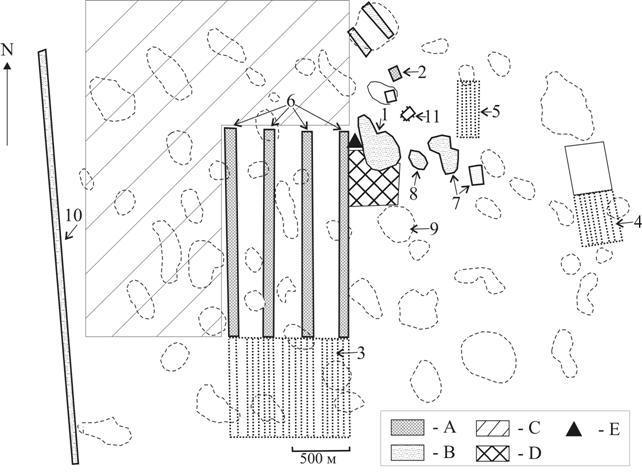
Схема расположения научных объектов
на территории Джаныбекского стационара
Location scheme of scientific objects
on the territory of Dzhanybek research station
A – лесные насаждения на почвах солонцового комплекса /
forest plantations on the soils of solonetz complex;
B – лесные насаждения на лугово-каштановых почвах больших падин /
forest plantations on meadow-chestnut soils of vast depressions;
С – залежные участки / fallow lands;
D – заповедный участок целины / reserved area of virgin land;
E – место расположения усадьбы стационара / station office location.
Дендрарий / Arboretum: 1 – на падине / in the depression; 2 – на почвах солонцового комплекса / on the soils of solonetz complex.
Агролесомелиоративные (АГЛС) системы разной ширины /
Agroforestry systems (AGFS) with various width:
3 – 1100 м, 4 – 400 м, 5 – 200 м;
6 – отрезок Государственной лесной полосы (ГЛП) «Чапаевск-Владимировка», состоящий из четырех полос (счет с запада), шириной 60 м / segment of State forest belt (SFB) «Chapaevsk-Vladimirovka», consisting of four belts (from west to east). 60 m wide;
7 – лесные массивы / forest massifs; 8 – сад / garden; 9 – целинные падины / virgin-soil depressions; 10 – магистральный канал / backbone; 11 – пруд / pond.
CONTENTS
═════════════════════════════════════════════════════════════════════════
Vol 16, Number 5 (45), 2010 special issue
═════════════════════════════════════════════════════════════════════════
Ecological investigations and some lessons of semi-desert development in Northern Pricaspian lowland
S. E. Vompersky 7-14
The modern condition of ecosystems and strategy of adaptive nature management in Northern Pricaspian semi-desert
M. L. Sizemskaya, M. K. Sapanov 15-24
Influence of climate change on the water resources of Northern Pricaspian lowland
М.К. Sapanov 25-30
Microdepressions microrelief of Caspian lowland and mechanisms of its formation
B. D. Abaturov 31-45
Automated analysis of the geographic distribution of chernozem-like dark-colored soils in the northern caspian lowland on the basis of space-borne imagery (the case study at the Dzhanybek research station)
M. V. Konyushkova, D. N. Kozlov 46-56
Profile morphology and some chemical characteristics of solonchakous solonetz soils of a fallow field in the Dzhanybek research station
M. L. Sizemskaya, M. K. Sapanov, A. V. Kolesnikov, I. I. Tolpeshta,
T. A. Sokolova, M. I. Akritskaya 7-66
Сhemical characteristics of meadow-chestnut soils of a fallow field in the Dzhanybek research station
A. V. Kolesnikov, T. A. Sokolova 67-78
Effect of silviculture amelioration on Potassium status in meadow-chestnut soils in clayey semi-desert
N. Yu. Kulakova, T. A. Sokolova 79-89
The significance of arboreal vegetation for vertebrates of the clayey semi-desert of Trans-Volga region
A. V. Bykov 90-97
Changes of solonetz complex plant cover under different stocking pressure at Djanybek scientific station and ajacent territories
N. M. Novikova, A. A. Vyshivkin, M. B. Shadrina, O. A. Buhareva 98-110
Daily activity of saiga and sheep in semi-desert pastures on Northern Caspian lowland
K. O. Larionov, O. A. Nikonova, B. D. Abaturov 111-120
To the fauna of terrestrial lacebugs (Insecta, Heteroptera) of the Dzhanybek station and contiguous territory
T. R. Khrynova, N. V. Smirnova, M. A. Khrisanova 121-128
Data on Cicadina-fauna (HOMOPTERA) at the Dzhanybek scientific station and adjacent territories
G.A. Anufriev 129-140
A supplement to the fauna of weevils (Сoleoptera, Сurculionoidea) of the lake Elton and adjacent territories
M. A. Khrisanova 141-150
abstracts
ECOLOGICAL INVESTIGATIONS AND SOME LESSONS OF SEMI-DESERT DEVELOPMENT IN NORTHERN PRICASPIAN LOWLAND
© 2010. S. E. Vompersky
Institute of Forest Science of Russian Academy of Sciences
Russia, 143030 Moscow area, Odintsovskii distr., Uspenskoe, Sovetskaja str., 21.
E-mail: *****@***ras. ru
Abstract. In article the main scientific and applied results 60-year-long biogeocenological researches in clay semi-desert Northern Pricaspian Lowland, executed on the basis of the Dzhanybek research station of Institute of Forest Science of the Russian Academy of Sciences are stressed. Efficiency of the biogeocenological approach in ecosystem researches is considered. It is noticed, that the substantiation of rational (more intensive) methods of use of semi-desert on the ecosystem level demands long researches and monitoring. The ways of development, successful in first two-three decades, need later corrections.
Key words: clay semi-desert, massive and field-protective forestation, biogeocenosis, stationary researches.
THE MODERN CONDITION OF ECOSYSTEMS AND STRATEGY OF ADAPTIVE NATURE MANAGEMENT IN NORTHERN PRICASPIAN SEMI-DESERT
© 2010. M. L. Sizemskaya, M. K. Sapanov
Institute of Forest Science of Russian Academy of Sciences
Russia, 143030 Moscow area, Odintsovskii distr., Uspenskoe, Sovetskaja str., 21. E-mail: *****@***ru
Abstract. Dynamics of weather conditions in the territory of Northern Pricaspian since 1951 till 2008 have been studied and development mechanisms of nature ecosystems during 50-year period have been revealed. Three parts of this process, in which there were appreciable changes of environment of region, have been shown. The general trend of natural and climatic conditions over last decades of the XX-th centuries can be described as a mesofitization stage of modern evolution of semi-desert landscapes. The basis of rational adaptive nature management, considering the features of modern soil-hydrological conditions and the need to improve the quality of environment, is developed. The results of 60-year successful scientific experience (desertification and degradation of soils control by methods of agroforest melioration) at the Dzhanybek Research Station of Institute of Forest Science RAS can be recommended for usage in practice in other regions.
Key words: semidesert, adaptive nature management, arid regions, Dzhanybek Research Station.
INFLUENCE OF CLIMATE CHANGE ON THE WATER RESOURCES
OF NORTHERN PRICASPIAN LOWLAND
© 2010. М.К. Sapanov
Institute of Forest Science of Russian Academy of Sciences
Russia, 143030 Moscow area, Odintsovskii distr., Uspenskoe, Sovetskaja str., 21. E-mail: *****@***ras. ru
Abstract. In Northern Pricaspian lowland since the middle of 1990-th there have been a gradual reduction of quantity of water in natural lakes and artificial reservoirs, created near rivers. The majority of them, especially not deep, is completely dried up or became shallow at the moment.
It happens due to lack of additional moisture, which is necessary for self-controlling of water level in reservoirs and soils. Self-controlling can be performed by equilibration of evaporation from water surface and evapotranspiration of natural ecosystems. Without self-controlling, evapotranspiration exceeds the precipitation. The surface run-off used to occur periodically (once in 4-5 years). Snow melted very quickly, and the icy water-proof layer of earth provided the ch conditions have began to disappear due to warming of the cold season of the year since 1995-th.
We have revealed that there is the reduction of amount of water resources in Northern Pricaspian lowland since the middle of 1990-th, which has been caused by the termination of spring melted snow run-off of because of essential warming of autumn and winter months. The surface run-off used to occur periodically once in 4-5 years. Snow melted very quickly, and the icy water-proof layer of earth provided the run-off.
Key words: arid regions, drying of water objects, a surface run-off, winter warming.
microdepressions microrelief of Caspian lowland
And mechanisms of its formation
© 2010. B. D. Abaturov
A. N. Severtsov Institute of Ecology and Evolution of Russian Academy of Sciences
Russia, 119071 Moscow, Leninskyi prospect., 33. E-mail: *****@***ru
Abstract. Formation of specific microrelief of shallow depression in the northern part of Caspian lowland is a multistage complex process that was analyzed by A. A. Rode for the first time. The initial stage of the microdepression formation on the most part of Hvalynsky accumulative plain after its clearing of sea waters was the surface rising on 30-40 cm. It was connected with the sharp reduction of soil density as a result of accumulation of sulphates and their precipitation in a solid phase after dessication of soils. The necessary condition of this process was a long-term flooding of plain by the Caspian Sea during the Hvalynsky transgression and the replacement of chloride salinization on the sulphatic one and the subsequent separation of ground waters from soil after sea deviation. As a result of soil density decrease and accumulation of salts, the soil has got sagging properties. The formation of water-proof solonetz horizon in the topsoil interfered with uniform humidifying of soils by waters of an atmospheric precipitation. The key role in this situation has played ground squirrels which are the constant component of environment. These animals formed annually the special holes-vesnjanki. They functioned as vertical drains, opened access of atmospheric waters to deep soil horizons and provided humidifying of the loosened and salted soil. These processes have led to soil consolidation and falling with the subsequent formation of microdepression. Thus, the spotty character of Caspian plain was caused by local type of formation of microdepression. The size of microdepression and its area depended on intensity of humidifying by the surface water. Reduction of the catchment area as a result of microdepression expansion has led to the attenuation of this process and formation of shallow depression only.
Key words: soilformation, readily soluble salts, microrisings, total porosity, microdepression, ground water, saline soil, solonetz, holes of mammals, soil density.
automated analysis of the geographic distribution
of chernozem-like dark-colored soils in the northern caspian lowland on the basis of space-borne imagery
(the case study at the dzhanybek research station)
© 2010. M. V. Konyushkova*, D. N. Kozlov**
*V. V. Dokuchaev Soil Science Institute of Russian Academy of Agricultural Sciences (RAAS)
Russia, 119017 Moscow, Pyzhevky per. 7. Е-mail: *****@***ru
** Moscow State M. V. Lomonosov University, Faculty of Geography
Russia, 119991 Moscow, Vorobievy Gory, MSU. E-mail: *****@***com
Abstract. Chernozem-like dark-colored soils, which occupy shallow micro - and mesodepressions in the north of the Caspian Lowland, are automatically interpreted with a good accuracy on all distinguished types of human-affected lands (excluding wooded areas of agroforest amelioration systems). These soils have higher NDVI values comparing with other soils of the solonetzic complex. On the basis of automated interpretation of the Quickbird image (2.44 m resolution), a map of distribution of chernozem-like soils in the area of the Dzhanybek research station (at the total area of 50.6 km2) was created. The fragment of this map is included in this paper. The accuracy of the map is 77%. In the moving window with the size of 15 x 15 pixels, the amount of pixels classified as chernozem-like soils was calculated. These data were transformed into the map of the portion of chernozem-like soils in the soil complex showing the irregular distribution of these soils within the study area. The full variant of this map is given in the paper. In the area of the Dzhanybek research station, the soil associations with the portion of chernozem-like soils of 0-25% predominate.
Key words: image analysis, soil map, soil survey, supervised classification.
Profile Morphology and some chemical characteristics
of solonchakous solonetz soils of a fallow field
in the Dzhanybek Research Station
© 2010. M. L. Sizemskaya, M. K. Sapanov, A. V. Kolesnikov,
I. I. Tolpeshta, T. A. Sokolova, M. I. Akritskaya
*Institute of Forest Science of Russian Academy of Sciences
Russia, 143030 Moscow area, Odintsovskii distr., Uspenskoe, Sovetskaja str., 21. E-mail: *****@***ras. ru
** Moscow State M. V. Lomonosov University, Soils Science faculty
Russia, 119991 Moscow, Vorobievy Gory, MSU, bl. 1. E-mail: *****@***ru
Abstract. Some morphological properties and the content and profile distribution of CaCO3 and those of soluble salts have been examined in three profiles of solonchakous solonetz (alkaline) soils of a fallow field in the Dzhanybek Research Station. The data obtained have been compared with the respective results related to virgin solonetz soils and solonetz soils reclaimed in the agricultural afforestation system. As contrast to virgin soils solonetz soils of the fallow field are notable for the reliably lower stores of soluble salts, Cl-, SO42- and Na+ in the top 50cm layer and by the reliably lower stores of Cl - in the upper 3 m layer. These favorable changes are thought to be the results of the trenching plowing which brought about the involving of gypsum from the lower horizons into the plough-layer and provided the formation of furrows promoting the snow accumulation in winter.
Key words: pristine plot, reclaimed plot, fallow field, solonetz, soil profile, content of salts.
Сhemical Сharacteristics of Meadow-Chestnut Soils of a Fallow Field in the Dzhanybek Research Station
© 2010. A. V. Kolesnikov*, T. A. Sokolova**
*Institute of Forest Science of Russian Academy of Sciences
Russia, 143030 Moscow area, Odintsovskii distr., Uspenskoe, Sovetskaja str., 21. E-mail: *****@***ras. ru
**Moscow State M. V. Lomonosov University, Soils Science faculty
Russia, 119991 Moscow, Vorobievy Gory, MSU, bl. 1. E-mail: *****@***ru
Abstract. Soluble salts content, exchangeable cations, pH values, Na+ and Ca2+ activity and the selectivity coefficients for the Ca2+↔Na+ exchange have been measured in samples taken by genetic horizons from three meadow-chestnut soil profiles of a fallow field in the Dzhanybek Experimental Station. On this field the trenching plowing was conducted in the early 1950s and various crops were grown till 1970s. Later on the field was abandoned. Ground water mineralization and their ion composition were examined. The data obtained was compared with respective characteristics of meadow-chestnut soils and ground water of pristine area and with those of meadow-chestnut soils reclaimed in the agricultural afforestation system.
The groundwater occurring on the studied area at the depth about 5m was found to be reliably less mineralized than that on reclaimed and pristine areas. This difference can be attributed to the lateral inflow of highly mineralized water to meadow-chestnut soils of the reclaimed plot caused by intensive uptake of water by shelterbelts. The pristine area studied can also be subject to the influence of mineralized groundwater.
The profiles studied are not affected by salinization, the sum of soluble salts in water extract does not exceed 0.1%. The concentrations of Cl-, SO42-, Ca2+ and Mg2+ albeit being low are reliably higher than in soils of pristine and reclaimed plots. It can be explained by the involvement of small amounts of soluble salts from the adjacent solonchakous solonetz soils in the course of the trenching plowing.
According to the small concentrations of soluble salts the activity of Na+ and Ca2+ are also low. Some decrease in Ca2+ activity in soils of a fallow field as compared with soils of pristine and reclaimed plots can be attributed to the slightly higher concentrations of SO42-, forming ion pairs with Ca2+.
As of the composition of exchangeable cations the soils of the fallow field are notable for the predominance of Ca+ and Mg2+. The percentage of exchangeable Na2+ albeit being small is reliably higher than in soils of pristine and reclaimed areas owing to the involvement of small amount of sodium sulfate from the adjacent salt-affected soils in the course of the trenching plowing.
The selectivity coefficients values for the binary Ca2+↔Na+ exchange calculated after Gapon, Wanselow and Nikolsky equations testifies to the high selectivity of soils studied to Na + mainly due the low percentage of exchangeable Na+. The KS Ca2+↔Na+ values were higher in soils of the fallow field than in those on pristine and reclaimed plots.
Key words: cation exchange, meadow-chestnut soils, Dzhanybek Research Station.
EFFECT OF SILVICULTURE AMELIORATION ON POTASSIUM STATUS IN MEADOW-CHESTNUT SOILS IN CLAYEY SEMI-DESERT
© 2010. N. Yu. Kulakova*, T. A. Sokolova**
*Institute of Forest Science of Russian Academy of sciences
Russia, 143030 Moscow area, Odintsovskii dist., Uspenskoe, Sovetskaja str., 21. E-mail: *****@***ru
**Moscow state M. V. Lomonosov university, Soils science faculty, Department of soils chemistry
Russia,119991 Moscow, Vorobievy Gory, MSU, block 1, build. 12, GSP-1. E-mail: *****@***ru
Abstract. The specific system of agrosilviculture has been developed for soils of solonetz complex on the Dzhanybek Research Station (Institute of Forest Science RAS). The system is thought to be an environmentally safe alternative to land irrigation system. This study was aimed at the estimation of the effect of silviculture amelioration on the reserves of various potassium compounds in meadow-chestnut soils which are the most fertile soils of the solonetz complex.
It was found that the reserves of exchangeable and readily-exchangeable potassium in ploughed layer (0-40 cm) of meadow-chestnut soils in agrosilviculture system were 1.5-4 times lower than those in the virgin soils. The changes in thermodynamic parameters of potassium status (the decrease in values of ΔК0 and AR0 and the increase in PBCk values) indicated lower potassium supply of reclaimed meadow-chestnut soils. However according to the gradation system accepted ameliorated soils were attributed to well-supplied with potassium as well as soils under virgin vegetation. The agrosilviculture did not influence the reserves of non-exchangeable potassium in soils studied.
Key words: silviculture amelioration, meadow-chestnut soils, potassium, thermodynamic parameters of potassium status
The significance of arboreal vegetation for vertebrates of the clayey semi-desert of Trans-Volga region
© 2010. A. V. Bykov
Institute of Forest Science of Russian Academy of Sciences
Russia, 143030 Moscow area, Odintsovskii distr., Uspenskoe, Sovetskaja str., 21. E-mail: *****@***ras. ru
Abstract. The present-day complex of dendrophilous vertebrates in the clayey semi-desert of Trans-Volga region is a highly reduced variant of the population being inhabited the former ravine forests. Artificial afforestation compensates to some degree the destruction of those forests promoting the spreading of dendrophilous species and the regeneration of almost lost population. The restoration of natural arboreal vegetation lost as a result of the land development is an obligatory factor for the preservation of biodiversity and faunistic richness of the region.
Key words: clayey semi-desert of Trans-Volga Region, artificial afforestation, arboreal vegetation, land development, nomadic migrations, fauna, population.
CHANGES OF SOLONETZ COMPLEX PLANT COVER UNDER DIFFERENT STOCKING PRESSURE AT DJANYBEK SCIENTIFIC STATION AND AJACENT TERRITORIES
© 2010. N. M. Novikova*, A. A. Vyshivkin*, M. B. Shadrina*, O. A. Buhareva**
* Water problems Institute of Russian Academy of Sciences
Russia, 119333 Moscow, Gubkina str. 3 Е-mail: *****@***com
** Institute of Forest Science of Russian Academy of Sciences
Russia, 143030 Moscow area, Odintsovskii distr., Uspenskoe, Sovetskaja str., 21.
Abstract. Transect and key sites methods were used for investigation of solonetz complex vegetation changes under different impact of cattle herd (cows, ships and goats). The groups of plant species differently responding to stocking pressure are revealed: avoiding, preferring, indifferent. Along a gradient of strengthening of cattle grazing decrease of plants height, numbers of species and projective cover within communities is determined. The optimum condition for vegetation is marked within the area of low grazing.
Key words: plant communities, transect, effect of grazing, the general (common) projective cover, amount of species, height of plants, productivity, stability to grazing, preservation.
Daily activity OF Saiga and Sheep in semi-desert pastures
ON northern Caspian lowland
© 2010. K. O. Larionov, O. A. Nikonova, B. D. Abaturov
A. N. Severtsov Institute of Ecology and Evolution of Russian Academy of Sciences
Russia, 119071 Moscow, Leninskyi prospect, 33. E-mail: kirill. *****@***ru
Abstract. Saiga and sheep on pastures are characterized by round-the-clock activity. Depending on environmental conditions in the stage of active grazing saiga spend usually from 27 to 50% of daily time, sheep – 22-37% of daily time. The durations of rest of saiga (lying) and sheep (lying or standing) are close for both species and is changing from 44 to 61%. The walk takes for both species 1.5-22% of grazing time. Day and night duration of grazing depends on ambient temperature. The duration of saiga grazing during daytime decreases with increasing temperature to 40 °C, while the night-grazing amounts to 17% of the total daily grazing time. Under optimum conditions the night grazing usually takes not more than 6% of total grazing time. For all correlations of the length of day and night grazing, total length of daily grazing remains constant. Round-the-clock duration of grazing changes during the seasons of the year and depends on the abundance and availability of food. The longest grazing time of sheep and saiga is during spring and autumn, with low avvailability of food. The shortest – in the early summer, with plenty of food on pastures.
Key words: saiga, sheep, budget of the time, round-the-clock duration of grazing, high temperature of air, optimum conditions.
To the fauna of terrestrial lacebugs (Insecta, Heteroptera) of the Dzhanybek Station and contiguous territory
© 2010. T. R. Khrynova*, N. V. Smirnova**, M. A. Khrisanova***
* Nizhni Novgorod State N. I. Lobachevskiy University
Russia, 603062 Nizhni Novgorod, Botanical garden, 1, 15. E-mail: *****@***ru
** Branch of the Russian State University
Russia, 428027 Cheboksary, Khusangaya str., 20. E-mail: nadyas05@mail.ru
*** Chuvash State I. N. Ulianov University
Russia, 428015 Cheboksary, Moskovskiy pr., 15. E-mail: *****@***ru
Abstract. As a result of entomofaunistic investigations in the area of the Dzhanybek Station and contiguous territory (Volgograd Region) in 2006-2007 71 species from 16 families of Heteroptera insects were recorded. The zoogeographic and a short ecological characteristic of the species are given.
Key words: Insecta, Heteroptera, fauna, zoogeographic characteristic, ecological characteristic, Dzhanybek Station, Volgograd Region.
data on cicadINA-fauna (hOMOPTERA) at the Dzhanybek scientific station and adjacent territories
© 2010. G.A. Anufriev
State natural biosphere reserve «Kerzhenskiy»
Russia, 603001 Nizhni Novgorod, Rozhdestvenskaya str., 23, Office 6. E-mail: *****@***com
Abstract. During investigations of Cicadina-fauna (Homoptera) at the Dzhanybek scientific station and adjacent territories (Volgograd area) in 2006-2007 more than 40 species of 8 families were identified. Points of findings and brief characteristics of biotops are presented. The history of Cicadina-fauna investigations in Volgograd area is considered. For the first time the species Phaeida tesquorum Em is recorded for the fauna of Russia.
Key words: Cicadina, Dzhanybek scientific station, the lake El´ton, Volgograd area, Western Kazakhstan.
A supplement to the fauna of weevils (Сoleoptera, Сurculionoidea) of the lake Elton and adjacent territories
© 2010. M. A. Khrisanova
Chuvash State I. N. Ulianov University
Russia, 428015 Cheboksary, Moskovskiy pr., 15. E-mail: *****@***ru
Abstract. As a result of entomofaunistic investigations in the area of the lake Elton and adjacent territories (Volgograd Region) in 2006-2007 82 species from 6 families of Сurculionoidea insects were recorded.
Key words: Сoleoptera, Сurculionoidea, fauna, lake Elton, Volgograd Region.
