


Партнерка на США и Канаду по недвижимости, выплаты в крипто
- 30% recurring commission
- Выплаты в USDT
- Вывод каждую неделю
- Комиссия до 5 лет за каждого referral
,
учитель английского языка
МОУ «Черлакская муниципальная гимназия»
Конспект открытого урока в 8 классе по теме «Охрана окружающей среды»
Цель: организовать деятельность обучающихся по обобщению и систематизации полученных знаний по теме и использованию их в речевом общении.
Задачи:
· совершенствование практических навыков владения лексикой по теме;
· развитие навыков устной речи в монологической и диалогической формах, развитие навыков аудирования и поискового чтения;
· воспитание у обучающихся чувства патриотизма, любви и бережного отношения
к природе.
Тип урока: обобщение и систематизация знаний и способов деятельности.
Методы: словесный, наглядный, частично - поисковый.
Формы учебной деятельности: фронтальная, индивидуальная, парная, групповая.
Применяемая технология: технология проектного обучения; информационно-коммуникационные технологии, компетентностный подход по , личностно-ориентированное развивающее обучение ().
Оборудование:
· аудиомагнитофон
· электронная презентация по теме
· компьютер, видеопроектор, экран
· плакаты по охране природы
· запись музыки «Времена года»
· запись текста для аудирования
The plan of the lesson
1. The beginning of the lesson
T: Dear friends!
Today I want you to think and speak about the place of a man in nature. Why did the writer say “To protect the nature means to protect the Motherland”? Moreover: what must people do to protect our common home - our planet? How do people of different countries try to keep the environment clean? I want to believe you’ll manage to use all the information you know on the topic “Keep our environment clean” during our lesson.
So, what do you think we are going to do today?
( Students formulate the tasks of the lesson)
T: Yes, you are quite tight. Today we are going to speak about the protection of the environment in monologues and dialogues, we’ll do projects, listen to a text and do a test and some other tasks.
2. The phonetic drill (the words are on the screen of the presentation)(Приложение 1)
T: Let’s pronounce some words and phrases. Say after me, please!
to worry about scientists
environment protection
energy nature
waste health
the chemical industry radiation
the Earth to forecast
pollution earthquake
litter generations
ecologists disaster
3. Speaking
1) Warm-up
T: First, answer my questions!
1 What are people all over the world worried about?
2. What do newspapers and magazines write about?
3. What kinds of waste are very dangerous?
4. Where does much of this dangerous waste go?
5. What can you say about fish and forest trees?
6. What can you say about transport’s influence on our nature and the health of the
people?
7. What about radiation in our country?
8. What do you know about the Chernobyl ecological disaster?
9. What about earthquakes?
10. Is it possible to forecast the earthquakes?
11. The Earth is our home, isn’t it?
12. We must take care of it, mustn’t we?
13. What does it mean?
14. Who is the importance of this task pointed out by?
15. Each of us must do everything possible to keep the land, air and water clean, mustn’t we?
16. What do you know about ecological problems in Omsk Region?
· The population of Omsk Region is becoming less. Annually only nine kids are born and twelve men die from 1,000 people in Omsk Region.
· 72% of the children suffer from lung diseases.
· 33% of the people have got cancer diseases.
· Omsk plants throw five tons of waste into the air every year.
· Omsk plants and factories throw 100,000 tons of waste into the Irtysh River every year.
· The Irtysh is one of the dirtiest rivers in our country.
· Thirty hectares of young trees are cut out every year in Omsk Region. We know that Omsk was called a garden-city in 1970s, but now we can’t say that there are a lot of trees and flowers in the city.
· Since the 15th of April till the 5th of May the so called Ecology Days (days of defence from ecological danger) are held under the slogan “Ecology-Security-Life” in our region.
17. How do the students of our gymnasium help the Earth?
· The students of our gymnasium have planted a lot of trees in the yard and they are going to plant different flowers around the building
2) Discussing ecological problems in dialogues
T: Let’s discuss some environmental problems in pairs!
The problem of water pollution is being discussed by an American student and a Russian specialist from Omsk-I know that your city is situated on the Irtysh River. But I wonder if you have a problem of water pollution. How is this problem decided in your region?
-Omsk is one of the biggest industrial cities in Siberia. We have got a lot of factories. Some of them are old and have no modern filtering systems. Our task is to protect nature. So we must reconstruct old factories in order to use modern filtering technique.
-You are on the right way.
The Baikal problem is being discussed by an American student and a Russian Candidate of Biological Science.-Last year I visited the Baikal Lake. It is considered to be the oldest and the cleanest lake on our planet. Visitors can look down through the water 20 metres deep and count stones on the bottom. It is interesting to know what measures have been taken in your country to protect the Baikal.
- There have been a lot of discussions on the Baikal in our country. Some scientists said that the Baikal should be preserved completely. Others wanted to use the water for economic purposes. And in 1986 the government decided to make the Baikal into a natural and national park. It shows that our state takes great care of nature. We must leave our planet clean for our children.
-Quite agree with you.
A British schoolboy and a Russian schoolgirl are speaking about societies for protection of nature in their countries.-Have you got any societies for protection of nature in your country?
-Yes, we have got the Voluntary All-Russia Society for Nature Protection. It helps the government on ecological problems. And have you got such societies in Great Britain?
-We have got Greenpeace, Friends of the Earth, London Wildlife and others.
4. Searching the words

 Find the words about nature and ecology in these directions:
N | A | T | U | R | E | T | S | B | E | C | O | L | O | G | Y |
S | E | A | L | P | O | L | L | U | T | I | O | N | C | Y | W |
A | I | R | A | L | A | N | D | X | B | D | H | A | Z | U | I |
L | O | S | K | S | U | N | T | A | Y | Z | K | R | A | I | N |
W | A | T | E | R | W | X | B | S | K | Y | Q | Y | M | X | D |
T: The criteria of your marks are on the screen. Put down the marks to each other. Check up your work with the help of the screen.
nature sun “5”- 12 words
ecology rain “4”- 10-11 words
sea water “3”- 6-9 words
pollution sky “2”-1-5 words
air lake
land wind
ListeningT: And now you will listen to the text. Your task is to listen to it very attentively and try to understand everything. Then you’ll do the test.
The criteria are on the screen:
“5”- no mistakes
“4”-1 mistake
“3”- 2 mistakes
“2”- 3 mistakes
T: Listen to the tape, please!
Text: “A Dolphin Asks For Help”
A ship was fishing near the Kuril Islands when the men saw a dolphin in the water. It was swimming towards their ship. The dolphin’s movements were strange. When it was nearer the men could see that there was an open wound on the dolphin’s body. It tried to jump on the ship, but it couldn’t. The fishermen took the dolphin on the ship. The ship’s doctor said that this animal needed operation. During the operation, which lasted for an hour and a half, the men threw sea water over the dolphin.
When the doctor had finished the operation, the men let the dolphin go back into the water. There were a lot of dolphins near the ship and they greeted it and swam round it as if they wanted to help it and to protect it.
Then they all swam near the ship for a long time. This was the way they thanked the ship’s doctor and the fishermen for the help they had given to one of them.
Test
“A Dolphin Asks For Help”
1. The dolphin’s movements were …
a) strange;
b) usual;
c) quick.
2. The men could see that …
a) the dolphin was very tired;
b) the dolphin was catching fish;
c) there was an open wound on the dolphin’s body.
3. The dolphin tried …
a) to swim away from the ship;
b) to jump on the ship;
c) to catch a big fish.
4. The ship’s doctor said that the animal needed …
a) operation;
b) rest;
c) sleep.
5. After the operation the men …
a) wanted the dolphin to stay on the ship;
b) let the dolphin go back into the water;
c) gave the dolphin some food.
T: Check up your answers with the help of the screen (1a; 2c; 3b; 4a; 5b) and put down your marks.
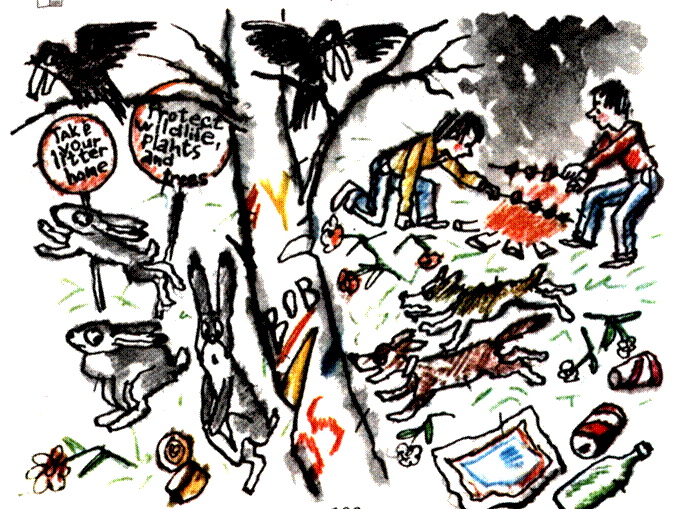
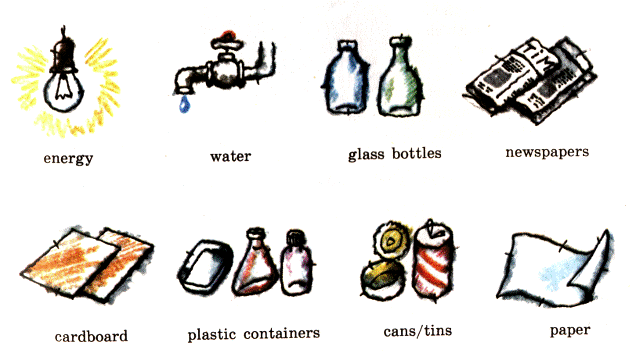
Project Work (Speaking)T: Look at the pictures on the screen, please![1]
(Students are looking at the pictures on the screen in the presentation.)
T: Children like to spend their free time in the country-side. Look at the first picture, please, and think over what happens when the children break the rules, then answer the following questions on the screen:
· What must we do?
· What mustn’t we do?
· What can we reduce?
· What can we reuse?
· What can we recycle?
Now you will work in groups and make two projects. The groups will present the rules on keeping our environment clean. The first group will start their rules with the words “We must”, the second group will present their rules starting with the words “We mustn’t”.
( Students are making their projects, then the representatives of the groups will explain the ideas of their projects to the class.)
Students of the first group: While looking at the first picture we can see that:
· Litter is left.
· Dogs are not kept under control.
· Flowers are pulled out.
· Animals are frightened.
· Trees are painted.
· Birds are caught.
· Animals are hurt.
· The air is polluted.
· Fires are started.
That’s why:
· We must keep the country tidy.
· We must respect the life and work of the country-side.
· We must keep the dogs under control.
· We must take litter home.
· We must water flowers and trees.
· We must grow flowers and trees.
· When we hike, we must leave the place clean.
Students of the second group speak:
· We mustn’t break trees.
· We mustn’t pick flowers in the forest or in the field.
· We mustn’t do any harm to our “lesser brothers”- animals.
· We mustn’t catch birds.
· We mustn’t throw waste paper and things into rivers, lakes or on the ground.
· We can reduce energy and water, we can reuse glass bottles and plastic containers, we can recycle newspapers, cardboard, cans and tins, paper, plastic containers and glass bottles.
SummarizingT: Now, let’s summarize everything we have just spoken about our environment.
( One of the students speaks on the topic before the class, then the other students work in pairs.)
Home taskWrite an essay about the ecological situation in Cherlak.
The end of the lessonT: Today we have revised the vocabulary and grammar patterns on the topic “Keeping Our Environment Clean ” and have discussed the importance of the ecological problems. Thank you very much for your active work at the lesson. It was great. Your marks are … . The lesson is over. Goodbye.
Приложение
 Picture № 1
Picture № 2
[1] Рисунки №1, №2 и частично задания к ним взяты из учебника «Счастливый английский» , книга 2, авторов , ,
