Партнерка на США и Канаду по недвижимости, выплаты в крипто
- 30% recurring commission
- Выплаты в USDT
- Вывод каждую неделю
- Комиссия до 5 лет за каждого referral
,
учитель английского языка
МБОУ Гимназия №2 г. Брянска
Из опыта работы по спецкурсу «Деловой английский язык»
Я преподаю «Деловой английский язык» более 10 лет и все эти годы структура курса совершенствовалась и претерпевала изменения.
В 1995-1996 году было трудно подобрать актуальное, оригинальное пособие, которое отвечало бы целям и задачам, которые мы перед собой ставили. Многие учебники по курсу «Деловой английский» дублировали разговорные темы из устной практики. Вот почему вначале за основу был взят учебник «Английский для международного сотрудничества» (авторы Бонк, Котий) и, вместе с ним, стали активно вводиться сопутствующие курсы, такие как «Деловое письмо», «Деловые диалоги». На основе этих материалов мои коллеги и я старались развить у учащихся навыки спонтанной речи, пополнить и расширить их словарный запас специальной лексикой, совершенствовать навыки диалогической речи, выводя их на полилог.
В 1997-1998 году наша гимназия приобрела ряд учебных пособий издательства “Longman”. Все эти годы мы с удовольствием работали по этим пособиям. Данный урок как раз является заключительным уроком по теме “Insurance” из учебника “We mean business”.
В 2005-2006 году мы перешли на новый УМК, который, как нам кажется, является современным, актуальным, отвечающим всем требованиям современного преподавания английского языка. Активное использование ресурсов I-net, мультимедийных средств обучения в сочетании с материалами УМК позволяют нам совершенствовать знания наших гимназистов в рамках одного из любимых спецкурсов «Деловой английский язык».
LESSON SCENARIO
by E. Kabanova (Bryansk)
TOPIC FOCUS: Insurance in the world of business and everyday life.
Objectives:
- to make students aware of some economic notions; to teach students work in a group; to develop study skills and social skills; to raise students’ interest in the world around them
Activity 1 Introduction into the lesson and goal - setting.
Teacher:
Good afternoon, students. I’m glad to see you at our lesson of Business English. Life is so tense and unpredictable that you can’t guess where you can get into trouble. Listen what happened with the Danilov’s.
Students: (Listen to the information)
The Danilovs have been saving money for the car for a long time. They were middle-class people. They never had expensive shop pings or travelled. The only thing they dreamed about was to buy a new car. and they did it. How beautiful it was. They left it in the yard and sat down at table to celebrate the event and when the guests came out to look at it – oh it was gone. They began to scream and cry. They were at loss what to do. “Why not go to militia or apply to the insurance company? “ advised their neighbours. “But we haven’t insured it yet” cried mother. “How careless you are! Don’t you know the world we are living in? Our life is so troublesome.” But it was late to argue.
Teacher:
Now what do you think our aim of the discussion is? Well, and can you offer activities we are going to be involved into. And we’ll see if yours coincide with mine. Let it be a sort of brainstorming.
Students:
- Insurance
- Practising active vocabulary developing speaking and listening skills Establishing links with economics and other social sciences Getting and exchanging new knowledge Learning to work in a group, cooperating
Teacher:
Yes, you practically hit the target. Let’s get down to business.
Activity 2 Vocabulary revision
Teacher:
First of all we need to revise what insurance is. Will you please give the definitions.
Students:
Insurance-(in law and economics) is a form of risk management primarily used to hedge against the risk of potential financial loss.
Teacher:
That’s right. But I’ve got one more. Will you please read it and say how you understand it using the knowledge of the previous one.
Insurance - is the equitable transfer of risk of a potential loss from one entity to another in exchange for premium and duty of care.
Teacher:
- Thanks a lot. Will you translate some terms. Now it’s high time we drilled our basic vocabulary. Repeat after me.
Students:
Students repeat the words after the teacher
Teacher:
- Well and now you can check if you remember the words properly.
Now I want to complicate the task. You are welcome to define the expressions and make up sentences with them.
Students:
- The students play a game “You give me, I give you” and make phrases with them.
(two students get an individual test: matching the words)
Teacher:
We shall work in groups now. Your task is to ask your mates the words and they will translate them and make phrases with them. We continue working in groups.
Students:
Students are defining the words and making sentences with them.
Teacher:
To put a full stop to our vocabulary work let’s check your writing skills. Listen to the clues and fill in the puzzle.
Students: ( listening to the recording and filling in the puzzle)
The script:
Use these clues to fill in the puzzle.
M: What's number one?
F: It's the people who put out fires. You know. . .
M: Oh yes. And number two?
F: Number two. Oh, it means something to do with the sea. It's a sort of insurance when you're insuring ships.
M: Uh-huh. And number three?
F: Those are the people who arrange insurance for other people.
M: Number four?
F: This word means a hundred years.
M: A hundred years. Oh, I know.
F: Number five means buildings or things you own.
M: Buildings or things you own. Mmmm. What about number six?
F: That means buying and selling. When you buy or sell things, you?
M: Oh yes. Seven?
F: These are the people who actually sell insurance. They promise to pay you if something goes wrong.
m: Uh-huh. Number eight?
F: This word means insurance. It's another word for protection or insurance.
M: Right. And the last one?
F: This is the money you pay for insurance.
M: Oh. Don't forget the hidden word.
F: Oh I think you know what that is now.
Teacher:
-Now do self-control. How many mistakes did you make? Well, I see that you can pronounce the words, write them let’s see if you can use them in the context properly.
Students:
The students are filling in the missing words in the text with the gaps.
Activity3 From the history of insurance
Teacher:
- To speak about the types and forms of the modern insurance I think it’s quite reasonable to come back to the history of insurance.
Students:
(Listen to the information and do the tasks)
The script:
KJ: Welcome to 'Introduction to Business'. On today's programme we have David Constable, who is going to talk about insurance. David, when did insurance first start?
DC: The history of insurance in Britain is a long one. In the early days there was a lot of marine trade between Britain and India and America. So at that time, in the 16th century, people were insuring their cargo ships.
KJ: So the first kind of insurance was marine insurance?
DC: Yes. Then in 1666 there was the Great Fire of London. Before then there were no fire brigades but after the Great Fire insurance companies employed their own fire brigades to protect the buildings they insured
KJ: How did people take out insurance?
DC: Well, the people who sell insurance are called underwriters, because they write their names under their promise to pay. In the 18th century, customers and underwriters used to arrange insurance in a coffee house which belonged to a man called Lloyd. Today Lloyd's is the name of a famous insurance market in London.
KJ: So if I want to insure a ship today, I must go to Lloyd's?
DC: No. You go to an insurance broker. The broker then goes to Lloyd's and arranges insurance for you with the underwriters who will give you the cheapest price.
Teacher:
Using I-net resources two of your friends prepared a report on the topic “The history of insurance”. Girls, you are welcome. All the rest are working too making at least 2 or 3 questions on the report.
Students:
Two students are presenting their report and answer the questions.
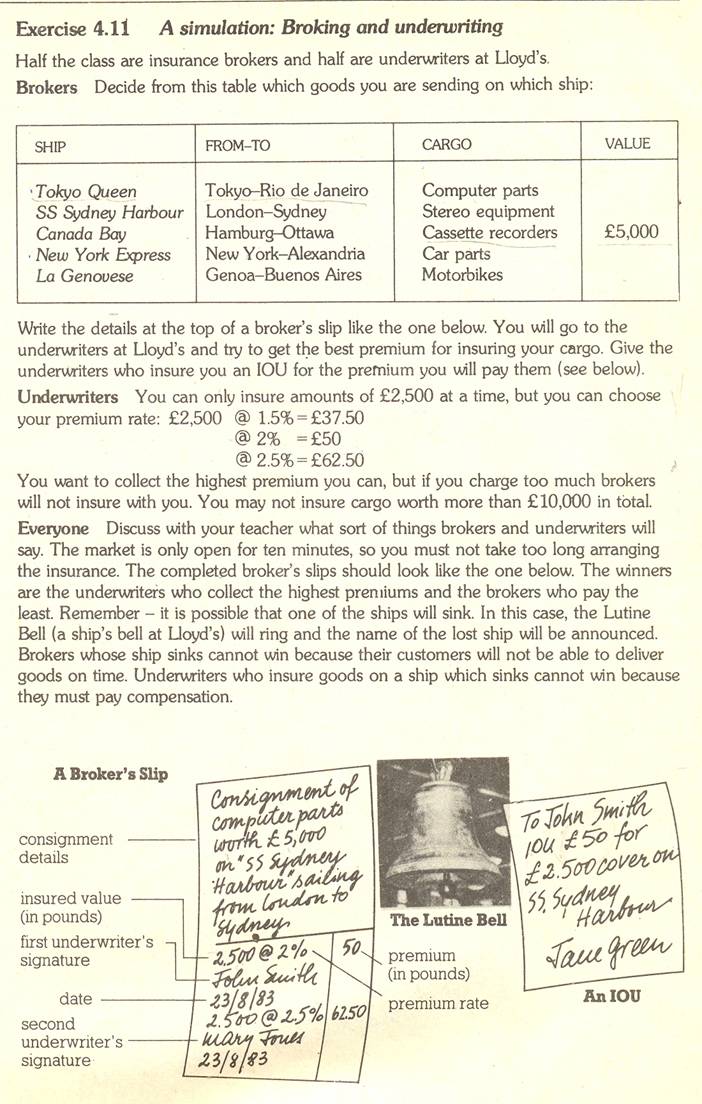
Activity4 Role-playing
Teacher:
Now its time for using our knowledge in practice. We are going to play brokers and underwriters.
Listen to the rules attentively, think of the activities you’ll do.
Students:
The students are role-playing following the rules and instructions.
Activity5 Developing speaking skills
Teacher:
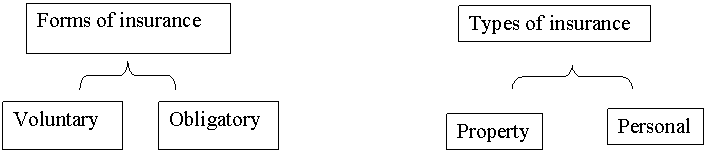
What forms and types of the insurance do you know? Speak on the chart.
Students:
The students speak on the insurance using the chart
Activity 6 Problem - solving
Teacher:
We are working in groups again. Discuss the problems in groups and answer the question below.
Problems suggested:
Igor Alexeevich wanted to insure his property against any damage. He was given an insurance certificate where at the back the rules of insurance were stated. According to these rules he was to apply to the company within 5 days.
On 5 th March his property was destroyed by the fire. He informed the agency only on 10 th of March. The agency refused in the claim for his compensation. “I didn’t read the rules attentively. I didn’t have the insurance certificate with me, that’s why I wasn’t able to see the terms correctly.”
What do you think: will the insurance company pay the compensation or not?
2. Somov insured his country house for 100 000 rubles. They discussed the amount of the insurance premium. It was 1 500 rubles per month and it was stated in the insurance agreement. But in 5 days the insurance company announced another sum of money three times bigger than the previous one saying that was because of dollar - rate changing.
What do you think : is this demand of the insurance company legal?
Students:
The students are solving the problems
Teacher:
And now your home task. Study your or your parents’ medical insurance certificate and find the following information
Take your medical insurance certificate and figure out:
The terms of the agreement The subject of the agreement The name of the insurance company The name of the insurance agentActivity 7 Rounding up
Teacher: My dear students,
I’m very grateful for you and your work. I really appreciate your success in our mutual work. Your results are excellent.
I look forward to meeting you at our next class again.
Please share your opinions of today’s lesson. Start like this:
This lesson was very useful for me because …