

Партнерка на США и Канаду по недвижимости, выплаты в крипто
- 30% recurring commission
- Выплаты в USDT
- Вывод каждую неделю
- Комиссия до 5 лет за каждого referral

Как Сделать КАХОН из Фанеры
How to Build CAJON with Plywood
The extinction of the forest space as consequence of a cruel and wild consumption has given place to the appearance of an alternative material that substitutes to the natural wood: the plywood. By way of intelligent saving, any fine wooden sheet with inferior quality can be recycled to form plywood by means of the overlapping and the one pressed of these. It is not difficult to discover this material in the products of the daily life and of the industry, but although for a bad habit it is already recognized as wood in these sectors, in some as that of the construction of musical instruments is almost impossible the adoption of this material without meaning for it as it decreases of quality in the result. The ethnic roots of the Cajon are unquestionable, and it has been in PERU where their consolidation like percussion instrument has carved in the history a space free of plagiarisms and invasions. With traditional constructive methods, the use of the natural wood has been the key factor in its sound, and added to a technique of special execution, keeps a lot of difference with the denominated flamenco drawer. When the first Cajon was introduced in Spain, they discovered that it spure character into the perfection with the flamenco feeling, but the lack of specialized manufacturers of drawer in the peninsula it justifies in its fair measure the appearance of another drawer with methods of constructive unaware to the Peruvian. It is normal that in industrial countries the one plywood and their varieties are easier of finding, something of thanking for who doesn't dominate the working noble wood that arrives at the shop in virgin form at and it is extremely expensive. All these lacks have had to be substituted by ingenious methods of accentuation of sharp as it is the use of strings of acoustic or electric guitar, box staffs or bells in the most extreme cases. Form to understand and know ledge, it has been given excessive importance to these added as for the acoustic result it refers, leaving aside the true constructive essence of a percussion Cajon, but it doesn't also stop to be surprised the imaginative capacity with which many manufacturers get their purposes. For that reason, although all that explained later on is the same steps to carry out for a professional, it would be absurd to think that we can reach their results without the same experience that they have won with work days. Also, the last control of quality gives it an experienced hearing. I trust for it that you know how to enjoy this work and you allow yourself all the patience of the world. Having clear that will use plywood, you should know that different quality exist. Although so alone you will choose the one that offers you the next market, but it is good to understand their physical properties, related with the quality and number of badges that form the plywood. | Постепенное исчезновение древесины из-за широкого и быстрого потребления дало результат появлению нового альтернативного материала – фанера. Собственно любая древесина может быть переработана в фанеру – теперь широко используемый материал не только в строительстве жилья но и музыкальных инструментов без намеков на ухудшение качества звука. Этнические корни Кахона неоспоримы – ПЕРУ. И тд и тп.... Неоспоримо что использование натуральной древесины было предпочтено в истории, что и сказалось на современном дизайне и техники игры на Кахоне. Когда Кахон начал впервые использоваться в Испании, заметили что он придает фламенко чувство совершенства. Замете что слушая фламенко гитару без кахона часто кажется как будто что-то не хватает J Однако отсутствие производителей кахона заставило понять что необходим профессиональный дизайн коробки как муз. инструмента. Сокращение доступности древесины также привело к модификациям, использовании фанеры, гитарных струн, колокольчиков (в экстремальных случаях) Не углубляясь в методику профессионального производства кахона, мы будем приятно удивлены каких результатов мы можем добиться с небольшим опытом в столярном деле и имея немного терпения. Итак, существуют разные типы фанеры и важно немного понимать акустические качества разных типов, по типу используемой древесины и количеству слоев. |
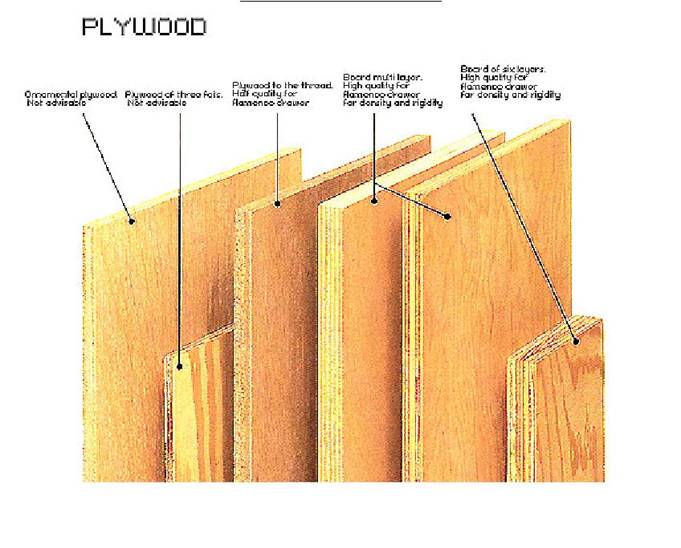
The manufacturer of musical instruments knows the qualities of a wooden class well and that it forms it will affect to the sound of his instrument, for that reason when choosing plywood it is convenient to know his density. In noble wood it is governed by the weight by cubic meter, determined by the strength and solidity of their fiber. On the other hand in wood plywood their density grants it the numbers of badges that compose it. For the construction of a Cajon we need to find plywood of 12 mm of thickness with a considerable density, and then we will keep in mind that to more density their sound becomes worse and to smaller expand: | Производители муз инструментов знают качества древесных пород и как они влияют на звук поэтому очень важно понять «плотность» фанеры. В благородных породах плотность определяется весом кубометра древесины, а также силой и жесткостью волокон. В фанере же, плотность и жесткость определяется кол-м слоев. Для строительства Кахона нам понадобиться многослойная фанера (см картинку – правые 3 образца: 5-6 или более слоев толщиной примерно 12мм). Помните что более плотный материал скорее всего будет глушить звук. |
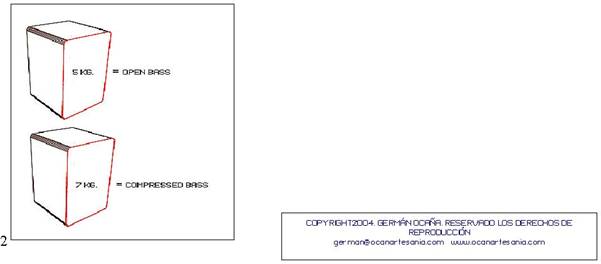
Having clear that sound type looks for, we can come closer the entire possible one and inside our possibilities if we follow the rule of the previous paragraph. We will build with plywood of 12 Mm. of thickness a drawer with the following measures: | Представьте себе звук который вы ищете в будущем Кахоне и учитывая 12мм толщину стенок построим коробку по схеме ниже: Верх (32x32см) Сторона (46x32cm), Зад (46x29.6cm) |


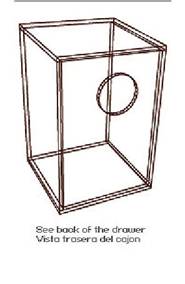
The sound hole will be located in the later part and it will have an advisable diameter of 12 cm. The quantity of space that we allow to give to thee xi to fair it will influence from a similar way to the density on its final sound: | Отдушина будет расположено на задней стенке вверху (напротив района деки по которой мы будет стучать). Рекомендуемый диаметр 12м. Размер отдушины напрямую влияет на звук инструмента, чем шире тем свободней и «открытей» звук. Сделаем без шурупов и гвоздей. Обычного столярного белый клея сочетаемого с давлением должно быть достаточно (хочу добавить что так делали в старину, а современные кахоны все-таки делаются на спец шурупах которые не выкручиваются) а дорогие кахоны для студий делаются как мебель, все рубцы вытачиваются и тоже клеятся. Не забудьте все поверхности зачистить шкуркой (даже внутри) |
Now we should prepare the land that will allow the location of the strings that are of acoustic or electric guitar, silk recovered in metal corresponding to the notes La or Re (A, D). We Prepare some wooden sticks hard (not coniferous as pines or firs that silence the attack) of a maximum 2cm. wide and 2 cm. deep that will be good us to hold the strings and to give but I space to the screws of the cover. They are located in the interior border of the face open of the drawer with white glue and pressure in the drying. The way to hold and to tighten the strings from the interior can be simple, like in the later example in that screws are used for wood, or sophisticated, like it would be the use of guitar tuners or Celtic harp. | Теперь надо сделать дырочки куда привяжутся струны: Ля или Ре (А, D). Понадобятся еще деревянные палочки желательно из натурального твердого дерева (не сосны или ели, и не «мохнатые» а то будут «глушить» удары). размером 2на2см толщиной. На них будут держаться струны. |

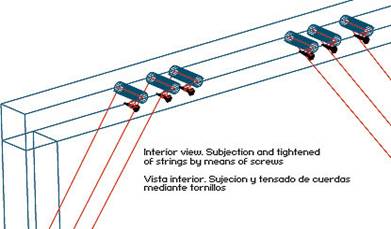
We will obtain as a result some strings that will play the interior of the cover lightly. In their vibrations we will recognize that’s harp of the flamenco Cajon. THE COVER The selection of the material for the construction of the cover is a topic complicated in this constructive adventure again. In this case the use of plywood more than conformity is a necessity. To build a cover wooden nobleman with 4 Mm. of thickness is hardly difficult if they don't restrain technical of joinery, indispensable to avoid in a future warp problem sand cracks. So we look for a laminate of 3 or 4 Mm. with the biggest consistency and, if it doesn't convince us their rigidity, we can add him a layer of wooden foil with white glue and to dry it in an alternative press. It is a simple solution for which buys material in a particular and not industrial way, because the best laminate for covers, like it is that of American birch, it is very expensive. The cover when being hit will be the one that the air that there is in the cavity of the Cajon, moves for that reason it influences the rigidity or consistency a lot of this in the final sound. Another time we apply the same equation that defines the results: More rigidity or consistency = compressed of middle bass Once well known our likes place the cover on the drawer to proceed to their closed one, trying that their measures are lightly superior to those of the drawer. | Таким образом наши струны будут несильно «дребезжать» и быстро «успокаивается» о наружную деку придавая характерное позвякивание. ДЕКА Выбор материала для изготовления акустической деки достаточно велик. Существует множество моделей из таких материалов как ель, береза, дуб, орех и тп. Сейчас стали популярны стекловолокно из-за их долгой живучести и мягко-глубоких «басов». Мы же делаем деку из фанеры, дабы придерживаться одно и того же материала. Если делать деку из древесины, то очень трудно найти такой кусок 4мм толщиной правильно выбранный для муз инструмента чтобы был сохранена цельность волокон необходимая для будущего избегания волнистости и трескания. |
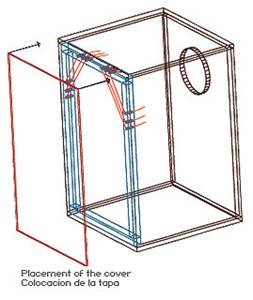
Next you proceed to the one screwed of this in their entire perimeter and in the way that is exposed in the following drawing. Many manufacturers opt for the one glued on their third three inferior behalves, leaving with screws the last third part superior. This technique will benefit to the bass sound, because it is nurtured of perfect cover subjection, but you will have problems when you need to change the strings when they break or loosen (something that happens very often, almost with total frequency). | Теперь просверлите дырочки под шурупы по периметру деки как нарисовано ниже. Не промахнитесь и не заденьте отверстия для струн! Использование такого большого кол-ва шурупов должно улучшить «басы» Многие производители частично приклеивают деку что улучшает «басы» но нам нужен будет доступ к натяжке струн позже, поэтому только обычные шурупы. |
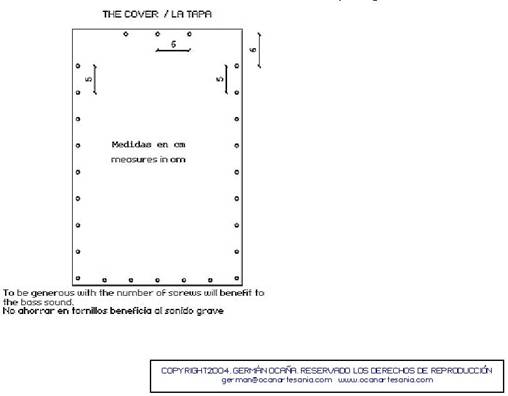
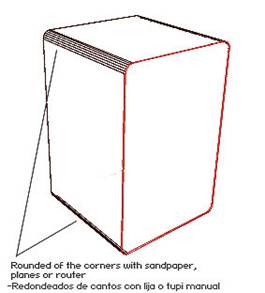
If the strings have been placed correctly, the cover will make them vibrate without problem some, but it can happen that the cover is convexes when they crowd together the screws and that it’s internal face doesn't caress them avoiding the vibrations. Then we help ourselves of adhesive paper to make that the strings play the interior face of this. Now the Cajon is already a percussion instrument, or at least it has been as a good intent, and all that is to make concerns to its finish and aesthetics. Unforgivable it would be not to round the songs or corners to soften it to the tact. It is not necessary to have a manual milling machine for it, with thick sandpaper and certain ability you can get that finish. | Если струны были правильно установлены, дека из заставить правильно бренчать. Но бывает что дека маленько сдвинулась или шурупы от деки потеснили дерево и палочки со струнами теперь неплотно прилегают к деке избегая вибраций. Теперь уже можно помочь клеящейся бумагой дабы «прижать» струны к деке. Осталось украсить это чудо. Но сначала закруглим наружные углы сверху по бокам. Шкурка, напильник сойдет (на картинке внизу) |
One of the advantages of plywood is their stability in front of the environment. The natural wood must be carefully treated and lacquered so that the climate and its variations don't affect them in a negative way, but the plywood is exempt of this type Of problem sand its varnishing could be avoided if it didn't provoke it the one dirtied progressive of the drawer. Also, a bigger number of layers in the cover can grant to this the consistency that he lacked as wood and to improve the sound. Any well-known method of finish is good for the drawer if it is of quick drying, for example, an acrylic varnish of slow drying, it can humidify the material and to bring gets bad acoustic consequences. Anyway, always it ends up filtering between the meeting of the cover and the drawer diminishing that crack that we look for in our instrument, for what is convenient to use a cutter or kitchen knife to detach it after the drying. Now already you will have that desired drawer whose positive result is proportional to the patience and dedication surrendered in its construction. An experienced manufacturer had possibly been able to sell him equally one or little more than what you have invested in his work, but it is better to prefix in this adventure the constructive desire that the economic one, and I don't say this to hide an undeniable saving but to remind him that everything in this world requires his time. Germán O caña | Одно из преимуществ фанеры – стабильность при меняющейся влажности. Натуральное дерево надо хорошо защищать, лакировать и тп. Фанеру не обязательно лакировать, только разве что чтобы не пачкалась. Она не потрескается и не будет гнутся. Несомненно это не для всех и есть шансы получить «первый блин комом» но учитывая цену фанеры рискнуть стоит если есть простой инструмент и позволяет время. * желательно найти резиновый «ножки» под дно чтобы не скользил или просто приклеить куски толстой резины. Стоит что-то помягче тоже соорудить для верха, попа не деревянная J |
