

Партнерка на США и Канаду по недвижимости, выплаты в крипто
- 30% recurring commission
- Выплаты в USDT
- Вывод каждую неделю
- Комиссия до 5 лет за каждого referral
№ 1 по теме «Имя существительное»
1. Напишите существительные во множественном числе, распределите по трём столбикам в зависимости от произношения окончания –s
address, beach, bottle, cinema, clock, guitar, hotel, island, lake, light, month, office, park, piece, smile, space, tape, village.
/S/ | /Z/ | /IZ/ | ||
1 | 7 | 13 | ||
2 | 8 | 14 | ||
3 | 9 | 15 | ||
4 | 10 | 16 | ||
5 | 11 | 17 | ||
6 | 12 | 18 |
2. Образуйте множественное число существительных.
carpet, gulf, photo, box, lady, wife, valley, thief, man, hero, woman, child, foot, tooth, life, handkerchief, tomato, shelf, sheep, deer, information, fish, shell
3. Перепишите предложения, вставляя данные в скобках существительные в единственном или множественном числе.
1) Joe's grandfather told some old theatre.... The funniest... was about a young actor. (story, stories)
2) Many... live in old palaces. Narnia's... lived also lived in the old one (king, kings)
3) Does anybody know the name of this... ? The truck drivers usuallly visit many.... (city, cities)
4) Simon's cat has five black .... One little... has a dark nose, (kitten, kittens)
5) Old... have much life experience. Jack's … also knows much. (granny, grannies)
4. Замените существительные с предлогом of существительными в притяжательном падеже.
Образец: the name of my friend - my friend's name
a greeting of teachers, the cat of his stepfather, the rays of the sun, a distance of seven kilometers, the joys of life, the car
of his parents, the theatres of New Yourk, the children of her brother Mark, the rights of the women.
5. Переведите следующие словосочетания на английский язык, употребляя притяжательный падеж.
1. Дочь моего брата. 2. Сыновья её друга. 3. Сын моих родителей. 4. Сыновья моих родителей. 5. Книга вашего коллеги. 6. Книги нашего коллеги. 7. Книга наших преподавателей, 8. Название функции. 9. Друг моей сестры. 10. Друзья моей сестры. 11. Друг моих родителей. 12. Друзья моих родителей. 13. Словарь этого студента. 14. Словари этого студента. 15. Словарь этих студентов. 16. Словари этих студентов. 17. Семья Грегори. 18. Фамилия директора. 19. Имя переменной
6. Глядя на семейное дерево, составьте предложения о людях на картинке.
Mary and Brian are married. They have a son, James, and a daughter, Julia. Julia is married to Paul. They have a son, Daniel.
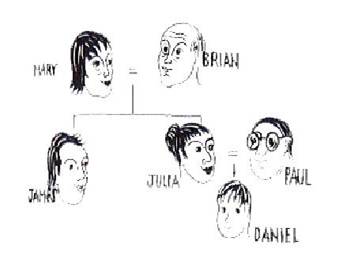
1 (Brian/husband) Вrian is Mary’s husband.
2 (Julia/mother) Julia is Daniel’s mother.
3 (Mary/wife) Mary is____________________
4 (James/brother) James __________________
5 (James/uncle) _________________________
6 (Julia/wife) Julia_______________________
7 (Mary/grandmother) ___________________
8 (Julia/sister) _________________________
9 (Paul/husband) ________________________
10 (Paul/father) _________________________
11 (Daniel/nephew) _______________________
№ 2 по теме «Прилагательное»
1. Образуйте сравнительную и превосходную степень от прилагательных.
а) tall, long, short, hot, cold, nice, large, big, wide, strong, happy, warm, high, heavy, low, hard, busy, easy, bright;
б) interesting, comfortable, important, necessary, beautiful, famous, pleasant, popular, wonderful, active, careful.
2. Вставьте вместо пропусков подходящие по смыслу прилагательные в сравнительной или превосходной степени.
long high young popular intelligent rich old
Образец: What is the highest mountain in the world?
a Who is ___________ person in Russia?!
b What is ___________ river in the world?
с What is ___________ sport in your country?
d Where is___________ university in Europe? 1
e Who is ___________ person in your family?
f Who is___________ student in your class?
3. Соедините части предложений, используя сравнительные конструкции
Пример: The town isn't very clean. The country is cleaner than the town.
a My car isn't very new. Your car_______
b Ann's house isn't very modern. Your house _____________Ann's.
с Bob's garden isn't very big. Your garden _____ much __________Bob's.
d Yesterday wasn't very hot. Today ___much ______ yesterday.
e Sue's homework wasn't very good. Your homework _______________ Sue's.
f Your car isn't very dirty. My car ___________yours
g This exercise isn't very difficult. The next exercise ___ much _______this one!
№ 3 по теме «Местоимения»
1. Переведите предложения на русский язык, обращая внимание на формы и значения местоимений.
1. Make yourself at home.
2. Have you any money on you?
3. I don't want to stay at home. Let's go somewhere tonight.
4. Is there anybody in the room? — No, there is nobody there.
5. Have you anything interesting to read? — Yes, come to my place. I've got some interesting books. You may take any
of them.
6. It's very dark here. I cannot see anybody.
7. Will you give me some water, please?
8. There is little fresh air in this room.
9. If you ever have any problems, let me know.
10. Everyone will tell you the way to the market.
2. Заполните пропуски притяжательными местоимениями
Образец: We have our breakfast at 8 o’clock.
1. This lady’s surname is Black. What’s … first name?
2. This chair is too small. What’s … length?
3. He is doing … homework
4. They have … Chinese lesson in the morning.
5. She is putting on … dress.
6. You often do … homework with … friend.
7. Please sit down. Is it … document?
8. They do … morning exercises in the open air.
3. Заполните пропуски соответствующими личными местоимениями, данными в скобках.
А. Образец: Whose book is it? - It is my book. It is... (my).- It is mine.
1. Whose cars are these? - They are my brother's. They are... (he).
2. Whose flat is that? - It is my uncle's. It is... (he).
3. Whose brushes are these? - They are the girls' brushes. They are... (their).
4. Whose towels are these? - They are our towels. They are... (our).
Б. Образец: Where is my baseball hat? - ... (my) is in my flat. I don't know where... (your) is. - Mine is in my car. I don't know where yours is.
1. Where are my scissors? - (my) are in my table. I don't know where... (your) are.
2. Where is my hat? ... (my) is on the shelf. I don't know where... (your) is.
3. Where is their newspaper? - ... (our) is in this bag. I don't know where... (their) is.
4. Where is his driving license? - ... (your) is in the car. I don't know where... (his) is.
4. Заполните пропуски указательными местоимениями this, that, these, those.
1) All... was so delightful!
2) ... tasks are very challenging.
3) ... won’t do.
4) ... armchair is very, comfortable.
5) ... is my laptop.
6) You can take one of... .
7) ... are the medicines of the latest type.
8) ... room at the end of the corridor is the canteen.
9) ... pillows are over there on the sofa.
5. Заполните пропуски местоимениями much, many, little, few. Переведите предложения на русский язык.
1. How... English words do you know?
2. There are... parks in our city.
3. They work too...
4. Does he read...
7 — It's a pity but he reads too...
5. I had very... friends at school.
6. Do you speak English....?
7. Hurry upl We have... time to waste.
8. Don't hurry! We have... time before the train comes in.
9. I have something to say. May I have... words with you?
10. Some... tea, please.
11. Please, try to make... noise.
12. I don't drink... coffee.
13. There were not... people at the stadium yesterday.
№ 4 по теме «Видо-временная форма английского глагола»
I. Найдите в тексте сказуемые, в которых присутствуют глаголы в действительном залоге, определите время глаголов и объясните употребление этого времени.
I live in Novokuznetsk. As you probably know, it’s located in Siberia, Russian Federation. It is a big metallurgy and coal city in the south of Kemerovo Oblast. As the oldest city in the region by far (1617), Novokuznetsk has been known by different names. It was known simply as Kuznetsk (Blacksmith City) until the 1930s when massive coal deposits were found, sparking the industrialization of the city under the name Stalinsk. In the Khruschev era, the city was reborn as Novokuznetsk (New Kuznetsk). Novokuznetsk's age and proximity to the Kemerovo Oblast's beautiful southern region makes it the top destination in the region for tourism. There are several things I like about living in this city. To tell the truth, I love my country and my city very much, so I can’t really choose the best thing of all. I was born in this city, the same as all my relatives I know about. All of them grew up in Novokuznetsk and I am sure that if anybody now asks them a question like: “Do you regret you were born here?” or “If you could, would you change your native city or your country, where you live?” the answer will be “No”. And I absolutely agree with this opinion. Some things have changed since I was born. Everything will change. The difference is when it will happen: earlier or later. The same thing happened with Novokuznetsk. Every new day lots of new things appear in my city. I know, from the time I was born, lots of things changed here but personally I think that every new change makes Novokuznetsk even better than it was before. I clearly understand that it isn’t true but I hope it is. If you came to visit me, I would take you to 2 interesting places. There’re lots of really great places in Novokuznetsk and near it. I’m sure that every tourist must visit the Kuznetsk Fortress. It’s really wonderful! And the second place, I think, visitors should choose themselves. I have such opinion because each person may have their interests so in Novokuznetsk you can find nearly everything you want.
II. Поставьте общие вопросы к данным утверждениям. Дайте на них краткие и полные отрицательные ответы.
Образец: I trust him. a) Do you trust him? - No, I don't' I don't trust him. She trusts b) Does she trust him? - No. she doesn't. She doesn't trust him.
a) 1. I know him well. 2. The children often swim in this river. 3. We pick apples in July. 4. The taxes rise every three days. 5. They sing well. 6. The children make terrible noise.
b) 1. Our English teacher speaks three foreign languages. 2. This man usually wears a hat. 3. She wants to learn Spanish. 4. Annie comes from Wales. 5. It takes me ten minutes to get to school. 6. She knows English well.
III. Употребите глаголы в скобках в одной из предложенных временных форм.
Present Indefinite (Simple) or Present Continuous
1. Tom usually (play) football but today he (play) tennis.
2. What language they (speak) in Holland? What language he (speak) now?
3. The professor (speak) five foreign languages. Right now he (speak) Dutch.
4. My friend always (tell) me the truth, but I see that she (tell) a lie now.
5. I usually (drive) to my work. — Be careful! You (drive) too fast.
6. She, as a rule, (wear) smart hats. But today she (wear) a funny-looking one.
7. I (do) a lot of work every day. Don't worry! I (know) what I (do).
8. Every Sunday he (watch) birds in the forest. Be quiet, the photographer (watch) that bird. He (want) to take a picture.
9, You (eat) fruit every day? What's the name of the fruit you (eat) with such pleasure?
10. She (adore) French perfume but I can't guess what perfume she (wear) tonight.
11. She (not understand) what the teacher (explain) now.
12. She (say) she (love) him very much now.
13. I (not recognize) the man who (give) a talk.
14. You usually (not drink) coffee at this time? What is that you (drink) now?
15. I (hear) Nick (want) to know where you (live) now.
Future Indefinite (Simple) or Present Indefinite (Simple)
1. I (go) and see Venice as soon as I (reach) Italy.
2. If the sun (be) red, it is a sign that we (have) a fine day tomorrow.
3. If you (not be) at home by six, I (eat) without you.
4. If Mother (not go) to the market eёarly, she (not get) fresh fish.
5. If Adam (sell) his car he (afford) a holiday in Florida.
6. Take some coins in ease you (need) to phone.
7. If nothing (go wrong), they (deliver) the furniture today.
8. Unless you (change) your mind we (not be able) to help you.
9. I (take) an umbrella in case it (rain).
10. If your son (not wear) sensible shoes on those hikes he (get) blisters.
11. If Martin (not win) it (be) the end of his sport career.
12. I (be) happy if my dream (come) true.
13. If the situation (get) worse, I (lose) my job.
14. Unless he (hurry) he (miss) the 5.30 train.
15. If your son (not work) hard enough; he (forget) what he (know).
Past Indefinite (Simple) or Present Perfect
1. He (forget) his French since he (leave) Paris.
2. Years ago he (be) very poor, and (not know) how to live. He (become) very rich now.
3. I can reach my work easily now, as I (buy) a new car.
4. The man you see there is the man to whom I (lend) the money.— When you (lend) it to him? — I (do) it yesterday.
5. I (lose) my keys and cannot remember where I (see) them last.
6. He cannot see well as he (become) short-sighted.
7. He is a man who (live) a remarkahle life.
8. What you (do) iast night?
9. What you (do) since I last (see) you?
10. I (not play) much football since I (leave) school.
№ 5 по теме Артикль
Упражнение 1. Вставьте артикли: a, an, the, где необходимо.
1. What's your name? My name is___Alison.
2. Where are you from? I am from ____ USA, ___ Wisconsin.
3. Where do you live? We live in ____ eastern part of ____ Minnesota. Our grandparents live in ____ Hudson.
4. What street do you live in? I live in ____ Green Street.
5. What school do you study at? I study at ____Hudson Middle school.
6. Have you got ___ pen-pal in ____ England?
7. What nationalities are your parents? My mother is ____ English. My father is ____ Swiss.
8. Where and when were you born? I was born in _____ Moscow in ___ 1984.
9. What's your mom? My mom is ____ housewife.
10. What's your dad? My dad is ____ driver.
Упражнение 2 Вставьте артикль the, где необходимо.
1. ___ Australia is ____ largest island in ____ world.
2. ____ Mississippi is ____ longest river in ____ North America.
3. ____ Pacific Ocean is ____ largest ocean in ____world.
4. What is ____ deepest lake in our country?
5. Which river is deeper: ____ Thames or _______ Severn in Great Britain?
6. ____ United States of America were formed in 1776.
№ 6
1. Заполните пропуски предлогами.
1) Where is John? He is... the laundry.
2) Where are the scissors? They are... the table.
3) Are the students... the canteen? Yes, they are.
4) Where is Mrs. Smith? She is... Toronto.
5) The Simpons are sitting... the garden.
6) We wanted to go... the hockey match yesterday.
7) There is a big shop... their house.
8) The children like to play... the street.
9) She took her lipstick... her pocket.
10) He threw the documents... the garbage.
2. Напишите по-английски следующие цифры и даты.
1) 1245, 827; 917.
2) 5629; 4861.
3) двести компьютеров; сотня страниц; две сотни человек.
4) тысяча мотоциклов; тысячи людей; миллион километров.
5) 5+3=8 10-4=6; 2x7=14; 15:3=5.
6) 31 августа; 17 октября.
7) 1914 год; 2012 год.
8) глава 2; трамвай 12.
3. Переведите предложения с оборотом THERE IS/ARE на русский язык.
1) There's a chair in front of the desk.
2) There are some people in the office.
3) There are some plants.
4) There's a photo.
5) There are some magazines.
6) There's a word processor.
7) The keys are near the telephone.
8) The photo is on the desk.
9) The bag is on the chair.
10) The photo is on the wall behind the telephone.
11) The man is on the sofa next to two women.
4. Образуйте утвердительную и отрицательную форму предложений. Переведите предложения на русский язык.
1) We start working at 8.30 o'clock.
2) His uncle lives in Angola.
3) She usually comes home in time.
4) John likes ice-cream.
5) Her grandfather is a politician.
6) My sister speaks Spanish.
7) Mary lives with her parents.
8) Sherlock travels very often.
9) His mother is a doctor.
10) His aunt likes to drive a car.
5. Составьте предложения из данных слов.
1) Chinese, they, well, speaks.
2) Her, necklace, a, he, expensive, bought. 3) A, she, student, was.
4) Have, an, I, umbrella, old.
5) Not, he, driver, is, a.
6) Have, they, family, friendly, a.
7) Surname, Bond, is, my.
8) Cousin, has, a, she.
9) In, he, Baker, lives, street.
10) On, cup, there is, a, table, the
6. Поставьте общие и специальные вопросы к предложениям.
Образец: My brother plays basketball. - Who plays basketball?
His nephew studies English. - What does his nephew study?
1) Their teacher explains very well.
2) His girlfriend works as a secretary.
3) The wife asks her husband many questions.
4) They have two cars in the family.
5) I usually have lunch at 11 o’clock.
6). We go to the swimming pool.
7) Greg works in his garage.
8) She drinks coffee in the morning.
9) They go to Kemerovo every month.
