

Партнерка на США и Канаду по недвижимости, выплаты в крипто
- 30% recurring commission
- Выплаты в USDT
- Вывод каждую неделю
- Комиссия до 5 лет за каждого referral
ISO 20022 – Universal financial industry message scheme
Bank Transaction Codes – External Code Sets
ISO 20022
10 June 2009
Version 6.3 – Approved Version
|
1 Introduction. 4
2 Document structure. 4
3 External Code Sets. 5
3.1 Section 1: Bank Transaction Code scope and high level structure. 5
3.1.1 Scope of the Bank Transaction Code. 5
3.1.2 The Bank Transaction Code component 6
3.1.3 Proprietary component 9
3.2 Section 2: Definition of the Domains. 10
3.2.1 Domains overview.. 10
3.2.2 Domains definition. 11
3.3 Section 3: Families within Domains. 12
3.3.1 Generic Family definition. 12
3.3.2 Payments Families definition. 13
3.3.3 Cash Management Families definition. 14
3.3.4 Derivatives Families definition. 15
3.3.5 Loans, Deposits & Syndications Families definition. 16
3.3.6 Foreign Exchange Families definition. 17
3.3.7 Precious Metals Families definition. 18
3.3.8 Commodities Families definition. 18
3.3.9 Trade Services Families definition. 19
3.3.10 Securities Families definition. 20
3.3.11 Account Management Families definition. 21
3.3.12 Extended Domain Family definition. 21
3.4 Section 4: Sub-Families within Families of Domains. 22
3.4.1 Generic Sub-Family definition. 22
3.4.2 Payments Sub-Families definition. 24
3.4.3 Cash Management Sub-Families definition. 34
3.4.4 Derivatives Sub-Families definition. 36
3.4.5 Loans, Deposits & Syndications Sub-Families definition. 38
3.4.6 Trade Services Sub-Families definition. 40
3.4.7 Securities Sub-Families definition. 42
3.4.8 Account Management Sub-Families definition. 53
3.5 Section 5: Domains without defined Sub-Families. 55
3.5.1 Foreign Exchange Sub-Families definition. 55
3.5.2 Precious Metal Sub-Families definition. 56
3.5.3 Commodities Sub-Families definition. 57
3.5.4 Exceptional Securities Sub-Families definition (Custody Collection) 58
4 Set of 4 character codes. 59
4.1 External Domain Code Set (ExternalBankTransactionDomain1Code) 59
4.2 External Family Code Set (ExternalBankTransactionFamily1Code) 59
4.3 External Sub-Family Code Set (ExternalBankTransactionSubFamily1Code) 64
4.3.1 Sub-Families of generic Families. 64
4.3.2 Generic Sub-Families. 65
4.3.3 Payments Domain. 66
4.3.4 Cash Management Domain. 73
4.3.5 Derivatives Domain. 74
4.3.6 Loans, Deposits & Syndications Domain. 75
4.3.7 Trade Services Domain. 76
4.3.8 Securities Domain. 77
4.3.9 Account Management Domain. 82
5 Revision record. 83
2 Introduction
This document provides the detailed description of the external code sets and values to be used in the Bank Transaction Code structure.
3 Document structure
Chapter 3 is composed of several sections:
Section 1: This section provides the overview of the approved structure of the Bank Transaction Code set, with detailed information on the scope and structure of the domains.
Section 2 to 5: Per domain there is one dedicated section. Each section contains:
- The families and sub-families of the corresponding domain, including the relevant definition for the families and sub-families.
Chapter 4 provides a summary of the domains, families and sub-families, with the codes to be applied.
4 External Code Sets
4.1 Section 1: Bank Transaction Code scope and high level structure
4.1.1 Scope of the Bank Transaction Code
The scope of the Bank Transaction Code is to deliver a harmonised set of codes, which should be applied in bank-to-customer cash account reporting information. The bank transaction code information allows the account servicer to correctly report a transaction, which in its turn will help account owners to perform their cash management and reconciliation operations.
The Bank Transaction Code proposes a harmonised, global alternative for the different domestic bank transaction code sets that exist. The lack of such a harmonised set led to a misuse and misinterpretation of the domestic codes.
The requirements that have been expressly identified as part of the scope of the Bank Transaction Code are the following:
- All transactions resulting in a cash movement on the customer’s account should be taken into account; Usage of national bank transaction code sets should be catered for initially in order to ease the migration from the existing sets towards the harmonised bank transaction code set. The existing domestic bank transaction code sets need to migrate towards the standardised set for consistency and interoperability. Clear definitions of the bank transaction codes are required so that the same code is always used in the same context and two codes may not be used for the same transaction. The bank transaction code is used to allow the reconciliation between the reason of the cash movement and the sub-ledger and/or the routing of the information to the adequate processing system at the customer side.
4.1.2 The Bank Transaction Code component
The structure of the Bank Transaction Code component includes the following 3 levels: |
|
- Domain: | Highest definition level to identify the sub-ledger. The domain defines the business area of the underlying transaction (e. g., payments, securities...). This layer is a specific ISO 20022 external code set
|
- Family: | Medium definition level: e. g. type of payments: credit transfer, direct debit. This layer is a specific ISO 20022 external code set |
- Sub-family: | Lowest definition level: e. g. type of cheques: drafts, etc This layer is a specific ISO 20022 external code set |
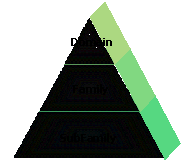
As shown below, it is possible to specify both a proprietary code and a standard code, in a structured format. The structured component provides for three mandatory levels. The first level is the Domain of the Bank Transaction Code. The Domain must be further extended with the Family and Sub-Family.
The values/codes for the Domain/Family/Sub-Family are the subject of this document and are registered as external ISO 20022 code sets.
Ref. | Structure Element | XML Tag | Multipicity | Data Type | Definition |
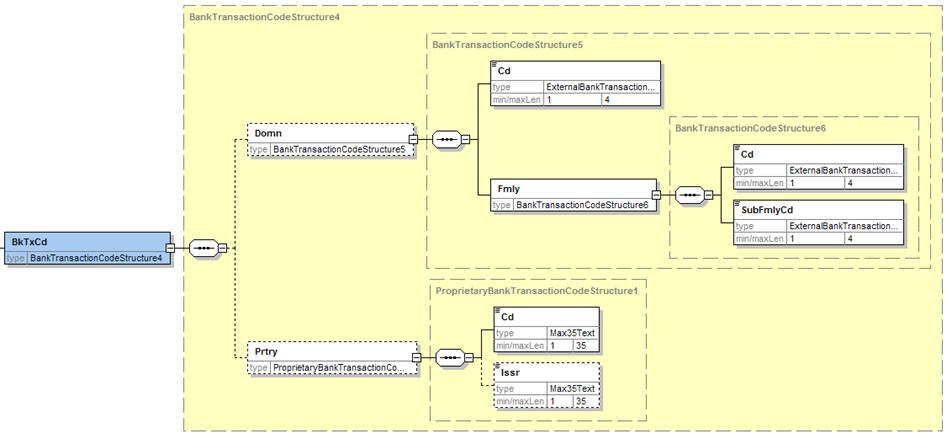
1.0 | BankTransactionCode | <BkTxCd> | [1..1] | Set of elements to fully identify the type of underlying transaction resulting in an entry. | |
1.1 | Domain | <Domn> | [0..1] | Specifies the domain, the family and the sub-family of the bank transaction code, in a structured and hierarchical format. Usage: If a specific family or sub-family code cannot be provided, the generic family code defined for the domain or the generic sub-family code defined for the family should be provided. | |
1.1.1 | Code | <Cd> | [1..1] | ExternalBankTransactionDomain1Code (4 chars max) | Specifies the business area of the underlying transaction. |
1.1.2 | Family | <Fmly> | [1..1] | Specifies the family and the sub-family of the bank transaction code, within a specific domain, in a structured and hierarchical format. | |
1.1.2a | Code | <Cd> | [1..1] | ExternalBankTransactionFamily1Code (4 chars max) | Specifies the family within a domain. |
1.1.2b | SubFamilyCode | <SubFmlyCd> | [1..1] | ExternalBankTransactionSubFamily1Code (4 chars max) | Specifies the sub-product family within a specific family. |
1.2 | Proprietary | <Prtry> | [0..1] | Proprietary identification of the bank transaction code, as defined by the issuer. | |
1.2.1 | Code | <Cd> | [1..1] | Max35Text | Proprietary bank transaction code to identify the underlying transaction. |
1.2.2 | Issuer | <Issr> | [0..1] | Max35Text | Identification of the issuer of the proprietary bank transaction code. |
Rules associated with the Bank Transaction Code structure:
Ÿ If Domain is absent, then Proprietary must be present.
Ÿ If Proprietary is absent, then Domain must be present
The picture below shows the Bank Transaction Code component in a graphical view.
4.1.3 Proprietary component
The Proprietary component has been added to the structure to cater for two of the most important requirements:
- During a transition period, existing national bank transaction code sets can be reported through the proprietary element in the bank transaction code structure. The proprietary element can be used to report codes that are not defined (yet) in the registered code sets, but are candidates to be included in the registered sets.
Even though the Proprietary element is used to define the Bank Transaction Code, the structured Domain/Family/Sub-Family structure may already be completed with the information available to the sender of the message.

|
Из за большого объема этот материал размещен на нескольких страницах:
1 2 3 4 5 6 |
